Part Four The Involvement of Walter Adams in Affairs of State
Chapter 12
Walter Adams in Parliament
Political ideals
The image on the plate – see following page shows Gladstone in his 70’s. The item would definitely not have been selected by Mary for aesthetic reasons. It follows that the plate was probably ordered and purchased by Walter himself, a reasonable assumption being that it was an illustration of a person whose parliamentary views and ethics very closely resembled his own. It therefore presents a unique window into the mind of Walter the politician. It follows that a brief exploration of the life and career of William Ewart Gladstone (1809-1898), when read in conjunction with a collection of Walter’s parliamentary speeches, could be a rewarding exercise.
GLADSTONE – His attributes
Gladstone was reputed to be a generous person, a courageous politician, sincere, of good manners, and of great personal warmth and breadth of mind. He is is said to have had a remarkable memory for detail, great powers of concentration and was a fearsome adversary in debate. He was a humanitarian of high political morality. In 1879, Lord Acton in assessing Gladstone’s standing, concluded that he could not be surpassed in character, genius and success and he was, beyond doubt, the greatest British statesman of the 19th century.
T HE GL A DSTONE PL ATE
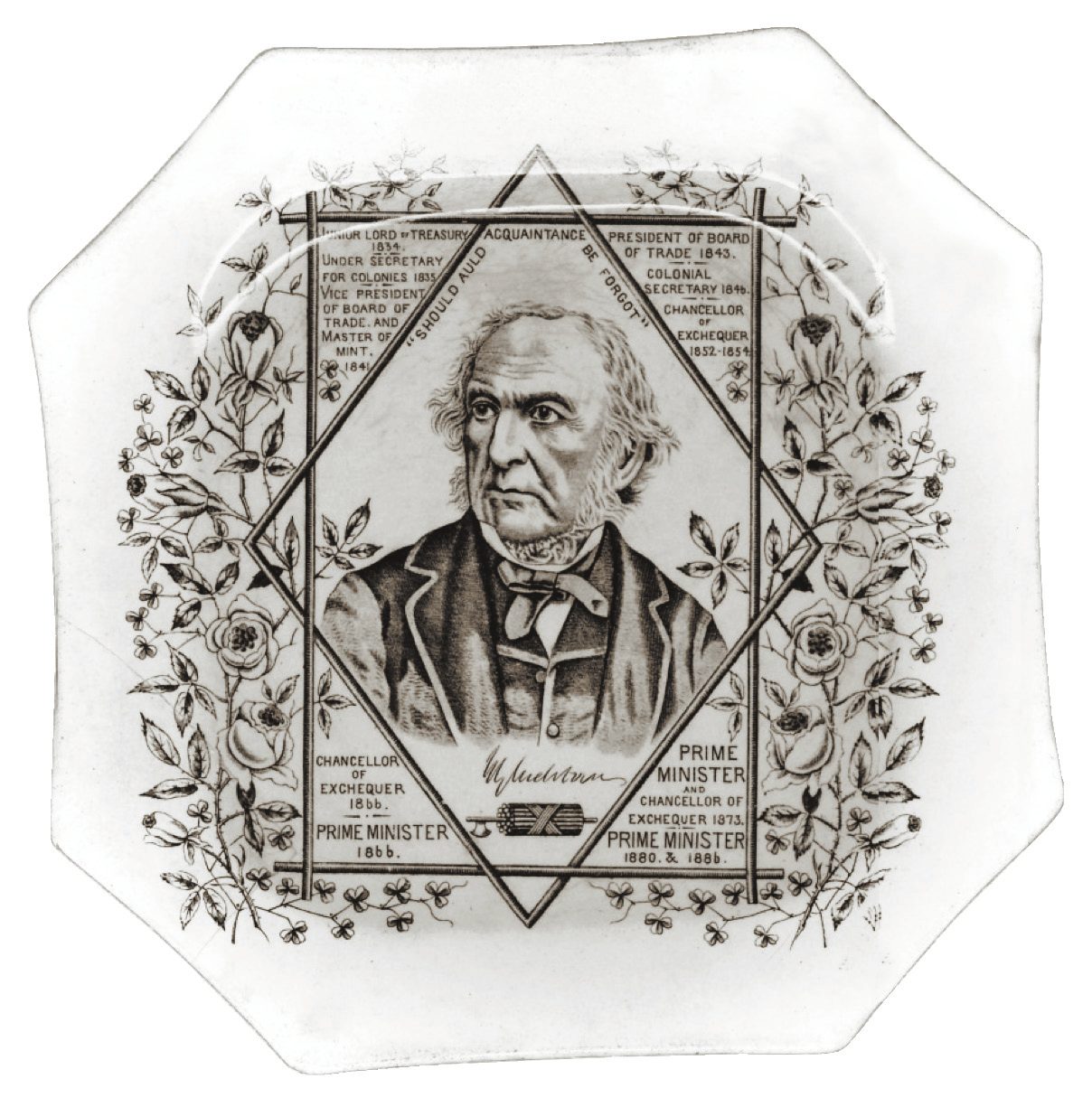
One of the few survivors of Mary and Walter’s porcelain collection is the Gladstone plate (circa 1887-91) Though Gladstone himself was high Anglican he had many Roman Catholic friends
- a fact often used against him in politics. In 1847 Gladstone voted for the admission of Jews to the British parliament, an act of considerable courage at the time. Ironically the man who later became his greatest opponent and rival, and the favourite of Queen Victoria was a Jew, Benjamin Disraeli. Gladstone and Disraeli dominated British politics throughout the latter half of Queen Victoria’s reign.
Gladstone’s career spanned many years and he was British prime minister four times over the periods 1868-74, 1880-85, 1886 and 1892-94. Throughout he was a persistent instigator of both social and political reform, and worked to apply strict Christian principles to foreign and domestic affairs, with varying degrees of success. He was unsuccessful in his persistent attempts to obtain home rule for Ireland. (This is perhaps relevant when one remembers that Mary Shannon, Walter’s wife, was an Irish Catholic from County Clare).
GLADSTONE’S EARLY YEARS
Gladstone was born in Liverpool on December 29th 1809 of pure Scottish descent (the family name was originally Gledstanes). His father John was a leading merchant of the trading and slaving port of Liverpool and became a member of parliament. He died leaving an estate of ₤600,000.
Gladstone went to Eton where he had a relatively undistinguished career. However in 1831, at Christ Church, Oxford, he obtained first class results in classics and mathematics, and became a disciple of the conservative philosopher Edmund Burke. He married Catherine Glynn whose mother was William Pitt’s first cousin. She was regarded as a woman of considerable charm, discretion and wit.
The son of the Duke of Newcastle, a schoolfriend of Gladstone’s, persuaded his father to support Gladstone’s election as a Tory to the parliamentary seat of Newark in 1832. This was the year that the Wigs enacted the parliamentary Reform Bill . In his early parliamentary career Gladstone was a Conservative with a strict Anglican philosophy. On consideration of Gladstone’s father’s background the Prime Minister, Robert Peel, appointed Gladstone to the position of vice-president of the Board of Trade which proved to be a very sound decision. Gladstone’s attention to detail achieved a major simplification of tariffs and in the process he became more of a free trader than Peel himself. Over this period British industry was dependent upon international trade, largely based upon cotton and woollen fabrics produced by steam-driven mills. In this period approximately 13.5 thousand tons per annum of raw wool were imported from Australia, and 340 thousand tons of raw cotton were imported from other sources. While in this position Gladstone achieved much improved conditions for the London dock workers. In 1843, as a consequence of Gladstone’s success in the executive position of vice-president, Peel invited him into his cabinet as the president of the Board of Trade.
A series of cabinet posts as a Conservative member followed.
THE REMAINDER OF GLADSTONE’S CAREER
In 1845 Gladstone became Secretary of State for the colonies and, while in the Colonial Office, he was lead towards liberalism by consideration of the claims for self-government by the English speaking colonists. He was a member of cabinet when the Peel government repealed the restrictive Corn Laws in 1846. Unfortunately this was too late to alleviate the terrible consequences of the Irish/Scottish famines. [The famine in Ireland would have been a major factor in Mary Shannon’s decision to migrate to Australia in 1854 - R. L. C.]. He was also a member of cabinet when the Peel government enacted the Public Health Act of 1848 which had been much agitated for by the author Charles Dickens and others.
In 1852 Gladstone lead a brilliant attack on Disraeli’s budget. This attack brought down Lord Derby’s government. In the following year he installed a competitive civil service system and brought down a successful budget for Robert Peel’s government. In 1859-60 the contributions of Palmerston, Russell and Gladstone were to assist in the unification of almost all of Italy.
In the early 1860’s Gladstone consolidated his popularity with the working classes by creating the Post Office Savings Bank. In 1868 his government carried three resolutions for the disestablishment of the Protestant Church of Ireland. He became the undisputed leader of the Liberals and, when Disraeli resigned, Queen Victoria called upon him to form a government. As a consequence he formed and led a very competent cabinet. This government instigated significant reforms including the Education Act of 1870 and the Ballot Act of 1872.
Using his skills in argument in combination with his sincerity and eloquence Gladstone won re-election in 1880 by defeating the incumbent Conservative government on moral grounds, and in response to the persistence of Irish agitator Charles Stewart Parnell, introduced the Irish Land Act in 1881. The Act guaranteed fair rents, fixity of tenure and fair sale of land but, perhaps predictably, did not satisfy Parnell. In 1886 Gladstone was returned as prime-minister after Lords Carnarvon and Salisbury resigned over dissention on Irish home rule, but the Liberal party was divided over the issue, and lost the election called by Gladstone to resolve it. For the following six years Gladstone endeavoured to convince the electorate that Ireland should be granted home rule as an act of wisdom and justice. In 1892 a divided and weakened Liberal Party was again elected, and in 1895 the House of Commons carried the Irish Home Rule Bill . Unfortunately this legislation was rejected by the House of Lords. Gladstone resigned and died from cancer of the palate in 1898. Walter Adams’ death, from a very similar cause, had occurred six years earlier.
(The details of events as described are largely derived from Encyclopaedia Britannica – 15th Edition.)