Part Four The Involvement of Walter Adams in Affairs of State
Chapter 13
Walter's First Year Speeches
To the Queensland Legislative Assembly
In June 1886 Walter was elected as the Conservative candidate for Mulgrave and in 1888 this electorate was divided at redistribution into the electorates of Bundaberg and Musgrave. Walter was elected unopposed as the first member for Bundaberg.
During Walter’s absence from Bundaberg for Parliamentary attendance the management of the household fell, in large measure, into the very capable hands of his daughter Maria Emily (known variously to the family as Rix or in later years as Aunty Sis).
BACKGROUND INFORMATION
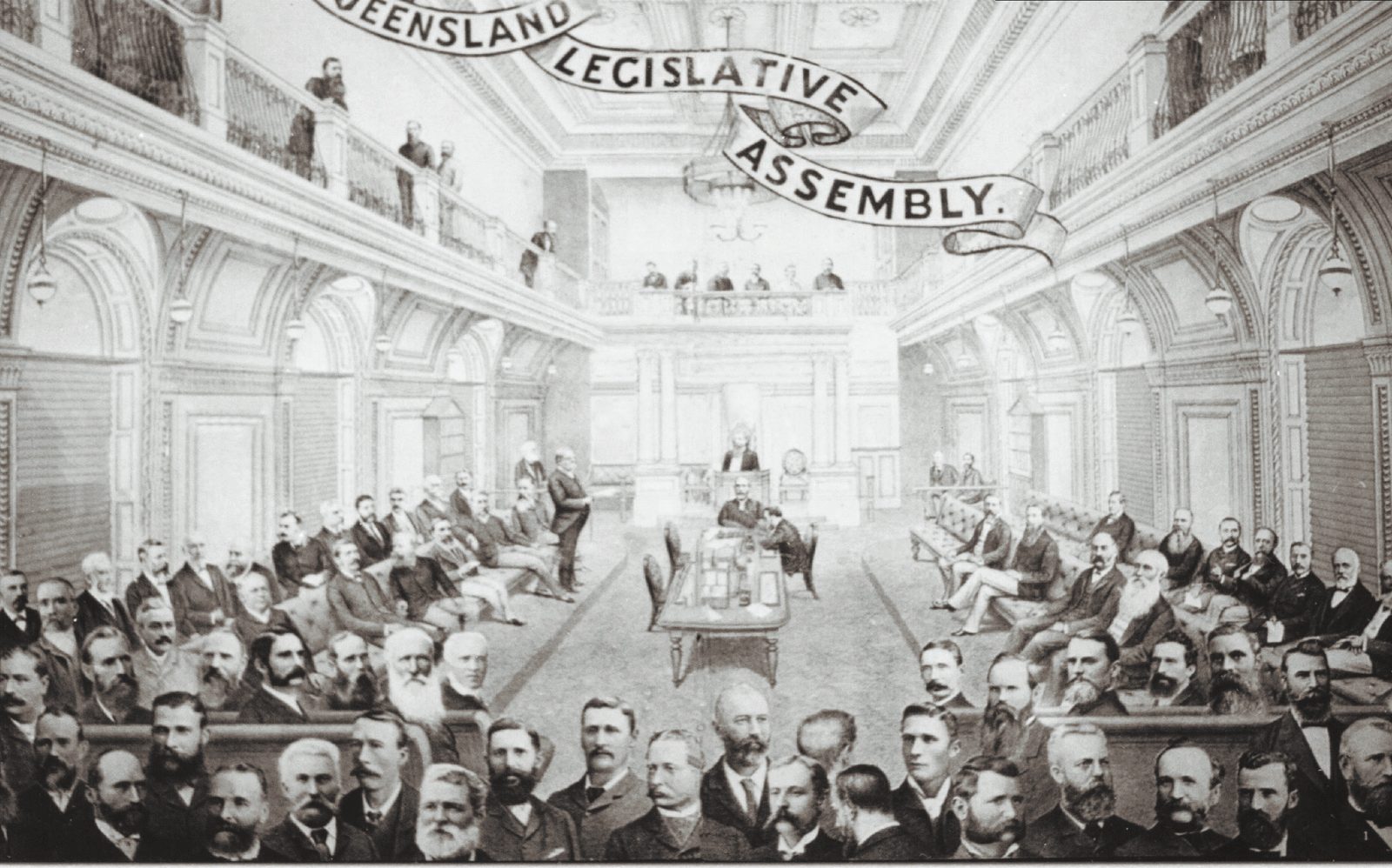
QUEENSLAND LEGISLATIVE ASSEMBLY CIRCA 1890
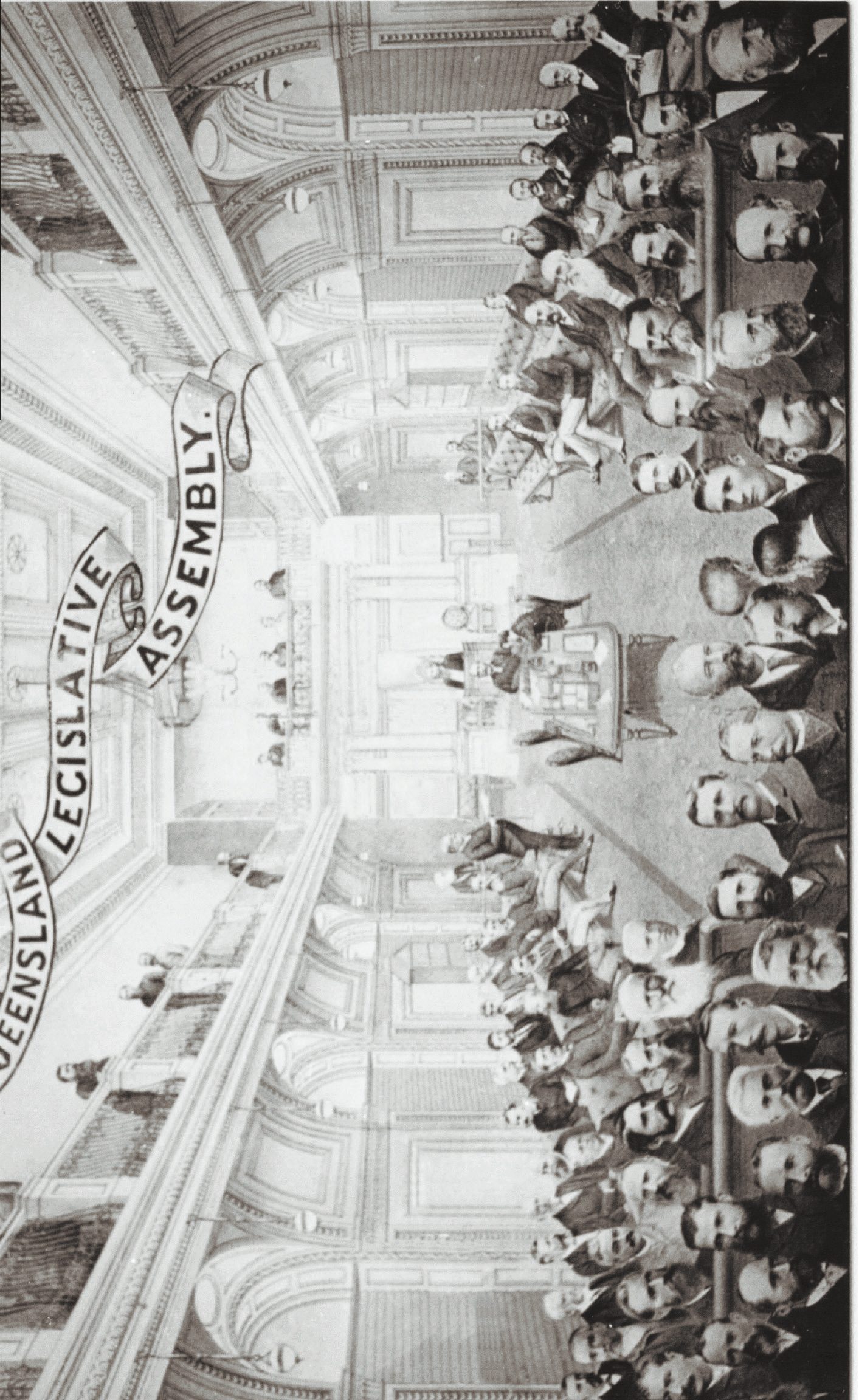
Walter is second from the left in the left side rear rank of the photograph
The material below derives from clippings (in small print – sometimes of only one to five lines and unsorted) contained in a worn, wicker-work folder found in an old steamer trunk. The texts involved were of Walter’s speeches to the house in his first year in the Queensland Parliament and were obviously saved by a family member, probably Aunty Sis. The regional dialect (in this case that of Somerset) of the settler of some thirty-six years is evident in Walter’s presentations. The material has been reassembled for this presentation. [Any comments incorporated in the headings are my own – R. L. C.]
Whilst the speeches themselves are not of earth shaking import they do provide a window of understanding into the nature of issues and feelings that the citizens of the new colony considered to be of significance at the time.
Walter’s books of the Queensland Parliament are still in my possession (and are a considerable loading on the floor joists). To date I have considered that Walter’s speeches of his first year are probably more representative of his personal thoughts and feelings, a theory that I may revisit if time permits a thorough review of all of this reference material.
SPEECHES OF THE NEW MAN IN THE HOUSE
RAILWAYS FOR THE BUSH
[Evidently related to a short section of line in the Brisbane – Ipswich area - R. L. C.] Mr. Adams said: Mr. Speaker as one of the new members, I rise to confirm the statement made by the hon. member for Blackall. I have complained on one or two occasions myself, that I have not been consulted upon matters of this kind. It was only on Tuesday – sometime during the day – that I asked if there was to be any meeting of members of this side of the House to discuss these matters, simply because I was not certain of it. I do not believe there was a meeting, and I can assure hon. members that I never have been asked since I have been in this House what position I was going to take up, or how I was going to vote. Therefore, every vote I have given in this House has been untrammelled, and according to my conscience. There is not the slightest doubt that the Colonial Treasurer would like to make a great deal of this matter. He would not like to see his hon. friend, the junior member for North Brisbane, saddled with the responsibility of expending the whole of this sum. Nevertheless, he does not mind saddling it upon the hon. gentleman who occupies the position of Chairman of Committees. That is quite plain enough, as he says that he cannot blame the Chairman of Committees for what he has done. I do not think there are many members who would blame him if he had done it in a different way. It was all right in committee; but it is the usual practice that, wherever there is a casting vote to be given, the Chairman invariably gives it with the lesser sum, if it is a money vote. The Chairman of Committees has sheltered himself behind the members of the Upper House, and says that he did not consider that he had given his casting vote in regard to a money question, for the simple reason that the money had been appropriated already. When we come to look at it in this way, that he did not consider it a money vote, I do not know what he could consider it. It has been said here that there is £175,000 put down for this piece of work of about two and a-half miles of railway, while I consider myself, and I daresay there are a number of other members who consider the same, that it will be of very slight benefit to a great number, for the simple reason that they can get trams and omnibuses within 500 yards on each side of the line or even half that distance, which will put them down anywhere they liked. When we come to consider that only £175,000 is put down for that piece of work, and the Chief Secretary acknowledged last night that it may cost £300,000, I think that may be regarded as an additional burden. So, according to his own showing, the Chairman ought to have acted according to the usual practice, and to have voted with the “Noes.” I rose for the express purpose of confirming what the hon. member for Blackall has already stated. I, personally, have never been asked in what way I was going to vote. I do not wish to find fault with anybody in the House – I do not know what the general practice is – but I certainly think it was my duty to point out, in respect to what the hon. Chairman of Committees has stated, that he did not consider the £175,000 was a money vote, as it had been already appropriated, that he really voted for the whole thing £300,000, and possibly, £500,000. I am perfectly satisfied that if that vote was carried to-morrow and the work was commenced, it would do much good to the unemployed at the present time. But the unemployed all over the colony would all flock together, and the very moment the work was finished they would clamour for more. And so I say, it is far better to carry on railways where people can settle on the land, rather than here where, when the job is done, they will only ask for more.
RAILWAY BALLAST AND EXPERT ADVICE
Mr. ADAMS said: Mr. Speaker, I must candidly confess that, as a young member of this House, I am greatly surprised. Hon. gentlemen on the other side of the House laugh: they laughed the other night when I was speaking but before I sat down they drew very long faces, and it is just possible they may draw long faces on the present occasion. I must say also - being a resident of Queensland even before it was called Queensland, and not having been out of it since it was Queensland - I have heard a great many things; but the strangest thing I ever heard has come from the hon. member for Cook, Mr. Hill. He does not appear to me to be seeking the interests of the colony generally - of the taxpayers; but he seems to me to be most terribly wroth about this contract of McSharry and O’Rouke’s and against the hon. gentleman who on one occasion occupied the position of Minister for Works. Now, sir, I cannot make out for the life of me how it is that this thing is followed out. We are told, and I think the country believes, that the Chief Engineer, Mr. Stanley, recommended that this ballast should be taken over, as ballast had been taken over by Mr. Smith, at 15 per cent. less than cost price. Well, when a gentleman occupying that position comes in and tells the Minister for Works he is of opinion that that ballast should be taken over in such a way, I maintain the Minister for Works would not be doing his duty if he did not take the advice of that officer. The officer is supposed to know far more about that work than the Minister for Works does himself. I think, notwithstanding the aspersions the hon. member for Cook has tried to heap on the hon. gentleman, the country itself will believe what the hon. gentleman, the late Minister for Works, has said. I am perfectly satisfied that honesty of principle has been carried out, and I believe that if honesty of principle had been carried out in such a way by the present Ministry they would have no occasion to complain. I, therefore, am astonished to think that hon. gentlemen on the other side of the House should laugh or even say a word when the hon. gentleman rose to speak. I think myself he is heaping degradation upon himself and not upon this side of the House.
PAYMENTS TO THE HON. MEMBERS
[How right he was – R. L. C.] Mr. ADAMS said that as a new member he would like to express his opinion on the Bill. It had been said by a member on the other side of the Committee, that although the Opposition members opposed the Bill for payment of members they were not too proud to receive pay. On looking round the Chamber he saw as many black-coated gentlemen on the Government side of the Committee as he did among those who sat in opposition, and he had not the slightest doubt that the former sought payment quite as much as members of the Opposition. Perhaps he might be one of the poorest members there, yet he intended to vote against the Bill, as he believed it would be the means of bringing in professional legislators or, if they liked to call them so, professional spouters. Many gentlemen in the colony had far more time at their disposal than agriculturists, and he was sorry to say that the agriculturists, who were the backbone of the colony, were not represented in that Chamber as they ought to be. Among agriculturists there were not many who had a slippery tongue, and some man who had, and who was a professional spouter, would go among them and get their confidence if payment of members was accepted. He believed that, if the Bill passed, it would not be a blessing but, on the contrary, a curse to the colony.
RURAL PROPERTY SELECTION, AN AMENDMENT
[Three months and making his mark – R. L. C.] Mr. ADAMS said clause 13 provided that, “when a lessee of a holding becomes entitled under the provisions of the 73rd section of the principal Act to a deed of grant of the land in fee-simple, all sums of money which have been paid in respect of the rent of the holding for the ten years next preceding the time when he becomes so entitled shall be credited to him in part payment of the prescribed price,” etc. He did not think that, because a man was not able to pay for a selection at the end of ten years, he should be compelled to pay an extra amount of rent. It would be greatly to the advantage, not only of the Treasury but the country generally, if the clause was modified in such a way that whatever rent a man paid during his tenure should be credited to him as part payment of the purchase money. If a man took up a selection, it did not matter whether it was 640 or 1,280 acres, and settled upon it, he was a useful colonist, and should be encouraged to keep it by being allowed whatever rent he paid to be taken as part of the purchase money. If the Minister for Lands would accept an amendment of that kind he would be enabled to settle far more people on the land than he would under the clause in its present form. He was sorry he had been absent from the Committee, because while he was absent two clauses were passed in which he had intended to propose amendments.
Mr. ADAMS said that he had risen to speak before, but the Premier had got up at the same time. He had waited to hear his explanation, and other members had got up afterwards, and he went out disgusted. He was sorry to say that when he returned to the Chamber he found that two clauses had been passed in the meantime, upon which he had something to say. One thing was certain – that the clause, as it stood at present, allowed the Land Board to impose 50 per cent. upon the selector.
The CHAIRMAN: That is not the question before the Committee. Clause 13 is the clause before the Committee.
Mr. ADAMS said as mover of the amendment, he was sorry to see that the hon. gentleman at the head of the Government had lost his temper. He had been in the House for three months and he was perfectly convinced that hon. members would give him credit that he had never tried to ruffle the temper of any hon. gentleman in it. He did not bring forward the amendment with any such desire, but having had the experience he had had in the colony, he was quite as well able to judge as any lawyer what was beneficial for the general public, and especially for those who desired to settle upon the land. He had introduced the amendment, not only in the interests of his constituents but in the best interests of the colony generally and he was perfectly satisfied that if the hon. gentleman at the head of the Government knew as much about selection as he did, that he would give way on that point with a good grace and not show his temper.
Mr. ADAMS said he quite agreed with what fell from the Minister for Lands, that to allow a selector to take up another selection anywhere in the same district would be rather too much. He took it from the ruling of the Chairman the other night that if an amendment was lost the original motion would be put and another amendment could not be proposed on the clause. He therefore moved that the word “ten” in the 2nd line be omitted with the view of inserting the word “twenty.” He was perfectly convinced, from seeing the country as he had seen it under its many aspects, that 20 miles would not be too great a distance.
The CHAIRMAN: I must point out to the hon. member that he cannot move that amendment unless the hon. member for Burke withdraws his amendment.
Mr. PALMER: With the view of having the amendment of the hon. member for Mulgrave tested, I will, with the permission of the Committee, withdraw my amendment.
Amendment, by leave, withdrawn.
Mr. ADAMS said he thought ten miles was not sufficient, and moved that the word “ten” be omitted, with the view of inserting the word “twenty”.
Mr. ADAMS said if he were in order he would move an amendment after the one before the Committee was disposed of. He would ask the ruling of the Chairman whether, if the present amendment were lost, he could move another.
Mr. NORTON: Not in a preceding part of the clause.
Mr. ADAMS said if that were the case he would move his amendment at once. He would move that in the first portion of the clause – ”when the lessee of an agricultural farm is the bona fide occupier of any country land situated at a distance not exceeding ten miles” – the word “ten” be omitted, and the word “twenty” be inserted in its place.
The CHAIRMAN: I may point out that the hon. gentleman is dealing with another clause. The Committee is considering the 2nd new clause.
Mr. ADAMS said that if the hon. member for Mackay would only look at the hon. member for Stanley he would see how he had borne the burden and heat of the day; he had been so long in the country that he had not a hair between his head and heaven. The hon. member for Stanley deserved a certain amount of credit; he did not bring in the amendment for his own purposes, but for the good of the colony. It was absolutely necessary that they should take into consideration that it was for the good of the colony, and he was perfectly satisfied that the hon. member would accomplish his purpose; and the consequence was that he would vote against the amendment of the hon. member for Stanley and for the amendment of the hon. member for Mackay:
Mr. ADAMS said there seemed to be an objection to the clause simply because the junior member for Stanley could not avail himself of it, but he did not think the hon. member ought to be considered at all. He thought the good of the country generally should be considered, and it was well known that there were numbers of pieces of land really not worth anything to any outsider. People who lived adjacent to those lands should be able to take them up, and consequently he thought the amendment a good one. He was not very much taken up with the Land Act of 1854, and agreed with the member for Mackay that it ought to be burnt. He thought it would be better to consign it to oblivion. Under the previous Act anyone wanting to select land knew exactly what he was going to select, and not only that, but he knew what he was going to pay. Under the present Act it appeared to him that not only did a man not know what he was going to pay for the selection, but he did not know what he was going to pay for the survey of the selection. Surveys under the present system very frequently cost about twice as much as under the previous Act . He held in his hand a letter he received some time ago from the Lands Department, which said:
Sir,
Referring to Mr. Thomas Williams’s letter forwarded to you on the 5th instant, relative to a demand for £3 12s. 7d. on account of extra survey fee on selection, as per margin, I have the honour to state that the sum charged is what the survey has cost the Government.
The amount now demanded is the difference between the money paid at date of application £6 14s 0d and the actual cost £10 6s 7d:
Now, under the previous Act the selector always knew the cost of survey, but under the present Act he did not. He had been advised, and the Minister for Lands had also been advised, that that selection had been surveyed on two sides, and the consequence was that in place of paying in accordance with the schedule the owner had to pay £3 12s. 7d. more. So much for the Land Act . With regard to the amendment of the junior member for Stanley, he considered it one that would be a benefit to the country generally, in as much as there were parcels of land now lying utterly useless, which would be utilised by those in possession of adjacent land. He should be most happy to support the amendment.
SEED CORN AND THE COLONIAL SECRETARY
[Not one of Walter’s chums – R. L. C.] Mr. ADAMS said: Mr. Speaker, – I can only repeat that the Colonial Secretary distinctly said to me in his office that he could not supply the corn to agricultural societies; he must supply it to the persons who made the application. I beg leave to withdraw the motion.
Motion for adjournment.
AND ON THE DISTRIBUTION OF AMERICAN SEED CORN
Mr. ADAMS said: Mr. Speaker, - I have a few remarks to make, and I will conclude with the usual motion for the adjournment of the House. The remarks I am about to make have reference to a statement made in this House on the 11th August by the Colonial Secretary. I may as well read that statement first. In reply to myself, the Colonial Secretary said, “In reply to the hon. member, I may say that Mr. Hogan’s name came down for seed corn, and that gentleman said he applied for himself and others.”
I have known the hon. gentleman for many years, and I am perfectly satisfied, and my constituents are also perfectly satisfied, that he would never have made that statement if he had not believed it to be true. The hon. member must have believed the statement was true when he made it, but the moment Hansard got as far as Bundaberg I received an urgent telegram to this effect, “Mr. Hogan applied for seed maize as secretary for association and did not say a word about himself and others. Copy of letter posted.”
I should not have called the attention of the House to this subject had I not been requested to do so by several of my constituents. The moment they saw the statement I refer to they thought it might, perhaps, injure the gentleman holding the position of secretary to that society, as it might be thought that he made the error, and not the hon. gentleman. I will read the letter applying for the maize; it is dated May 21st 1886, and is as follows:
Sir – I am directed by resolution, passed at a committee meeting of the Mulgrave Pastoral, Agricultural, and Horticultural Society, held yesterday, to apply for a quantity of the seed maize at the disposal of the Government, and which will arrive shortly from America. This is an extensive maize-growing district, and already a large number of applications have been received here from the farmers by the society to procure some of it.
It will be seen that there was not one word about Hogan and others; he has just sent the resolution as it was passed. As I said before, I do not wish the Colonial Secretary to believe that I myself or my constituents think he would make such a statement unless he believed it was a positive fact. With these few remarks, sir, I move the adjournment of the House.
Mr. ADAMS said: Mr. Speaker, – I will take advantage of the motion for adjournment to say a few words on the subject. People are, I think, only too glad to get a supply of the seed, and are quite willing to pay for it. But there is one matter that ought not to be overlooked. There is a great number of agricultural societies in the colony, and I believe that many have applied for some of this seed corn for distribution among the farmers. I think that if there are thirty bushels of corn left over after supplying the applicants whose names are on the list, it would be a wise thing for the Colonial Secretary to forward it to some of the agricultural societies of the colony for distribution. I know that the secretary of the Bundaberg society was instructed to make application for a supply, and when I called at the Colonial Secretary’s Office the other day I was informed that his application would be taken as that of a private individual, although he represents about 200 persons. I think the officers of such societies are far more likely than the Minister to know who are bona fide farmers, and I hope the hon. gentleman will accept my suggestion.
Mr. ADAMS said: Mr. Speaker, – I crave the permission of the House to make an explanation. I called at the office of the Colonial Secretary the other day, and on reading through the names of the applicants for the seed the Colonial Secretary distinctly stated that Mr. Hogan’s name was down as a private individual, and I then pointed out that he was the secretary of the agricultural society at Bundaberg.
LOCK* HOSPITALS AND FUNDS FOR THE BUNDABERG HOSPITAL
(Do times really change?) Mr. ADAMS said that to test the feeling of the Committee he moved that the vote for lock hospitals be reduced by £1,000.
Mr. ADAMS said that before coming to the House he had heard a great deal of Mr. W. Brookes, but he now found that he was a gentleman intoxicated with his own verbosity.
Possibly he might be wrong, but he thought he was able to grasp a small matter in a few hours’ debate, as well as that hon. gentleman. No doubt the hon. member might be a great man standing on the floor of the House for the time he had done. But he (Mr. Adams) had not the slightest doubt that some people had got common sense as well as that hon. gentleman, and he could not see why they should debate for six hours at a stretch, and after the whole thing had been carried by the casting vote of the Speaker, that it should not be taken notice of. He had taken notice of it, and he asked why they should want £l,600 if the Act was to be abolished? It was time the public should know that no action was to be taken on this matter. He had seen within the last two days that 1,200 Hansards had been sent out by clergymen and others showing that the Act was to be abolished. That might do a great deal of good, so far as he knew. He did not know that there was much evil in it unless to those who thought evil. He was satisfied that there was not evil in many things read unless the people who read them were evil themselves: But if the Act was to be abolished, why should they want £1,600 for the lock hospital?
Mr. ADAMS said the hon. member for South Brisbane (Mr. Jordan) seems to have lost a great deal of his energy. Although he had advocated the abolition of the Contagious Diseases Act for a couple of hours the other night, and had carried his motion on a division by the casting vote of the Speaker, yet he was allowing the Government to ask for £1,600 for lock hospitals, just as if his motion had never been passed.
Mr. ADAMS said he saw there was £150 down for the Bundaberg Hospital, and he would like to ask if it was the same amount as last year.
The COLONIAL SECRETARY: Yes.
Mr. ADAMS said he had been snubbed on one occasion before by the Colonial Secretary, and he did not wish to be snubbed again by him. He had risen simply to say that the amount for the hospital at Bundaberg should be supplemented, for the reason that Bundaberg, being a seaport town, a great many persons come down from the north for accommodation, and many of them were unable to pay a solitary penny towards their maintenance. He might say also that he had, as a member of the committee, applied on several occasions to have people received at Dunwich, but they would not be received, on the ground that there was not sufficient accommodation for them at Dunwich. The consequence was they had to maintain them in the hospital out of charity, and to draw on other funds to maintain them. He had asked on several occasions that the sum voted for Bundaberg should be supplemented, so that they might be able to maintain those people without unnecessarily fleecing the subscribers to the hospital. He hoped the Colonial Secretary would see his way to granting something more than was at present granted to that hospital.
Mr. ADAMS said the hon. member was perfectly right in saying that people came all the way from Bundaberg to the Brisbane Hospital but any person who came down from Bundaberg had to get a cheque for £3 to pay for admission, besides which the Bundaberg people paid the steamer fare. It was perfectly true that patients would come to Brisbane from Bundaberg, but the people there were generous enough to give each of them a cheque for £3 to ensure their admission into the hospital. Perhaps some hon. members might be surprised to hear that sick people from the North often went into the Bundaberg Hospital, and they were not admitted as persons paid for by the Government, but by tickets from subscribers. The Brisbane Hospital received £1,000 where other similar institutions in the country received £50. He did not see why Brisbane should be so unduly favoured. Equal justice should be done to all, or if any exception was made it should be made in favour of the seaport towns, where people were constantly coming by sea, and were they often fell ill and had to throw themselves upon the charity of the people. He was happy to say that the country people were charitable, subscribed liberally to their local institutions, and were able to give the poor patients a ticket of admission to the hospital without calling upon them to pay for it.
Mr. ADAMS said the Chief Secretary had told them the money had to come out of the Treasury. Well, if there was to be a general fleecing of the Treasury, the country hospitals had as good a right to fleece it as the Brisbane Hospital. If the pauper patients in Brisbane were paid for, the same should be done in the country. There was, no doubt, something in what the hon. gentleman said about all the patients being admitted on the police magistrate’s order, if they were paid for by the Government; but it must be remembered that the subscribers to an institution had a certain amount of pride in being able to give a ticket now and again, and that pride would be sufficient to induce them to give a ticket to a suffering neighbour rather than allow him to go to the police magistrate for one. But he did think what was sauce for the goose should be sauce for the gander – what was given to the Brisbane institution should be given to the institutions generally
[NOTE: *Lock Hospitals are now referred to as Quarantine Stations. They were reserved for patients with transmissable diseases that were incurable at the time.]
THE CAIRNS POST-MASTER’S SALARY
Mr. ADAMS asked what the postmaster at Cairns received for his services.
The COLONIAL TREASURER: ₤6 per annum.
Mr. ADAMS said that was not enough to pay rent for a box to keep the letters dry.
The PREMIER: He can resign and somebody else will take it.
Mr. ADAMS said there were other patriotic men in the colony as well as the Premier, and he had no doubt the gentleman who held the office would do the work without remuneration for the purpose of serving his neighbors. Many persons would do that rather than see people walk miles and miles for their letters. But if they were to be remunerated for their services they should get sufficient remuneration. He hoped that before next year the Postmaster-General would see fit to remunerate the man, at any rate, sufficiently to keep a house over his head, if he did not remunerate him for the services he rendered.
TAX PAYERS’ MONEY
Mr. ADAMS said Mr. Speaker, – I should be glad if the hon. the Chief Secretary could see his way clear to grant leave of absence in this case. It is a well-known fact that Mr. Morehead is now on his way back to the colony, and I think, if there was nothing else that should induce hon. members to grant this application, the interests of the taxpayers of the colony should do so. The Chief Secretary may smile, but I maintain that the interests of the taxpayers of the colony ought to be considered on this occasion as well as they were in the beginning of the session, when extra taxation was placed upon them. We know, sir, that no election can be conducted without expense to the Government; and taking into consideration that Mr. Morehead is on his way home, and will be in his place next session, I think leave of absence should be granted. The expense of another election, no matter how small it may be, should be considered, and I appeal to hon. members opposite, who have the interests of the taxpayers at heart, to consent to granting this application. If it is to be a precedent, let it be a precedent. The Act and the Standing Orders give power to grant leave of absence, and in the interests of the taxpayers I think it ought to be granted in this case.
GOLD MINING AND SHORT NOTICE
[A complaint still relevant and a family weakness, recurring through generations, for losing money in gold mines. These are often, as Mark Twain so shrewdly observed, “Holes in the ground surrounded by liars.” His daughter Ellen’s will allowed her trustees almost complete discretion – but not the discretion to invest in gold mines – R. L. C.]
Mr. ADAMS said he was personally interested in gold-mining matters, and had frequently had calls* sent to him fourteen days after they were actually due. He therefore thought it would be wise for the Committee to give the question thorough consideration, and say whether it would not be better to allow a day or two more than a day or two less.
SUBSIDISED HEALTH
[NOTE: Presumably to raise finance for further exploration or development by the issue of additional shares – R. L. C.] Mr. ADAMS said: Mr. Speaker, I for one deeply regret the introduction of this Bill at the present time. The Health Act of 1884, as we are all aware, was one of those which gave the Premier such a grand name. It was held up as being one of the best pieces of legislation that ever were formulated in any of the Australian colonies. It was looked upon by municipal bodies as a measure calculated to do a vast amount of good, and it must be evident to all who have read the various local papers and the returns that have been laid on the table, that it has done a vast amount of good in diminishing the death-rate. It would have been well, therefore, if the hon. gentleman, at any rate, had delayed the introduction of this Bill for a time, until the colony got a little older. Some reference has been made to what the Premier said when he introduced the Health Act of 1884. I remember reading those remarks at the time, and feeling extremely proud to think we had a gentleman of such ability and able to see so far ahead at the head of the Government. One remark the hon. gentleman made when moving the second reading of that Bill was this:-
“I consider, sir, that it would certainly be worth our while to spend a little money and a great deal of attention to preserve the lives of people in the colony, considering that we willingly spend so much to bring them, here.”
Now, it appears, as though we are still spending as much as ever in bringing people to the colony the Act which was made to preserve their lives is to be wiped out, and they are to be left to their own resources. If we want to preserve the health of those people whom we bring to the colony, it would be better to curtail their number than not to look after their health at all. Do not let them die out. While that Bill was going through committee, the Speaker, who, I presume, must have been on the floor of the House, said:
“No mention was made in the clause with regard to the amount of the rate that the municipal council might levy. Municipalities were very heavily taxed as it was just now; what with the general rates, water rates, lighting rates, and loan rates, they were very heavily taxed indeed. That clause would place a very great power in the hands of local authorities.”
We have seen since that the local authorities have a great power; but they ought to have been informed at the time that it was not the intention of the Government to leave that Act in force, although no doubt they have been forced to pursue their present course owing to the Colonial Treasurer, in consequence of his deficit, wanting all the money he can lay his hands upon. I was always given to understand that the present Government was legislating for the many and not for the few; and now, although the many have to pay their share of the taxes, their health is no longer to be looked after. It would be far better to give the Act a somewhat longer trial. With regard to the endowment, I think it ought to be paid up to July next instead of January, because the Government has never, to my knowledge, paid the endowment upon any rate until six months after it was due. I believe the Bill is a mistake altogether, and, in the interest of my constituents, I am bound to vote against it.
ABORIGINIES, LAUDANUM* AND WALTER’S HORSE
Mr. ADAMS said: Mr. Speaker, It seems to be the opinion of members on both sides of the House that the Bill hardly goes far enough. When it comes to blacks being so abused by Europeans, and (with) young boys just came to the country adopting the vice, something should be done to stop it. But the objection to the Bill, Mr. Speaker, is with reference to laudanum. It says, “The term `opium means and includes opium, laudanum, or any preparation of either.” Now, sir, it is absolutely necessary to keep laudanum on a station; in fact it is necessary to be kept by any person skilled with horses. I keep five or six ounces in my own house at a time, and many a time I have used the whole of that before I could get another bottle. I think the Bill ought to define how much laudanum should be kept; four ounces is not sufficient. Sometimes a man might have to travel a very long distance to get this valuable drug in cases of illness, and the patient might die before he returns, and in that case the cure would be worse than the disease. The other objection I have to this Bill is that the police can go into any dwelling between the hours of 6 in the morning and 12 at night. Take, for instance, a person with a grudge against another. It would be easy for him to make a very grand statement before a magistrate that he believed this drug was kept in a certain habitation, though he might know when making the oath that the thing was not so. Now, it would be very hard for a family to be disturbed in the small hours of the morning, or the middle of the night, by the police making a search. I think it would be wise to alter that, and say not later than 10. Even that is bad enough: 12 o’clock is, I think, out of the way altogether. I shall support the Bill going into committee.
[NOTE: Laudanum - A socially acceptable opiate, said to be extensively used by ladies of the day who were experiencing the “vapours” – a fairly frequent occurrence at the time going by contemporary accounts: never had the opportunity to try laudanum on my own horse – R. L. C.]
UNEMPLOYMENT ASSISTANCE
Mr. ADAMS said he saw one difficulty in the clause to which he would call attention. In a place like this colony, where people went about from place to place seeking for employment, how were they to be asked to report themselves to the commissioner of police? They might have to go a very considerable distance to do it, as they might not be able to write. They should, he thought, be allowed to report by a marksman, or else be allowed to report to a justice of the peace.
DEMOCRACY
Mr. ADAMS said that the clause would allow great power to the minority of a board. The 2nd paragraph provided that, “every such meeting shall be public, and all questions shall be decided by a majority present, and a quorum shall comprise not less than two members, nor less than one-third of the whole number of members for the time being.” If there were only one or two or even three divisions or municipalities represented on a joint local authority, and there were only two members from each, when it happened that there were only two members present they could do just as they liked, as they would constitute one-third of the whole number, and they would be able to “pile on the agony” with reference to business to any extent. He would therefore move that the words, “two members, nor less than one-third” be omitted with the view of inserting the word “majority.”
CONDITIONS OF RURAL LEASES
In clause 236 – “Terms of lease”, Mr. ADAMS said that on the second reading of the Bill he had pointed out to the Chief Secretary that the board might take-possession and have the power of leasing the land for a term not exceeding seven years; and he had also pointed out that isolated places where people allowed their rates to get into arrears were just the places where they could not get anyone to lease land for seven years. If the lease were extended to fourteen years, it would make people more anxious to pay their rates. He moved that the word “seven” be omitted with the view of inserting; “fourteen.”
Mr. ADAMS said he knew that where a property changed owners the name of the purchaser was put on the rate-book. It was certain that the board had power to alter the rate, but the 2nd paragraph of the clause provided the same right of appeal from any alteration in the rate-book as from a valuation, and that the party should receive thirty days’ notice of the alteration before the rate, should be payable by him.
Mr. ADAMS said he would remind hon. members that in some cases it was necessary to act promptly. He had twice been a mayor under the Local Government Act , and during his term of office there were several cases where tenants were about to leave premises while they were heavily in debt for rates. He had in those cases to issue his warrant instanter, or they would have cleared out, and the landlord would have had to pay the rates. Therefore the first part of the clause did not give the chairman too much power. He knew it was the usual thing, where it was possible, that a resolution should be arrived at by the council or board before extreme measures were resorted to.
Mr. ADAMS said he merely wished to point out that possibly 10 per cent. was not too much. If a board did not require so much they could go lower, and if they wanted more it could go as high as 10 per cent. It would be all that was necessary if the minimum were reduced to 5 per cent., because if a board did not require more than 5 per cent. upon improved lands it could then tax at 5 per cent. But at present if a board did not want more than 5 per cent., and the minimum was placed at 8 per cent., the public would be taxed when taxation to that extent was not required at all. If the Premier would make it not less than 5 per cent., and not more than 10 per cent., it would be sufficient.
Mr. ADAMS said he would like more information. He supposed country lands would be, say four or five miles from a town, or where population was not very thick. Now, a plantation had to be fenced before a crop could be grown, and it was then fully improved without machinery at all. When they took into consideration that the machinery might cost £50,000 to £70,000, or even £100,000, it would be very hard on the owner to tax that sum. It was not spent for his own benefit, but for that of the whole country side. He would like to know whether it was intended that that machinery should be taxed.
Mr. ADAMS could only say that, after an experience of twenty-one years, this was the only clause of the whole Act that required to be amended. He had been requested to get it altered, and if the Local Government Act was going to be amended he should endeavour to get it done. It had been the bane of municipalities, and it would be a bane to the boards.
ADVERTISING LAND SALES
Mr. ADAMS said no doubt, as far as Brisbane and provincial towns were concerned, posters might do very well, but he thought that in addition to posting them in the locality they should put them on the back of the Crown lands ranger, and let him ride all round the country, so that the people might see when and where the sale was to take place. People who lived in towns were not the only persons who wished to purchase land; it was generally those who lived in the country who desired to do so. He had called attention to that once before in that House. The practice in the outside districts was to insert a short advertisement stating that a land sale would take place on a certain day, and that particulars would be found in the Government Gazette of a certain date; but it was not everybody in those districts who could see the Gazette . They had not the same facilities as people living in Brisbane or other towns, who had only to go to the Land Office to get the required information. And yet some people travelled 40, 50, and even 100 miles to purchase land at Government sales. A short time before he came to the House a land sale was advertised at Bundaberg; a short notice appeared saying particulars would be found in the Government Gazette . There were no posters – not even on the back of the Crown lands ranger – and the consequence was that very few people attended the sale. He knew that several people, who did not purchase land at that sale, would have done so had it been fully advertised. He was perfectly convinced that the Government, in place of saving money by keeping advertisements out of the local papers, lost a great deal more than the cost of the advertisements by the low price obtained for the land.
ON SUGAR AND TIMBER MILLS
*Mr. ADAMS said before the Minister for Lands replied he should like to say a word or two. There could be no doubt that the present regulations were most harassing to the timber trade. At the present time timber-getters cut their timber and paid the royalty, but the timber laid on the ground for frequently a long time, as they would not take it to the mills. It might be urged that the timber-cutters were too numerous, but that was not the case. In many mills, when they were cutting soft timber, the mill-owners would not take hardwood, and the consequence was that they would not advance the money to pay the royalty until they were prepared to take the timber. It would be better for the mill-owners and for the men if a heavier license were imposed in place of the royalty. He trusted the Minister for Lands would consider the matter; and if possible remove the royalty.
Mr. ADAMS asked if mining machinery was taxed.
The PREMIER: That is exempted altogether.
Mr. ADAMS said that the machinery of a sugar-mill or a saw-mill was absolutely necessary to perform the work for which it was used, just as a carpenter’s tools were necessary for him to perform his work.
[Walter’s plantation had a small mill, and his son-in-law Tom Riedy (and for a time his son James) was a timber getter and hauler. The installation of the Colonial Sugar Refining Company’s mills and equipment in North Queensland was heavily taxed by the Queensland Government: a curious act for a state that required development. Does this strike a familiar chord? R. L. C.]
ON BUILDING SOCIETIES AND WOMEN’S RIGHTS
Mr. ADAMS said it would be very unwise to leave the latter part of the clause out. He knew that societies were sometimes got at. He knew of one instance in which money was going to be lent on a property, and a fortnight after the owner went insolvent. If the society had closed the transaction then that man would have defrauded his creditors. He believed that in a number of societies the rules were such that if depreciation took place in any way, and the security was not sufficient, the society could foreclose at any time. Now, if a society was going to foreclose upon a, person, and he did not wish to lose his property, if he had other security elsewhere, no doubt he would be able to raise money from someone else to pay off sufficient to prevent the society from foreclosing. Therefore he thought it would be very unwise to give such a power as that referred to.
Mr. PATTISON said he did not know what the law was now, but the custom certainly was for married women to be large shareholders in building societies.
Mr. ADAMS said he thought the amendment was a very good one indeed. According to the rules of his society, as soon as a female got married she had to transfer her shares to her husband*. Several attempts had been made to alter that rule, but without effect.
[Presumably one consequence of this particular amendment was to override this forced transfer rule, an objective that had evidently eluded Walter in past efforts outside the House.]
Mr. ADAMS said he thought the hon. gentleman who moved the amendment could have had very little to do with the working of building societies or he would withdraw his amendment. He (Mr. Adams) had assisted in working building societies, and had always found that there were some persons who were discontented. It would be easy for such persons to get a roll-up, and the consequence would be that the directorate would be put to a great deal of trouble and considerable expense. Whatever building societies he had been connected with had always considered that there should be not less than a two-thirds majority to alter any rule. It would be very undesirable to leave the words out.
ON PUBLICANS
[An area of family participation; though Walter himself had ceased to be a hotel proprietor by this time – R. L. C.] Mr. ADAMS thought the hon. gentleman who had just sat down had hardly proved his case. He wanted to make it appear that publicans were, as a class, men of common sense, and yet that they would not engage men as contractors unless these men got drunk on their premises and spent all the money they had made out of their contracts. But he could assure the Committee that publicans would not engage men who were getting continuously drunk. As a general rule the publicans wanted sober men to do their work as much as other people. The hon. gentleman also said that there were publicans who were bad men. He was aware that there had been publicans in the early days of the colony who were no better than they ought to be. It is just possible that publicans, even in this present day, who were no better than they ought to be, but he could safely say there were other men who were no better than they ought to be. The gentlemen on the other side might be blue-ribbon men, but if they were they would know that it was always advisable to get the best men they could to hold publicans’ licenses – men who would not sell a man any more liquor when they saw he had already enough aboard. Hon. members might say he spoke in that way because he was a publican himself. He was a publican when he entered the House, but he was not a publican now, though he considered himself just as good a man when he entered the House as he was now. They were agreed that a man must have a character as a good member of society he must be a sensible man, and a man of tact before he got a license; but the moment that man got his license from the bench that moment he became a blackguard in the terms of the Act , because the Act distinctly told him that before he became a publican he could be a member of the board, but when he became a publican he was debarred. Another thing, many publicans had a large stake in the district in which they lived. They might have twenty or thirty allotments, and they would reasonably like to be able to protect their own interests, and yet they could not become members of the board, though the next man who simply rented a house at so much a year, who had no interest in the district, and who might be a sly grog-seller, could be a member of the board. He hoped both sides of the House would take the matter into consideration, and unite to wipe that slur upon the publicans off the Statute-book altogether and give them equal privileges with other persons.
Mr. ADAMS said he would support the amendment of the leader of the Opposition. The publicans were as respectable as any other class in the community, and he believed they were very much maligned. There was a class of men on some of the divisional boards about whom he knew this – that unless a man got on their books and owed them money, he would never get a job from those boards. Seeing that no money was to be paid in public-houses, he did not see why the publican should be disqualified; and as the question did not affect the Bill , he hoped hon. members on both sides would support the amendment.
ON RATES AND VOTING RIGHTS
Mr. ADAMS said he noticed the difficulty pointed out by the hon. gentleman who had just sat down. But there was another difficulty. There were a number of individuals who lived in the country districts who might have five, six, or seven different properties, and who were naturally supposed to pay up the whole of the rates on these properties. They might have been furnished with notices or a list by the town clerk, or the divisional board clerk, and have paid accordingly. But suppose they came in, sometimes twenty or thirty miles, to record their votes, and found that they had not got a vote at all, for the simple reason that one of the properties had been missed. Under the old Municipalities Act any man could vote if he came in and paid up his rates before voting, and that worked very well. Now they had a sort of a roll to make up, but they had also the rate-book to go to. He thought that if any man came in and paid his rates to the rate collector, the collector should give him a receipt, and that receipt might be handed to the poll-clerk, allowing that he was entitled to vote. He thought the difficulty might be got over in that way, and allow any man who wished to vote to have a vote, if he had paid up on the day of election. It would be a great boon to boards in country districts, because they would get a larger sum in rates than they would get in any other way. At the present time, under the Local Government Act , a roll was made out. At any rate, he believed the rate collector should be in his office at any time he was wanted to take the rates. Sometimes it happened that a vote was of some consideration. For instance, a certain portion of the people wanted a certain person to represent a certain, part of the district; there might be a resident of another part standing against him – a man whom those people did not want to get in – and he could assure hon. members that in such a case people would go long distances to pay up their rates for the express purpose of being able to vote for the person they thought it best to put in. He thought it would be far wiser to allow the people to pay up, even on the very last day.
ON VOTE RIGGING
Mr. ADAMS said he had no intention of prolonging the discussion, but he would point out that he had known cases in which two neighbours had submitted their papers to one another for verification, and if they had to get another witness to their signatures they would have had to travel two or three miles. There appeared to be a number of bad people down here, and if they really wished to take away the ballot-papers in blank form they could score out the names and take the papers with them. His only object in drawing attention to the question was to make the ballot as secret as possible
Mr. ADAMS said there was another way of looking at it. Any persons who took a blank voting-paper in that way were punishable by the Act.
The PREMIER: You have to catch them first.
Mr. ADAMS said he maintained that there was no secrecy preserved if voting was carried out in the way the clause provided. On Clause 95 , as follows:
The voter shall strike out from the voting-paper the name of every candidate for whom he does not wish to vote, and shall then sign such paper in the presence of some other voter for the same division, or of a justice of the peace. He shall then place the voting-paper in a closed envelope addressed to the returning officer at the place of nomination, and endorsed, ‘Voting-paper, Division of … ,’ and shall transmit the same by post, and any post letter so endorsed shall be transmitted post free, any statute to the contrary notwithstanding.
Mr. ADAMS said he had called attention to this clause on the second reading of the Bill. There had been a great deal said about voting as near as possible by ballot. Here it said that:
The voter shall strike out from the voting-paper the name of every candidate for whom he does not wish to vote, and shall then sign such paper in the presence of some other voter for the same division.
On the second reading he had requested the Premier to see whether it would not be advisable to turn that part of the clause right round, so as to make the voter sign the paper first, and after he signed to strike out the name of the candidate he did not wish to vote for. He had seen the difficulty himself, and he knew that many would be glad to see the man sign his name before he struck out the candidate’s name.
Mr. ADAMS said if returning officers said such outrageous things as had been stated the penalty contained in the 2nd paragraph of clause 86 would apply to them:
Every returning officer, presiding officer, poll clerk, or scrutineer who attempts to ascertain or discover, or directly or indirectly aids in ascertaining or discovering the person for whom any vote is given, except in the case of a person voting openly, or who having in the exercise of his office obtained knowledge of the person for whom any voter has voted, discloses such knowledge unless in answer to some question put in the course of proceeding before some competent tribunal; and
Every returning officer, presiding officer, poll clerk, or scrutineer who places upon any ballotpaper any mark or writing not authorised by this Act shall be guilty of a misdemeanour, and on conviction shall be liable to imprisonment for any term not exceeding two years, with or without hard labour.
He did not think that any man that would be elected to a position on the board or a chairman of a board would lay himself open to such a penalty. He considered that to take the responsibility out of the hands of the board, or its chairman, would be a very great slur indeed.
BYLAWS
Mr. ADAMS said it was well known that by-laws had been abused in many instances, and they might be abused again. He thought it was better that they should not give people a chance of abusing them.
VEHICLE LICENCES
Mr. ADAMS said he noticed that paragraph 3 rendered vehicles of every description in a municipality liable to pay a license. That would be very hard on men living a few miles away and who were compelled to drive into town.
He would suggest the insertion of the words, “plying for hire,” after “all vehicles”.
The PREMIER said it might, but the probability was so remote that he did not propose to alter the law on the subject at the present time.
Mr: ADAMS said he intended to move an amendment on the 3rd subsection, for it would act very harshly indeed on small farmers who came into town to deliver produce. He moved that the word “used” in the 1st. line be omitted, for the purpose of inserting the words “plying for hire.”
The PREMIER said he could not agree to the amendment, for the reasons just now given.
ON PLANTATION LABOUR
Mr. ADAMS said : Mr. Speaker, I did not intend to say anything on this matter, as I believe it is the desire of hon. members to get on with the business of the country instead of occupying time by frequent motions for adjournment ; but on hearing the remarks of the hon. gentleman who has just sat down I cannot help thinking that the unemployed will have a perfect right to say, “Save me from my friends”. That hon. member, I must say, is a perfect fanatic and will do far more injury to the working men of this colony than he will ever do them good, judging from the nonsense we hear from him occasionally. The hon. member says that if the planters were not to employ coloured labour there would be any amount of employment for the working classes of the colony. I am almost surprised that the hon. member is not a planter; he seems to know a great deal about it, and one would imagine from his remarks that there are tremendous profits made by working plantations with coloured labour. If the hon. member would only look a little further into the question he would see that if it were not for the black labour there would be no planters. I saw that it had been stated the other day, at a meeting of the unemployed, that they distinctly declared they would not accept 15s., 18s., or 20s. a week. Would the hon. gentleman like to employ a man at 20s. a week who only earned for him 18s.? It is not possible in the present state of the labour market to grow sugar with white labour, because white labour is not reliable. The moment they became dissatisfied from any cause, the white labourers would leave the planter in the lurch, and the whole of his crop of sugar might perish for all they cared. We want labour that we can rely upon, and we give the preference to black labour because we can rely upon it. To show how beneficial planting has been to the colony, I will mention one or two instances that have occurred in my own neighbourhood. On our estate of 500 or 600 acres of land which formerly supported two men, two women, and one child, the gentleman who now holds it is paying £45 a day in wages alone. That is sugar-planting; and I can assure the hon. member that nearly three-fourths of that goes to white people. Another place is paying, to my knowledge, £400 a month, and another £350 a month in wages in that district; and the population of the district has increased, as may be seen from the census returns, from 900 to more than 9,000 - and all through sugar-planting. In a new country like this, it must be admitted that working men, as well as other people, will have to put up with difficulties, and when stagnation occurs they ought to assist in bearing the burden as well as those who have been here before them.