Part Two “Farm Labourer 18 Read and Write”
Chapter 10
A New Life in an Old Land
On 2nd September 1849, an 18 year old “farm labourer”, who was of the Church of England persuasion and could read and write, landed at Sydney with his parents and younger brothers and sisters from the ship Victoria out of Plymouth. (Appendix A1)
Walter Adams was born on 22nd November 1830 at Yeovil, Somersetshire. He was the third child and second son of George and Sarah Adams and brother of Alfred, Sarah, Matilda, Emily, Jane, Henry, James and Edward.
The occupations of George and Sarah were given on the board list of the Victoria as a leather dresser of Symington or Simington and a house servant of Yeovil respectively. At the time the colony was hungry for rural workers and domestic staff.
In 1815 prohibitive duties were imposed on the importation of grain into England.
These restrictions continued until the 1840s, effectively protecting English agriculture and forcing the people to depend on their own country for breadstuffs. In 1846, however, England did not escape the crop failures which devastated Ireland. This emergency ensured the victory of free traders in the Parliament. The Corn Laws were finally and completely repealed in 1849. Was this threat to security the spur which prompted the emigration of a family from Somerset?
According to Pugh’s Almanac of 1887, Walter was educated at Somerton near Yeovil [other records suggest at a private school - J. K. C.] and he accepted a position in an extensive machinery factory owned by his cousin. The records say his initial ventures in colonial business life were unsuccessful and he was compelled to enter the employ of a blacksmith 18 months after landing in Sydney. By November 1851 he was at Maitland, probably in the employ of the Australian Agricultural Company.
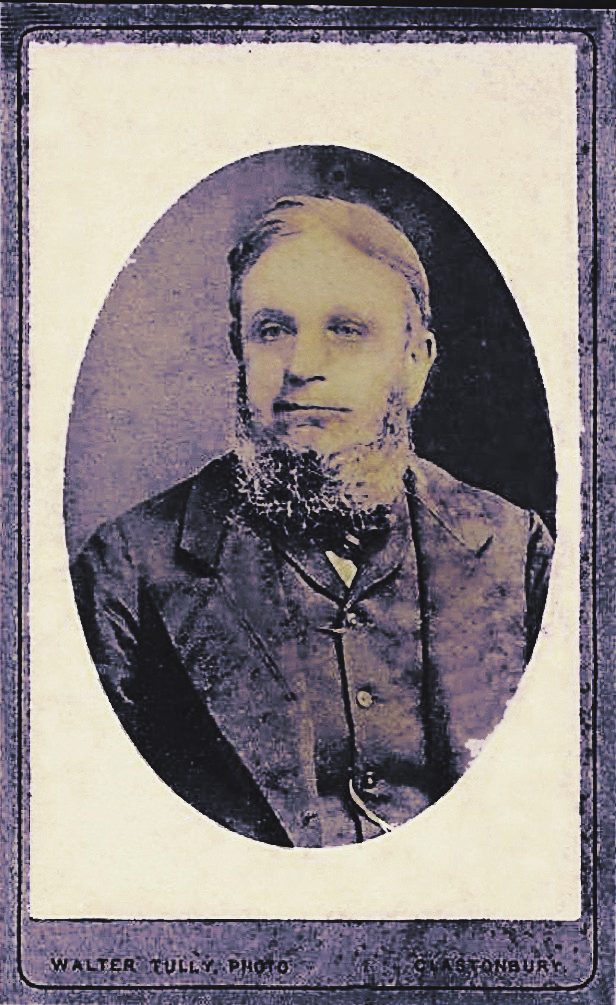
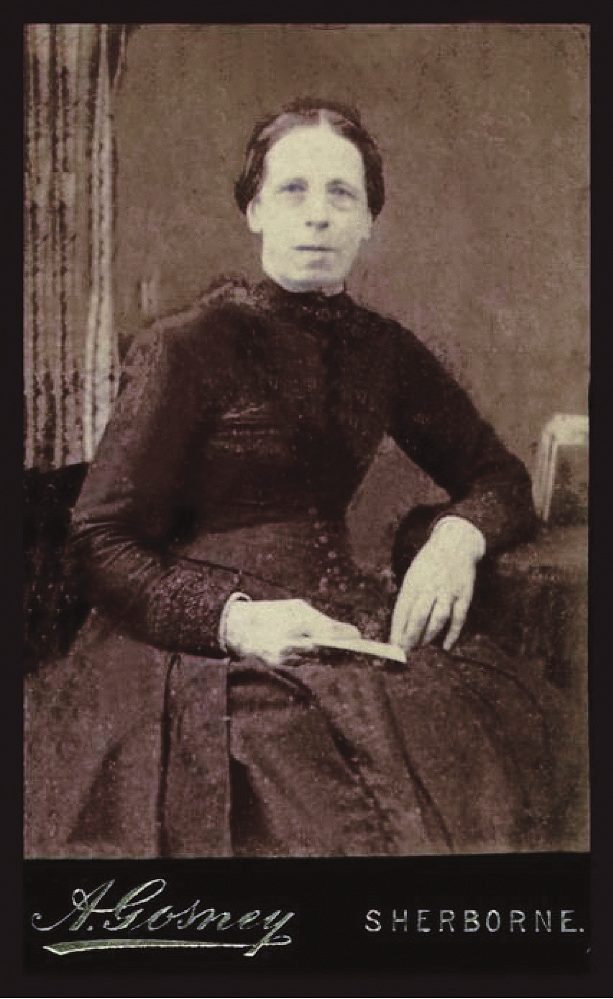
His younger brothers (Edward and James) also adopted the blacksmith trade. (The trades of leatherworker and blacksmith, together with woodworker and teamster, were of critical importance to the then current technology of the young colony - J. K. C) While the rest of the family settled in the Hunter Valley of New South Wales, Walter was, by 1854, a resident of the Queensland settlement of Gayndah.
On 20th March of that year he married Mary Shannon. Mary, a Catholic, was the daughter of Manus and Susanna Shannon of Ennistymon, County Clare, Ireland. (Appendix A2)
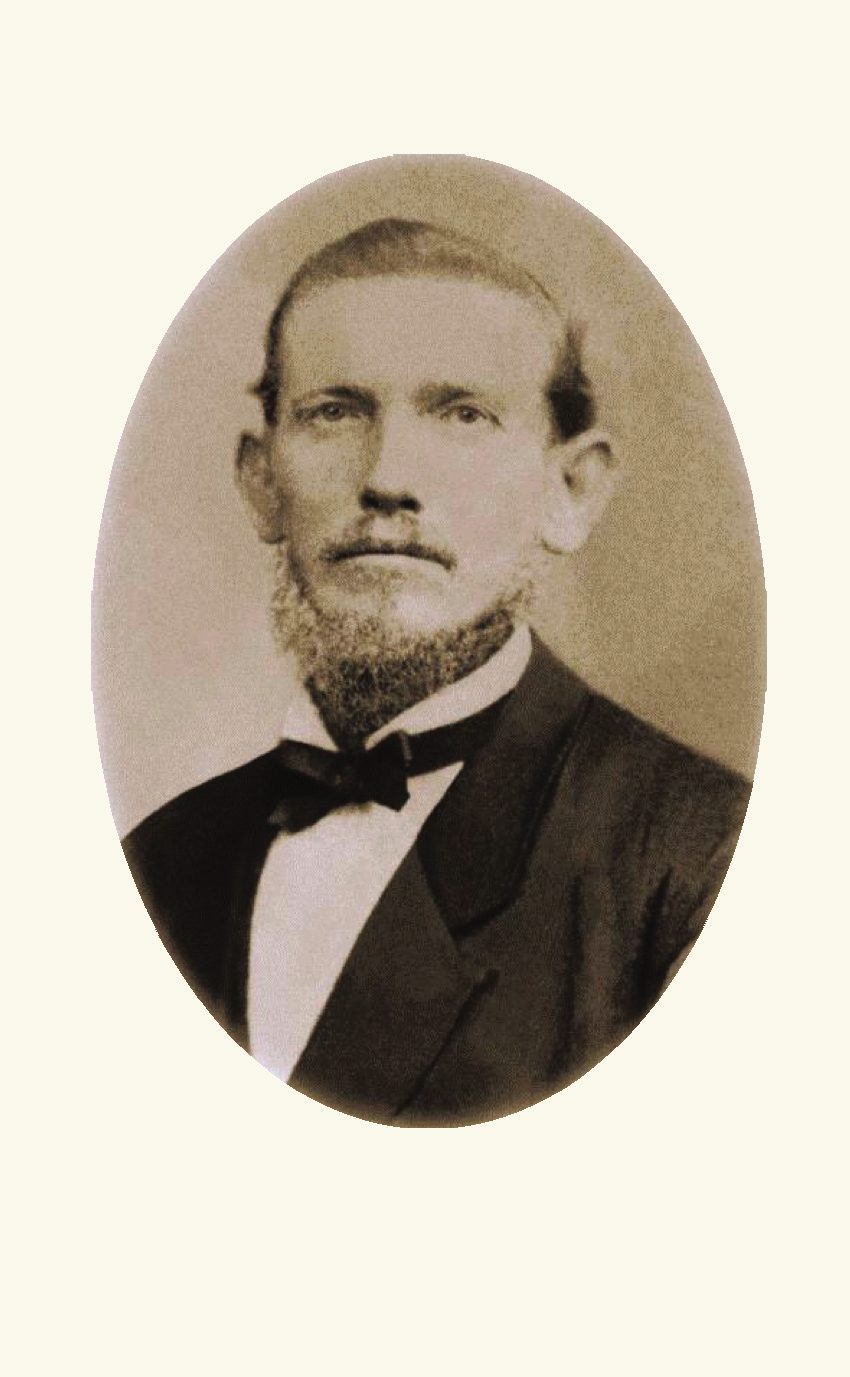
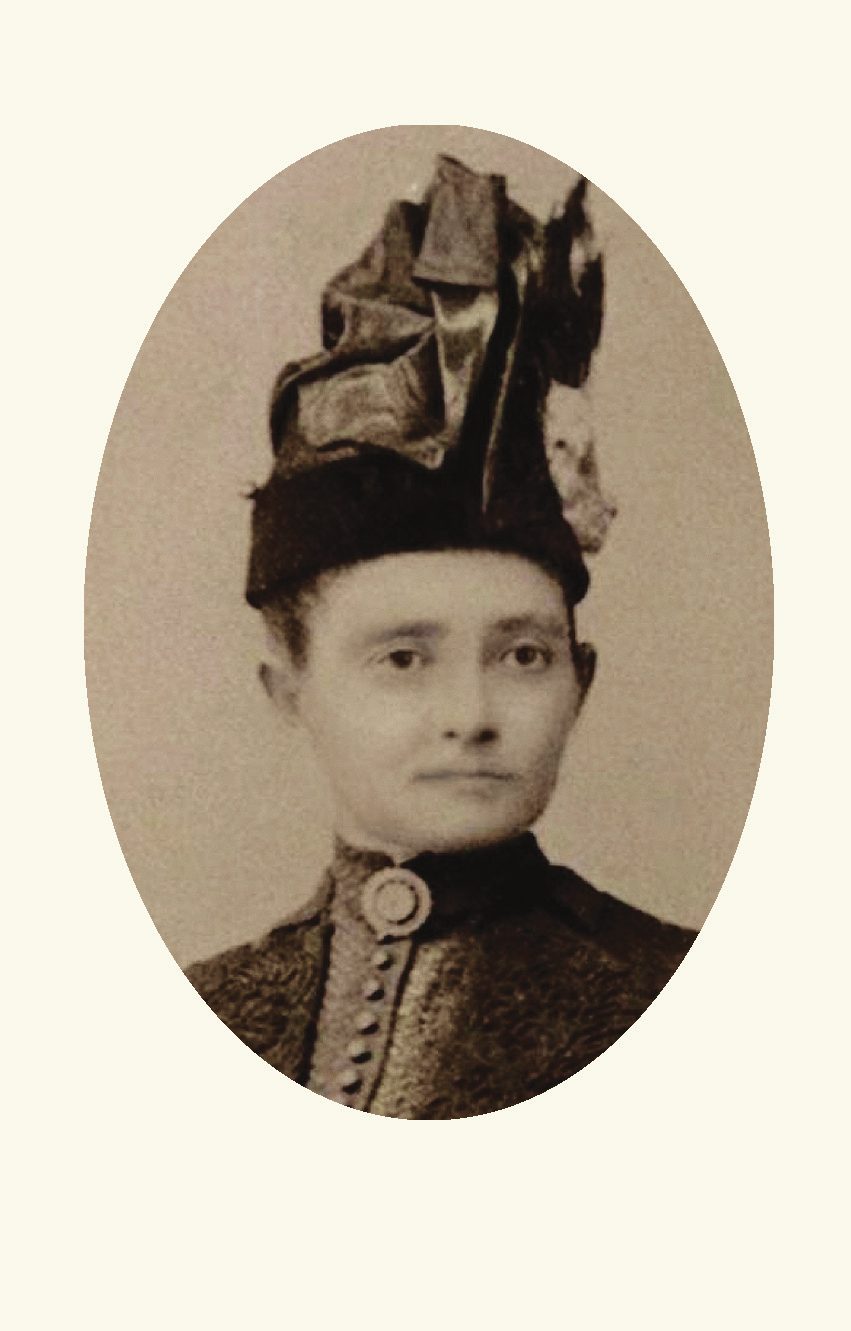
Born on 6th January 1833 Mary migrated, as a ‘20 year old housemaid’ who could neither read nor write, on the Joseph Somes out of Plymouth on 21st October 1851, and landed in Sydney on 1st February 1852. Records indicate that Mary paid £1 for her passage.
The Ireland that Mary left was in crisis and the catalyst was the humble potato. Extracts from Gladstone - Parnell and the Great Irish Struggle , (1886) describe this Ireland:
It was (the) state of affairs between the landlord and the tenant that gave the potato its fatal importance in the economy of Irish life. All the wheat and oats which were grown on the land must go to the payment of rent; and also much of the potato crop as was not required to keep the tenant and his family from absolute starvation. The potato was well suited for the position of the tenant. It produced a larger amount per acre than any other crop; it suited the soil and the climate. The potato meant abundant food or starvation, life or wholesale death. It was the thin partition between famine and the Irish people.
The plant had its bad qualities as well as its good; it was fickle, perishable, liable to wholesale destruction, and more than once already had given proof to its terrible uncertainty .
The ‘Struggle’ goes on to describe the emergence of potato blight in North America and Europe, its progression to Ireland and its catastrophic direct and indirect effects on the Irish people, exacerbated by the social and political circumstances of the time:
Pestilence always hovers on the flank of famine. … a quarter of a million people … perished from fever alone. The famine and the fever were naturally accompanied and followed by other maladies which result from insufficiency and unsuitability of food. The potato blight continued with varying virulence until 1851; its existence being marked by the prevalence in more or less severe epidemics of dysentery, which carried off 5,492 persons in 1846, 25,757 in 1847, the annual totals swelling until in 1849 the deaths from this disease alone amounted to 29,446; cholera, which destroyed 35,989 lives in 1848 - 49; smallpox, to which 38,273 persons fell victims in the decennial period between 1841 and 1851 .
Inevitably, emigration was encouraged as a partial solution to the people’s plight. The History of Ireland (Haverty 1882) reported:
In 1846, the year of the great famine, some 250,000 emigrated to the United States and Canada. The tide kept on increasing for several years; The population of Ireland, according to the contemporary census, was, in 1841 – 8,175,224 persons; in 1851- 6,553,290 persons; and in 1861- 5,764,548 persons.
In 1851, the year that Mary left Ireland, emigration was decreasing; however there were still 152,060 registered emigrants in that year.
The demographic effects on Ireland’s population may be indicated by the composition of ‘Assisted Immigrants’ on the Joseph Somes . There were 34 married couples accompanied by 58 children 14 years or younger, 58 single males and 62 single females. Of these single females all but six were Irish and, with one exception, a 37 year old, were aged from 16 to 26.
The witnesses to the wedding of Walter and Mary were Prudence Lean and James Speering. Who were they and do their records give us any clues to the lives of Walter and Mary?
Prudence arrived with her labourer husband, Benjamin, and their infant, Emil, at Moreton Bay on 29th April 1853 on the Florentia . Prudence and Benjamin were 27 and 24 years old respectively. They were from Cornwall, of the Church of England, could read and write and they had no relations in the colony. No further record was found of them in Queensland but Prudence and Benjamin both died in faraway Narrandera in the Riverina in 1913 and 1917, their parents being given as ‘Hoskins’ and ‘Unknown’ and ‘John’ and ‘Unknown’ respectively.
James Speering, a labourer, arrived at Moreton Bay on 10th August 1852 on the Meridian with his wife, Angelina, and a daughter of the same name. They were 26, 26 and 3 years old respectively from Limerick and of the Church of England. They also had no relations in the colony. James and his wife could read and write. James was the son of Thomas Speering and Susannah Sparling and Angelina was the daughter of William and Margaret Corneil. They were married on 29th February 1848 at Adare, Limerick. After arriving in the colony, a further five children, Margaret, Thomas, James, Edwin Charles and William, were born and James worked as a shepherd and tailor and was a storekeeper on the Paradise Gold fields. James and Angelina died at Brisbane in 1890 and 1907 respectively and they are buried in Toowong Cemetery.
There seems to be no evidence of close contact between Walter and Mary and the witnesses either before or after the ceremony. In particular, their records give no clues to the activities of Walter and Mary in the period, 1852 to early 1854.
In contrast, the celebrant, Edward Tanner, the rector of St Paul’s Church of England, Maryborough, in 1854 remained closely associated with the couple well into their later years.
In 1854 the newly married couple were resident at Albert Street, Maryborough, and in May 1855 Mary presented Walter with an heir, George Manus. A further seven children, Matilda Jane, Mary Ann, James Walter, Sarah Margaret, Maria Emily, Susanna and Ellen Elizabeth were to be born in the town. Susanna died in infancy in 1869. (Appendix A9)
For a short time after travelling to Maryborough Walter again worked for wages as a blacksmith; however it is clear that he had by then accumulated some capital. On 11th September 1855 he purchased 64 perches in Lennox Street in the name of his new son and further allotments, on 29th October 1856 in Bazaar Street and on 9th September 1859 in Albert Street, in his own name. (Appendices A3 & A14a) Around 1855 he established his own machinery business which he conducted for seven years.
On 8th October 1860 he purchased three blocks of land totalling 13 acres 2 roods 24 perches (augmented by an adjacent block of 4 acres 32 perches on 21st December 1869) in The Pocket on the flood plain of the Mary River and commenced farming. (Appendix A14b) Mr Edward J. Aldridge, the founder of Maryborough had introduced sugar cane into the Wide Bay district in 1860. Ever the innovator, as amply demonstrated in later life, Walter drew on some of the resultant seed stock and, in 1864 made preparation to produce stands of cane, “... in the jungle near Maryborough, at a place called Somerville considered to be ‘finer than anything … seen in Mauritius’ by an expert Thomy de Keating who arrived at Maryborough from that island in 1865.” (Appendix A5) There was no machinery for crushing at this time so these early crops were fed to cattle.
In 1869 Walter commenced a contracting business which he was to carry on for two years. He also was an alderman of the town over the five year period from February 1867 to February 1872, included in which was the holding of the office of Chairman of the Council’s Works Committee.
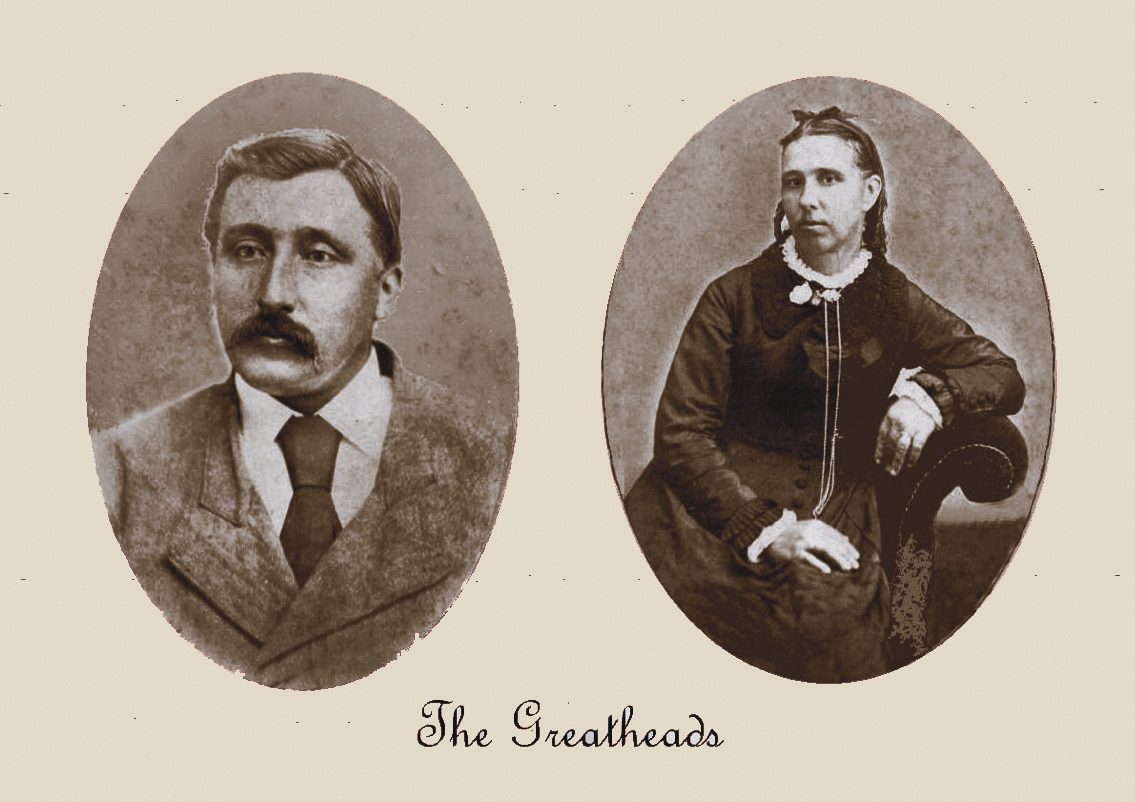
In 1871 he gave a clear signal that he had recognised an opportunity and challenge to the north. On 28th January he purchased three allotments in the fledgling town of Bundaberg at an auction held in Maryborough.
Walter resigned from the Maryborough Council, left his well-established business interests, commenced to dissolve his property holdings and moved to the Burnett. To mark the occasion, the citizens of Maryborough made a presentation to Walter which was accompanied by an illuminated address. (Appendix A12)
In March 1872 Walter selected a block of 240 acres between the Burnett River and Mon Repos on the edge of the Woongarra Scrub. A conditional purchase lease was granted under the Crown Lands Alienation Act of 1868 on 14th July 1872.
The aim of this Act was to break up the large pastoral holdings of the squatters and to encourage agriculture on mixed farming enterprises. Land was classified and valued as ‘agricultural’ worth 15 shillings per acre, ‘first-class pastoral’ worth 10 shillings per acre, and ‘second-class pastoral’ worth 5 shillings per acre. Lands purchased by Walter under the Act were acquired through seven annual rental payments.
No records have been found of Kennen or Digby but Thomas Chase arrived at Maryborough on the Great Queensland on 9th October 1874 so his starting date as Bailiff is a little fuzzy but he clearly went straight into Walter’s employ on his arrival at Bundaberg. He was accompanied on the voyage by his wife, Ann (nee Steel) and children, Mary Ann, Mark, George, Thomas, John, Eliza, Ellen Jane, Frederick, Henry, Lucy, Jane and James, who ranged in age from 22 to 3 years. A thirteenth child, Richard Burnett, was born in 1875. Thomas was born at Kingston, Surrey, in 1821 and Ann at Millford, Southampton, in 1829. They married at Portsea, Hampshire, in July 1852. Descendants of the family remain in the Bundaberg district.
Walter’s Barolin selection, which became his principal rural holding, was variously described as Somerville Plantation and Sommerville Plantation in contemporary records and Summerville Plantation in later mentions. In this text the middle course, ‘Sommerville’, has been adopted. It consisted of 75 acres of agricultural land and 165 acres of second-class pastoral land, much of the latter being ti-tree swamp. (Appendices A14d & A18)
On the other hand Charles Faulkner and George Noakes, who had moved from Maryborough at the same time as Walter, had both selected adjacent or nearby blocks which were made up of the more valuable agricultural land only.
In a report by Horace Burkitt, Commissioner for Crown Lands at Bundaberg on 1st May 1876, Sommerville was described and its improvements valued as follows: It is possible that proximity to river transport was a factor in Walter’s choice of the selection as this advantage may have been suggested by his friend George Greathead who set up the first regular coastal shipping line between Bundaberg and Maryborough.
A condition under the Act was continuous and bona fide occupancy of the selection by a Selector’s Bailiff. Walter’s Bailiffs on Sommerville were from February to June 1872
- D. Kennen (with the two sons of the selector assisting clearing), from June 1872 to August 1873 – a man called Digby, from August 1873 to August 1874 – George Manus Adams, and from September 1874 to July 1876 – Thomas Chase.
All 200 acres cleared and under crop £100 - 00 – 0 Elsewhere it was stated that the selection had 40 acres under maize valued at £200. Burkitt concluded that at the time of his visit in June 1875, “the place had all the appearance of a well worked maize growing farm.” On 10th June 1876 a Certificate of Fulfilment of Conditions by Selector under The Crown Lands Alienation Act of 1868 was granted. Walter was to acquire several other rural properties under this act.
- 15 acres of scrub fallen
- £37 - 10 – 0
- About 20 chains of fence, split post,
- sapling rails
- £10 - 10 – 0
- 2 piggeries/slabbed
- £6 - 00 – 0
- 2 water holes
- £8 - 00 – 0
- 2 log barns, thatched at £10 each
- £20 - 00 – 0
- 1 Slab and shingle cottage
- £14 - 00 – 0
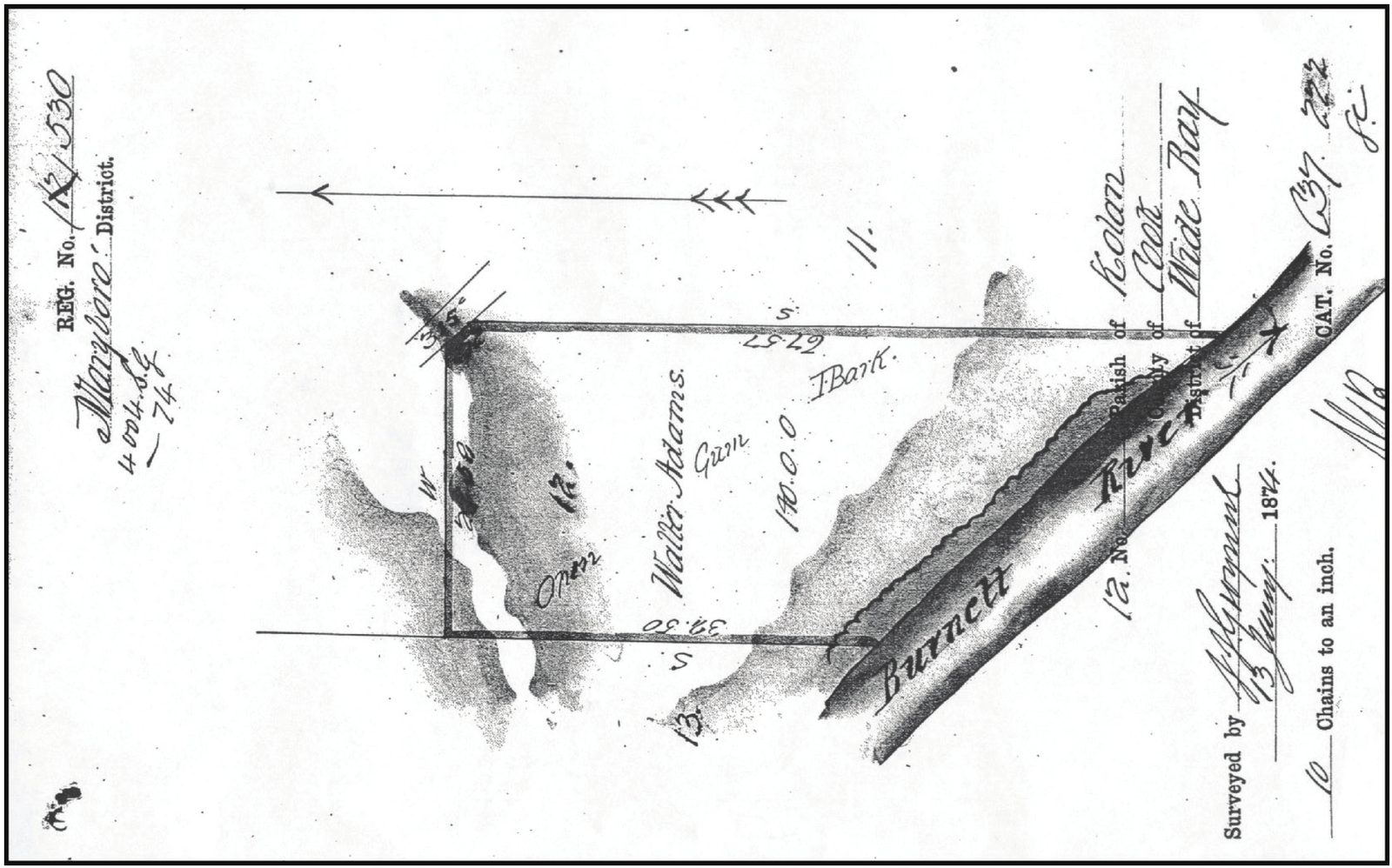
His earliest selection in the Burnett was a homestead block of 140 acres (10 acres of agricultural land and 130 acres of 2nd class pastoral land) on the North bank of the Burnett River at South Kolan. Probably at the same time, he selected 320 acres at Gin Gin. These choices he later came to regret.
There is no evidence that he attempted to develop the Gin Gin property. A letter to the Land Commissioner on 7th October 1872 indicates he sought to forfeit its lease but, by mistake, the selection at South Kolan was cancelled and so he sought the reinstatement of that lease. Later developments suggest he would have been better off without the bother. The Kolan property, located approximately 14 miles south-west of Bundaberg proved to be a costly and frustrating experience. This debacle is described in his letter to the Land Commissioner, Bundaberg, of 17th March 1875.
Sir,
On the 25th of November 1871 I selected a homestead selection for the purpose of actual settlement by myself and family on the Kolan run and on the 18th of January following left Maryborough and proceeded Whither to settle upon said selection – before leaving I was promised that my selection should be surveyed as soon as possible – I was also informed if I was to Erect my buildings and make my improvements as near as possible to a tree marked (“? ed.) I should then be about the middle of said selection after arrival on the spot selected and a great deal of trouble and delay I found the tree as described and commenced operations and after spending four months on the spot selected from January to May Erecting a four roomed slab house at a cost of about £20, a stockyard at £30 besides felling five acres of the best timber where the best of the land was I was informed by the surveyor that when the block was surveyed my improvements would be out of the lease. I was then left in a dilemma and not knowing what to do I left to reside in the town of Bundaberg – and from that day I have had no official notice of its survey and as you are aware on inquiry at your office I was informed that it was not marked as surveyed on the map neither has their been any official notification of it being surveyed. [He had indeed erected the house and yards on the adjoining property selected by John Nolan. He proceeded to seek the transfer of fees paid on the selection to his existing and a proposed Barolin property - J. K. C.].
Seeing now that nearly four years has elapsed since selection and that I have spent in improvements over £60 and that now the land is useless to me, having to shift my labour and capital Elsewhere I would beg that I may be allowed to transfer it for the selection lately forfeited by symonds on the Barolin run being selection 307 portion {?ed.} and against the selection owned by me and where I am now working and have worked since it was surveyed although in doing this I shall loose my improvements on the other yet I am prepared to do so - not for the essential value off the land mentioned but simply because it is adjoining the site of my other operations. I am emboldened to ask this transfer as I believe the present Government wishes to do justice to all Bonafide selectors and I am sure they cannot fail to see that it would be a great hardship for me to have to loose my homestead and improvements without being able to take other in its place and letting the rent and survey fee go as payment – the improvements I am willing to loose the land through the delay becoming useless to me.
I have the Honour to Be Sir Your Humble Servant,
Walter Adams
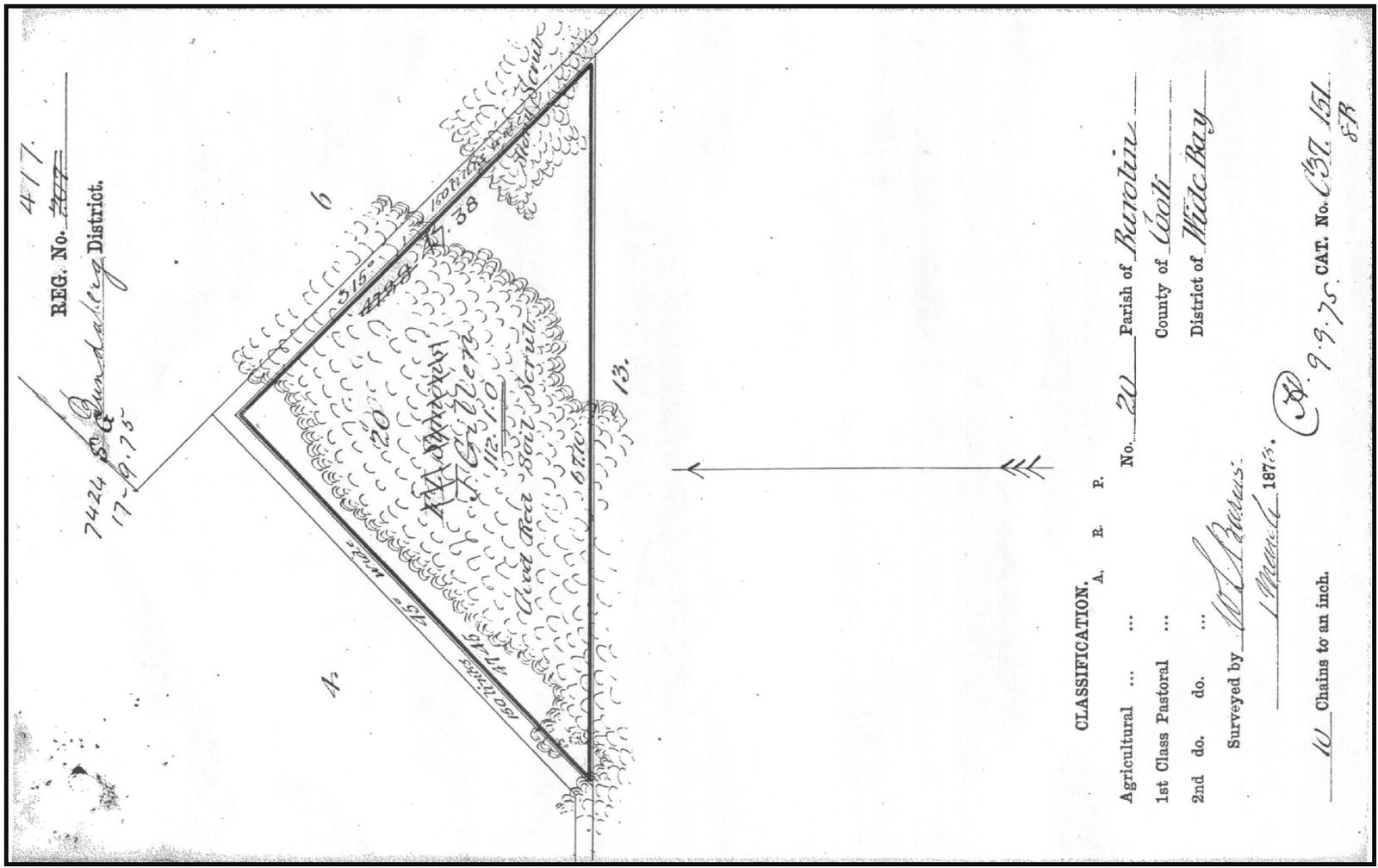
The “ selection owned by me ” was Sommerville. The “ selection lately forfeited by symonds ” was Lot No. 207, not 307, selected by Frederick Lewis Symons and forfeited on 19th February 1875 and which consisted of approximately 112 acres in a triangular block on the Northern boundary of Sommerville. Walter was unsuccessful in gaining this Symons selection. However his request to transfer the fees to Barolin was granted on 1st June 1875. It was Joseph Gillen who had applied for the Simonds land and his Certificate of Fulfilment of Conditions was granted in 1877.
Bundaberg in an area which is now bounded by the Bundaberg-Maryborough Railway, Thebeban Road, Walker Street and an extended Faldt Street. This block was Portion 32, Parish of Bundaberg, County of Cook. It had been occupied since about July 1873. An inspection on 14th October 1876 indicated that the Selector’s Bailiff was James Adams, Walter’s son, with George, his elder brother, also occasionally present on the property. The inspector’s report contained what was probably Jim’s first work reference. He was rated “generally useful and attends school” and he was “not employed elsewhere”.
Improvements were:
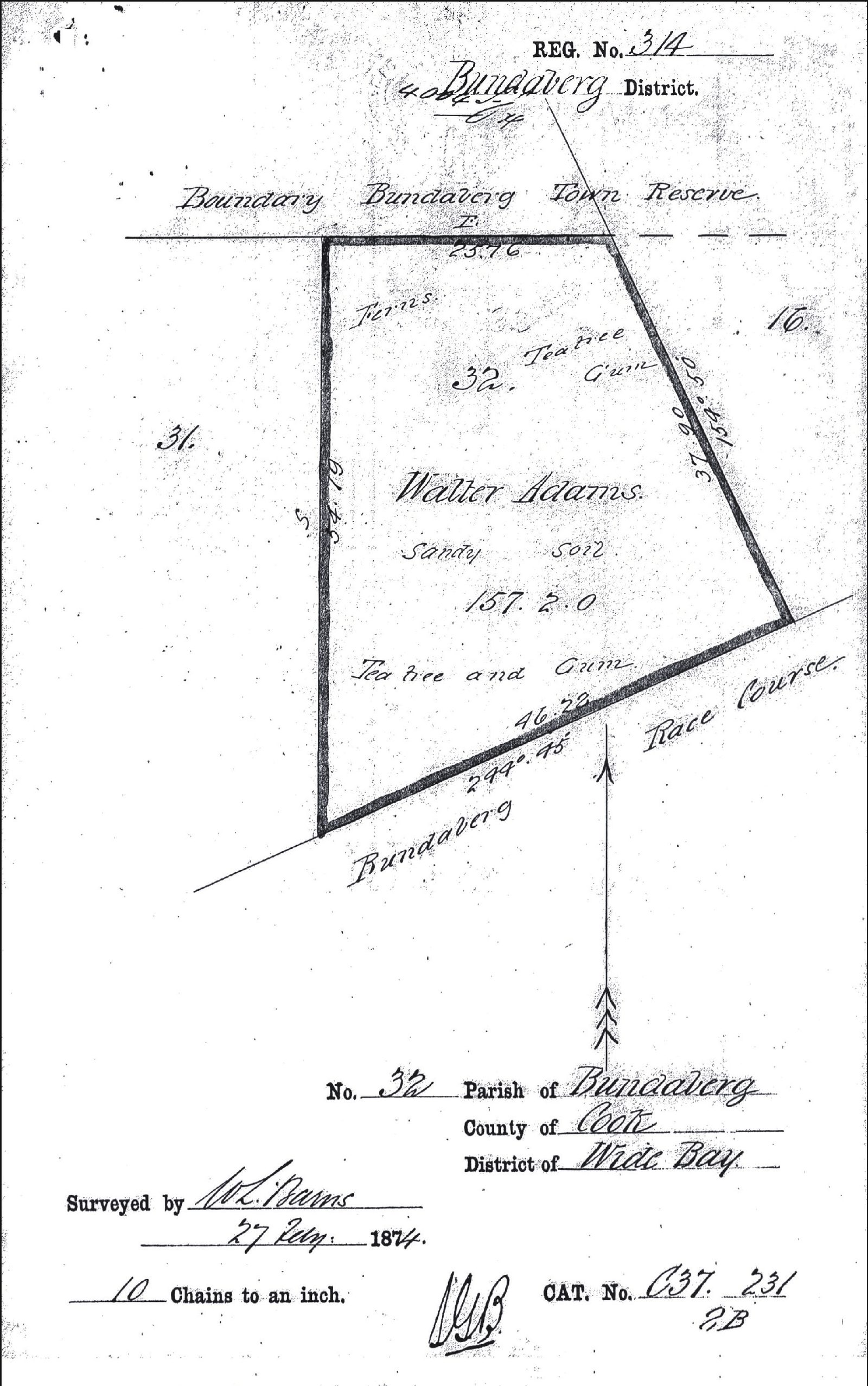
“About 150 chains split post and a conditional purchase lease on 157 acres 2 roods of second-class pastoral land at South The property was used as a horse paddock, horses being received on agistment. Hector Burkitt in a letter of 10th June 1876 to his masters at the Land Office enclosing the Certificate of Fulfilment , expressed concern the land was in the Bundaberg suburban area, within one and one quarter miles of the nearest sold town lots and, as such, the greater portion should have been valued at £1 per acre and the remainder at 15s per acre under the provisions of the Act . He further argued that the presence on the property of the garden indicated it was suitable for cultivation so it must be superior to 2nd Class Pastoral. The deed was granted on 10th May 1877 and it seems Walter got a bargain for his outlay of 5s per acre.
| rail fence, 2 rails Stockyard 3 rails and cap with calf pen £15 House Weatherboard and shingle 2 acres Garden, stumped and cleared Total Value Everything in good order.” On 29th October 1874 Walter was granted | £135 | ||
|---|---|---|---|
| £24 | |||
| £20 | |||
| £194 | |||
| that his predecessor had classified the property, | |||
| and adjacent ones, as 2nd Class Pastoral, when | |||
| A N e w L i f e i n a n O l d L a n d | 81 |
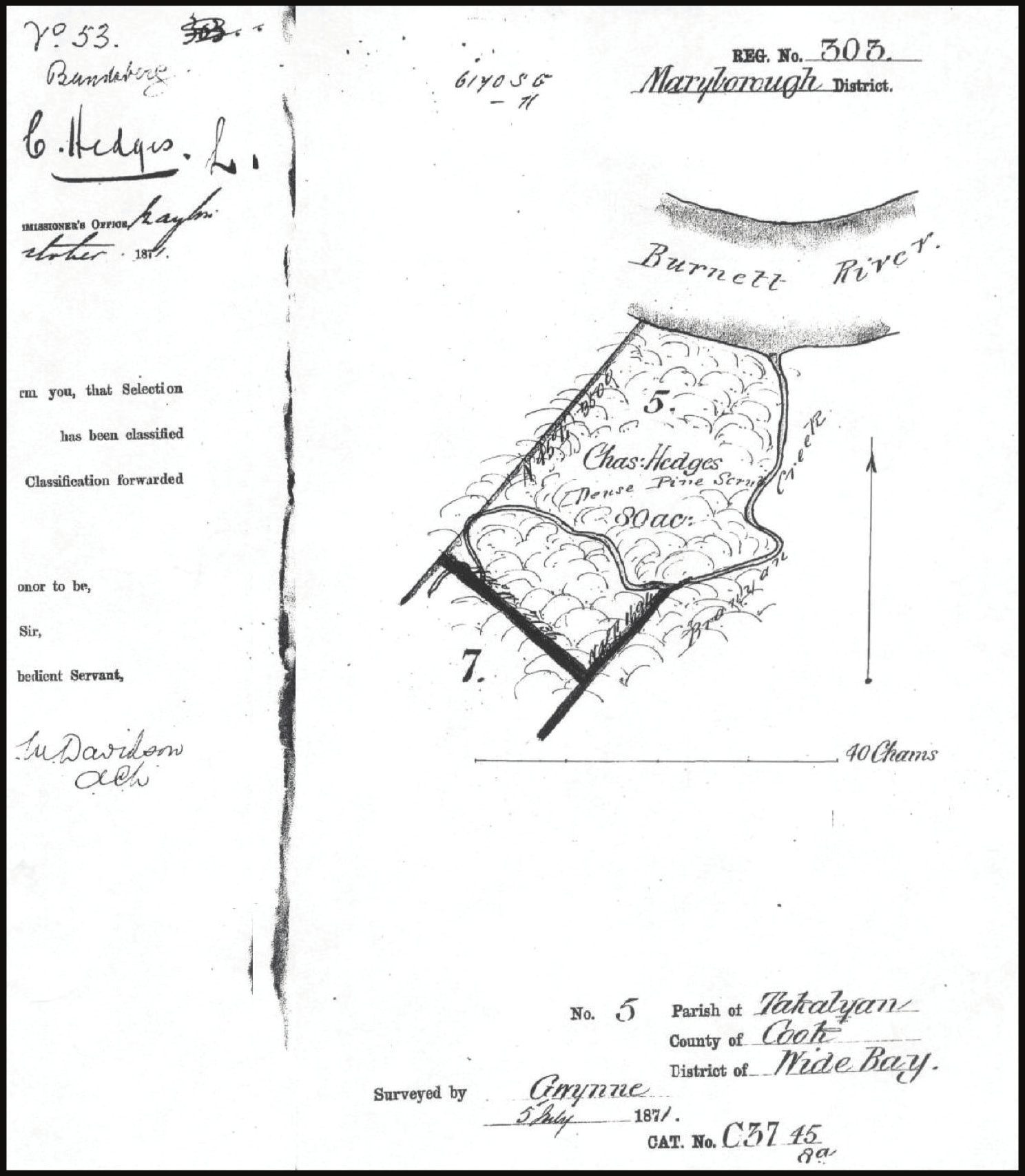
Another block acquired by Walter was a homestead block of eighty acres of agricultural land on the South bank of the Burnett River in the Parish of Takalvan selected on 24th June 1870 at the Lands Office, Maryborough, by Charles Hedges. On 24 December 1870 Charles wrote to the Land Agent, Bundaberg, to advise that the land had not been surveyed and he, therefore, had appointed a local surveyor, to mark out the land and also to mark out a selection of three hundred and twenty acres taken up and granted (conditional purchase) on the fourth of August 1870 . In a Power of Attorney “signed, sealed and delivered” on 10th November 1874, Hedges , by memorandum of agreement bearing (that) date herewith sold all his right title and interest in the aforesaid selection of eighty acres … at or for the price: sum of three hundred pounds Sterling and whereas the said Charles Hedges being compelled to leave Bundaberg for remote portions of her Majesty’s dominions to wit England and Wales, Scotland and Ireland in furtherance of his private pursuits … has deemed it desirable that Walter Adams, Publican of Bundaberg, should be appointed as the Attorney of him .
Charles is an enigmatic figure. A Charles Hedges arrived at Sydney on 9th February 1850 as a 19 year old farm labourer from Chednor, Buckinghamshire, who was Church of England, could neither read nor write, and had no relations in the colony; however, the Bundaberg Charles Hedges left behind not only the land but also a photograph album (still in the family’s possession) containing photographs of Windsor Castle, Eton College and other locations in the Thames Valley. Included were, ‘Lodge …’, ‘Vineries …’ and ‘Stables at Newnham’. Curiously, the home of Ellen Elizabeth Adams and her husband at 116 George Street, Bundaberg, was later named Newnham .
On the 4th July 1876, William H. Franklin, Bailiff of Crown Lands, Bundaberg, carried out what was apparently the first inspection of the property. He described the selector as, “Charles Hedges, Gentleman, at present in England.”
The property was Portion No. 5, Parish of Takalvan, County of Cook, consisting of 70 acres of agricultural land and 10 acres of 2nd class pastoral land used, “for the growth of maize” Franklin advised that, “a man named Creavy (“Farmer”) resides on the land in the interests of Walter Adams.”
Improvements on the Hedges’s land were:
- About 35 acres cleared
- £175
- Weatherboard Cottage, Shingles
- (2 rooms/verandah)
- £30
- Large barn W. B. Slabs, Shingles
- £25
- Lean-to – paling fence
- £15
He concluded, “This selection is now I believe a freehold & held by Walter Adams”.
Other Lands Department documents present a confusing picture on the size and nature of the property. They state that at the time of selection it was Lot No. 53 consisting of 80 acres of agricultural land and 37 acres of 2nd class pastoral; at forfeiture by Hedges Lot No. 313 of 60 acres agricultural and 260 of 2nd class pastoral; and at time of acquisition by Walter, Lot No. 112 of 37 acres agricultural and 92 acres 2 roods of 2nd class pastoral.
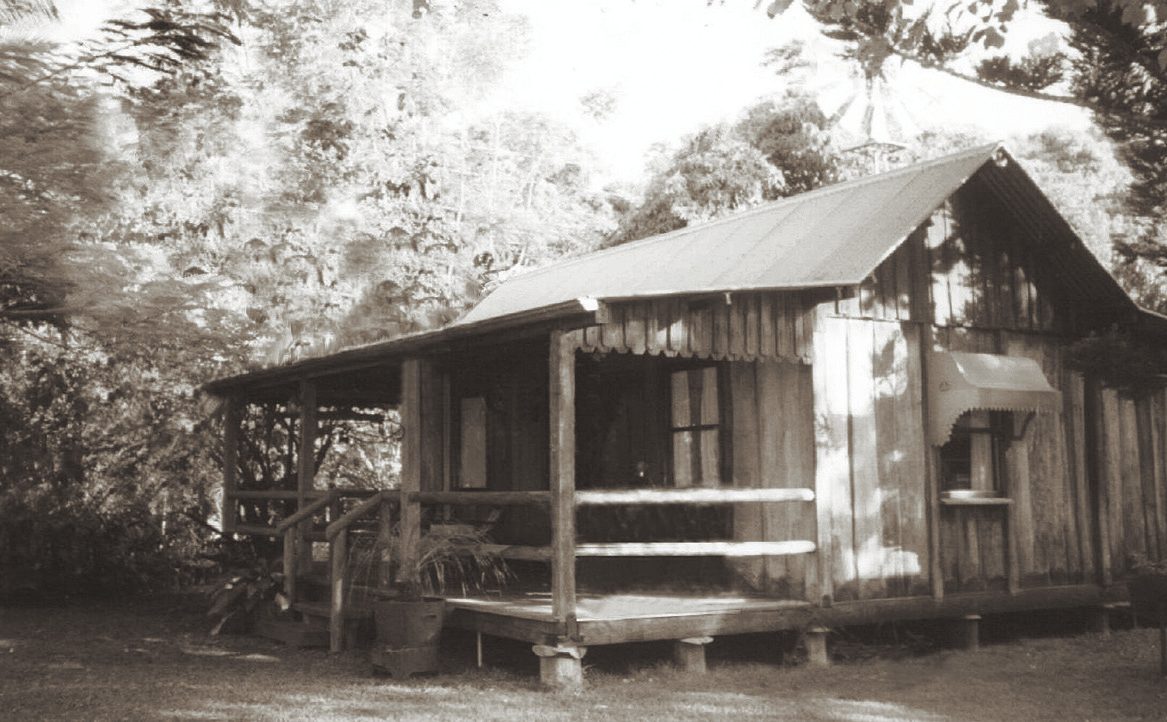
An article in the Queensland Country Life of 29th September 1983 summarised the history of the property. In 1877 land for what now is Branyan Drive was resumed on the northern fringe of the property. Rather than receiving cash compensation, Walter requested and, on 10th June 1879, received 4 acres on the northern side of the road. His stated intention was to build a house as the land there, while on the river bank, was high above flood level; however, he sold the 4 acres in 1884 to Robert Dyball, one of Bundaberg’s early solicitors, but it took a later owner, architect Leonard Young, to achieve Walter’s vision. The cottage built by Young, Birra-Barra Homestead, was for some time a tourist attraction.
In addition to acquiring these rural lands, Walter also purchased at least 16 town allotments additional to his original three purchases. Details of these properties are given in Appendix 3.
The original cash crop at Sommerville Plantation was maize. The virgin soils gave very high yields and two harvests per year. Prices initially were high at 6 to 7 shillings per bushel. In 1876 the crop failed due to weevil attack and prices plummeted to as low as 1 shilling per bushel. Diversification was essential. Walter tried wheat and sugar cane, apparently with some success, since he sent samples of both to the Paris Exhibition of December 1877.
A sugar refinery using new technology was operating successfully in Maryborough. In 1875 a petition to its owners, Tooth and Cran, by Bundaberg farmers and others interested in sugar growing sought the establishment of a similar works on the Burnett. At a meeting on 7th March 1878 convened by Mr. A. C. Walker a committee comprising Walter Adams, Alexander Walker, Edward Tanner, Andrew Dunn, John Nott and Richard Jones was formed to further the venture. Lack of risk capital caused delays however by January 1882 machinery for the proposed Millaquin crushing mill and refinery had arrived from England and the machinery for Walter’s Sommerville Plantation satellite mill was to land shortly thereafter, in August 1882.
The season of 1883 marked the beginning of successful, large-scale sugar production and refining in the Bundaberg area with Sommerville being one of the smaller plantations in the district. In 1888 it had 120 acres under cane, was valued at £10,000 and employed 8 white males paid £402 per annum and 27 and 3 black males and females paid £845/15s./0d per annum. Fairymead, the largest plantation, had 1,252 acres under cane, was valued at £75,000 and employed 47 and 4 white males and females paid £5,000 and 267 black males paid £5,860.
Walter’s first significant construction job in his new community was self-serving. He, and other residents of the rapidly developing Woongarra Scrub, travelled to Bundaberg by a long route - south to skirt the headwaters of Saltwater Creek - west to the Maryborough Road (now Maryborough Street) - then north to the township. In 1872 Walter estimated the cost of construction of a bridge across the creek at the By-Wash and convinced the Government to devote funds for the project. There are two versions of what followed. John Young Walker reported:
The public-spirited promoter having casually found that no tender would likely be sent in sufficiently low to meet the estimate adopted by the Government, himself tendered for the bridge at less than his own estimate. And thus “Adams Bridge” was built, and was known ever after by that name, until superseded by the dam near the Breweries and, separating the salt from the fresh water, erected by the Woongarra Divisional Board”. [NOTE: This Board was created in 1886 - R. L. C.] . This was the first bridge built in the Bundaberg district, at a cost of £329. Others have succeeded, more pretentious and more costly, but none more meeting so urgent a public want.
Neville Rackemann’s version is:
Walter Adams was the only person in the settlement in a position to carry out the job. If his tender - the only one - was considered too high, then the bridge would not be built. Adams was in a quandary. Above all, he wanted the bridge built, even if he ultimately did so at a loss. He privately mentioned a figure to a government contact and was assured that the amount would be acceptable to the Treasury. Anxious to commence the bridge as soon as possible, Adams went ahead at his own expense, confident he would be reimbursed by the government. In the meantime, Treasury officials decided that Adams’s costs were above the estimate finally accepted by the relevant department. It took considerable time and effort for Adams to have his £329 account finally settled to his satisfaction.
Another example of Walter’s ‘can do’ approach to civic development is given by the history of South Bundaberg’s first wharf. Walker reported:
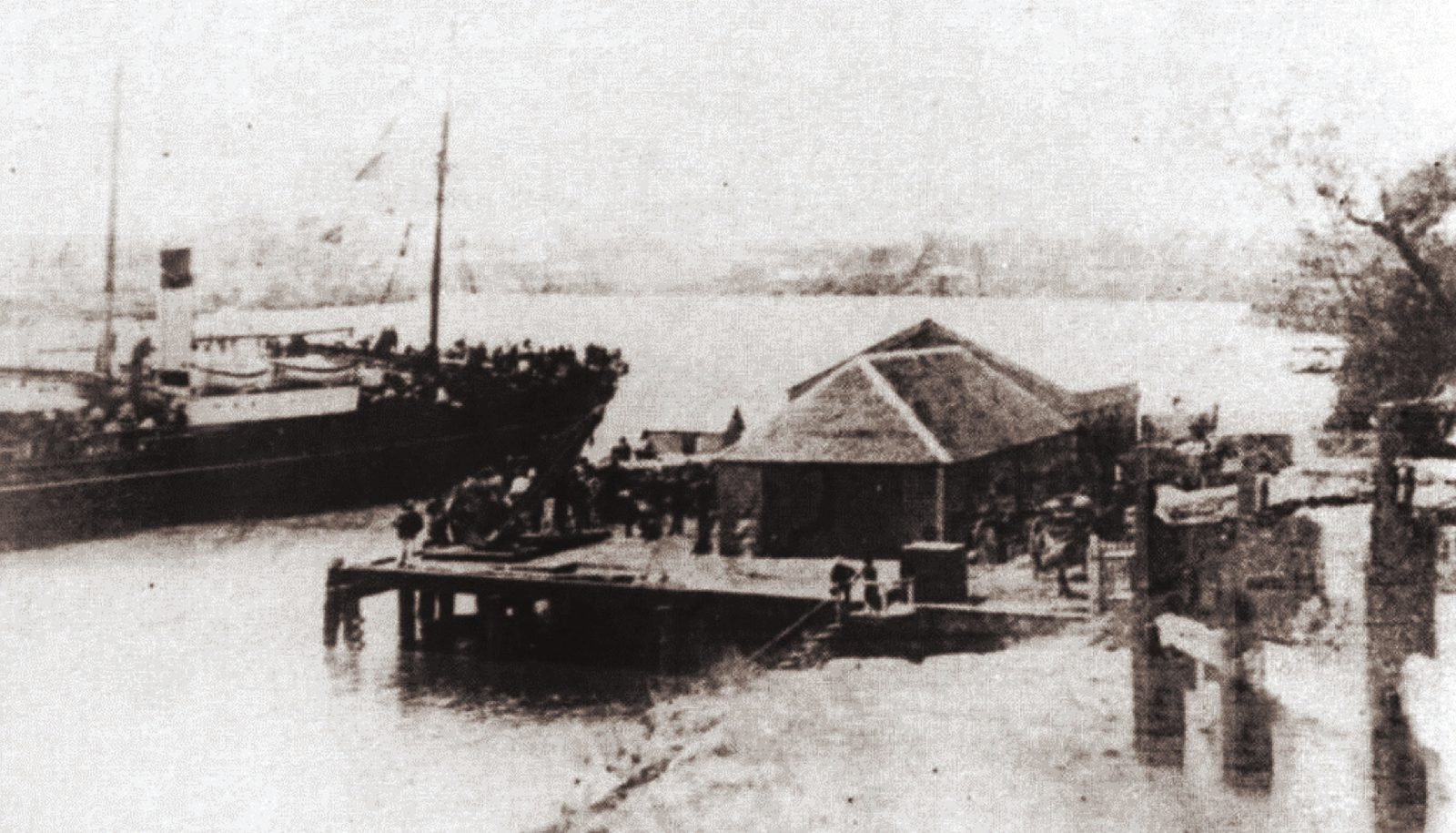
When it was unquestioned and unquestionable that the river was navigable and was one of the finest natural ports in Queensland, an application was made for money to be placed on the Estimates for the erection of a wharf; and the sum named was £2,000. This application was made through the then member for Bundaberg, Mr Walter Scott.
The answer received was that money was not nearly sufficient and that the position and prospects of the town would not warrant the expenditure for a long time to come. Here again, we quote: Mr Adams was strongly to the fore. Procuring at Mr Cathcart’s store a sheet of tea paper – the only writing material immediately available – he drew a pencil sketch of the desired wharf, added a set of specifications to match, sent it to Mr Scott and offered to take responsibility of erecting it for £1,900. This brought the Department to re-consider the matter; money was found and a tender accepted for the first wharf, now known as Queen’s Wharf . Walter completed the wharf in 1875. The A.S.N. Company leased the wharf in 1876, moving from the flood-prone North Bundaberg wharves previously used.
Other major projects carried out by Walter were construction of the first major road works, the Bundaberg to Bingera Road; and construction of the telegraph line from the township to the pilot station at Burnett Heads. Both jobs were completed in 1873.
In January 1873, a first step was taken to formalise the process of civic development. A Bundaberg Progress Committee was formed. Its membership was John Steuart, Walter Adams, George Bell, Samuel Johnston and Alex. Walker. The duties of the Committee were to communicate with Government through the heads of departments or parliamentary representatives on all subjects of importance affecting the interests of the town and district.
At the first meeting, an eleven point list of urgent requirements was compiled which included roads to Burnett Heads, Gayndah, Maryborough and Mount Perry, telegraphic communication, immigrant quarters and a share of immigrants, a punt across the Burnett River, beacons at the river mouth, a bridge at Saltwater Creek, a bi-weekly mail to Maryborough and Mount Perry; clearing principal streets of timber and placing roads under the control of a road trust, and securing reserves for botanic gardens, hospital, cemetery and recreation purposes.
This first Bundaberg Progress Committee had a short recorded life. The last minutes are dated March 1873; however, it achieved an objective of establishing priorities for the growth of the community. As was the case before 1873, implementation relied on the energies of the district’s innovators.
Walter, drawing on his Maryborough Council experience, was a prime agent in securing sufficient reserves for public purposes while land was comparatively of little value. Until this time, only the School of Arts and School Reserves had been secured.
A Cemetery Reserve was first addressed. The few dead had been buried in the centre of the town on an allotment diagonally across the intersection from the present Anglican Church. Many people believed that the burial ground was sufficiently distant and the town would never extend beyond it in their or their children’s life times. Walter remarked, “the future of Bundaberg no man can predict.” A trust was established and, on the advice of Walter, in co-operation with Alex. Walker of Bingera, the present site of the General Cemetery was selected and applied for. A slight hiccup was the need to block an application to the Lands Office by the district surveyor, John Charlton Thompson, for an agriculture block which included the reserve. This problem was overcome and, ironically, Thompson’s wife, Hannah, was the first person buried in the newly consecrated ground.
Walter now turned his attention to establishing a race course. In 1873 a reserve had been granted. Joined by Thomas Watson, Walter collected over £30 for surveying and clearing the course. The local surveyors required £10 to mark the circle of the track. This expenditure would have left too little in the kitty to complete the job. Walter, John Foley, George Skyring and Fred Colman marked off what is the present running ground of the Bundaberg Race Course between 9 o’clock one morning and 3 o’clock that afternoon. Family lore also maintains that enthusiasm for the clearing of the track was maintained by the sustenance of voluntary workers at the end of the day with appropriate supplies from his recently established hotel.
As far back as 1868 it was known or supposed that Bundaberg was over or on the edge of an extensive coal basin. Around 1875 a seam was found in the bed of Pine Creek by Walter, James Elwood and another man. The trio had been prospecting the district for some time. Samples were tested and found to be of excellent quality. Reports by a surveyor and a practical miner were so satisfactory that a limited liability company of twenty-five members was speedily formed, a board of directors appointed, work commenced and a conditional contract to supply the A.S.N. Company’s ships was negotiated. By March 1876 a shaft to a depth of 116 feet 6 inches had given encouraging shows of coal; however, a majority of shareholders were reluctant to throw more capital at the venture. At a meeting held at Adams Hotel, it was agreed unanimously that the balance of funds be returned to shareholders. While a viable coal industry has never been developed in the Bundaberg district, the presence of these deposits was used to effect by proponents of a Bundaberg to Mount Perry railway line. Among the foremost of these was Walter Adams. (A shaft that may have met the description of the one above was still in evidence in the 1950’s, and was located in the Scouts’ reserve on the south bank of the Burnett River.)
In 1869 copper ore was discovered at Mount Perry. The field was hailed as potentially the most productive in Australia. Initially, the ore was hauled by drays via Gayndah to Maryborough. However, with the development of the town and port of Bundaberg more of this traffic could be re-routed from Mount Perry to Bundaberg. Both ports sought railways from the field, Bundaberg arguing that freight costs to its port would be less than two-thirds of the costs to Maryborough. Not only was there rivalry between the sister towns but also towns in other parts of the State, including Gympie and Charters Towers, were fighting for a share of the limited cake devoted to rail construction. The convoluted and protracted politics of the issue are described by Walker. One interesting aspect was a resolution passed at a meeting held at the Bundaberg School of Arts in 1875. This accepted as a compromise that the line should initially extend only to New Moonta since the last 20 miles to Mount Perry was the most expensive part of the line.
Surely it was only a coincidence that at least five of the seven speakers at the meeting, including Walter, were Provisional Trustees of the New Moonta Copper Mine. As it turned out, the line never went directly to New Moonta, although the Mount Perry road did. In August 1881, the line was opened to Moolboolaman, in June 1883 to Gibb’s Siding (about four miles from New Moonta) and in May 1884 to Mount Perry.
Financial difficulties delayed the establishment of a Primary Public School in Bundaberg. In 1875, however, at the third attempt, sufficient funds were obtained by public subscription and a school was built. A further problem then arose. There was no Government official in the town authorised or available to supervise the building. This difficulty was overcome by the appointment of Walter, John Cathcart and a gentleman called Beard (who worked in the Lands Office). This group voluntarily undertook the work. Walter also was responsible for promoting the establishment in 1877 of a Provisional School which became the Burnett Heads State School. His enthusiasm for the project was no doubt heightened by the presence on Summerville of Thomas and Ann Chase and their family. Lucy Chase was one of the first pupils enrolled at the Provisional School.
In March 1878 a meeting was held for the purpose of electing a Hospital Fund Committee and Trustees. Walter was a foundation member of this Committee and, after the building was completed in 1881, was for a time President of the Hospital Committee.
Other civic positions held by Walter were: President of the School of Arts Committee, President of the Agricultural and Pastoral Society, Member of the Botanic Gardens Trust, inaugural President of the Bundaberg Chamber of Commerce in 1882 and, curiously, member of the Bathing Company Committee which supervised the floating baths constructed by the Council in 1881 at the end of Tantitha Street.
In July 1877 a well-attended public meeting chaired by Walter elected a new and larger Progress Committee. Those elected were: James C. Walker, President, Walter Adams, Vice-President, Andrew M. Goodwin, Secretary, John Rowland, Alex. Walker, Henry J. Ford, George T. Bell, G. J. Young, Samuel Johnston, J. Diamond, Richard H. Datson and Frederick Smith.
On 15th July 1878 the Committee convened a public meeting to consider the desirability of incorporating Bundaberg as a municipality. Those in favour sought incorporation on the grounds of Bundaberg’s size and importance; but they’d failed to do their sums. Under the relevant legislation, the Municipal Institutions Amendments Act of 1864, councils had been given the, “care, construction and management of roads, public streets, bridges, ferries, wharves, jetties and public thoroughfares.” Walter explained that the town and district had enjoyed average annual expenditure of £1,400 over the last six years derived from government endowments and borrowings. As a municipality the town could expect to derive a total of £220 in rates which would attract a £440 endowment, in sum a decrease of £740 on the present system. In addition, the community would have to support a town clerk, a rate collector, an inspector of nuisances, a town surveyor, a council chamber, plus their running costs, leaving the impressive sum of £259 per annum for public works. Walter moved that, “This meeting stands adjourned for two years.” This motion was carried with enthusiasm.
The term of two years was not quite up before local incorporation was forced on the district by the Divisional Boards Act of 1879. In 1880 the Bundaberg Divisional Board was constituted and the agricultural and grazing lands adjoining the town were administered by the Barolin and Kolan Divisional Boards.
It soon became apparent that the town would be better administered financially under the Local Government Act of 1878 rather than the Act of 1879. In February 1881 the Bundaberg Board petitioned the Government to constitute the town as a municipality. The petition was granted in April.
At the first election, for six councillors, the vote was based on the parliamentary roll; but only freeholders and leaseholders were eligible. By far the majority of rate-payers had their names on the roll under six month residence qualifications. Only 55 people out of an otherwise eligible population of about 330 had a vote. On the 7th June, Richard Ruddell, John Rowland, Christian Gaffel, William Bligh O’Connell, Walter Adams and Frank Isembert were declared elected.
Signs of things to come were immediately evident when the successful candidates addressed the public. Gaffel fired the first round. He declared the day was his proudest. He did not belong to those who had retarded the progress of the town. Adams had done that and was not fit to be an alderman. Walter returned thanks and said it was not the proudest moment of his life because he had not been elected by the voice of the people. He promised he would challenge his colleagues to resign as soon as the rate roll was completed so that all rate-payers could determine who should represent them.
The tone was set, and worse became evident as the warring parties were split three against three. It even required three meetings to elect Ruddell, the poll leader, as Bundaberg’s first mayor. In July, however, by a rare unanimous vote, it was agreed to petition the Government to increase the number of councillors to nine. With unabated acrimony the Council ground on until 19th October when, in the belief that a representative roll was in place, the aldermen resigned as a body.
They were doomed to disappointment and embarrassment. The Colonial Secretary advised that, owing to the Council’s hasty and unwise action, a new poll would be held under the same conditions as before. This time sixty votes were recorded but at least new blood was successfully enlisted. On the second Council were John Lamb, O’Connell, Joseph Wright, Frederick Nott, Rowland and Adams. Lamb was unanimously elected mayor at the first meeting held on 29th November.
By February 1882 the rate-payers’ list had been revised and an election was held for a council of nine. Those elected were Adams, O’Connell, Lamb, Michael Duffy, Nott, Ruddell, Andrew Goodwin, William E. Curtis and Wright. Walter, who headed the poll, was elected mayor. Walker observed, A now fairly representative Council, consisting mainly of those who were really the civic ‘elder-men’ of the settlement, set itself with commendable energy to ‘redeem the time’, to recover the leeway lost by previous mischances, to perform zealously and efficiently their legitimate functions and to re-emblazon the somewhat smudged escutcheon of ‘aldermanic dignity’ . Walter was re-elected as mayor in 1883 and continued as an alderman until moving to the Legislative Assembly.
Walter showed his political colours as early as 1878. He supported the Conservative candidate for Mulgrave, Thomas McIlwraith, in the press and by chairing public meetings in Bundaberg. In June 1886 the seat became vacant on McIlwraith’s resignation. Walter was selected as the Conservative candidate. He was opposed by James Court Walker representing the Liberal Party. The result was 541 votes for Adams and 435 votes for Walker.
In 1888 the electorate of Mulgrave was divided at redistribution into Bundaberg and Musgrave. Walter was elected unopposed as the first member for Bundaberg. (Appendix A11)
During his terms in Parliament some accomplishments close to his heart were the passage of the Bundaberg School of Arts Enabling Bill of 1887 for the construction of the building which still stands in Bourbong Street and the construction and opening of the Burnett River railway bridge.
As the representative of what now had become one of the most important sugar growing areas in the State, Walter was heavily involved in the ‘Kanaka Question’, a debate which raged from 1889 to 1892. At one time he was a determined opponent of black labour in any form. His subsequent experience as a planter, of the unreliability of the available white labour and the industry and honesty of the islanders compelled him to modify his views.
Adams Hotel has been mentioned in other contexts. In 1873 Walter was granted a liquor licence and, over the period 1872-73, he constructed the Adams Hotel on the corner of Bourbong and Barolin Streets. In 1879 the name was changed to the Metropolitan Hotel and, by 1886, it had been replaced by the existing, two-story brick structure. In the September of the same year Walter transferred the licence from himself to his son George Manus, probably to meet the requirements necessary to become elected as a M.L.A. On George’s tragically early death in 1888, his wife, Cecilia, assumed the licence which she held until 1898. In June of that year an experienced publican, Martin Moran, took over the licence. From 1901 to 1910 Thomas Corrigan, a former boarding-house keeper was licensee. A W. J. Corrigan, probably Thomas’s nephew, held the licence in 1911. Transfer of the licence to a T. B. Cross in 1912 may represent the transfer of ownership from the Adams estate.
Adams Hotel played a dual role for the Catholic community in the early days. As well as slaking its thirst and satisfying its appetite, it provided a place of worship.
Walter was raised in the Church of England. As mentioned earlier, he and Mary were married by the Reverend Edward Tanner who was, at the time, Rector of St. Paul’s Church, Maryborough. He then became the first Church of England cleric in Bundaberg. Tanner was, one suspects, a man after Walter’s own heart although at times his political foe. He left the ministry in 1875 and selected The Grange plantation in the Woongarra. In all roles he was prominent in Bundaberg’s civic life. In time Walter was to adopt the religion of his wife with devotion and enthusiasm.
In the early days of Bundaberg, the town’s Catholics were visited by Father O’Brien, the Maryborough parish priest. Mass was celebrated in private homes until Adams Hotel was opened. The celebration was transferred to the hotel’s dining room. The altar, kneeler, tabernacle and Eucharistic vessels used in the early days were preserved at Summerville House, 118 George Street and at Newnham, 116 George Street, until the 1960’s when they were presented to the Church. It appears that they were subsequently lost.
During 1873 a Church Building Fund was established. On 2nd March 1874, Walter, James Drinan and Father Constantine Rossolini, the parish priest of Gayndah and Mount Perry, purchased, as trustees for the Roman Catholic Church, three 1 rood allotments (allotments 1, 2 and 3 of Section 8) on the corner of Barolin and Woongarra Streets for £2 per allotment at Government auction. By October 1875 a simple wooden building, the first church to be built in the district, was opened by the Rev. Father O’Brien, who came to the opening complete with his own choir. The original church was to be replaced in short order by a larger, 48 feet by 24 feet, structure built on the same site. About this time Father Rossolini was appointed as Bundaberg’s first parish priest. The larger “Holy Rosary” Church was replaced in 1887 by the inspiring brick and concrete building now on the site. It has been said that the little wooden shed now standing in the middle of the Bundaberg Catholic Cemetery, and now showing its age, was the original wooden church. As it does not conform to the above dimensions, as attributed by J. Y. Walker to the second and larger, wooden structure this may well be correct.
The Sisters of Saint Joseph, whose founder was Sister Mary McKillop, arrived in Bundaberg in 1876. The Sisters, under the leadership of Sister Teresa Maginnis as Superior, much endeared themselves to the locals with their charitable works and very valuable teaching, which was conducted in the original wooden church. Unfortunately, relations between Bishop Quinn in Brisbane and Sister Mary broke down, due to unmet expectations, and the Sisters of Saint Joseph were withdrawn from Bundaberg, and from the rest of Queensland, in 1880. This was despite strong representations from Father Rossolini and his close friend, Walter Adams, who along with other parishioners was greatly disappointed, even appalled, by the turn of events. While the replacement sisters continued with the work in a creditable fashion and the convent continued to flourish, the feelings engendered by the loss to the Parish of the pioneering Joeys carried on over several generations. Walter and other members of the family, particularly one of their star pupils, Maria, maintained correspondence with Mother Mary and Sister Teresa after the nuns’ departure. On 11th July 1880, the day before their departure, Walter read an address of appreciation to the Sisters in the church after Benediction. He also handed the Sisters a purse containing £37.
Early in 1884 Walter was presented with a charter by the grand executive of the Hibernian Australasian Catholic Benefit Society to form a branch in Bundaberg. This Branch, St. Mary’s 162, was formed on 2nd June 1884 with Walter as President. On the 16th November 1889, Walter and Father Rossolini, joined by Michael Gahan, again acted as trustees for the Church for 40 acres of land at South Bundaberg (Subdivision 1 of Portion 33). The block was, “for the erection and maintenance thereon of a Roman Catholic Church, School, and priest’s residence”. It now is the site of the Bundaberg Catholic Cemetery and Shalom College.
On 4th May 1892 Walter and Mary travelled to Sydney for medical attention to a tumour in his neck and lower face. He died there on 15th May. His body was returned by train to Bundaberg and, after a funeral service at St. Mary’s Church of the Holy Rosary, he was buried at the Bundaberg Catholic Cemetery on 21st May 1892. A chronology of the train journey, arrival in Bundaberg, church vigil, funeral ceremony, procession and internment was reported in, The Bundaberg and Mount Perry Mail of May 23, 1892. (Appendix B1) It describes an expression of grief and respect for an individual by the community of the town not previously seen or, probably, matched since.
In his last will, made on 15th May 1889, Walter appointed as executors his son-in-law, John Henry Edma Bertheau, and Denis Hogan, an insurance and commission agent who was closely associated with the administration of Walter’s affairs. (Appendix A7a,b,c) Denis, the son of William Hogan and Catherine Shannon, probably was a nephew or cousin of Mary. He arrived at Rockhampton on the R.M.S. Roma in 1882, aged 21 years, and died in Bundaberg on 22nd November, 1918. In a codicil that he signed only thirteen days before his death on the 2nd May 1892, Walter, rather curiously, replaced John Henry with his surviving son, James Walter. (Appendix A7d)
He bequeathed to his wife, Mary, all his estate with the exception of moneys secured upon mortgage of real estate. Freehold property held by him at the time of the will and at his death was the Metropolitan Hotel (located on Allotments 8 and 9 of Section 11) and his private residence, Summerville House (located on Allotments 6 and 7 of Section 56 – Appendix A10) These properties were to be administered on trust for Mary to receive rents, profits and residence during her life. On her death they were to fall into and form part of Walter’s residuary estate.
The executors/trustees were granted wide-ranging powers for the administration of the estate which, following his and Mary’s deaths, was to be divided into thirteen equal shares. His children, Matilda Jane Riedy, Mary Ann Bertheau, James Walter Adams, Sarah Margaret Buckley, Maria Emily Adams and Ellen Elizabeth Adams were each to receive two thirteenths and his grandson, Walter Thomas Adams, son of George Manus Adams, was to receive one thirteenth. Appropriate provisions were made for beneficiaries pre-deceasing and for inheritance by minors.
At probate, on 17th June 1892, Walter’s personal estate was valued at £869 and his real estate at £12,669. Sales of residences in Bundaberg at the time suggest that Summerville House may have been valued at about £500. The Metropolitan Hotel sold in 1912 for £9,500. Sommerville Plantation was valued at £10,000 in 1888. A mortgage on the plantation may have been a component of the estate. If so, as James Walter identified his occupation as ‘Planter’ in the codicil of the will, it is probable that he, either singularly or with others, was the mortgagor.
Mary Adams died on 26th February 1904 and was laid to rest next to Walter in the Bundaberg Catholic Cemetery. (Mary’s will - Appendix A8)
This is the on-record account of the life of Walter Adams. The person behind the records is best described by his peers.
The Bundaberg and Mount Perry Mail of Monday, May 16, 1892, stated, We but re-echo the general sentiment of both town and district that only with difficulty will the community be able to find another man of equal qualities and attractiveness of character to replace him who has fallen in his 62nd year. Ever zealous for the welfare of the town and people he represented, the many institutions that now embellish our social life in Bundaberg, and in the establishment and development of which he was the foremost worker, are lasting reminders to us of him who is no more. Respected by those of equal status in life, he was no less revered by many of humbler ranks – and among these are many who in silence received from his kindly hand and will sadly miss his unremitting ministrations .
Pugh’s Almanac of 1887 declared Walter, “made himself the pioneer in the foundation of a thriving settlement.”
THE FAMILY
ADAMS Walter 3/c and 2/s George Adams and Sarah Frugge/Fudge/Fugh ;
| b: d: bd: rel: m: chn: | 22 Nov. 1830 Yeovil, Somersetshire; | |
|---|---|---|
| 15 May 1892 Newtown, Sydney; | ||
| 21 May 1892 Bundaberg Catholic Cemetery; | ||
| Church of England/Roman Catholic; | ||
| Mary Shannon 20 March 1854 Gayndah; | ||
| George Manus (18 May 1855 Maryborough – 19 Nov. 1888 Bundaberg); | ||
| Matilda Jane RIEDY (30 Nov. 1856 Maryborough – 19 March 1918 Bundaberg); | ||
| Mary Ann BERTHEAU (30 Dec. 1857 Maryborough – 2 July 1919 Childers); | ||
| Ellen Elizabeth ADAMS (17 March 1869 Maryborough – 31 Jan. 1948 | ||
| Bundaberg); occ & res: 1849 | ||
| Farm labourer Board list of Victoria ; | ||
| 1851 | Blacksmith West Maitland; | |
| 1854 | Blacksmith Gayndah; | |
| 1855 | Machinery manufacturer Albert Street, Maryborough; | |
| 1860 | Agriculturalist and machinery manufacturer Lennox Street, | |
| Maryborough; | ||
| 23 June 1864 Freehold Lennox Street, Maryborough; | ||
| 24 June 1865-71 Freehold Maryborough; | ||
| 1867-72 | Agriculturalist, Contractor, Alderman and Chairman of | |
| Works Committee, Maryborough Municipal Council; | ||
| Jan. May 1872 Selector South Kolan; | ||
| June 1872 | Agriculturalist and contractor, Bundaberg; | |
| 1873 | Agriculturalist, contractor and publican Adams Hotel, | |
| Bourbong Street, Bundaberg; | ||
| 8 Dec. 1874 | Householder Bundaberg; | |
| 16 Nov. 1875-85 Freeholder Bundaberg; | ||
| 1881 | Alderman Inaugural Bundaberg Municipal Council; | |
| 1882-83 | Mayor Bundaberg Municipal Council; | |
| 1884-86 | Alderman Bundaberg Municipal Council; |
James Walter (23 May 1860 Maryborough – 18 July 1936 Bundaberg); Sarah Margaret BUCKLEY (14 Oct. 1862 Maryborough – 11 Sept. 1935 Brisbane); Maria Emily (6 July 1865 Maryborough – 7 March 1946 Bundaberg); Susanna (30 Aug. 1867 Maryborough – 6 March 1869 Maryborough);
| 1886-88 | Member of Legislative Assembly for the electorate of Mulgrave; | |
| 27 Nov. 1888 Residence Sommerville Plantation. | ||
| 27 Dec. 1889 Freeholder Sommerville Plantation; | ||
| 1888-92 | Member of Legislative Assembly for the electorate of Bundaberg; | |
| 26 March 1890- | ||
| 30 Dec. 1891 Freehold Bundaberg. | ||
| ADAMS Mary d/o Manus Shannon and Susanna (Unknown) ; b: d: rel: m: chn: | ||
| 6 Jan. 1833 | Ennistymon, County Clare, Ireland; | |
| 26 Feb. 1904 Bundaberg; | ||
| Roman Catholic; | ||
| Walter Adams 20 March 1854 Gayndah; | ||
| George Manus (18 May 1855 Maryborough – 19 Nov. 1888 Bundaberg); | ||
| Matilda Jane RIEDY (30 Nov. 1856 Maryborough – 19 March 1918 Bundaberg); | ||
| Mary Ann BERTHEAU (30 Dec. 1857 Maryborough – 2 July 1919 Childers); | ||
| Ellen Elizabeth ADAMS (17 March 1869 Maryborough – 31 Jan. 1948 | ||
| Bundaberg); occ & res: 1852 | ||
| Housemaid Board list of Joseph Somes ; | ||
| 1854 | Housemaid Gayndah; | |
| 1854 | Home duties Albert Street, Maryborough; | |
| 1855-72 | Home duties Lennox Street, Maryborough; | |
| Jan. May 1872 Home duties South Kolan; | ||
| June 1872 | Home duties Bundaberg; | |
| 1873-78 | Home duties Adams Hotel Bourbong Street, Bundaberg; | |
| Circa 1878-1886 Home duties Metropolitan Hotel Bourbong Street, | ||
| Circa 1886- | ||
| circa 1890 | Home duties Sommerville Plantation; |
James Walter (23 May 1860 Maryborough – 18 July 1936 Bundaberg); Sarah Margaret BUCKLEY (14 Oct. 1862 Maryborough – 11 Sept. 1935 Brisbane); Maria Emily (6 July 1865 Maryborough – 7 March 1946 Bundaberg); Susanna (30 Aug. 1867 Maryborough – 6 March 1969 Maryborough); Circa1890-1904 Home duties Sommerville House, 118 George Street, Bundaberg ABBREVIATIONS AND SYMBOLS FOR ABOVE
GENERAL POSITION IN FAMILY
- b = born
- d/o = daughter of
- bd = buried
- e/c = eldest child
- c = circa (about)
- e/d = eldest daughter
- ch = children
- e/s = eldest son
- d = died
- o/c = only child
- m = married
- o/d = only daughter
- occ = occupation
- o/s = only son
- res = residence
- s/o = son of
- sic = so, in this way 1/c = first child, etc
- st = street
- 2/d = second daughter, etc
ACKNOWLEDGEMENTS
I appreciate the encouragement and research support of my brother, sister-in-law and nieces, Richard, Pat and Frances Connor and Catherine Deane. My thanks to Richard and Pat for background research in Queensland, New South Wales and England and to Richard for the reproduction, restoration and presentation of the illustrations.
Photographs and/or family details were provided directly by George Adams, Jacqui Kirkman, Ros Lumb, John Miley and Sadie and Shane MacNamara and indirectly by others.
Robert (Bob) Gough, of Bundaberg, readily offered to apply his skills to transform the recollections and photographic restoration of Sommerville House into detailed line drawings, a valuable and difficult contribution.
The help and courtesy of staff at the Queeensland State Library, the Queeensland State Archives and the Australian National Archives are appreciated.
John Kingsley Connor
BIBLIOGRAPHY
Sources consulted include the following publications:
Bundaberg & Mount Perry Mail , No. 1878, Anon., 16 May 1892.
The Bundaberg Star, Anon., 21 May 1892.
Bundaberg and District Pioneers – A Biological Index to 1901 , Bundaberg Genealogical Association Inc.
published by the Association, 1988.
The Encyclopaedia of Australia’s Battles , Coulthard – Clark, Chris. Allen & Unwin, (2001) Crows Nest, N.S.W., 2001.
The History of Ireland , Haverty, Martin., McNeil and Coffee, Sydney, N.S.W., 1882.
Wide Bay and Burnett Directory , Ivimey, Aleck J. ed., Muir and Mordom, Brisbane, 1887.
The Final Campaigns , Long, Gavin, Australian War Memorial, Canberra, 1963.
Bundaberg History and People , Nolan, Janette. University of Queensland Press, 1978.
Gladstone- Parnell and the Great Irish Struggle , O’Connor, Thomas Power and McWade, Robert, The Oceanic Publishing Company, Sydney, N.S.W., 1886.
Pugh’s Almanac and Queensland Directory , Pugh, T. P., Gordon and Gotch, 1887
Bundaberg - From Pioneers to Prosperity , Rackemann, Neville, Bundaberg City Council, 1992
Constantine Rossolini – Pioneer Priest of the Burnett (1845-1893) , Tynan, Patrick J., Church Archivists’ Press, Brisbane, 2002.
The History of Bundaberg - a Typical Queensland Agricultural Settlement , Walker, J. Y., W. C. Aitken, (Bundaberg), Gordon and Gotch, Brisbane, Sydney, Melbourne, London, 1890.
APPENDIX A1
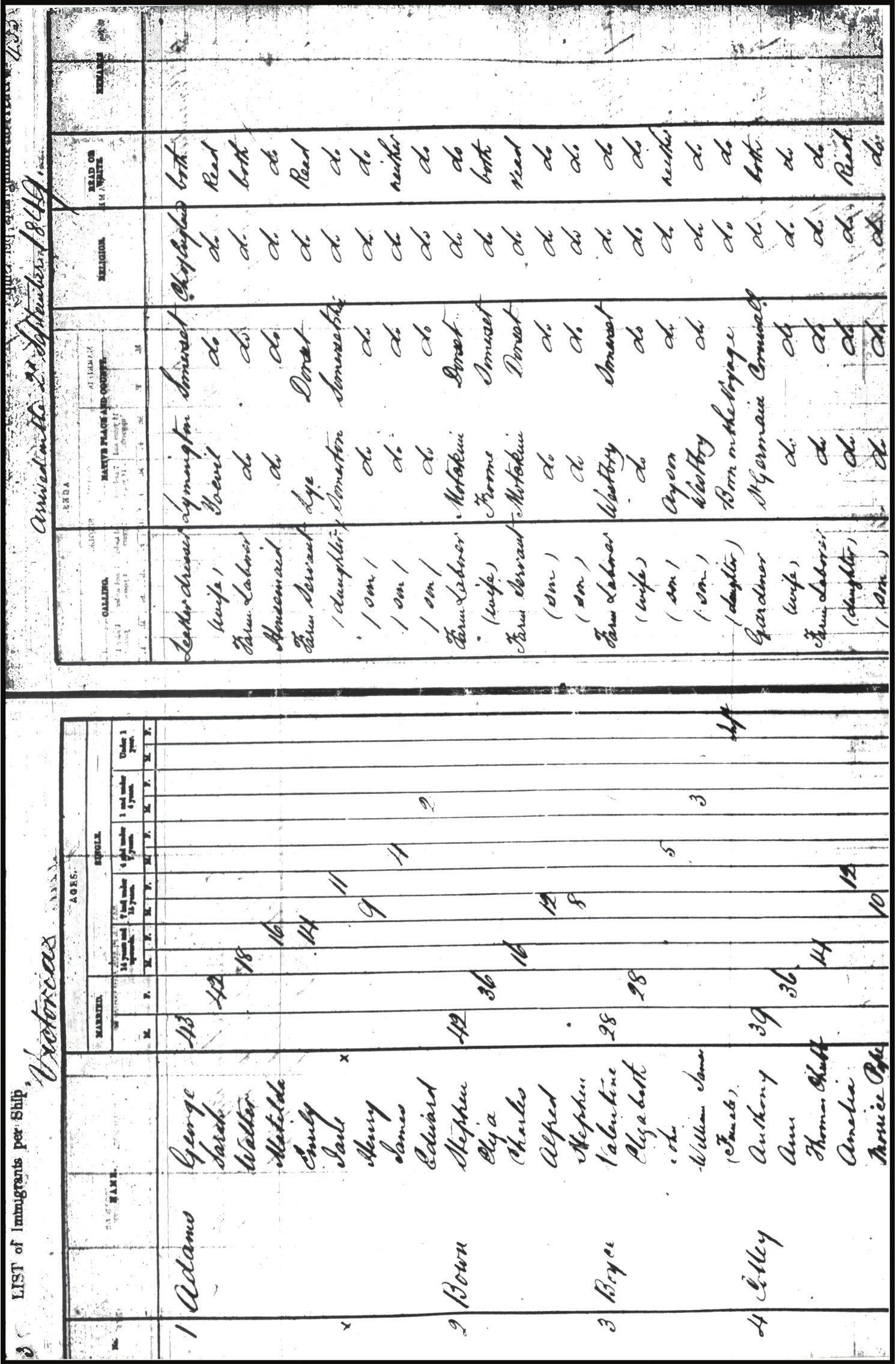
Extract from board list of the Victoria arrival of Adams Family in Australia
APPENDIX A2
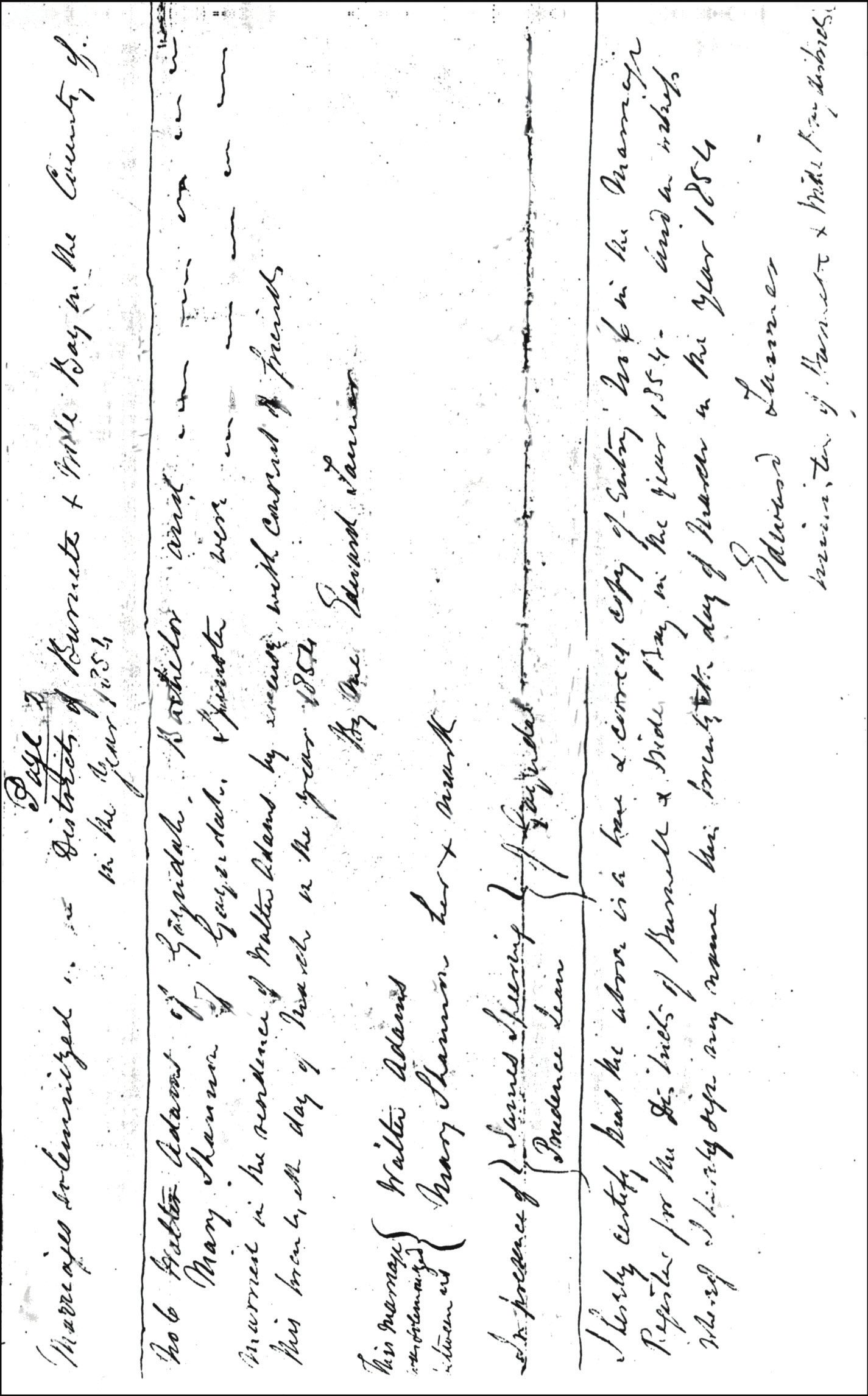
Copy of Walter Adams and Mary Shannon’s Marriage Certificate – Gayndah 1854
APPENDIX A3
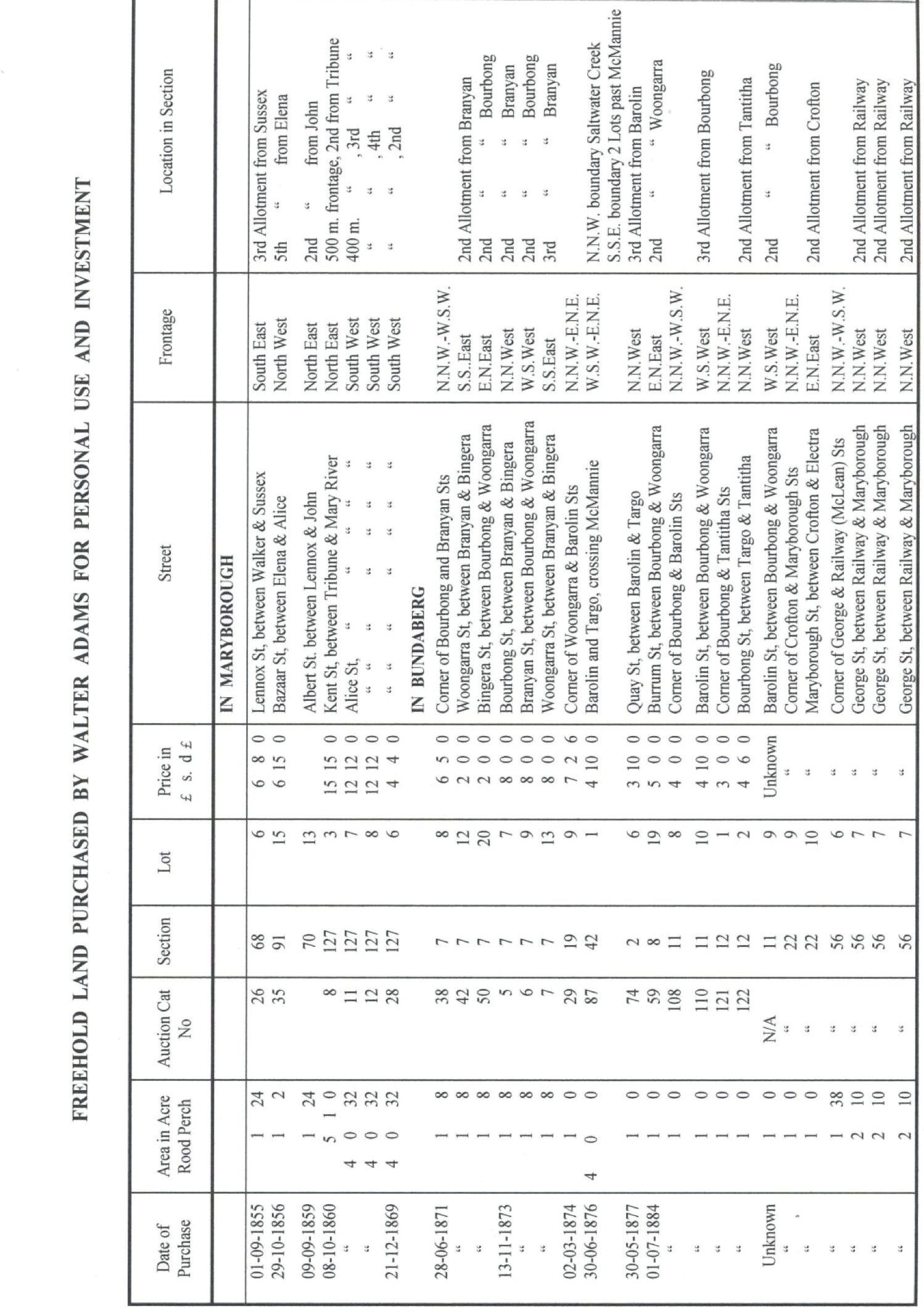
Freehold land purchased by Walter Adams for personal use and investment
APPENDIX A4
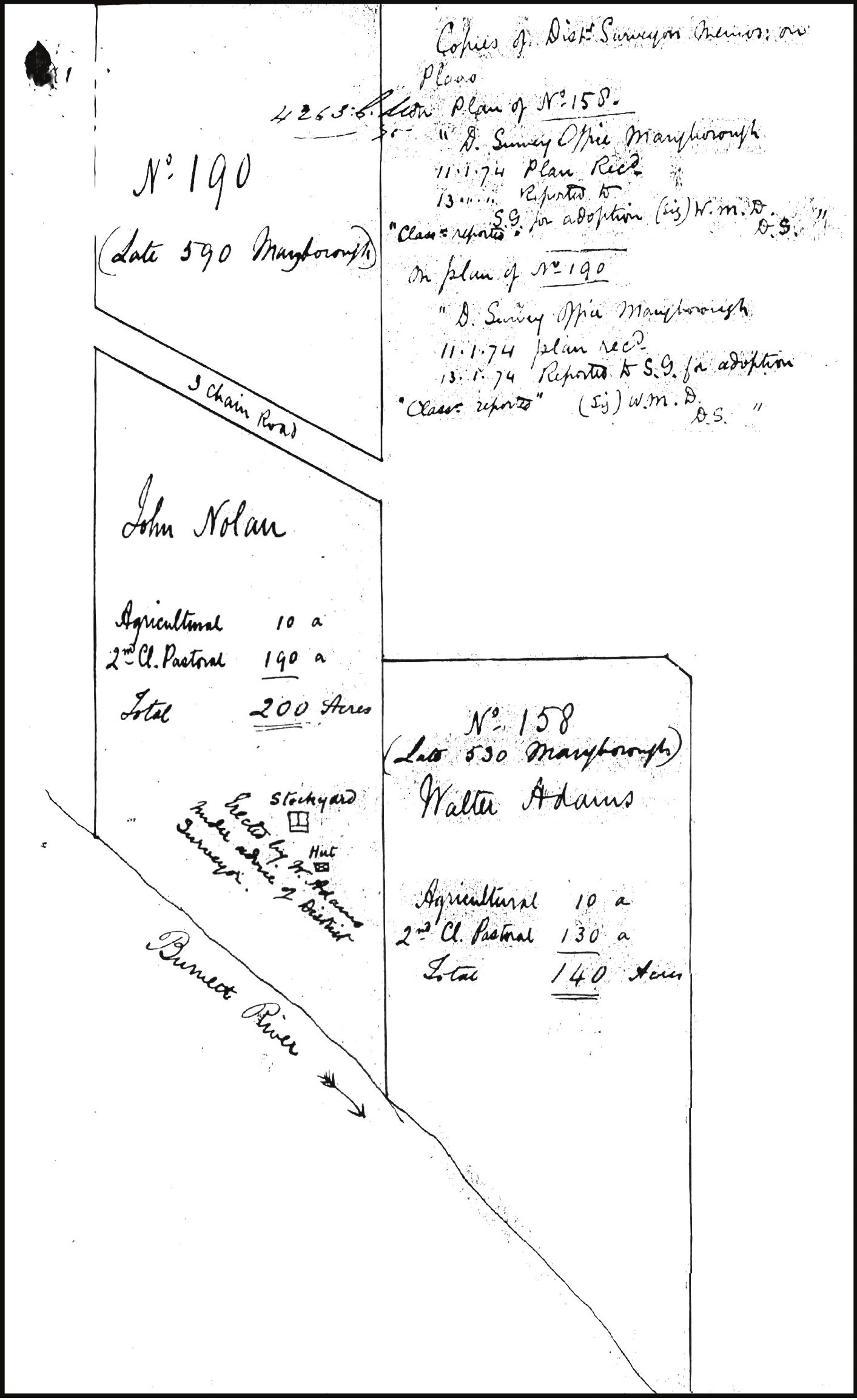
The Kolan Land – (More Detail)
APPENDIX A5
THE SUGAR PIONEER OF MARYBOROUGH
(As copied from Page 142 of the Wide Bay & Burnett Directory – 1887)
The honour or introducing sugar cane into the Wide Bay District is assigned by Mr. Walter Adams, M.L.A., himself an old planter, to Mr. E. J. Aldridge, as far back as 1860. It was in that year, states the hon. gentleman, that Mr. Aldridge made his first experiment. It is probable that this was the commencement of sugar culture in Queensland. The first crop saw the light at a place called Copenhagen near Maryborough, and it was used to feed cattle on as there was no machinery, not even Government machinery, in the whole of Queensland to “crush” it. The first Separation had just taken place, and Brisbane, with a population of not more than six thousand people, was as full of ardour with hopes of the future as Townsville is today. The North, by the way, is very much more advanced than was the country round Moreton Bay nearly thirty years ago. Mr. Adams who had then settled in the jungle near Maryborough, at a place known as Somerville, got some of the cane which grew luxuriantly. In the great flood of 1864, the stools of cane were first covered, the water subsequently rising to a height of four feet up the stalks. However the cane was none the worse for its two months drenching, and grew more vigorously than over. Then Mr. Adams communicated with a gentleman by the name of Sheridan, who held a position as Sub collector of Customs at Maryborough, and who had been in Mauritius, and knew all about it generally. Three sticks, from one stool, were forwarded for Mr. Sheridan’s inspection, the result being most satisfactory. The official declaration made from the official stool was in fact that the samples were finer than anything he had seen in the Mauritius. Then the cane advanced another stage, for the Sub collector sent it to the Courier. Probably the verdict of the leading paper in those big gooseberry days was equally encouraging, and a reader of that journal – a Mr Benke – took a journey to Maryborough, where he induced Messrs Gladwell and Greathead to start central mills, so that the farmers could grow cane. It is not cheering to these gentlemen, who have half theorised cane out of existence in Queensland, to know that before some of them were born the system of central mills was demonstrated to be a dead failure. The failure of the farmer of those days was owing to the same cause as the official failure of this generation lack of experience. The cane flourished, but the farmers did not know what to do with it when it was cut. Strange to say how history repeats itself our saccharine historian states that even then white men would not work on the cane, and that the farmers were actually importing South Sea boys at £10 to £12 per head. How has civilization developed since that time when, to day, with white men as inflexibly disposed as ever as to doing blanked blackfellows work, the cost of South Sea boys has gone up double, and the price of sugar has gone down a hundred per cent. Strange to say that sugar did not pay under those circumstances, nor did it pay in the times which people look back to now as the halcyon days of McIlwraith. It probably never will pay, but the planters continue, at any rate, to live on the loss. One thing is certain that our third industry, which has gone through all the trials and troubles that a malicious administration could accomplish against it, will live in the future, with a little strengthening reciprocity, and a thorough change of official handling, to be a bigger thing than we can dream about today.
APPENDIX A6a
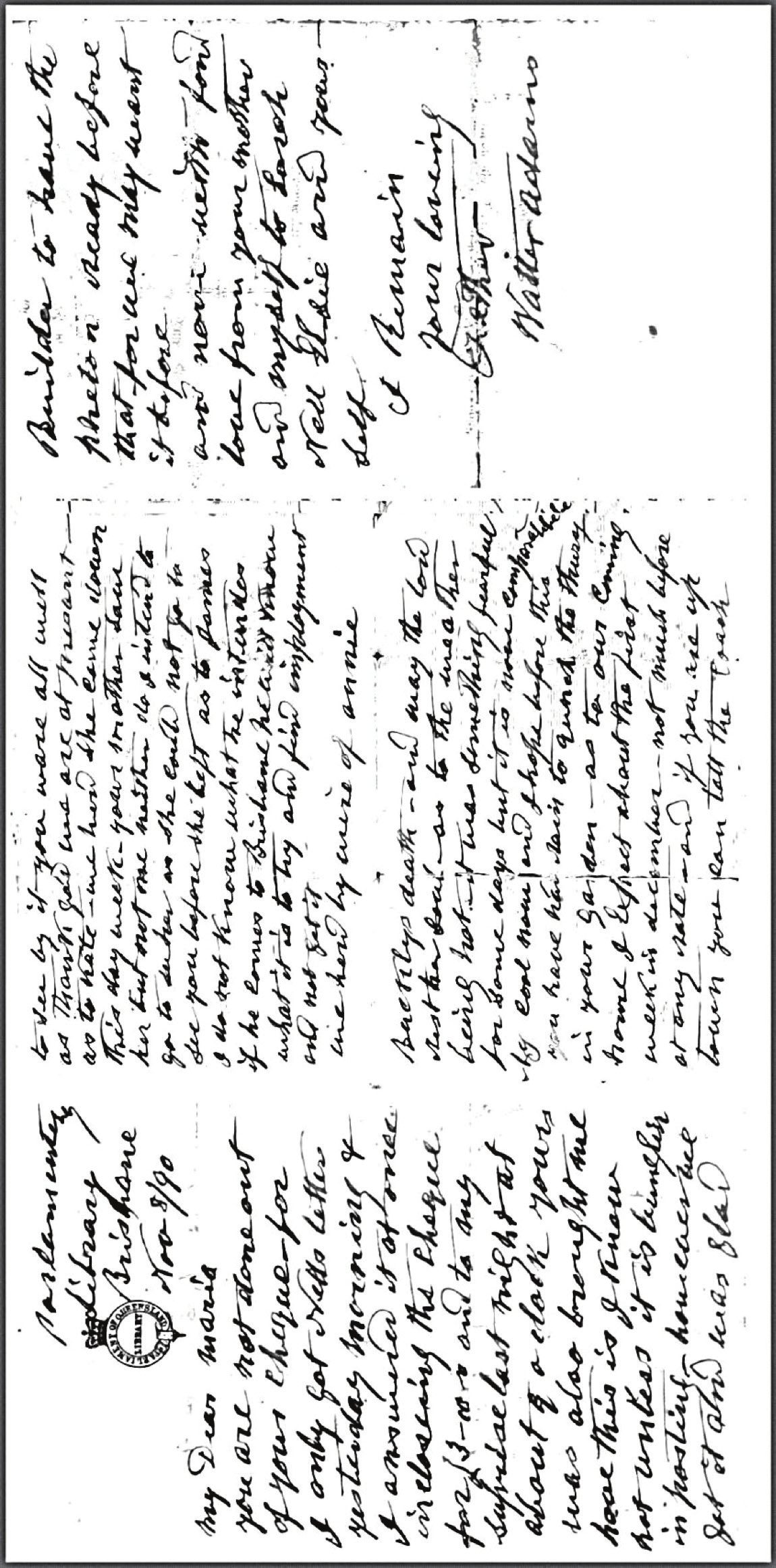
A Walter Adams letter
- Page 1
APPENDIX A6b
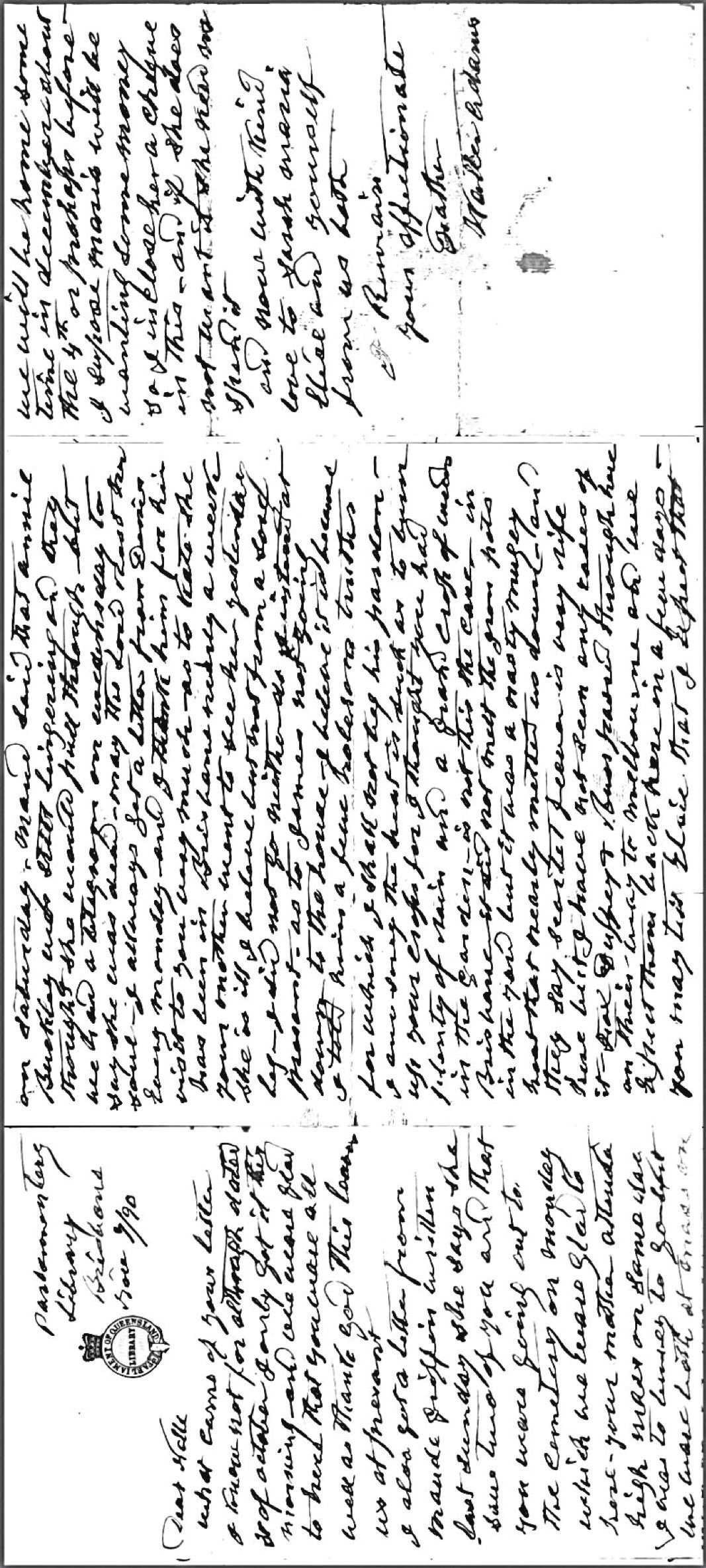
A Walter Adams letter – Page 2
APPENDIX A7a
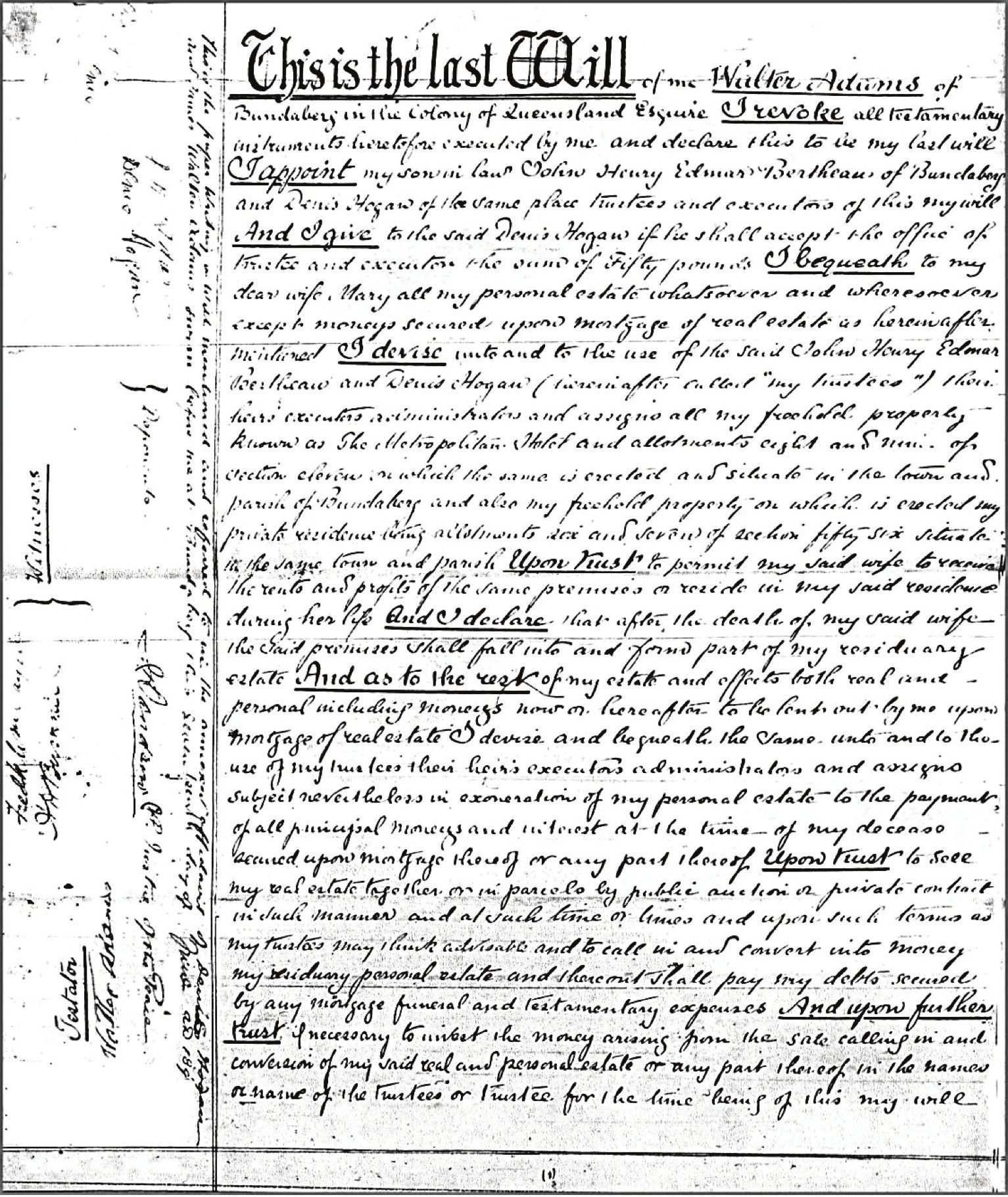
Last Will and Codicil of Walter Adams
- Page 1
APPENDIX A7b
Last Will and Codicil of Walter Adams – Page 2
APPENDIX A7c
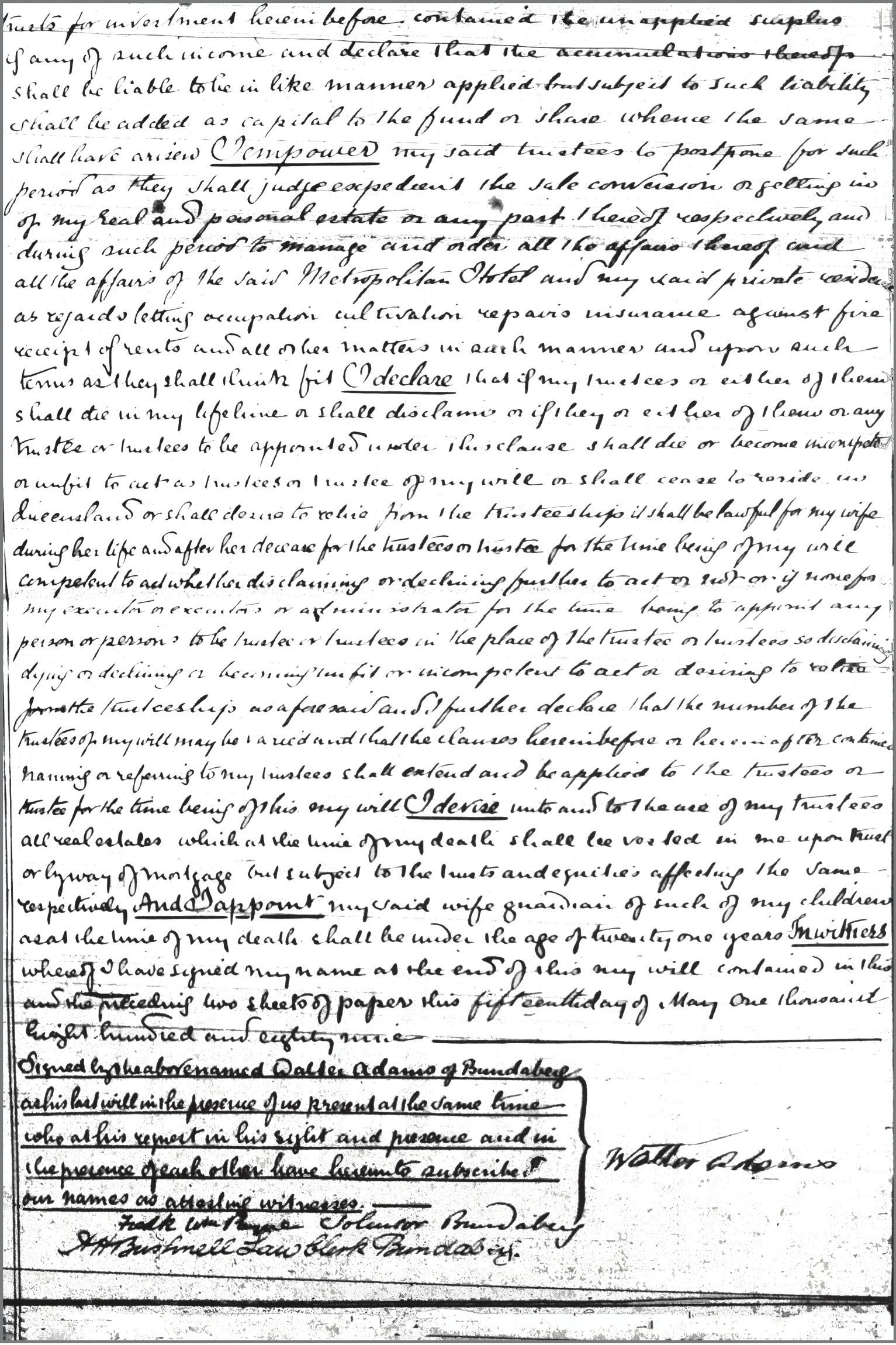
Last Will and Codicil of Walter Adams
- Page 3
APPENDIX A7d
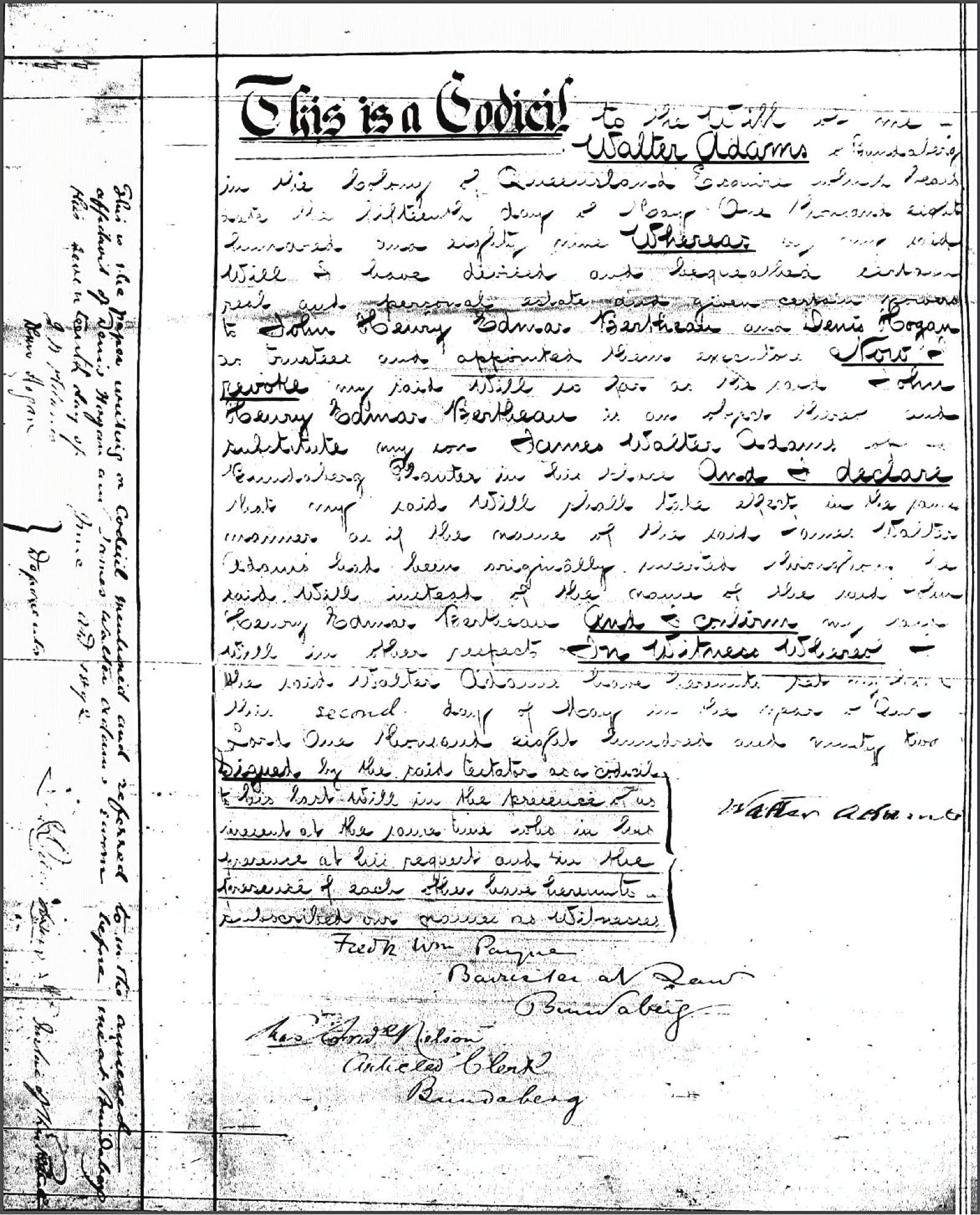
Codicil to Will of Walter Adams – Page 4
APPENDIX A8
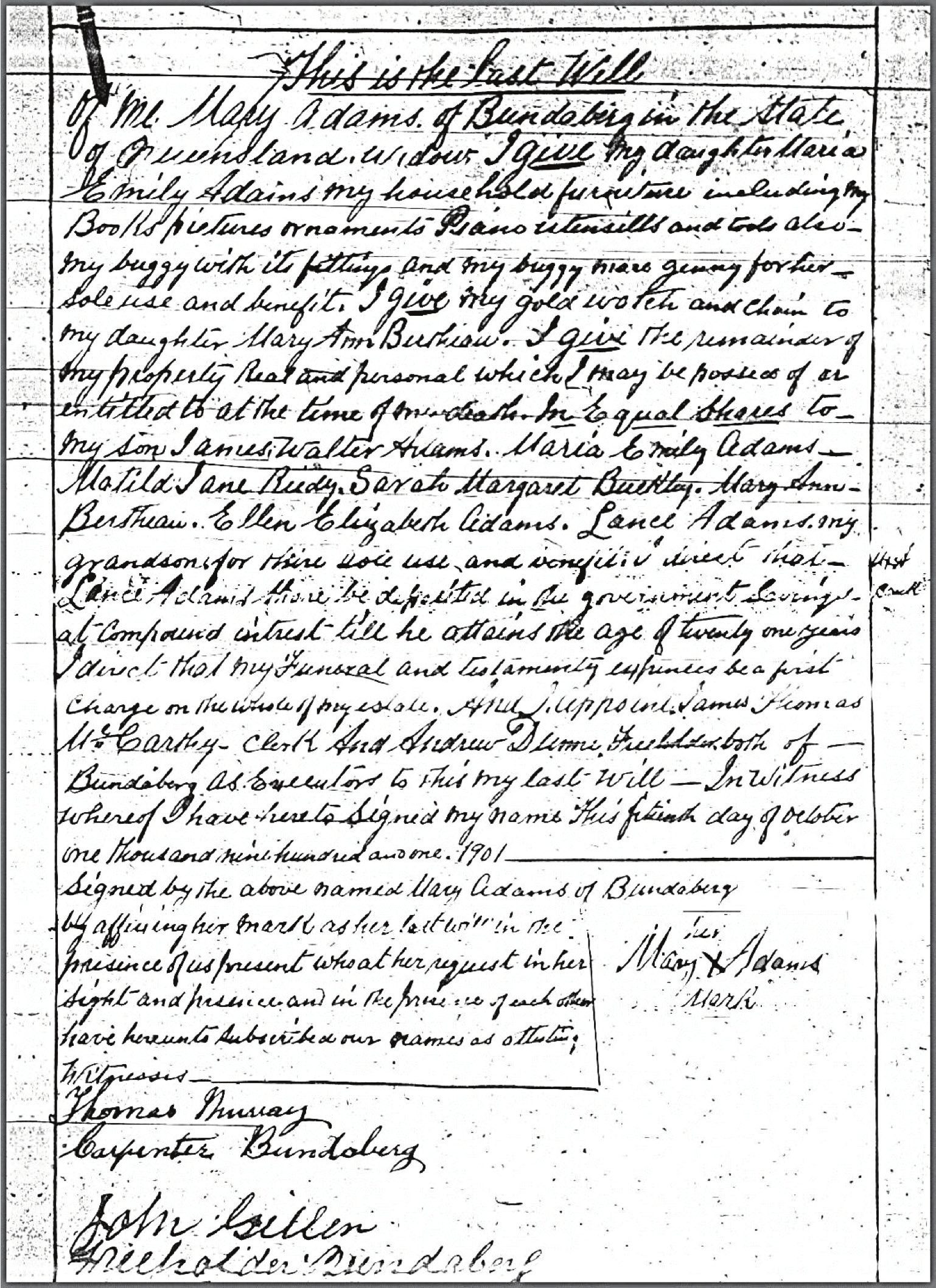
Last Will of Mary Adams
APPENDIX A9
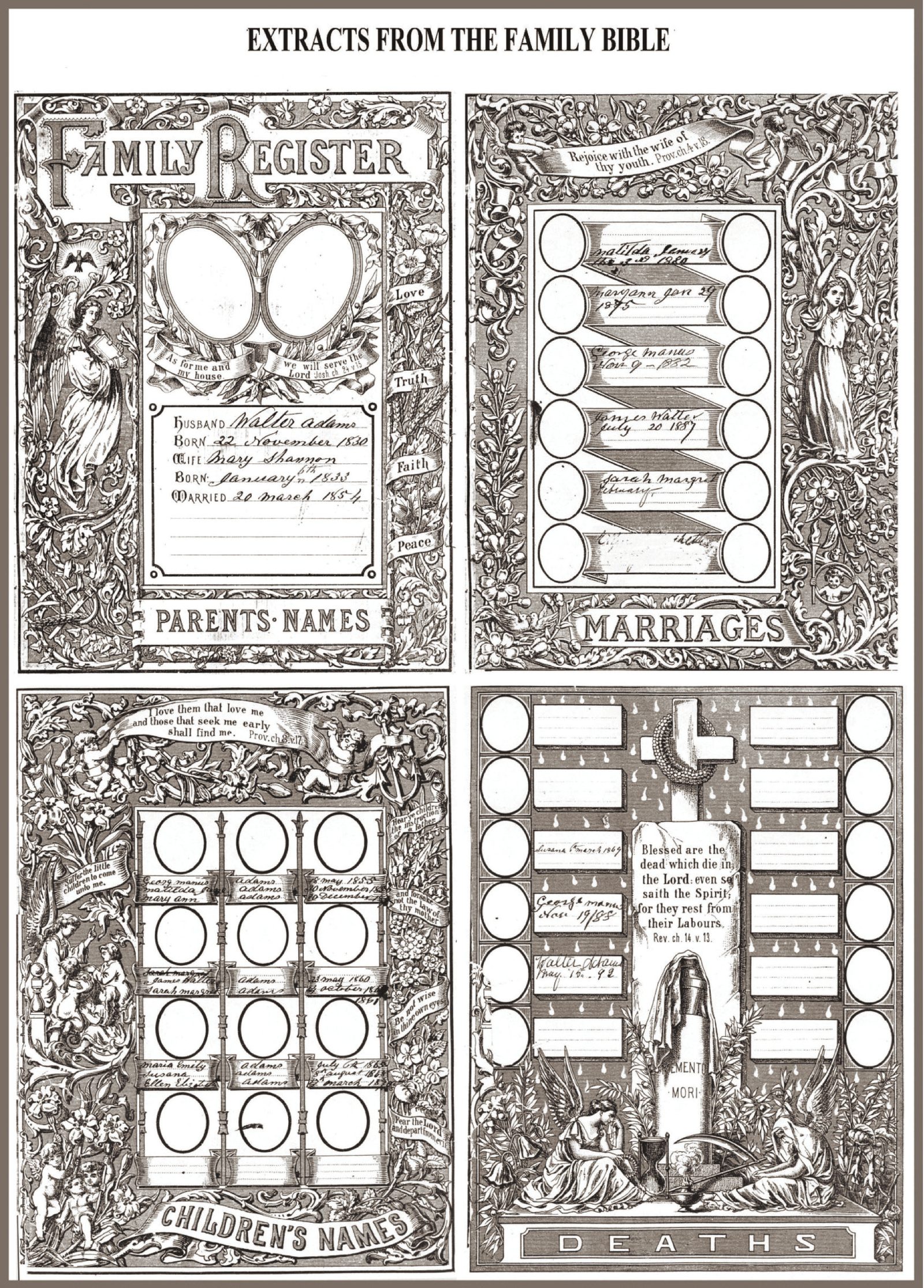
Pages from the Family Bible
APPENDIX A10a
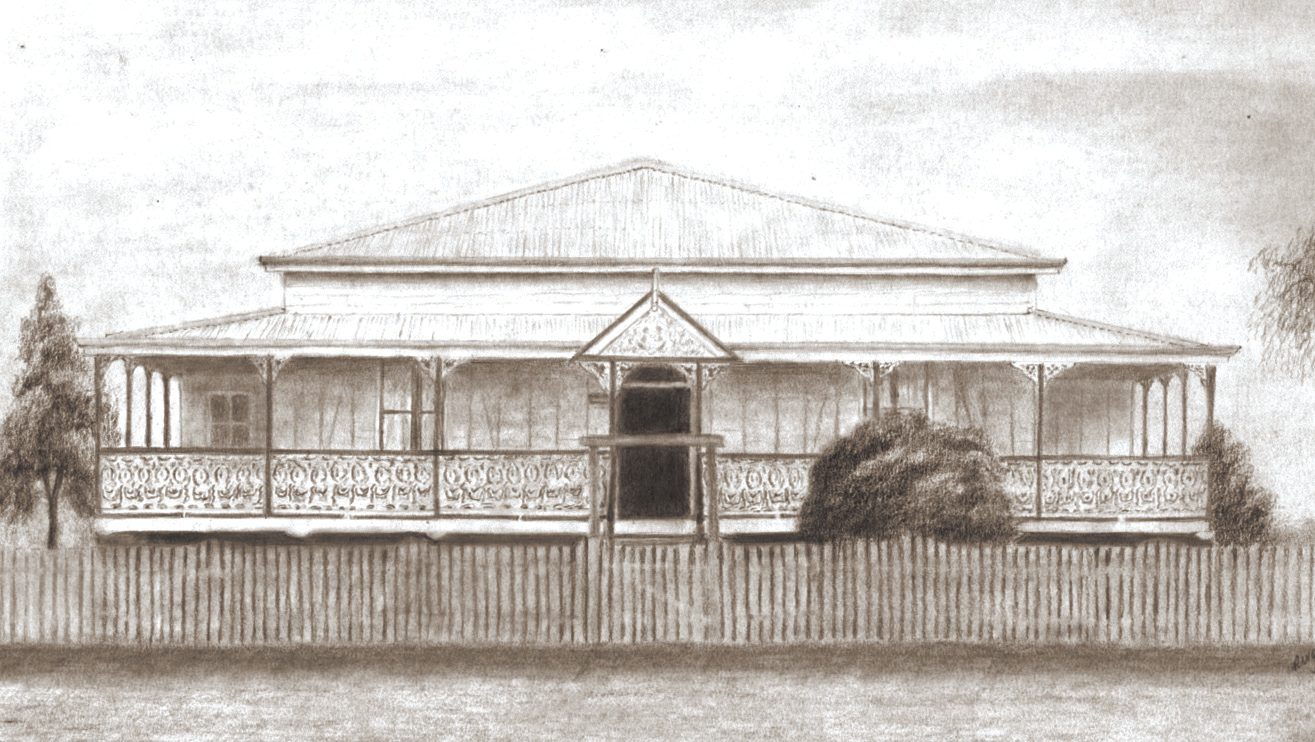
Walter and Mary’s home at 118 George Street .
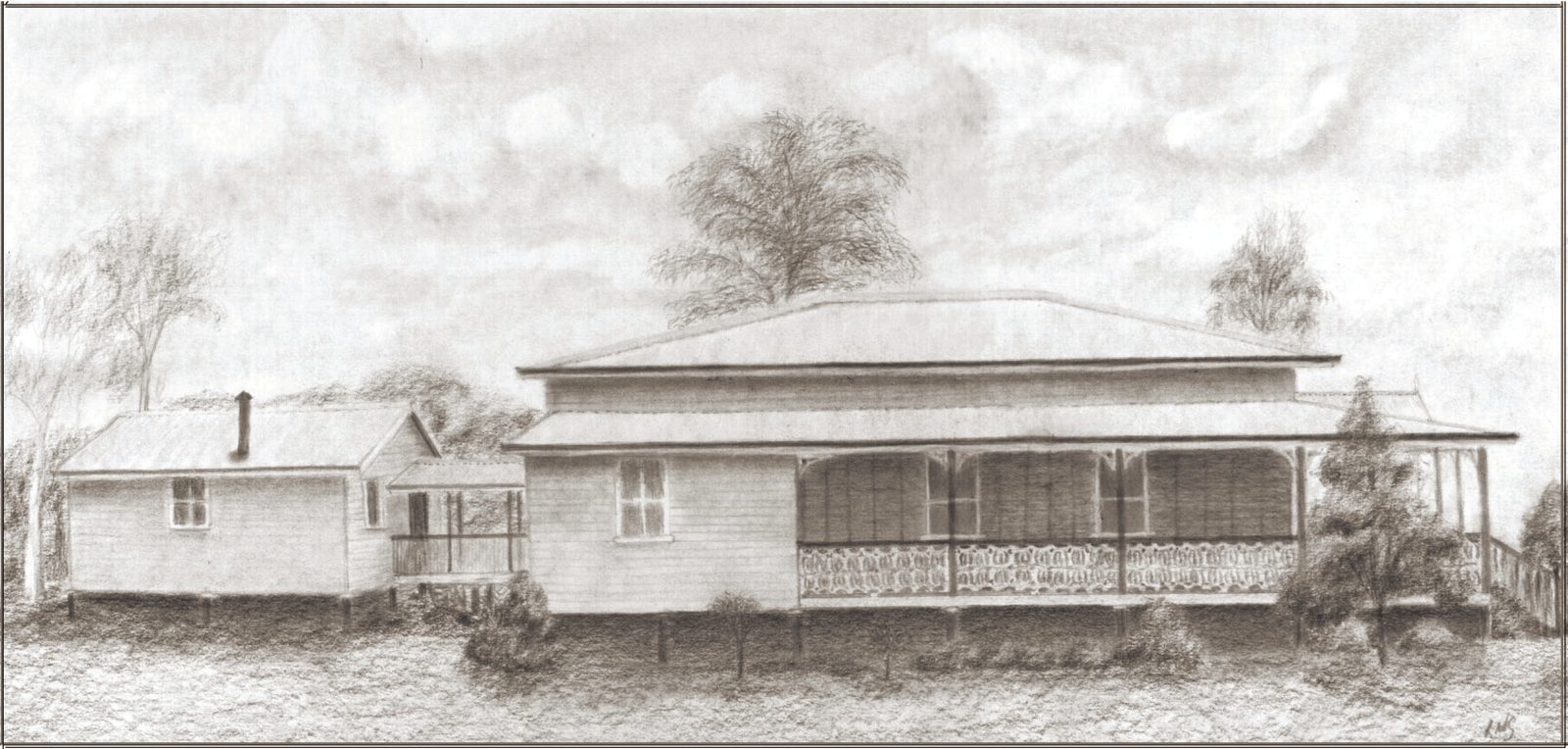
Drawings by Bundaberg artist Mr. Robert Gough
APPENDIX A10b
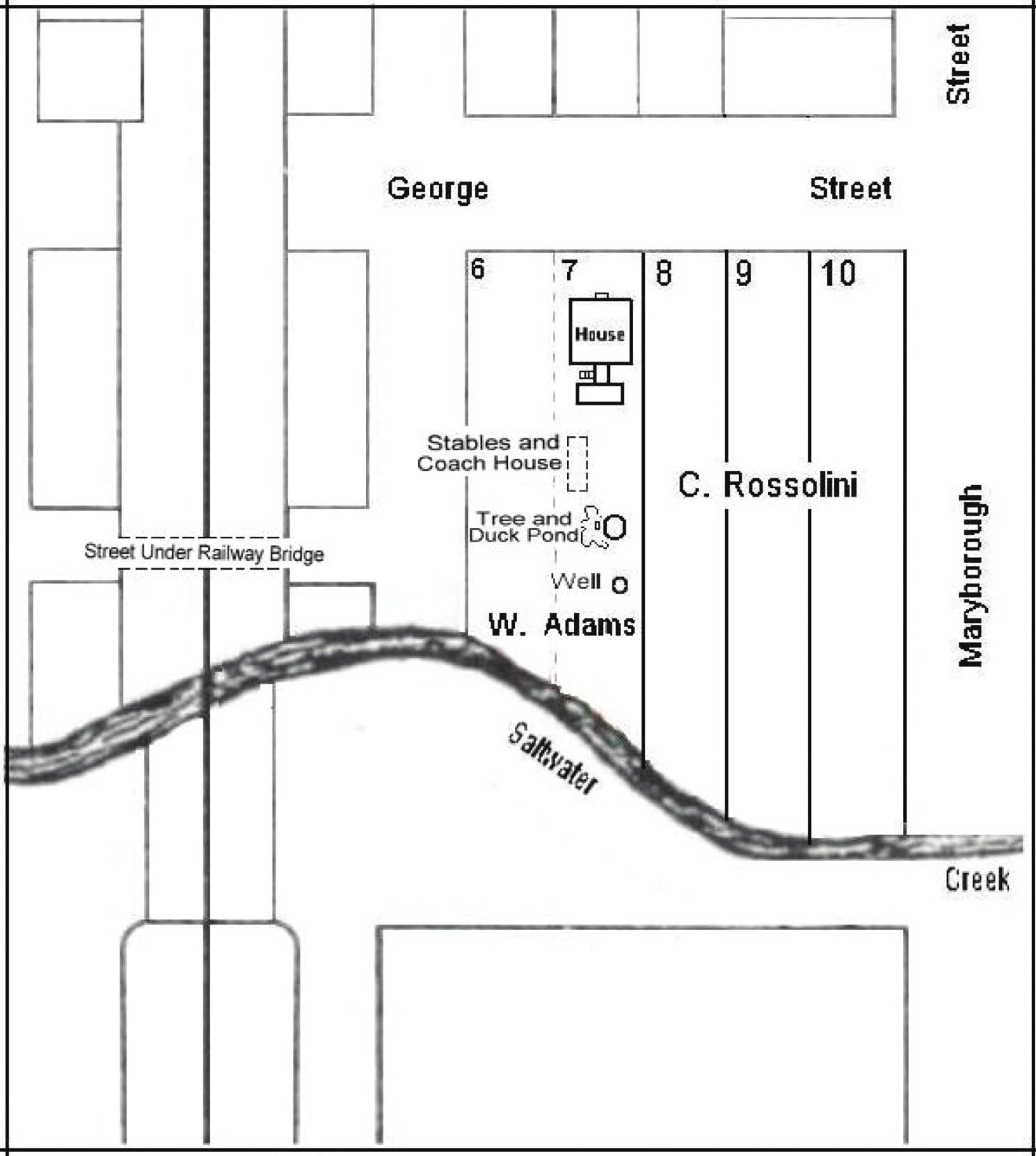
Plan showing property layout at Walter and Mary’s George Street residence
From personal knowledge combined with family description
APPENDIX A11
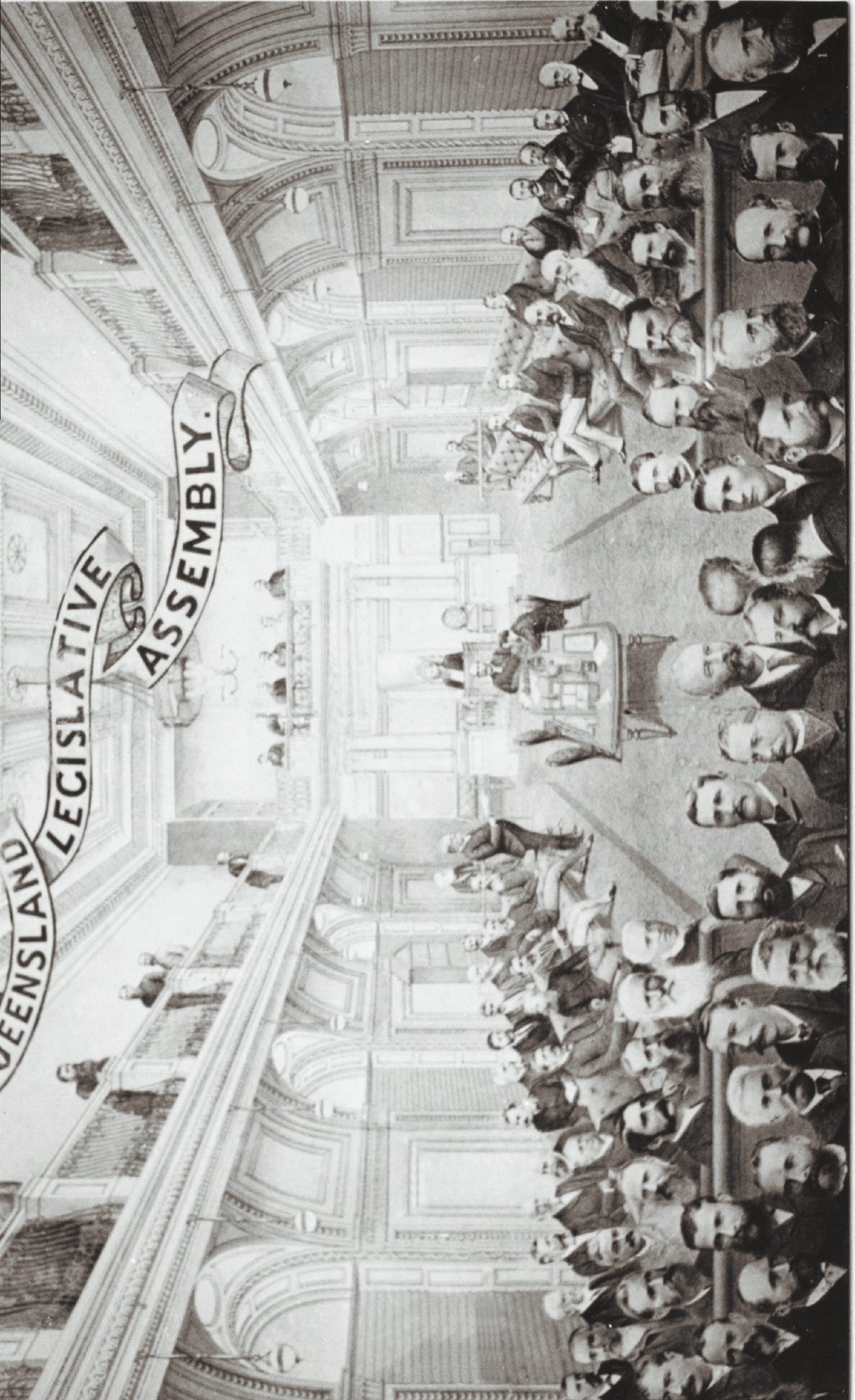
The Queensland Legislative Assembly
Walter is second from the left in the photograph’s left rear row
APPENDIX A12
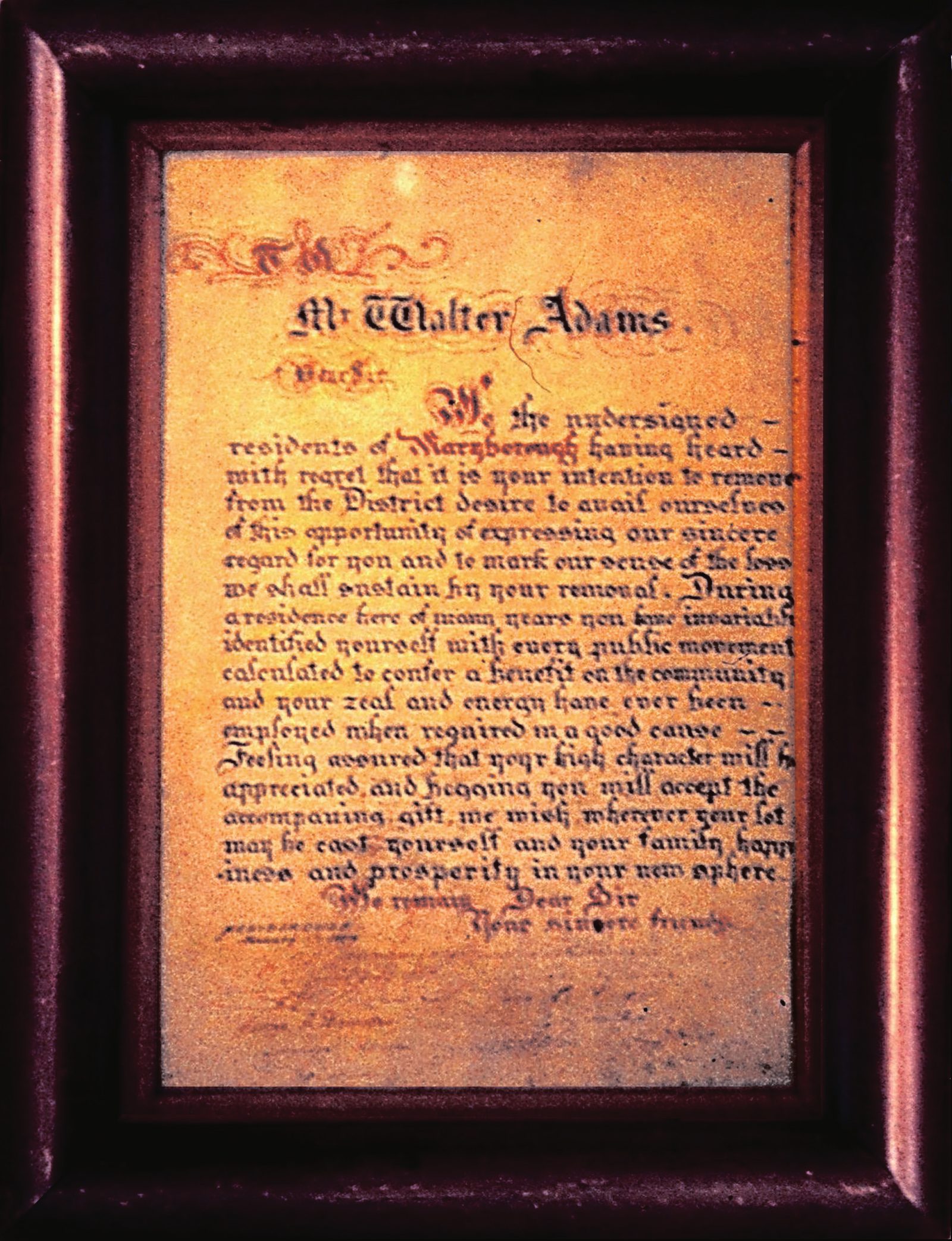
Illuminated Address – Presented on Walter’s departure from Maryborough
APPENDIX A13
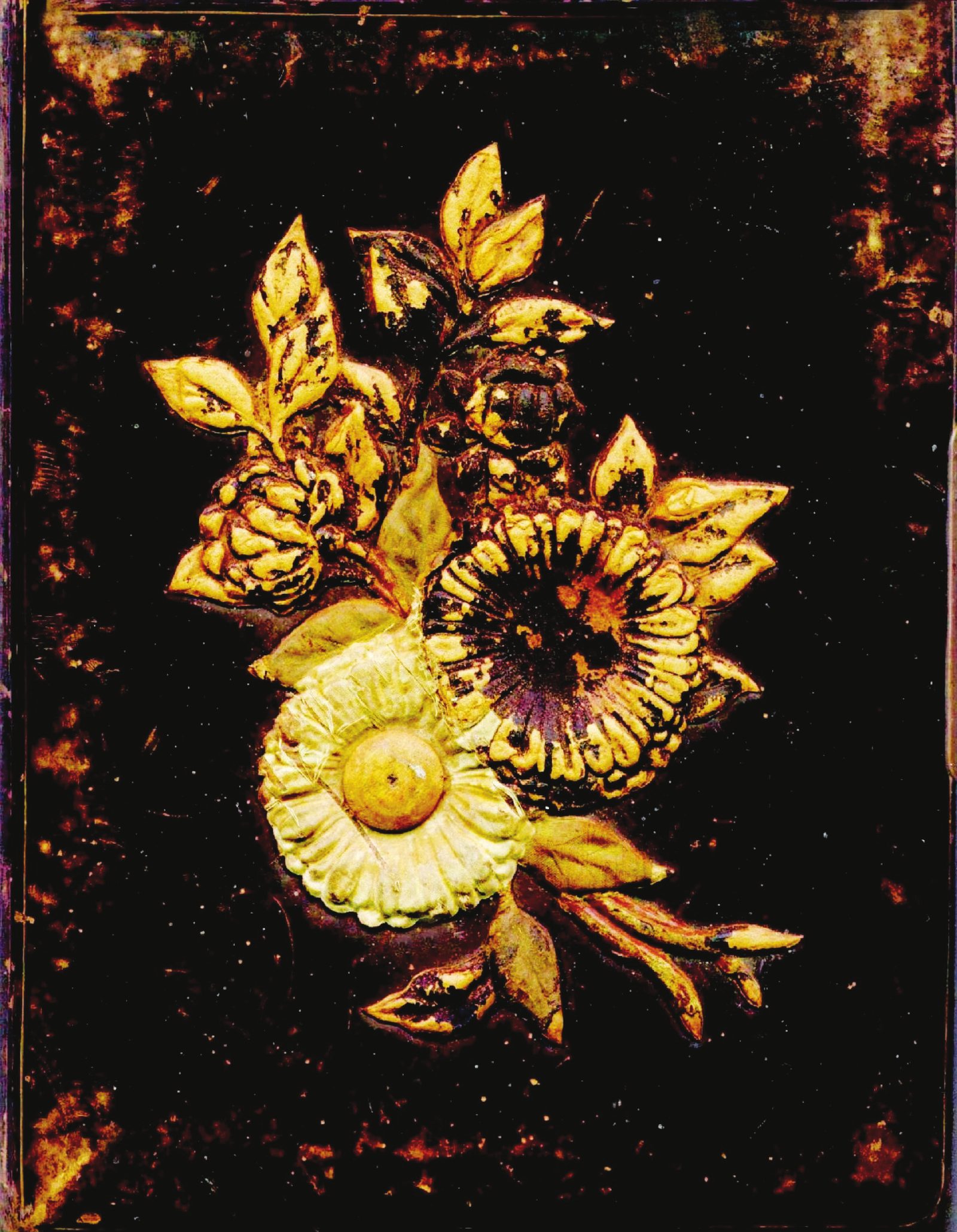
Cover of original family photograph album
APPENDIX A14a
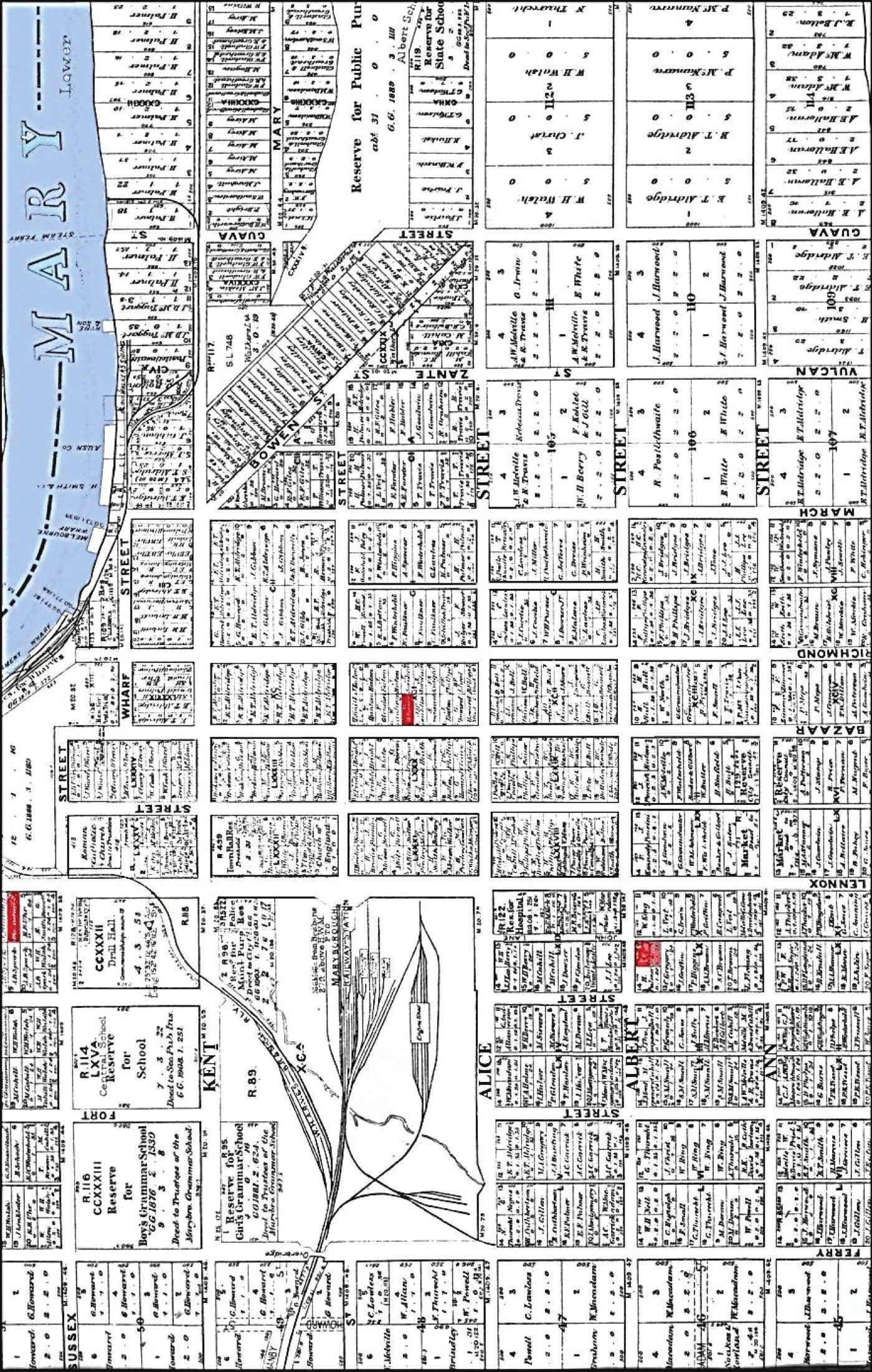
Walter’s land holdings in Maryborough township – Page 1
APPENDIX A14b
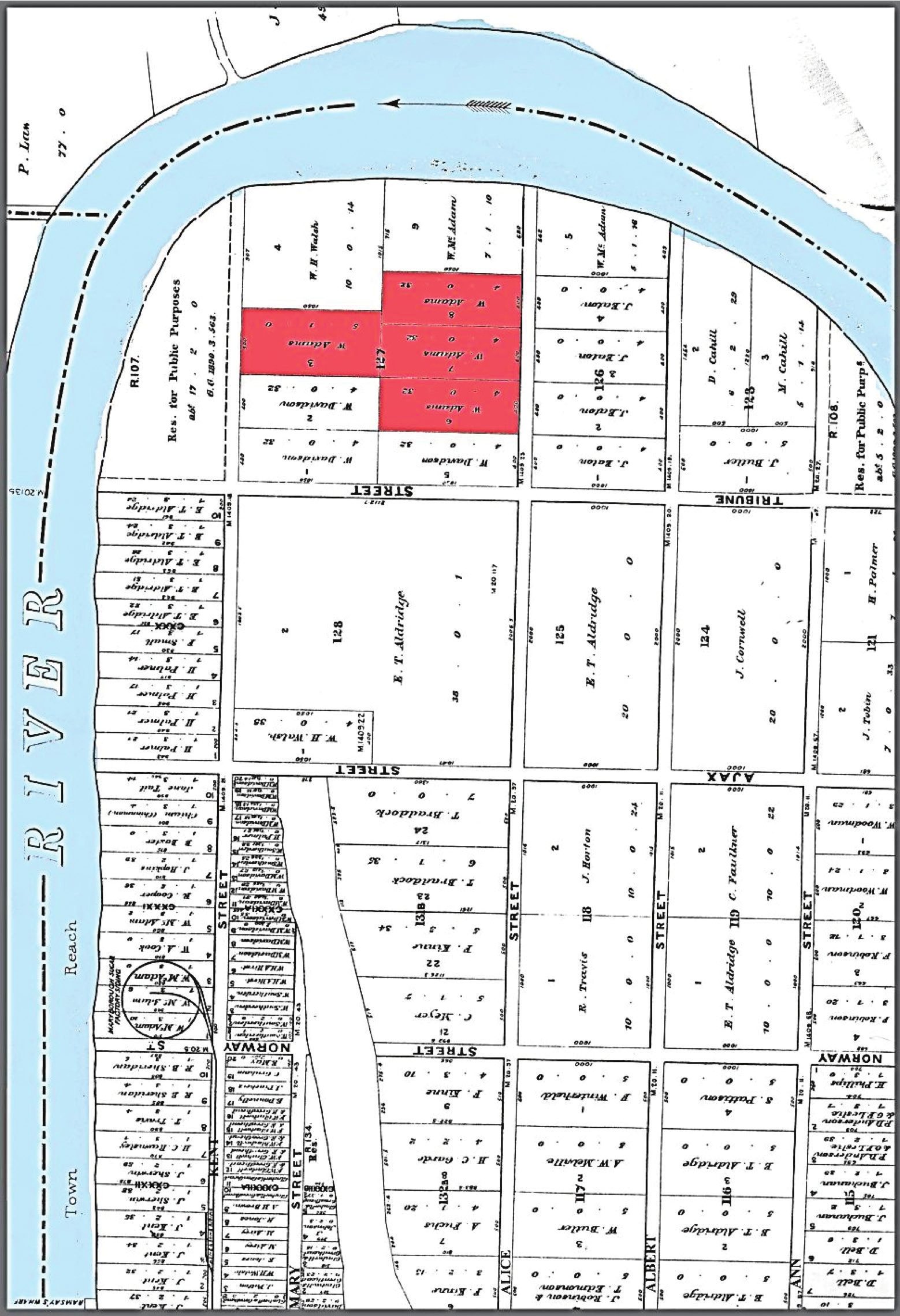
Walter’s land holdings in Maryborough district
- Page 2
APPENDIX A14c
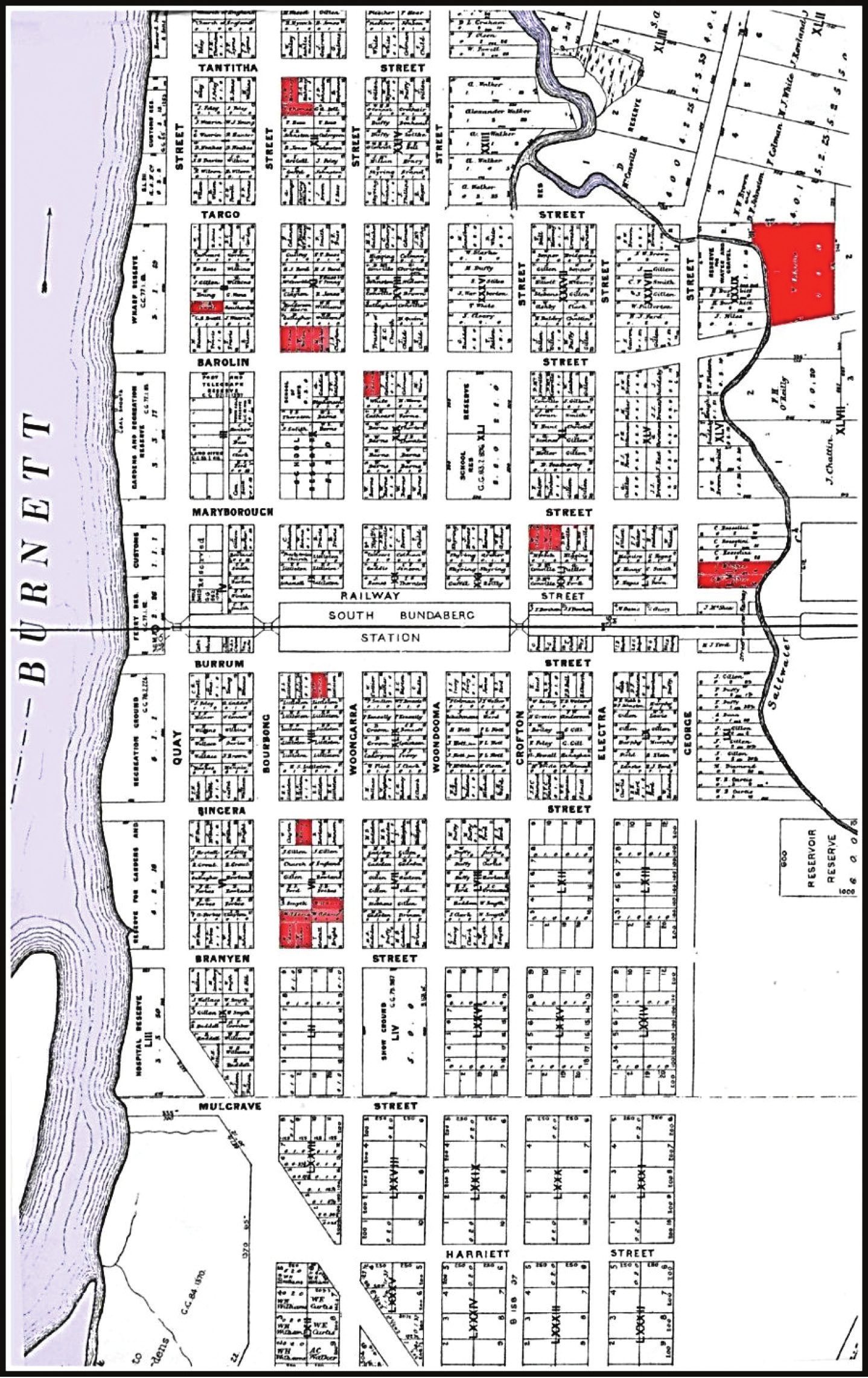
Walter’s land holdings in Bundaberg township – Page 3
APPENDIX A14d
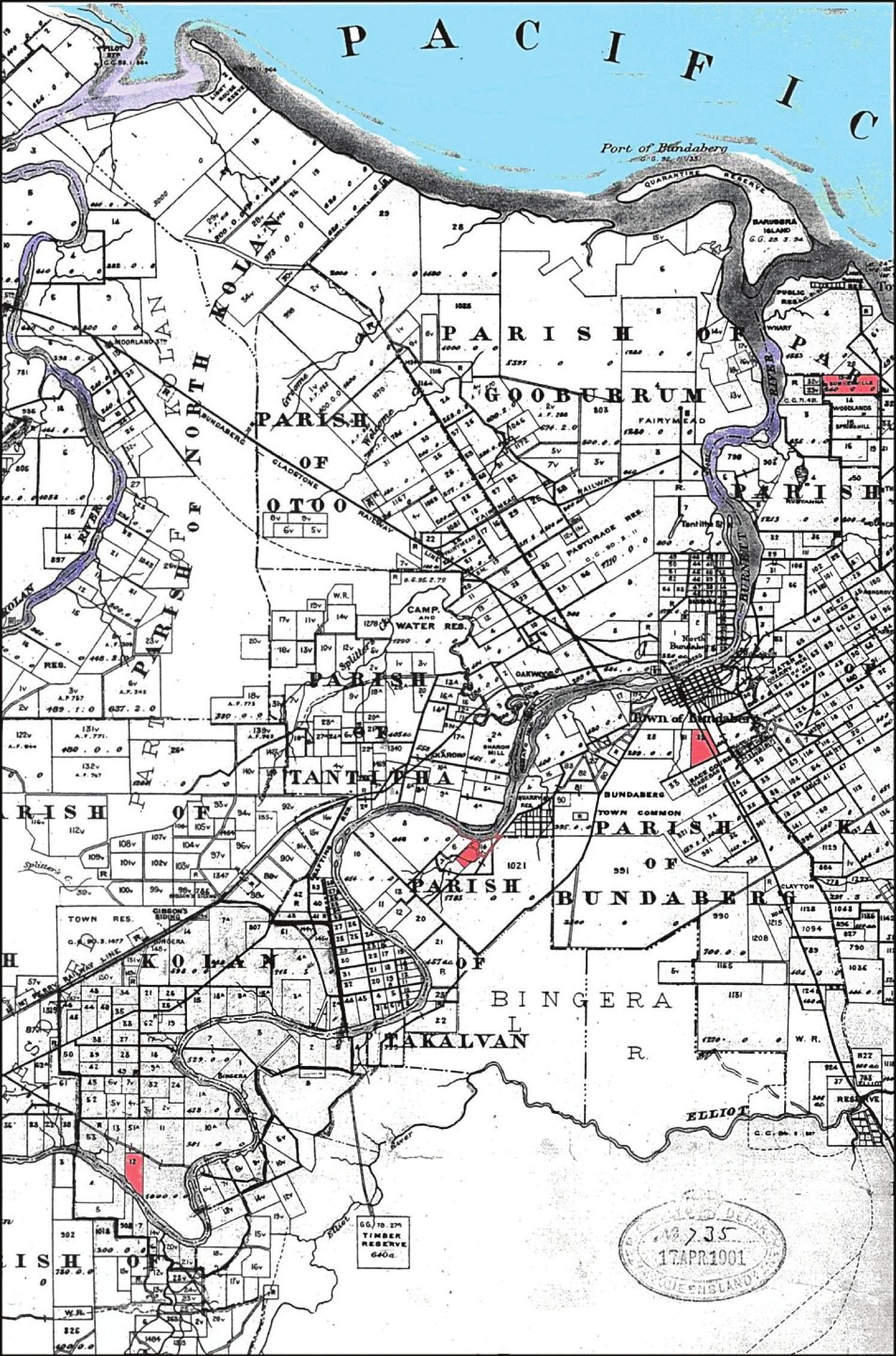
Walter’s land holdings in Bundaberg district
- Page 4
APPENDIX A15a
Some Surviving Books of the Typically (?) Victorian Adams’ Library .
| Gustavas Vassa The African | ||
| Published: | Published for and sold by the Author – Olaudah Equiano | |
| Publication: | Dublin 1791. Fourth Edition Enlarged. | |
| Subject: | Anti-African Slavery | |
| Refer: | English Parliament The Quakers, sold at the Dublin Chronicle Office | |
| – Price 4 (British) shillings | ||
| Subscribers: | In The Hundreds, Some notable subscribers were: | |
| H.R.H. The Prince of Wales | ||
| Rev. Thomas Clarkson | ||
| Captain John Clarkson R.N. | ||
| Inscriptions: | Eliza Drought “Ballze” | |
| Eliza Margaret Mitchell – Book January 27th 1813 | ||
| Eliza Drought “Ballze” | ||
| Book Munny | ||
| Esza Drought | ||
| (ii) | Title: | Menhardoc |
| Author: | G. Manville Fenn | |
| Published: 1885 | ||
| Subject: | Story of Cornish Men and Mines |
Munny Eliza Gother Mitc (From the William’s Family Library?)
APPENDIX A15b
| Authors: | Addison & Steele | |
| Publisher: | Suttaby, Evance & Fox & B & R Cosby, Stationers Court. | |
| Published: | 1812 | |
| Subject: | Current Events. | |
| Inscription: | M W Osborne. | |
| (iv) Title: | Cooking and Domestic Economy for Young Housewives | |
| Author: | H.S.C. ? | |
| Publisher: | William and Robert Chambers, London & Edinborough. | |
| Published: | 1874 - ( First Edition 1858 ) | |
| Subject: | Domestic Affairs | |
| Inscription: | Mifs S A Hall St Marcus School, Bolton | |
| (v) Title: | Photograph Album of English Scenes | |
| Inscription: | Charles Hedges - See Notes | |
| Owner’s Crest Swan’s Head/Neck with Motto”Spectemuragendo” | ||
| Illustrations: | At Branyan on the Burnett River on 20-06-1872. | |
| The Lodge At “Newnham” | ||
| Scenes of Shillingford, Benson Lock, Wallingford, | ||
| Eton College at Montsford Ferry, Monkey Island | ||
| Notes on Photograph Album: | ||
| (a) | Lease of the Branyan land was transferred to Walter on 10.07.1876. | |
| (b) | Walter’s daughter Ellen Elizabeth and son-in-law Richard Walter | |
| Adams later named their residence at 116 George Street, Bundaberg | ||
| “Newnham”. | ||
| (vii) Title: | The Ladies Guide - Illustrated | |
| Author: | Kellogg | |
| Published: 1895 | ||
| Subject : | Ladies’ Health and Domestic Affairs |
Corkham Lock, Cliefden, Windsor Castle,
APPENDIX A15c
| Author: | – | |
| Published: | – | |
| Subject: | Domestic Affairs | |
| (ix) Title: | The History of Ireland | |
| Author: | Martin Haverty | |
| Published: | By Author: | |
| Subject: | History | |
| (x) Title: | The Great Irish Struggle | |
| Author: | Thomas Power O’Connor M.P. & Robert McWade Esq. | |
| Published: | 1886 | |
| Subject: | History | |
| (xi) | Title: | History of the Catholic Church in Australia |
| Author: | Patrick Frances Cardinal Moran (Archbishop of Sydney) | |
| Published: | Circa 1890 | |
| Subject: | History - Religion | |
| (xii) Title: | The Aldine History of Queensland – Volume 1 of 2 | |
| Published: | 1888 | |
| Subject: History (xiii) Title: | ||
| The History of Bundaberg | ||
| Author: | J. Y. Walker | |
| Published: | 1890 | |
| Subject: History (xiv) Title: | ||
| Australia Illustrated – Volumes I & II | ||
| Author: | – | |
| Published: | Circa1880 |
Subject: Geography
APPENDIX A15d
| Author: | James D McCabe | |
| Published: | 1878 | |
| Subject: | Encyclopedic | |
| (xvi) Title: | New Italy-The Richmond District of NSW | |
| Author: | Fredrick Chudleigh Clifford | |
| Published: | 1889 | |
| Subject: | A brief sketch of a new and thriving colony. | |
| (xvii) Title: Author: Burke | Lingard’s School History of England | |
| Published: | 1854 | |
| Subject: | History | |
| (xviii) Title: | The Whole Works of the Right Honourable Duncan Forbes | |
| Author: | D Forbes | |
| Published: | Circa 1870 | |
| Subject: | Religion and philosophy | |
| (xix) Title: | Works of Alexander Pope Efq – Volumes vii, viii & ix | |
| Author: | Alexander Pope | |
| Publisher | Published for J & P Knapton in Ludgate St.,London | |
| Published: | 1751 | |
| Subject: | Being Volumes 1, 2 & 3 of his Letters. | |
| Added Crest: | By Original Owner - Shield with Phoenix And Three Lions | |
| Rampant | ||
| Inscriptions: | John Stevens Esq | |
| (xx) Title: | The Poetical Works of Lord Byron | |
| Author: | Lord Byron | |
| Published: | Circa1850 | |
| Subject: | Poetry |
APPENDIX A15e
| Author: Cowper | ||
|---|---|---|
| Published: | 1892 | |
| Subject : | Poetry | |
| (xxii) Title: Author: Moore | The Poetical Works of Thomas Moore | |
| Published : | – | |
| Subject : | Poetry | |
| (xxiii) Title: Author: Burns | The Complete Works of Robert Burns | |
| Publication: | – | |
| Subject : | Poetry | |
| (xxiv) Title: Author: Pindar Subject: Poetry (xxv) Title: | Odes of Pindar | |
| Elegant Extracts | ||
| Author: | Various | |
| Published: | 1808 | |
| Subject: | “Pieces of Useful and Entertaining Poetry for Young People” | |
| (xxvi) Title: | Bacon’s Essay Advancement of Learning Novem Organum | |
| Author: | Bacon | |
| Published: | Circa 1890 | |
| Subject: | Essays | |
| (xxvii) Title: | True Riches or Wealth Without Wings | |
| Author: | T. S. Arthur | |
| Published: | 1882 | |
| Subject: | Philosophical Considerations |
- (xxvii) Title:
- Three Men in a Boat
- Author:
- Jerome K Jerome
- Published:
- 1889
Subject: Autobiographical
APPENDIX A15f
APPENDIX A16
CONVERSION TABLE
- To Convert
- Multiply By
- Length
- inches into millimetres
- 25.4
- feet into metres
- 0.3048
- yards into metres
- 0.9144
- chains into metres
- 20.1168
- miles into kilometres
- 1.6093
- Weight
- pounds into kilograms
- 0.4536
- hundredweight into kilograms
- 50.8
- Volume and Capacity
- bushels into gallons
- 8
- gallons into litres
- 4.5461
- litres into cubic metres
- 0.0010
- Area
- acres into hectares
- 0.4047
- acres into square metres
- 4047.0
- roods into square metres
- 1012.0
- perches into square metres
- 25.3
- Currency
- pence into cents
- 0.8333
- shillings into cents
- 10
- pounds into dollars
- 2
APPENDIX A17
COMMODITY AND SERVICES COSTS IN 1892
Prices for items as advertised in the Bundaberg and Mount Perry Mail or in the Bundaberg Star in the Year 1892 .
| BUNDABERG LAND AND PROPERTY: | * Town allotments | |
|---|---|---|
| - South and West | 16 - 00 - 00 | |
| - East and North | 30 - 00 - 00 | |
| * Houses - cottages | 180 - 00 - 00 | |
| * “Villa” residence | 500 - 00 - 00 | |
| * Woongarra farms/acre | 3 - 00 - 00 | |
| FOOD: | * Flour/lb | 1.5d |
| * Bread/loaf | 3d | |
| * White sugar/lb | 2.5d | |
| * N Z cheese/lb | 8d | |
| * Prime mutton/lb | 4d | |
| * Prime onions/lb | 1d | |
| * Worcestershire sauce | 4d | |
| * English marmalade | 7d | |
| * English pickles | 7d | |
| * Soft drink | 3d | |
| * Soft drink | 3d | |
| TAILORMADE CLOTHES: | * Suits | 3 - 05 - 00 |
| * Coat & trousers | 2 - 10 - 00 | |
| * Trousers | 17 - 06 |
Continued over page
APPENDIX A17 cont.
| * Ladies’ shoes | 10 - 06 | |
| * " slippers | 4 - 06 | |
| * Men’s shoes | 15 - 06 | |
| * Hand-sewn boots | 1 - 04 - 06 | |
| STEAMER | FARES FROM BUNDABERG | |
| * to Brisbane - Saloon | 10 - 00 - 00 | |
| " " - Steerage | 15 - 00 | |
| * to Melbourne - Saloon | 15 - 15 - 00 | |
| " " - Steerage | 3 - 00 - 00 | |
| BRISBANE | * to London - Saloon | 50 - 00 - 00 |
| " " - Steerage | 18 - 00 - 00 | |
| " " - Return | 80 - 00 - 00 | |
| OTHER: | * Brass canopy bedstead | 10 - 00 - 00 |
| * Double wire mattress | 2 - 12 - 00 | |
| * Haircut | 6d | |
| * Shave | 3d | |
| * Cigar | 3d |
Imperial to Metric NOTE: In 1888 the average white annual wage in the Bundaberg sugar industry was approximately £75.
By comparison the Australian Bureau of Statistics reported that the average annual wage in Australia to May 1995 was $34,200, so that £1 in Bundaberg at the end of the nineteenth century had an equivalent purchasing power of approximately $460 at the end of the twentieth century.
APPENDIX A18
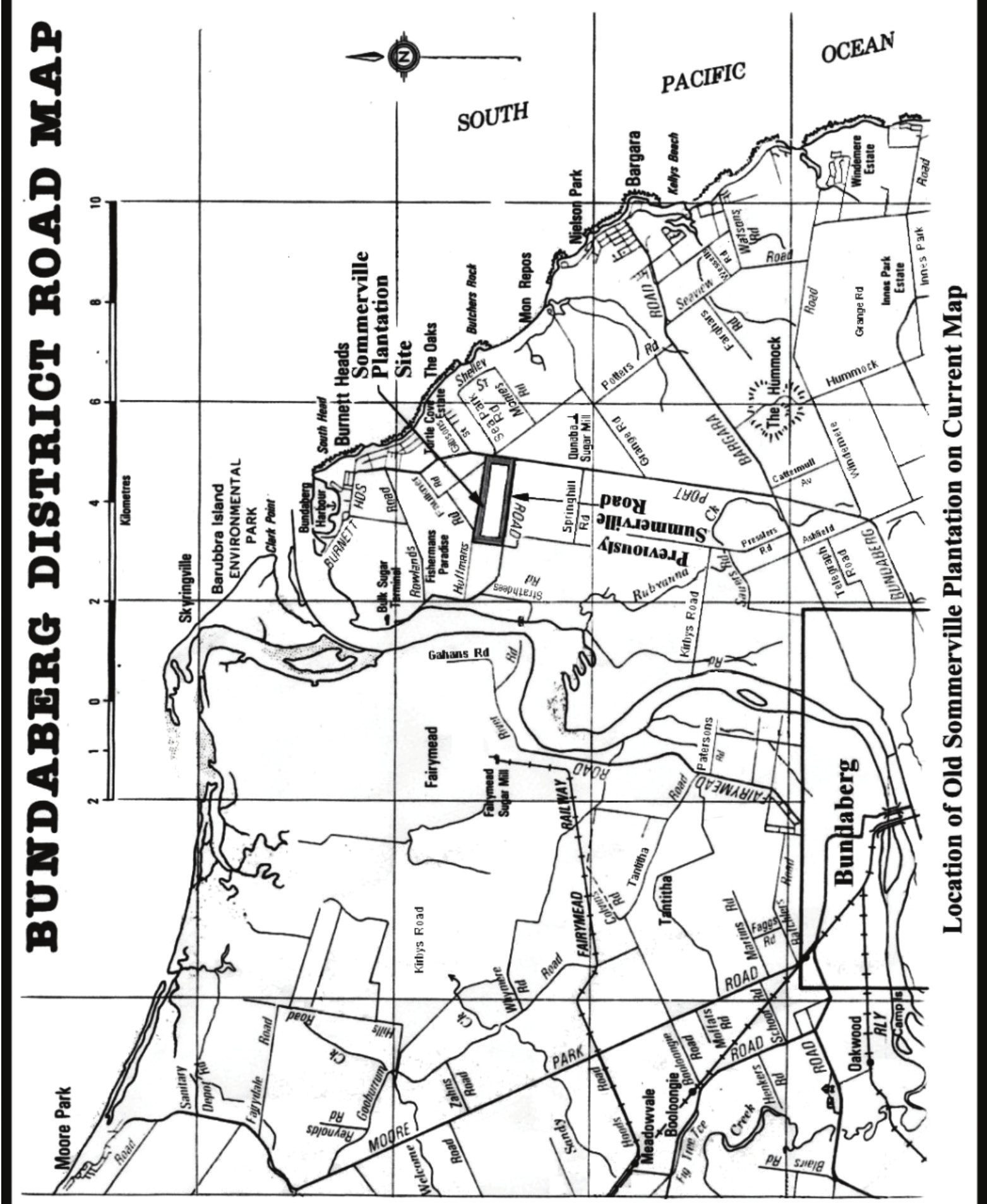
The location of Summerville Plantation
- superimposed on current road map