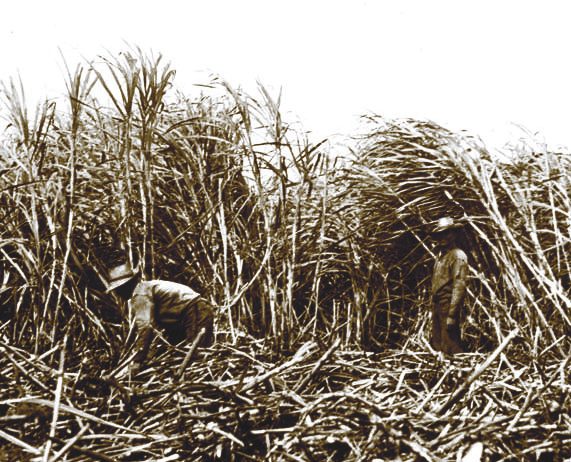
Part One The Early Bundaberg Pioneers and Their Plantations
Chapter 9
A Walk Through the Woongarra
The scrub has been felled, the tree stumps removed, the labourers have cleared the random basalt cobbles and boulders from the fields and formed them into dry stone walls on the boundaries of these fields; regular cultivation is established. The year is 1887 and it is time to take a relaxed stroll through the now cultivated Woongarra Scrub land with a contemporary reporter. Here we will become conversant with the opinions of some of the early settlers as we start on.
The purpose of including the following article is to present, as far as possible at this remote time, the words and thoughts of the plain speaking planters, two of whom – Mr. Noakes and Mr. Faulkner – were immediate/ close neighbours to Walter Adams’ Sommerville and had migrated from Maryborough to the Woongarra at the same time as Walter. The article is an extract from the Wide Bay & Burnett Directory of 1887 :
In the same way that there are Italians who have never heard of Como and Maggiore there are Queenslanders who are ignorant of the existence of the Woongarra, and who are specially commended, therefore, to leave no line of what follows unread. People who swelter themselves at Brisbane, with the ozone, or rather mud stink of Sandgate as the one and only alternative, would not believe that a tolerably correct reproduction of Paradise was available two days journey from the red hot streets of the half-baked metropolis. It is in fact the garden of the Burnett; a little strip of coast hemmed in on the other side by the river and covered from one end to the other with the richest vegetation a semi-tropical clime can produce. There are some score or so of plantations, in the Woongarra, which are at present enjoying the richest season that has ever came on them – and when (it) is said in the Woongarra it means something. Just as you pass out thence from Bundaberg you pass Millaquin, the great refinery that has pretty well refined the district to twenty times its former value, and all of the crushing mills in the district are connected by piping with the big mill.
The main road soon brings you through a mass of bright green sugar cane ready for cutting, which forms part of Mr. Christiansen’s plantation. Then comes Messrs. Olsen and Grother who have a plant that turns out 4 tons per day and which is now crushing the cane of Mr. J. I. Walker, of the Poplars. At this plantation there are 50 acres of cane and 20 of corn, the work on which is done by five hands. “My experience of white hands” says Mr. Walker “is not satisfactory. They want constant watching, while the Kanakas are conscientious and do not want looking after every hour in the day”. Passing one or two German plantations, a little Lutheran church on the right and the Kalkie state school on the left, the Duncraggan Mill, at the bottom of a gentle descent, is next arrived at. This plantation, with the crushing plant, is the property of Messrs. Cran Bros. and Co., also of Lindah and The Island, near Maryborough. There are 1,000 acres of cane under crop, and there are 120 Kanakas employed, with 12 or 14 white men. The same tale is told of the crop - “Best we ever had - from 2 tons to 2½ tons to the acre.” The residence of the managing partner is round the corner, and on the way thither, Mr. Dredge’s plantation, Sunbury farm, is passed. There is sugar and maize alike here, as one crop is necessary to alternate with the other. The Government, which knows nothing of crops except from a penal point of view, has decreed that Kanakas must not touch maize even though it is grown for their own consumption. There are only 3 black men on Sunbury, and when their time is up they will go, and none will come to replace them, because of the maize. Attempts have been made to get further labour but they have failed and now the place will have to trust to the tender mercies of the very stray labourer who, with £1 a week and his board, will probably do about half as much as one of the black fellows will do now. Surely if farmers must put up with the refuse of the labour market they should not pay for it at more than its value.
Rosewood farm comes next, belonging to Mr. Neilson. Only one white man and a black one were discovered here and they have 30 acres of cane to supervise. Following up the road leading to the coast, Mr. Marthei, the owner of 50 acres, is met. He is a corn grower and another compulsory employer of white labour, and finds the 15 shillings per week they get for their precarious services rather an overcharge when contrasted with the 10 shillings that the boys cost.
In a little white cottage resides the Mr. Cran aforementioned, who is supervising the finishing of a crushing mill on the ground to connect with Millaquin, that will cost about £20,000. The wages paid to the black men are about one half that paid to the white, the latter being £80 weekly, the number of white men being nearly one fourth that of the Kanakas. Were the latter taken away the others would also have to shift camp. Mr. Cran, in conversation, stated that he had never seen a white man to work more than four days in the field, and his experience lasted some years. “Such experience would make you gray headed in a week,” said he. He spoke very doubtfully of the future of the industry if the boys were taken away, and said it would have a tendency to paralyse all speculation in that direction. The firm at present employs 300 boys altogether, and no complaints had ever been made at any time. As far as boys’ rations were concerned they were unlimited, and it was a matter of much wonder to visitors how such large quantities of tucker were absorbed by such slender specimens of humanity. Their state on being landed from the islands was also suggestive of the belief that a square meal must have been a special festival to them there. As for protracted hours - both white and coloured men worked the same, 10 per diem - from 7 a.m. till 6 p.m. with an hour for dinner at noon. Cases of illness, Mr. Cran added, were very rare.
A little way further up was the Grange, where the Rev. E. Tanner, who was the pioneer of Anglicanism in Maryborough 35 years ago [and who officiated at the marriage of Walter and Mary in Gayndah in 1854. R. L. C.], now resides. There are 80 Kanakas and 6 white men – 5 more than he would have if he could, he added. Even with all willingness and steadiness - rare qualities to find in the sundowner - the work of the field was utterly unfitted for them. Mr. Davidson’s house is just beyond, and the owner was discovered working with his boys on a portion of cleared land. One fourth of his crop had been crushed and sent down, and he was waiting for the rest to go. Mr. Noakes, who resided at the next plantation [and who relocated from Maryborough with neighbours Mr. C. Faulkiner and Mr. Walter Adams and selected land in the Woongarra in 1872 – R. L. C.] , was the lucky man who happened to be sending (cane) juice down, and after we had inspected the land generally he gave me a short account of his experiences there. He is a plain, quiet man who spoke without reference to politics on any side, and as an unvarnished tale, it may be taken as emblematic of many others. “I came here,” said he “in ‘73 (1873) and started on corn, which was then fetching from 3 shillings to 3 shillings & 6 pence per bushel. Things were by no means overpayable at this rate, especially when it is remembered that the scrub was exceedingly heavy and cost not less than £10 per acre to clear. Just as the first troubles were over, maize fell to 1 shilling & 6 pence, and most of the farmers were soon more or less hard up. I have sold to Mr. Boston, the butcher, a four-bushel bag of maize for 4 shillings. That was not 1 shilling a bushel as the bag had to be thrown in. There were a couple of white men employed at 10 shillings per week, and three or four Kanakas. In 1882, just before sugar was introduced, maize was up to 2 shillings, 6 pence and most of the growers were on their beam-ends. I have offered this property of 160 acres for (sale at) £750 about that time, and failed to get a buyer at all. I am glad I did not sell as it is worth £50 an acre to me to-day - that is provided my labour is untouched. I should value the estate as being worth not less than £1000 now. This change was brought about by the cultivation of sugar in the district. We have paid away a liability which rested on the estate at the rate of £2000 a year since that time, and instead of two white men at 10 shillings we can employ five at wages ranging from £1 to 30 shillings. The 58 Kanakas get £16 to £18 per year, and under present circumstances and with the magnificent harvest, sugar is undoubtedly paying now. Such is my confidence in my boys,” said Mr. Noakes, “that I can leave them all day long without supervision, knowing well that the work will not suffer in my absence, and I know that in case of sudden emergency they will work till late at night without a murmur. Of course I make that up to them at other times.”
A walk to the boys quarters and to the cook house was convincing enough that the food was in every respect as good as that we had partaken of at the house. The bread was all the same baking. Later on in the evening Mr. Noakes detailed some of his harrowing experiences whilst in quest of a horse driver. And he gave vent to a most emphatic opinion on the class of immigrants that the colony is regularly afflicted with, that deserve echoing in the (Legislative) Assembly or in the office of the Agent-General.
“The first man that came,” said he “worked one week for £1 and then cleared (out) without saying good bye or anything. I don’t despise my own skin, and I would try as I did to get someone to stick to his job but it was no good. I don’t believe that some of the men that came had ever seen a horse before they came to Australia. Last year I had 50 acres burnt down and gave a contract for making cane holes at 2 shillings & 6 pence per hundred to two men, one of whom had done such work before. After that nine men came along and asked for work, and I put them on the same job, finding mattocks and other things. Although some of them were making 7 shillings per day, as one of them admitted, within a week of their coming on, six out of the nine men walked off, stating that they could not make wages. The other two stopped on some weeks afterwards.”
Mr. Noakes further stated that the land was taken up for 10 shillings per acre, under the Act of 1868, one of the best that had ever been passed, and under which he put 10 shillings of improvements on the land. The price of tip-top land before sugar started was £5 - one could buy all he wanted for that price. The land which now forms the site of a butcher shop at Bundaberg was sold for £50 which is now worth £1,000. He was offered an allotment close to the church for a draft horse. That allotment is now worth £300 or £400.
Amongst other things, the speaker stated that some of his boys had been with him upwards of ten years and that during the last four or five years he had employed from 50 to 60 boys. Only one case of insubordination had yet occurred amongst his men … .
In speaking of discipline, I asked if there were any punishments and I was informed that there was one form which has hitherto proved abundantly effective. That was to make a boy work by himself, something that caused him to be made fun of by his mates, a thing which no properly constituted Kanaka can put up with. A very few hours of such punishment will bring an offender to reason.
MON REPOS . One of the handsomest plantations in the Woongarra district, owned by Mr. Barton, one of the best known planters south of Mackay. The plantation is a model one, and in point of general comfort the Kanakas are as well looked after as any similar number of labouring men in the colony. In fact, so far from there being the slightest signs of ill treatment visible Mr. Barton spoke to the boys as he would have talked to so many children, asking them about their troubles and ready to have a joke with any of them. The boys were in splendid condition, fat, healthy and good tempered from a long course of helping themselves ad lib. The bread was the same as that made for the house, and the dwellings were made by the lads themselves, except the main building where the single boys were accommodated. The married ones looked comfortable enough in their little humpies, built of white bark, looking taut and weather tight, and extensively fumigated with the smoke that can only get out the door.
Mon Repos has 60 Kanakas at present, of whom 40 are about to leave for home, leaving only 20 to get in a crop of some 250 acres – a task that would be impossible with that number of white labourers. It is not due to official negligence that more men are not to hand, as the ‘Young Dick’, which had a large number on board for Mon Repos, has lately came to grief en route. As it is it may be two or three months before assistance arrives. There are 6 white men employed as plough men and overseers, whose food is cooked in the house for them. Asked what was his experience, of white men, Mr. Barton said, “I never have many here as there are so many outlets that they can, and do, take advantage of which give them much greater inducements than I can offer them. Men do not come to this country except to benefit themselves. I have never had the slightest trouble with my boys – I have never had a boy in goal and I have never lifted my hand to one. They are the only reliable labour we have at present.”
A gentleman holding a high position in connection with a bank, having its headquarters in Sydney, was a visitor at Mon Repos when I called there. He stated very emphatically that the people of Brisbane could not be aware that the withdrawal of labour from the planters would largely tend to ruin the trade of the metropolis. “Anyone can see,” said he, “that most of the timber mills and many of the principal houses depend on the sugar industry more or less directly, and if the smash were to be allowed to take place the results would be deplorable and far greater than appears to be imagined just now.” He spoke as one who had travelled in America, the land of protection, in which he had lived cheaper than in Sydney or London, and prophesied that that state of things must sooner or later rule in a young colony like this. In Sydney there was going on revulsion of feeling, the consequence of what already was that some large woolen manufactories were already springing up there, the outlay on which was very large. “As an instance of free trade he added that some of the best woollen manufacturers in Glasgow had gone to Paris and started manufactories there, protected by the duty imposed in France. He strongly eulogized the financial condition of Maryborough which he said was one of the most healthy towns in the colony. “But if they take away the sugar industry it will ruin everything,” added he. “I am astonished that the people of Brisbane cannot see that, if the sugar industry is ruined, Brisbane must suffer very severely. It will affect the colony so materially that a lot of the people must shut up shop. An enormous amount of money will be withdrawn from circulation and this must affect Brisbane especially. It would in fact be like stopping one of the arteries of the body. Queensland cannot compete with us in maize; it won’t pay here to any great extent. On the Hawkesbury we get 160 bushels to the acre, and the best land in this colony does not grow more than 50 or 60 bushels. The fact is, it is a sugar growing country and it is impossible to fight against nature.” From his experience of plantations he was satisfied that it was absolutely impossible to work them with white labour. “The black men generally,” he added, “seem to be well looked after by the doctor, which is more than I can say for many communities of white men I have seen.” Referring to the financial position of the planters, he stated that as soon as it was definitely known that the labour was to be stopped, all the banks holding mortgages on the plantations would at once proceed to foreclose, as it would be only wasting time to wait longer.
THE BRIGHTON OF BUNDABERG. It was not more than half-an-hour’s ride from Mon Repos to a repose of another kind - to a cottage by the sea where the wants of man and beast are considered, catered, and charged for. There is a splendid beach in front of the house, and the delicious sense of relief that I experienced as I had a dip in the breakers at the end of an exhausting ride on a sultry day was something to be devoutly thankful for. It was three months since I had strayed so far, and there had come upon the place a change decidedly for the better. It was very much more comfortable, had a far better table than before, and on the hill overlooking the beach was divers gymnastic apparatus that were new to me. There was also a bath house that wanted no key to unlock or stray sixpence for the unnecessary and verbose attendant. I found subsequently that the house had changed hands, as the new proprietor did not come in till dark, bringing with him a large iron target that is destined for the Defence Force to shoot at, and which is to be stuck somewhere close handy. The house, with one or two others, is all that is tangible of Barolin township, but on Sunday and Thursday afternoons when the beauty and bravery of Bundaberg are present, the sad sea waves and the sandy beach show an assortment of uncommon objects of the sea shore.
The next day closed my sojourn at the Woongarra. I saw both Mr. Faulkner [who relocated from Maryborough with neighbours Mr. G. Noakes and Mr. Walter Adams and who selected land in the Woongarra in 1872 - R. L. C.] , and Mr. Farquhar, the first, one of the oldest inhabitants of the district. Some of the experiences he has had with white ploughmen, who tied the reins to the plough shafts, and of drivers, whose career of horsemanship was a brief and bloody one, were, some of them funny enough, that is to the hearer. Possibly the person who has to stand the loss would look at the matter in a more prosaic light. Mr. Faulkner said that the experience of years had taught him that most of the white immigrants who came out as agricultural laborers and mechanics were more or less frauds; not only useless but having a tendency to madden the unfortunate employer who has to explain which is the horse and which is the cart, and so on. Plantation life is exhausting enough without that. Mr. Farquhar’s place is a little kingdom of itself, and is known all over Queensland as the Hummock, from the fact of there being a dromedary shaped hill on the estate, from the top of which one can see all over the Woongarra. Had anyone stood there a few centuries ago [A bit more than that – R. L. C.] , he would have felt a troubled sensation under him, for the Hummock is an extinct volcano, and had planting been carried on in the aboriginal days [Again a bit before that, tertiary volcanics I think - R. L. C.] it is highly probable that the upper soil might have been wafted in the direction of the blue Pacific. There are great stones all-round the top of the mountain, some of which show a water-worn appearance. Upon looking for traces of slavery at the Hummock I was informed that the overseer, a gentleman from the West Indies was not allowed to strike back a boy who had attempted to assault him. The large number of horses in the stables were all well fed and happy and Mr. Farquhar buys all his maize – amounting to some £10 worth per week – from the local farmers. It seems so funny to protect the good farmers from the wicked planters by rendering the latter helpless. It is only consistent when seen in a Pickwickian or political light. The planters can’t see it at all, and the farmers even prefer the lucre to the moral contamination – that’s what they call it at home.