Part One The Early Bundaberg Pioneers and Their Plantations
Chapter 4
The Establishment of a New Town
Following the disastrous floods of 1870 a decision was taken to establish the township of Bundaberg on the south bank of the Burnett River, where the ground was significantly higher than that of the land on the northern bank which is situated between the existing Burnett River and an earlier, now buried river channel. The surveying of the town layout was carried out by Mr. Thompson and his assistant Mr. Edwards and they preferentially adopted aboriginal place names for the streets, though in an Anglicised form.
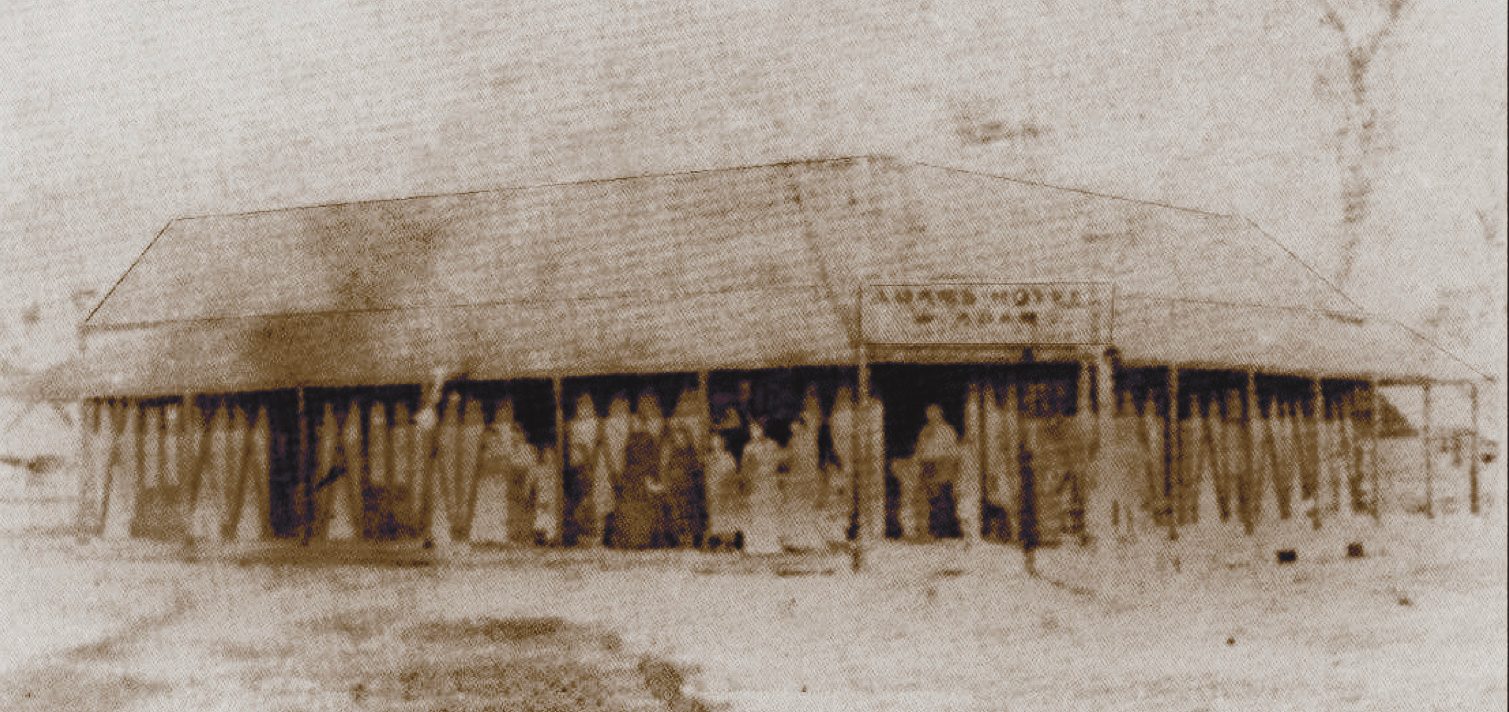
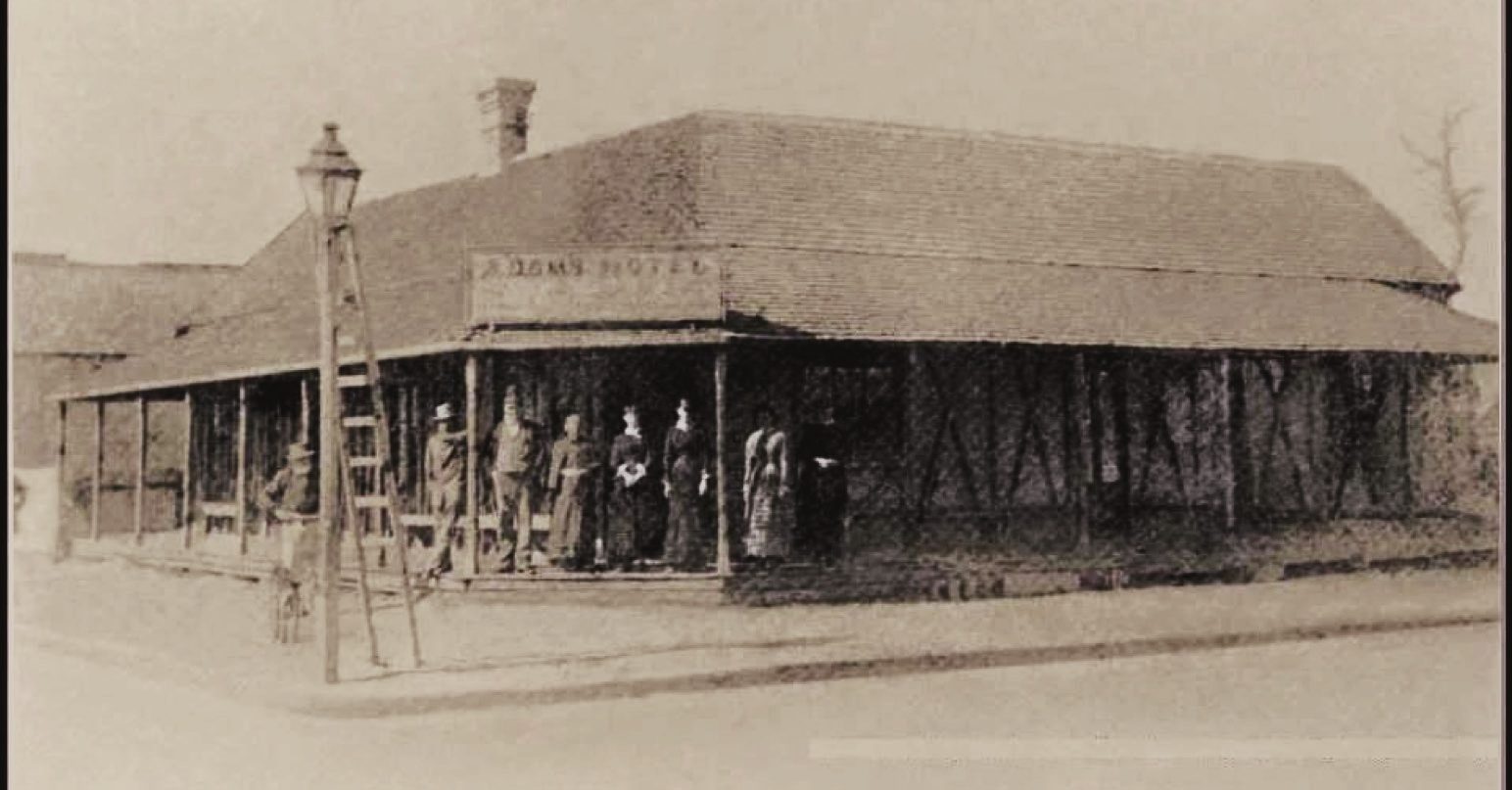
Work on the town’s relocation must have progressed very rapidly as the Adams Hotel in Bourbong Street was up and running by 1873 at the latest: and in 1886, a relatively short thirteen years later, this near new hotel was being demolished to make way for the much more substantial, two story brick and mortar establishment that had, since 1879, been renamed the Metropolitan Hotel.
The following photographs of the original Adams Hotel have been included for two reasons; the first is obviously related to their historical significance but the second, and why both photographs have been included, is that they provide means to act as a benchmark for the dating of other very early Bundaberg photographs.
In the photograph, taken shortly after construction (1872-3), it will be noted that there is no street gas lighting and no kerbing. However in the second photograph, taken before the renaming of the hotel as the Metropolitan, in 1879, it will be noted that there are both gas lights and kerbing.
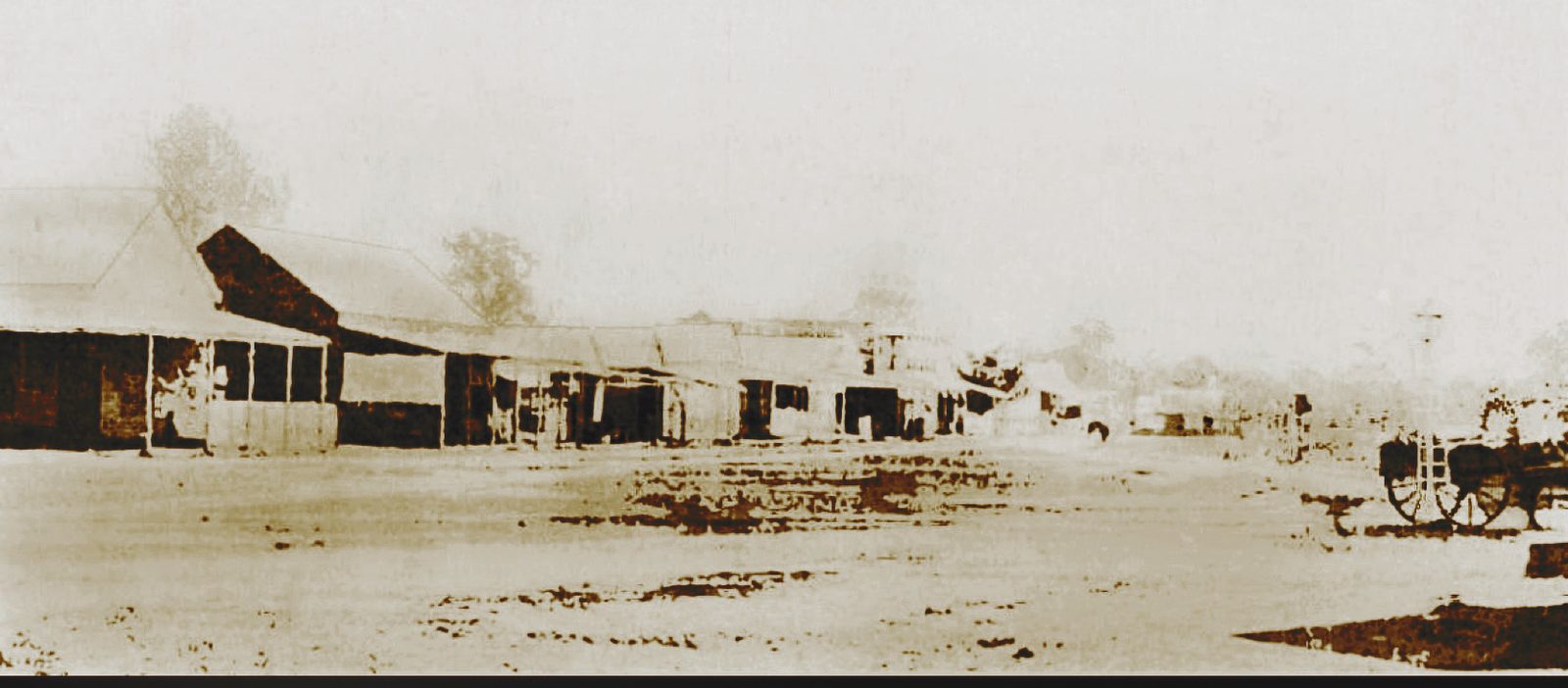
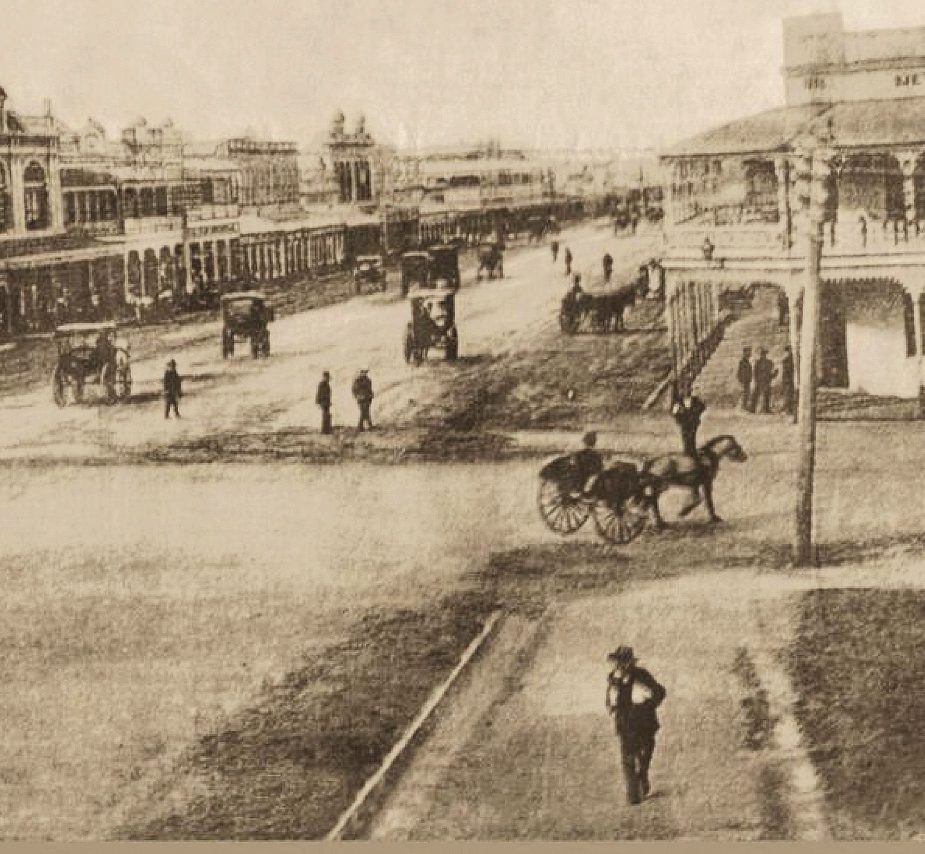
As an example, the leading photograph taken along very early Bourbong Street, has street lighting but no kerbing, which would suggest that it was probably taken between 1873 and 1878. The shadows indicate that the photographer was facing west, and the pointed shadow of the unseen façade to the north would seem to indicate a locality near the then town centre, probably at a point on the north-eastern corner of the Bourbong and Maryborough Street intersection. It will be observed that the gas street-light, with its attendant ladder, is identical to the one appearing in the later dated photograph of the Adams Hotel corner.
PLACE NAMES
According to Mr. J. Y. Walker Bourbong (Boorbung) Street was named after the Aboriginal name for a chain of waterholes between the town and Rubyanna; and Targo (Tchago) Street was named after the locality where Saltwater Creek meets the river. Tantitha, Walla, Bingera and Woongarra Streets have similar indigenous place name derivations. Bunda was the name given by the aboriginals to Mr. Edwards, who designed the town layout, and this may have been their way of accepting him into the tribe. Surveyor Thompson added the suffix berg (for burg - representing a town) to Bunda to arrive at the name of Bundaberg, that is to say Bunda’s town.
The Steuarts had very good relations with the local aborigines, and they often shared information with historical writer J. Y. Walker with whom they also had a long, ongoing association. Mr. Walker’s explanation of the place name derivations is therefore quite credible. It is of course also quite possible that Mr. Walker himself may have had similar good relations with the original inhabitants.
SOME OF THE TOWN’S FIRSTS
Some significant first events for the new town were:
- Captain Roberts, the purchaser of George Greathead’s coastal shipping business, and who commanded a small boat of 13 tons between Bundaberg and Maryborough, constructed the first house on the riverbank near the future hospital site;
- the first steamer to visit the Bundaberg Port was the Sir John Young ;
- the first selection made under the new Lands Act of 1868 was made on Splitters’ Creek by Mr. R. Kendall;
- The first two land sales of Bundaberg allotments were made in Maryborough at an upset price of £8 per acre. The allotments did not sell freely or at high prices, and many of them remained unsold;
- The first wharf on the north side of the river was erected by the Australian Steam Navigation Company;
- The first store on the north side of the river was established by Mr. H. J. Ford but he was flooded out, and narrowly escaped drowning, in the flood of 1870;
- A branch of the Bank of New South Wales was opened in April 1872;
- The first land sale in Bundaberg took place on 22nd August 1872, and the first transaction was the purchase by Mr. T. E. Thornton of Portion 3 of Section 10 adjoining the School of Arts Reserve in Bourbon Street for £4 10s. (The subsequent rapid rise in Bundaberg land prices by 1890 resulted in a single similar allotment at the extreme end of Bourbong Street, with some wooden buildings erected, was advertised for sale as being cheap at nearly £4,000);
- The opening of the first south bank store by Mr. A. Cathcart, acting as agent for Messrs. Southerden of Maryborough, later to become the store of Buss and Williams and - in 1876 - Buss and Company*;
- Also in 1876 a coach service to Maryborough and the first racing programme.
- A brewery was established by Messrs.
Steindl and Fleming in 1883; this partnership was dissolved in 1888 and Mr Steindl then created a second brewery; and
- The distillery was established in East Bundaberg in 1888 at a cost of £5,000 - the famous Bundaberg Rum had arrived.
[NOTE: As previously mentioned, two former employees of Buss and Company, Michael Joseph Reddan and William Buxton Mellor, were to open their competing store of Reddan and Mellor in 1886.]
| 1871 1872 1873 1874 1875 1876 1877 1878 1879 1880 1881 1882 1883 1884 1885 | £192 -15 - 9 |
|---|---|
| £ 1,162 - 2 - 11 | |
| £ 2,092 - 6 - 2 | |
| £ 1,283 -11 - 7 | |
| £ 1,643 -12 - 2 | |
| £ 1,569 -11 - 8 | |
| £ 1,650 -11-10 | |
| £ 1,719 - 4 - 6 | |
| £ 4,004 -15-10 | |
| £ 3,456 -11 - 1 | |
| £ 5,473 -18 - 3 | |
| £ 8,316 - 9 - 2 | |
| £ 10,989 -18 -10 | |
| £ 13,452 - 6 - 8 | |
| £ 14, 306 - 5 - 0 |
AND SOME RELEVANT STATISTICS
The list of customs returns given below shows Bundaberg’s rise in purchasing power in the early years following settlement:
By excluding the very early years, the average annual compound percentage increase in returns over the ten year period from 1875 to 1885 was in excess of 24%.
In 1880 the volume of sugar crop in the Bundaberg district was 900 tons; and this, by 1890, was estimated to have increased to 1800 tons. In 1888 the total value of Bundaberg’s exports was £362,500 of which amount £308,422 was the value contributed by the export of sugar, leaving only £54,078 for other productions. With no sugar it is obvious that there could have been no prosperity for Bundaberg, and the town itself would only have been a small and penurious village. In all of Queensland there were 205,737 acres under cultivation and of this 51,815 acres were under cane, that being one quarter of the total. From 1883 to 1887 sugar of all classes had fallen 50% in price while, at the same time Kanaka labour costs had risen by 50%. This, and other factors mentioned below, caused very considerable stress to the sugar industry; though Bundaberg, with its rapidly expanding production and central mill, was better off than most other districts in this regard. By the mid to late 1880’s the very depressed state of the Queensland sugar industry, together with the significance of the finances of the industry to the colony, had precipitated a Royal Commission into the industry. Some details, as submitted to the Queensland Parliament by this Commission follow.
SATURDAY NIGHT IN BUNDABERG
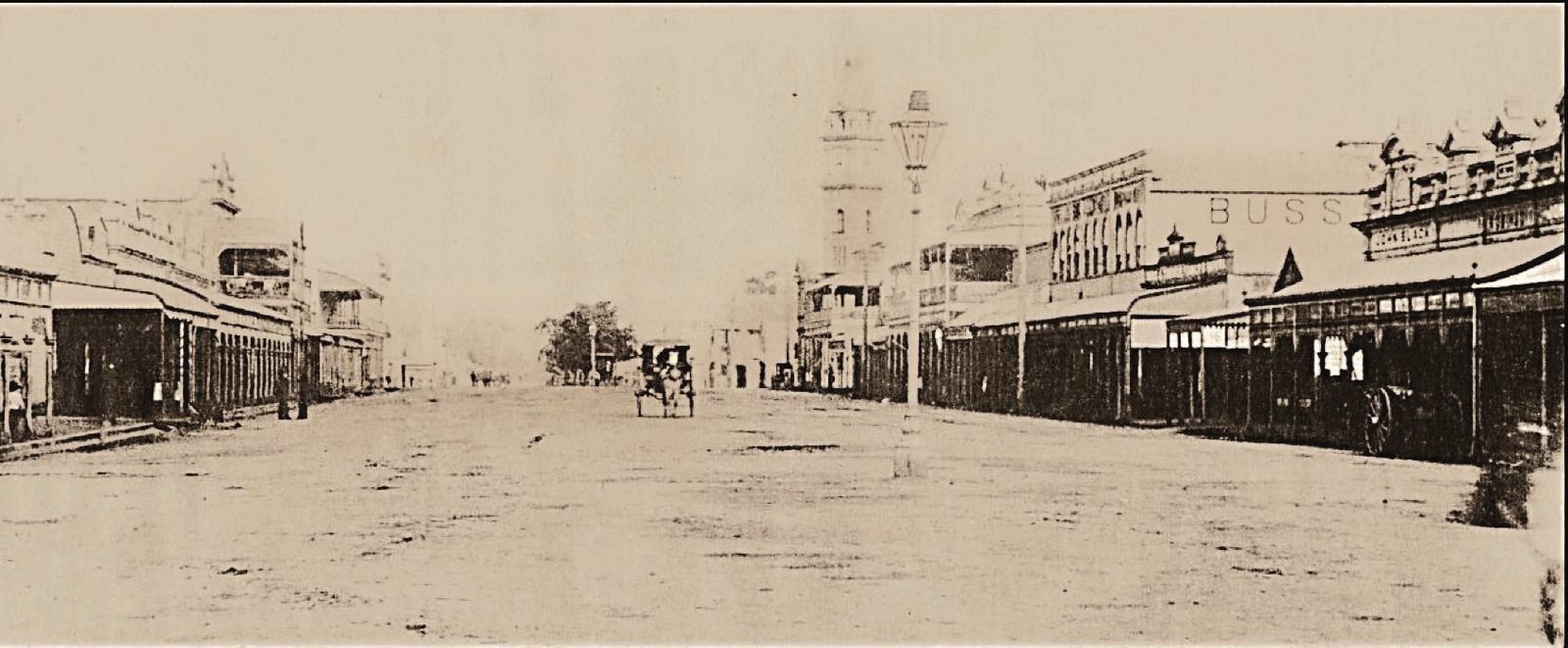
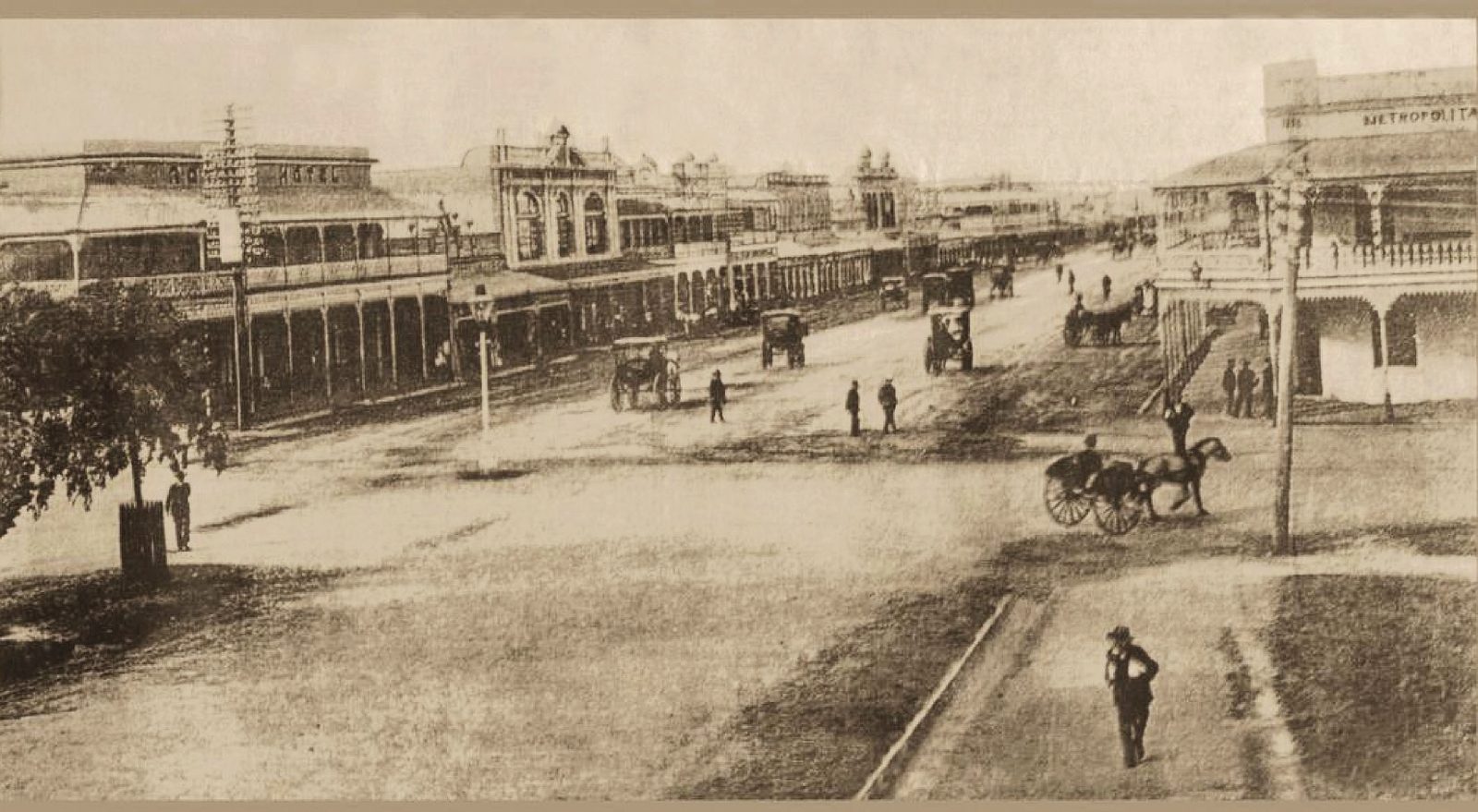
The following article is an extract from the Wide Bay & Burnett Directory of 1887. It gives Anyone coming to Bundaberg in the daytime, on any of the days of the week except Saturday, would most likely pronounce the place a regular “sleepy hollow”. During the hot, sweltering afternoons, before the sea breeze wakes up at sunset, one might fire a cannon ball along Bourbon Street – the main highway – without hitting anything more important than a stray dog. The streets are all wide, and there is a dimness of vista in the mile or so of straight street that one never forgets. But appearances are all deceptive, and in this case, particularly so. Wait til the business day comes round – the Saint Saturday of the store keepers. The street is fairly well frequented from breakfast time, and as the morning wears on, there are visible a number of country people, some on horseback and others in buggies. The first call is invariably at the Post Office and is generally followed by a stroll or drive round the street over-looking and running parallel with the river, where some of the banks are to be found, and where the Lands, Customs and Polynesian Immigration offices and the Court House overlook the Burnett. As noon comes along it is evident that the town has half as many people again in it as it had the previous day. There is something like a continuous stream of people on the sunny side of the street – the left hand side from the Post Office – always the business side to be noticed. Some auctions are going on, judging by the red flag sticking out of a tall three-storey building and sundry boards standing outside on the footway with a lot of people lolling in and out of the very wide portals. There is a bit of a lull for an hour or so while the luncheon is being attended to, but the afternoon is lively enough as a rule, if that terrible visitation of a wet Saturday does not come on.
- a vivid account of the life of the bustling town
- centre of Bundaberg in Walter’s time.
The country folk have a distinct look of their own – a sturdy, well-to-do somewhat obtrusive sort of prosperity about them, with more pronounced complexions than the pale town-dwellers. There are scores of German farmers and their wives who appear to be very fond of talking Teuton in small groups, while “mien daug” is frisking about close at hand. Many of the store keepers stand at their doors, waiting to meet farmer this or farmer that, and as a general thing, there is a good deal of gossip mixed up with business, and not seldom a turn into the “Palace” close at hand to finish off. The planters are of a different character and generally come in on horse-back and appear busy and preoccupied. Judging by what fearful and extraordinary calumnies have been circulated down South about the Queensland planter, one feels a thrill of surprise in finding him precisely the same as any ordinary well-dressed man. He does not carry a cow hide, and he does not as a rule drink raw brandy to drive him to the necessary stage of Harriet Beecher Stowe ferocity, and, in fact, to meet and speak to the average planter would give no other idea than that he was a cultivated gentleman as likely to commit suicide as to be guilty of any brutality towards the boys under his care. It is strange, by the way, that the white men who work on the plantations often complain that the Kanakas are treated far better than they are. As for the lads themselves, they say nothing in English, but as they are always laughing and look fat and sleek, and shiny in the sun, they probably don’t care a straw one way or the other.
The exodus of visitors takes place from four to six o’clock. The daily mail comes in from Maryborough at about five, and after the letters are taken there is nothing to hinder the planter or settler any longer. By dusk the town is quiet as ever. But on Saturday nights, there are signs of revival. After tea-time, soon after the gas gets lit up – yes, gentle reader, we have gas and very good gas too in Bundaberg – you see young Bundaberg and his wife starting on a tour down Bourbon-street which will take some couple of hours, and the close of it will see them loaded with small parcels and with the memories of divers neighbours’ yarns of domestic troubles, and so on. From all quarters you will see swarms of Kanakas coming quietly down the middle of the street, with all the gorgeousness that money and ‘trade’ drapery can make them. A tall straw hat, with a cheap silk neck tie that would shame the sun at noon day, with a pipe, generally a clay – sometimes a briar or meerschaum – all this, with much guttural chattering and laughing makes up a Bundaberg kanaka on Saturday night, and he never travels singly. It is a lie to say that they are the cause of rows between themselves and white men. They don’t get drunk, but some of the white men generally do, just to show the superiority of civilisation over heathendom, and they will sometimes go out of their way to raise a fight. But such things have become a very rare occurrence, and a walk through the main street of Bundaberg on such a night is much safer for an unprotected woman than the main thoroughfares of Brisbane, Sydney or Melbourne would be.
As you go along from the Post Office, now that the night has come on, you will notice a considerable illumination in a big store to the left – the leading store of Bundaberg, a place that has been a sort of foster nurse to half the business houses in the town. It is lofty and spacious, and is generally filled with people from one end to the other. Everybody knows that “Buss’s” is thoroughly dependable, and a child with a letter ordering goods would be served just as well as the P.M. himself. The firm is one of very few in this colony that seem to preserve the traditions of such houses that Dickens had in his mind’s eye when he wrote of Chuzzlewit Bros. No employee ever leaves Buss’s except to set up for himself, and when it is added that some half dozen of the best firms in the town have all started from this source, it need hardly be said that the firm is an honoured one. The large ironmonger’s shop – a very handsome iron and plate glass front it has too – has, for one of its partners, one of the old assistants of the big store. There is another iron monger opposite whose proprietor is probably the best known man in the town, and to right and left of him are the leading chemists, a notable firm of auctioneers, the biggest butchering establishment, belonging to Skyring Bros – one of whom was a Bundaberg pioneer – and the shop of the chief watchmakers and jewellers. Then there is a waste piece of ground and a number of smaller shops, conspicuous among which, on account of its own black and gold decorations in the midst of such dinginess, is a very pretty little drapers’ shop. Further down at the corner, is a firm that has been connected with Bundaberg for many years, and who are still occupying the same quarters as they did when the town was half its size. That, however, is to be remedied ere long. This brings us to the centre of the town, for where the cross streets meet burns an extra strong gas lamp
– 50 candle power – around which there are numerous crowds of pater and mater families chatting and gossiping. Every now and then, someone who has drunk not wisely, but too well
– always a white man – will lurch along on the arm of some bosom friend whom he loves with an evident excess of affection. Then comes a long struggle to clasp the lamp post, which he clings to as a last resource, no matter how the big hotel, all ablaze with light, on one side of him, and the Stationers’ Hall on the other side appear to be going round and round and over each other in the air. Hark! What is that singing and tramping in the distance? As they come nearer, you may see some red coats gleam in the light of the streets – it is the “Salvationists” and they are on a parade with the idea of possibly picking up such poor specimens as that lamp post pendant. They sing strange songs, do these curious folk, but as nobody but the policeman or the semi-drunken friend is at hand, perhaps the army had better take him away as they do. They have dealt with worse cases than that since they came up here to camp.
That great white building with the wide roomy balconies running all round the corner is the leading hotel in the town for which a fabulous rent is said to be paid and which is always busy and bustling even in dull times. And there is a shop at the other side of the street that seems equally free from any tendency to fluctuation. Tonight there are people inside and half in and crowding the pavement all around, for this corner is a stopping place that very few people manage to pass by. Inside are all the newspapers a Mulgrave man wants, and books and stationery, and tobacco, and half a hundred other things.
The shop is so big, that there are any amounts of loafers who have only come in just to look at a book or two or to buy some cigars for the Sunday. It is suggestive of Cole’s Book Arcade in Melbourne, where some thousands filter in one end and out of the other on Saturday nights and, although Young’s is passed through in the same way by hundreds of people, no pilfering ever takes place. Further on there are a few stores including a gay confectionary place much patronised by the youth of both sexes, and a store that would remind you very much of the old-fashioned shops at home. After passing by a few iron mongers’ shops, you get into the Kanaka and Chinese quarters. There are several shops in which the yellow ones sell various things – very various things – to the guileless kanaka and Johnny is run for pretty closely by the white store keepers. It is related that on the occasion of a little conflict taking place in the town one night several of the storekeepers besought the mayor to keep the boys out of the town on such occasions. This he did so well that the said storekeepers had only themselves to wait upon for three weary Saturdays, and they went and implored the mayor to let in the lads again, which his worship did, feeling, however, a strong desire to keep up the fun for another month or two. There are a couple of bright new white stone stores on the other side of the street, one a very pushing firm of grocers and the other an equally enterprising couple of drapers. Beyond this the lights cease and away right ahead are the gas lamps on the bridge crossing the Burnett not far from Millaquin.