Part One The Early Bundaberg Pioneers and Their Plantations
Chapter 3
The Very Early Planters and Pioneers
As earlier mentioned, the first man known to have grown sugar cane in the Australian mainland was Thomas Alison Scott who, as a young man, had managed sugar plantations in the West Indies. He obtained canes from Tahiti in 1817 for planting in the Sydney Botanical Gardens. In 1823 the government appointed Scott to take over the growing of a sugar crop at the Port Macquarie penal settlement utilising convict labour and in 1827 he succeeded in making some raw sugar. However the experiment failed due to unsuitable soils and climate, though Scott claimed to have provided both cane for planting and advice to farmers when the industry made a second, successful start in northern rivers area of New South Wales and in Queensland. Scott also provided some cane cuttings to Captain Louis Hope, the proprietor of the first commercially successful private plantation in the Australian colony.
The very earliest records of sugar cane being grown in Queensland date back to the original early European settlers. Commandant Bishop who preceded Captain Logan had, in 1826, written a report which stated, in part, that the sugar cane planted by the late Commandant six or eight months ago, “flourishes exceedingly and most luxuriantly.” It appears that sugar cane was being grown successfully only one or two years after the first Queensland landing.
In the year 1838 Mr. Mayo, who had experience with plantations in the East Indies, planted a small patch of land in the Moreton Bay area (now the Redland Shire) with sugar cane from Mauritius. This was probably the first attempt of a private planting in Australia.
The American Civil War interrupted the commercial supplies of cotton and, as a consequence, unsuccessful attempts were made to help meet the demand created by growing cotton in north-eastern Australia. Many of these unsuccessful planters then turned to the planting of sugar cane as a more viable substitute. The Queensland census of 1861 indicated a population of 34,000 persons and, in the following year, the State Government passed the Coffee and Sugar Act which was intended to encourage the establishment of viable industries to provide employment for this increasing population. The Coffee and Sugar Regulation Act of 1862 made available selected lands at a nominal rental and with an associated right to purchase the rental property. The Bills immediately stimulated enterprise in this area. One of the first to realize the benefits of its provisions was Captain Louis Hope of Ormiston, near Moreton Bay. With land at 12 shillings per acre Captain Hope planted twenty acres of sugar cane in 1863 and, by establishing a sugar mill, pioneered the way for the establishment of the sugar industry on a commercial basis. By 1867 six mills in Queensland were producing a total of 168 tons of raw sugar.
At Mackay, the first sugar cane known to be planted in the far north was planted by Mr. John Spiller in 1863 and, in the following year, a complete mill was erected on the banks of the Pioneer River.
Sugar cane was grown extensively on the banks of the Brisbane and Logan Rivers and the planters installed many small sugar mills. Even the largest of these mills, built on what is now called Bulimba Creek, relied on draught-horses and not steam to power the mill machinery. The Brisbane suburb of St Lucia was named after the sugar producing island of the same name in the West Indies, due to the sugar cane grown in the area. Here mixed agriculture commenced in 1852 with Robert Cribb being the district’s first farmer. The American civil war presented an opportunity to grow cotton but this venture ceased with the war’s conclusion in 1865. William Dart obtained sugar cane planting stock from Mauritius in 1869 and installed his own horse-powered mill on the river bank at St Lucia and, the battery for the mill being supplied by Smellie and Co. of Brisbane. The first batch of cane to be milled was supplied by Alexander Watt who was Dart’s neighbour. Following unfavourable growing seasons in the St Lucia area in the late 1870’s sugar cane planting ceased here and by the early 1880’s these farmlands had been given over to land developers.
Elsewhere in the south-eastern Queensland region the sugar industry prospered and sugar cane was the prime crop in this region for many years. The period 1870 to 1880 was, in general, a very prosperous one for the cane planters and this enabled many of them to consolidate their financial position and to improve their properties. These early planters were in the main successful even though they had to overcome the disadvantages caused by their lack of both cane growing experience and capital. In addition they were employing field practices and mill technology that would have been considered out-dated by the sugar industry in the West Indies.
Indentured labourers from the islands of the Southwest Pacific had been brought to the Brisbane area in 1863 by Captain Robert Towns to work in the cotton plantations. To recruit his labour Captain Towns had given written instructions to Captain Grueber of the Don Juan and verbal instructions to sandalwood trader turned recruiter Henry Ross Lewin that ordered both Grueber and Lewin to, “on no account attempt to force or take people against their free will and consent” as the New Hebrideans were, “a poor, timid, inoffensive race.”
Even though Towns had provided a mess hall and sleeping huts for the Islanders prior to their arrival on his plantation the Brisbane Courier accused Towns of bringing slave labour into the Colony, and went on to accuse the Government of callousness in condoning the activity. Following the setback to cotton planting in 1865 these people, known as Kanakas (from the Melanesian word literally meaning man), had their employment reassigned to the sugar industry. At this time actual slavery, though banned in all of the British colonies, was still in use on the competing plantations of the Dutch colonies, and of those in Puerto Rico and in Cuba. The resolution of the issue of slavery in the American States would not be resolved until after the conclusion of their civil war in 1865.
The use of indentured Kanaka labour in the Australian colonies was to become a cause of disputation, over a period of nearly forty years (1863 to 1904), between pro and anti Kanaka factions. The end to indentured Pacific Island labour, proposed under Queensland legislation to occur in December 1890 but, for practical reasons, actually executed in 1904, was finally precipitated by an Australian-wide Government Treaty. This treaty offered Islanders, then resident in Australia, the choice of either repatriation or of full resident citizenship rights. The same treaty granted equivalent citizenship rights to labourers from other countries such as India, China, Burma and Malaya.
It should be remembered that conditions on many of the Kanakas’ home islands were far from perfect due to inter-tribal wars and other causes and, as a consequence, many islanders opted not to return to their home islands at the conclusion of their period of indenture. Some from the Bundaberg area were relocated to Moa Island, the largest island in the Torres Strait, where a Church of England mission was established for the purpose. Moa Island’s original population, according to Torres Strait lore, had earlier been lost to inter-tribal warfare. It is probable that Florence Young, a member of the prominent Bundaberg plantation family, was the main driving force behind the establishment of this mission. Other Islanders stayed in Queensland to live as ordinary citizens; some to become planters or businessmen in their own right.
The very first settlers in the Bundaberg area were not planters but timber getters seeking ash and white cedar timber for the making of cask staves. The casks were required for storing the tallow produced by the boiling down of surplus cattle at the Baffle Creek establishment. At this time, in 1866, these cattle had no other ready market, and the shipping of live cattle was not a viable option.
The captain of a small coastal ship had reported that timber for this purpose may be available near the mouth of the Burnett River.
An expedition from Baffle Creek was mounted by John W. Steuart and his aboriginal guides, comprising a male and his female partner, into what is now the Bundaberg area to investigate the possibility of obtaining the large quantities of timber required for the rendering works. Travelling along the coast they arrived at what is now Rubyanna, via Tomato Island. They then backtracked and re-crossed the Burnett River at Tomato Island to reach Tantitha. Here they were met by John’s brother Gavin who had travelled from Baffle Creek to Tantitha via Yandaran with the pack-horses.
Following this expedition, John and Gavin set up camp near the present site of the North Bundaberg Railway Station and, on Christmas Day 1866, they set about establishing a 320 acre selection under the Coffee and Sugar Regulations Act of 1862, on the north bank of the Burnett. They gave the name Woondooma to this selection which was approved in April 1869. They then erected a small, five horsepower mill on the site.
Their business was not successful and Woondooma passed into the hands of Farquhar and Dunn in 1878. Mr. Dunn the resident partner died in April 1880, and by 1890 Mr. Farquhar had become the chief partner in the Hummock, then one of the finest Woongarra plantations. Other selections made under the Coffee and Sugar Regulations at the time were Fairymead, Rubyanna and probably Millbank.
The Steuarts’ contribution to the Bundaberg settlement has been recorded in the (misspelt) street name of Gavan in North Bundaberg. When the Steuarts arrived on the river the European population of the district consisted of five men at Tantitha, two at Bingera and three at Kolan.
The Steuart brothers chartered the ketch Lady Bowen, under the navigation of the Baffle Creek pilot Lawrence Jansen, to deliver supplies to their camp. Their own boat was consigned with these supplies and, with the aid of a pocket-compass, they proceeded to draft a rough chart of the river. This they supplied to the Port Office at Maryborough, thus enabling Mr. Thos. Miller of that port to send his schooner, the Elizabeth , under Captain Coode into the Burnett River. Following other major pioneering works in the Bundaberg area the Steuart Brothers left Bundaberg and relocated to the Daintree River area, John in 1877, and Gavin in the early 1880’s where they were again the earliest pioneers, though now in a less forgiving and more demanding environment.
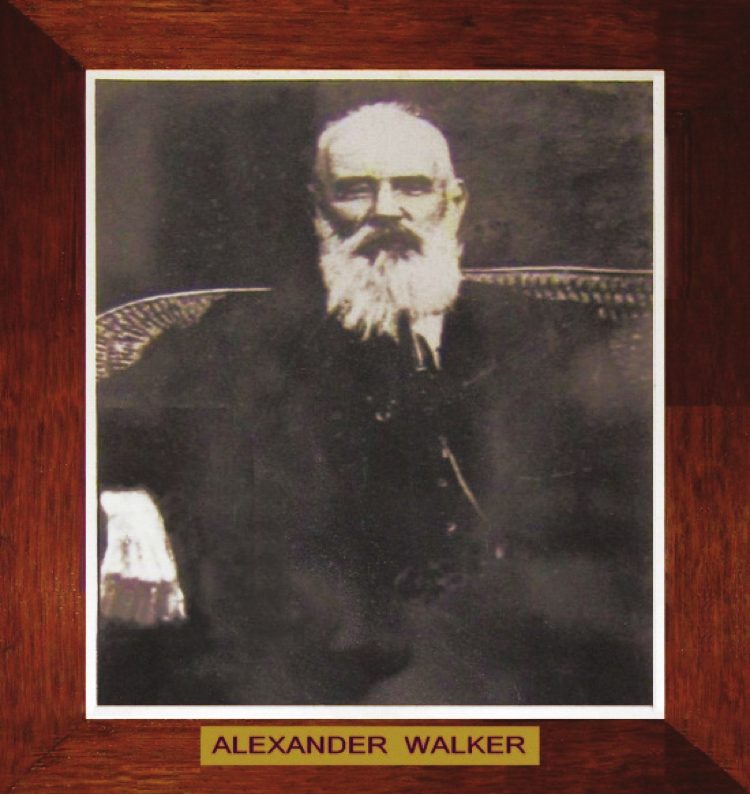
Prior to this exploration by the Steuarts, Mr. Alex Walker with a party of men from Gayndah had also explored the Burnett River downstream as far as Barolin and on to the South Head, and they had also declared it to be navigable.
Whether dictated by fate or genes there will always be some who must constantly follow their star to the expanding, outer limits of either the geographical or intellectual boundaries. Such people were the Steuarts who, through their endeavours deserved much more success and recognition than they obtained in real life; perhaps they always tried to reach just that little bit too far. Much of their energy was expended on ventures that benefited the community as much as, if not more than, themselves; and their own affairs appear to have been conducted with insufficient resources to provide any meaningful margin of safety. Some people, such as the Reddans and the Mellors, prospered by helping to consolidate the advances in developments that had already been made, while others like Walter Adams, through a fortunate mix of confidence, competence, a sense of adventure and no doubt some luck managed to succeed whilst keeping a foot in both the pioneering and consolidation camps. I think that it was John Paul Getty who once remarked that to become rich one had to rise early, work hard – and strike oil!
The first recorded planter in the immediate Bundaberg area was Thomas Watson who made a successful application for a selection of 320 acres under the Coffee and Sugar Regulations Act of 1862. The selection, named Mabbro was approved on 20th October 1868. Mr. Watson subsequently sold 100 acres of this selection to Samuel Johnston, originally of County Derry, who had immigrated to Australia in 1840. Johnston commenced installation of his Bundaberg sawmill in late 1868 following his relocation from the Fitzroy area where he had been conducting his previous sawmilling operation. Gavin Steuart was to state that Samuel Johnston’s mill was to provide a major boost to the early development of the Bundaberg settlement, and John Young Walker later observed that Mr. Johnston, the owner of the Waterview Saw and Sugar Mills, was to become one of Bundaberg’s most prosperous citizens.
Mr. Watson had arrived on the Bundaberg scene via Bingera Station, then owned by Mr. Alexander Walker of Gayndah. For a considerable time his wife and daughter were the only white women inhabitants of Bundaberg. They were domiciled in the substantial slab hut with shingle roof that Thomas had erected and behind which the Mulgrave Hotel was later constructed.
By the beginning of 1868 the Districtsurveyor, John Thompson, using his wife’s name, had established a 1200 acre selection called Rubyanna. He was joined in the venture by Mr. R. Kendall, formally a mathematics master at the Grammar School and later Town Clerk of Ipswich. The venture furnished employment to a large number of people, and also provided impetus to agricultural settlement in the area, but was a commercial failure.
The names of Bingera, Barolin, Branyan, Tantitha and Kolan are familiar to all residents of Bundaberg; but what were they? The simple answer is that they were the first cattle properties in the Bundaberg area. But, as in many issues of this nature, the people who were later to study the district’s history were to find that the matter was far from simple.
The first squatters to arrive in the Queensland colony were settlers searching for large areas of land to provide permanent grazing for their sheep flocks. The initial wave of these squatters were to find that, because of the prevalence of spear-grass and of diseases caused by the moisture prevailing east of the Great Dividing Range, the coastal lands were not hospitable to sheep husbandry. Following a population increase provided by more or less steady immigration, and with the dramatic acceleration in this immigration upon the advent of the gold rushes, a more reliable market had opened for cattle products. This in turn had provided a corresponding rise in demand for properties suitable for cattle grazing. As the Bundaberg area had been bypassed by the first wave of settlement, prospective squatters such as Alex Walker were encouraged by the 1847 Orders in Council to investigate the area in a search for cattle, rather than sheep, lands.
The earliest, surveyed stations between the Burnett and Elliott Rivers were Branyan, stretching along the south bank of the Burnett, and Bingera, south of Branyan Station and north of the Elliott River. Barolin Station, was to overly the remaining area east of the Sloping Hummock and between the two rivers. The northern bank of the Burnett River, opposite the future Bundaberg Township, was occupied by Tantitha Station with the Kolan Station being located further upstream.
Though the stations mentioned above are of considerable significance to the very early history of Bundaberg, their changes in ownership, history of stocking, and modifications due to the Crown Lands Alienation Act of 1868 are outside the scope of this work and are, quite frankly, beyond the limits of my knowledge. Nor are they covered by my available references. However Neville Rackemann, in his book, BUNDABERG From Pioneers To Prosperity , explores the nature, vicissitudes and evolving changes in ownership of these stations in considerable detail and this work provides an excellent reference for any person who wishes to explore this particular segment of history.
With respect to Branyan and Bingera Stations even Mr. Rackermann is forced to remark, “Even with research carried out over a long period, it is doubtful whether all the facts will ever come to light.” One aspect of the matter does seem to be clear; research carried out by Mr. Ron Harvey of Bundaberg indicates that Alexander Walker and his companions were the first to reside on Branyan Station with Bingera Station apparently remaining unoccupied. At a later time, and having accumulated the titles to the remnants of both Branyan and Bingera Stations, Robert and John Ridler combined the two stations under the single name of Bingera Station. This holding was to revert to the ownership of Alex Walker in 1875. The Barolin lease was acquired by Alfred and Arthur Brown; Tantitha was originally leased by the Hassalls in 1860 and Kolan by Robert Tooth.
However the era of the cattle station in the immediate vicinity of the future Bundaberg Township was to be relatively short owing to its replacement by agricultural expansion. Some of the early plantations, which were soon to replace the early cattle stations, were:
On the north side of the river:
- The Youngs’ plantation Fairymead – taken up under the Coffee and Sugar Regulations by Messrs. Hassell and Ogg;
- Richard Palmer’s Millbank – to the west and described below;
On the south side of the Woongarra scrub:
- The plantations of George Greathead (Hopewell) and William Archer (Everton), who arrived together from Maryborough in 1869 – and some others;
At the opposite end, along the river bank from the site of the future Kennedy Bridge (completed in 1878 by Mr. W. W. Lapham) to Rubyanna:
- The plantations of Messes R. Kendall, Kirby, Jealous, R. Lee (Sherwood) and M’Gill;
Along the Barolin Track on the eastern side reached from the river bank the next contingent from Maryborough, their selections being surveyed by Surveyor Barnes in March 1872:
- The plantations of Messrs. Adams (Sommerville), Noakes (Springhill) and Faulkner (Woodlands). Prior to this Mr. Faulkner had been an unsuccessful prospector in the goldfields of California, New South Wales, Victoria and of Gympie in Queensland.
And in the Woongarra Scrub proper:
- The plantations of W. Price and of Richard Jones settled in 1871 which were later to become part of the Duncraggan estate.
It was not realized at the time that the Woongarra lands overlaid a freshwater aquifer that was, up to at least the early 1960’s, discharging into the chain of waterholes located just east of Bundaberg (later to be tapped for the town’s water supply); on the south to the waterholes of the freshwater Elliot River; and on the eastern seaboard to the Pacific Ocean. The ground-water surface was just above high tide level near the sea and it could be found within about 1.3 metres of the ground surface in a large part of this eastern area. The pumping of town and irrigation water from bores was eventually to halt, and then to reverse, these outflows.
The availability of this plentiful, shallow, underground water was, no doubt, the reason for the existence of the dense Woongarra Scrub with its,
… interlaced mass of rampant vegetation, mighty trees bound together above by vines like the cables of a frigate, and matted below by intervening thorns and briars to such that path there is none till it is cut through the solid greenery by axe and billhook … myriads of fireflies … wallabies by the score … boots full of blood drawn and disgorged by the leeches, which cling to every limb and leaflet of the dank vegetation … the doves which form the majority of the bird population … the flash of the metallic gleam and scarlet and golden plumage of the regent-bird … the mosquitoes unintermittent in their attentions … you may possibly disturb tallegalla (the bush turkey) … casting your eye upward through a rare break in the overshadowing canopy you may see in the empyrean the widespread wings of the Australian eagle … and haply, turning your glance earthwards … the basilisk glance of the black or tiger snake or even the lazy wrigglings of the harmless carpet python .
J. Y. Walker.
[Note: the brown snake, though abundant in the area generally, seemed to prefer the open forest and grasslands - R. L. C.]
Again J. Y. Walker, in his History of Bundaberg
- A Typical Queensland Agricultural Settlement , is to the fore in describing the initial clearing of this scrub:
A patch of five, ten, or twenty acres is marked off; and the work of clearing begins. The first operation is technically called “brushing.” This consists in cutting at the ground all vines, and undergrowth, and all saplings which are amenable to the bill-hook. Then follows the felling of the larger timber. This is rather a nice job, and affords scope for the exercise of considerable skill and “woodcraft.” In this, as in all other cases, it is experientia that docet. A skilful “ feller” (no pun here) will cut, usually about two feet from the ground, the smaller trees first, then tackle the larger timber, and, observing the “hang of the wood,” will cut nearly through over a considerable area, till coming to a dominant tree, with a decided hang, he will cut it entirely through, sending perhaps half an acre down with a single crash. Carrying this practice out, over the area to be felled, the trunks will probably be found lying in parallel lines and the tops so matted together in a flat heap that in six weeks or two months, a running fire started at one end under the impulse of a brisk breeze will burn, not only the matted light stuff which carries the fire, but also most of the solid trunks, and leave the ground clear and ready for its first crop. Seldom, however, do matters turn out quite so well as indicated. There is usually some piling and chopping to be done before the crop can be put in; and a bad fire is a tremendous disaster.
It may be seen from the general denudation of the district surrounding Bundaberg that ‘bad fires’ have not been frequent. No horses or implements can be employed in this first operation of scrub agricultural settlement. The crop (usually maize) is put in with the hoe alone; and sometimes from the interlacing of the reticulation of roots there is difficulty in stirring soil sufficient to cover the seed. Nevertheless, by this rough mode of manipulation, enormous crops are raised; and in about four years, with a very little stumping the plough may be put in.
In the meantime, while the scrub is drying, that is between the felling and the fire, perhaps the farmer is “a few pounds to the good,” and can afford to set about the building of his first house which may afterwards become a barn. This must needs be of split slabs - we do not build log-houses in Australia; and there are no roads to sawmill, nor money to spare for weatherboards or squared scantling, which is so much easier and pleasanter to build with. There is plenty of ash in the scrub, which splits nicely, also Flindosa (called in the south Crow’s Ash) and, in some of the scrubs, Moreton Bay Pine, from which slabs might be procured. But all three are perishable. He would prefer a flooded gum, if he could find one. These are monstrous isolated specimens of the Eucalypti growing in the damp pockets of the scrub or on the alluvial deposits of the rivers. They attain enormous size, and usually split freely. To a new chum settler the discovery of one of them within reasonable distance is a windfall. It may furnish material for his house and all his first outbuildings. There are very few of them now left in the district of the lower Burnett. The breaking up of one of these giants of the forest is quite an event in the district in which it occurs. Many have been attempted, and, from sheer lack of manual and mechanical power to manipulate such masses of timber, have been left standing, half-felled.
And, But while the settler in the scrub has abundant compensation for the labour required to fell and work up these enormous ‘flooded gums’ in the mass of valuable building material he thereby acquires, there is another majestic vegetable growth which it gives him nearly as much trouble to dispose of. This is the small-leaved fig which occurs throughout the scrubs at intervals more or less frequent. It attains occasionally immense dimensions and looking over the scrubs from an outside elevation the tops of these giants may be seen like lofty pyramids and domes of lofty green towering above the surrounding jungle. Starting life as a parasite from some seed dropped by a bird in the fork of another tree, it drops to the ground around the parent stem slender filaments or rootlets, which taking hold, swell in bulk, speedily coalesce into a single stem and ultimately crush the life out of the supporting tree.
By-and-bye innumerable vines and creepers climb into the lofty branches and tumbling over in a cataract of green; twist themselves among the tops of the adjoining trees, interlacing the whole in one inextricable mass. Below, the surface roots run along over acres of ground, swelling around the butt of the tree into buttresses which form detached chambers of considerable size. The felling of one of these trees necessitates of course the previous felling or half-felling of a large surrounding area, involves the labor of many days, and when the final crash comes its reverberations are heard throughout the neighbourhood. On one such occasion when more than an acre of scrub was half felled, dependent on the one long dominant monarch, the stroke of the axe produced a crash so tremendous as to startle a farmer’s wife fully half a mile away … . The timber, however, is utterly worthless for building, being, when green, soft as soap, and, when dry, porous as pumice stone. Though of such immense bulk, it does not long cumber the ground, burning like tinder after a year or two’s drying .
When Edward Aldridge, generally acknowledged as the founder of Maryborough, established the Baddow Station, now a Maryborough suburb, in the period 1848-49, the brothers Richard and Henry Palmer were with him as station owners in their own right and were later to become very early planters in the Bundaberg region.
Henry Palmer went on to become Mayor of Maryborough (1861), the Member for Port Curtis in the Queensland Legislative Assembly, and a leading pioneer in the Wide Bay sugar industry. On the 29th December 1869 Mr. Palmer selected 480 acres on the north bank of the Burnett River. This was resumed from the Bingera Station, and renamed Sharon Plantation. It was located about 1.5 miles upstream from the city centre’s Burnett River traffic bridge. The schooner Countess of Belmore delivered the new machinery for Henry Palmer’s plantation, Sharon, on the opposite bank of the Burnett River in July 1876.
Richard E. Palmer was the first man known to both grow and process sugar cane in the Bundaberg region. It took his farm workers two years, starting in 1871, to clear rainforest and plant 74 acres of sugar cane. Mr. Palmer named his selection Millbank. A mill building was erected at Millbank and consisted of a corrugated iron shed with a split slab floor. The Walker Foundry in Maryborough built the mill plant which incorporated a double-gear mill with four foot wide rollers. These rollers, three Wetzell pans for boiling sugar cane juice, and centrifuges to separate dark-chocolate coloured molasses from yellow sugar crystals, produced Bundaberg region’s first commercial sugar in August, 1872. This mill was destroyed in the flood of 1875 and the Maryborough Chronicle of the 24th June 1876 recorded that the Good Hope Sugar Mill had been purchased by Mr. Palmer and relocated from its Maryborough location to act as a replacement mill on his Millbank selection. The memory of this long vanished sugar cane field, with its mill site, is now preserved in the name of the West Bundaberg suburb of Millbank. Buss and Penny subsequently acquired the Millbank plantation in 1883 and cleared a large portion of the forest land for suburban residences.
In 1881 the, ‘Yankee notion’ Victor Sugar Mill was demonstrated in Walter Adams’ back yard. It was said to cost a trifling £60 to £200 and operated without steam power. One of these mills was purchased by Mr. S. Rowe and another by Mr. R. Thompson. A great deal of manual labour was required to operate the mill but Mr. Rowe did manage to produce some sugar in the first season; he then abandoned the equipment and instead opted to pump his juice to Millaquin. Mr. Thompson, on finding it necessary to employ expensive labour to work his mill was forced to sell his plantation to the Pemberton Grange plantation, the property of Messrs Buss and Davidson.
The Thompson mill was transported by Martin Wessel to his farm on the Kolan where he was fortunate to have some stalwart sons who helped him in its operation. Unfortunately the sons’ opinions of the mill do not appear to have been recorded. This mill was subsequently replaced by full vacuum pan sugar-making equipment.
Other early, second generation mills were erected at:
- Avoca Plantation – S. & V. Maunsel purchased in November 1880 for £3280, the equipment arrived from Glasgow in April 1882;
- Kalbar – Doctor May – commenced operation in June 1882;
- Bonna – Mr. Pringle – commenced operation in October 1883;
- Tegege (on the Kolan) – Richard Jones (former owner of a property sold into the Duncraggan plantation) – in 1884
- Oakwood – Buchanan & Denny a juice mill;
- Cuba – McDouall Brothers – later dismantled; and
- Fairymead (1884) and Bingera (1885) also acquired mills at about this time.
Some of these early mills were on the cultivated, alluvial river flats, or on the river bank itself, and were subsequently subjected to flood damage.
By 1888 the mills on Mon Repos, Springhill, Waterview and Windemere Plantations had followed the much earlier Millbank example and had been converted to full mill status. Most other mills, including that on Sommerville, remained as juice mills utilizing the Millaquin facilities.