Part One The Early Bundaberg Pioneers and Their Plantations
Chapter 2
The Road(s) to Bundaberg
The explorers
The story goes that once a song was written called The Road to Bundaberg . However the title line did not scan very well and was subsequently altered to the more lyrical The Road to Gundagai . The rest, as the colloquial expression has it ‘is history’ and a very popular song was born.
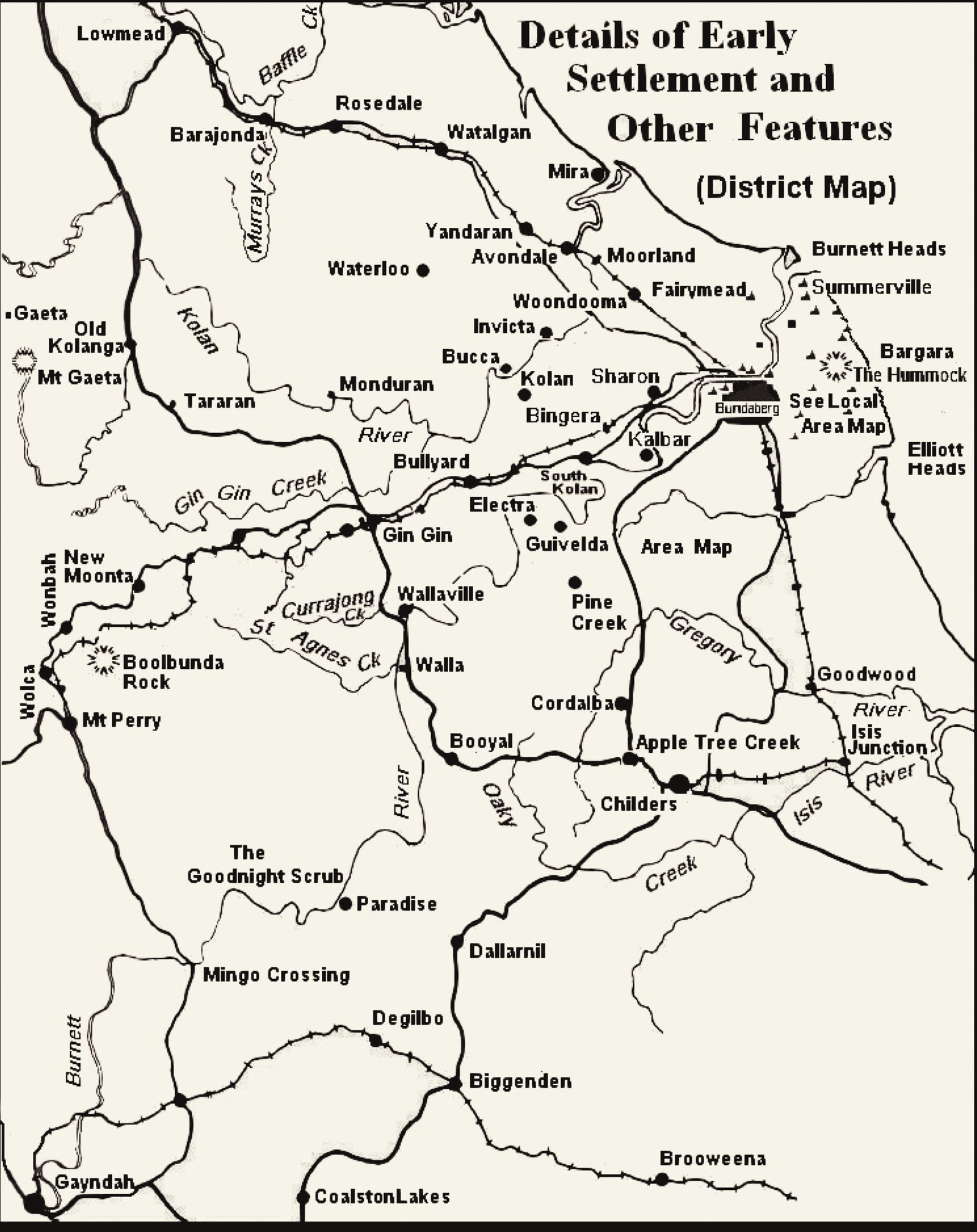
In the following passages there will not be one but several ‘roads’ or routes mentioned as having opened with the passage of time as the attractions of the Bundaberg area became better known and of more interest to travellers and settlers; and as commerce demanded more convenient transport of goods and people.
Some routes of special significance are:
- By sea to the mouth of the (then to be named) Burnett River – Assistant Surveyor James Charles Burnett – in 1847;
- Down the Burnett River from Gayndah – Alexander Walker with his brother Robert and Messrs. Barnard and Parker in the early 1860’s; and
- Overland from Baffle Creek – the Steuart Brothers in 1866 – The Steuart brothers, John and Gavin, deserve to be the subjects of a book in their own right;
- By sea – The first ship of any size to enter the Burnett was the Elizabeth , under Thomas Miller, which entered the river to deliver a saw mill in early 1867. Regular communication by coastal shipping from Maryborough was commenced by Mr. George Greathead in 1868 - (This shipping business was subsequently sold to Captain F. Roberts);
- Overland – From Gayndah via Mount Perry – the first stage (Gayndah to Mount Perry) by William Robert Knight in 1862; and the second stage (Mount Perry to Bundaberg) by William Knight with Mr. Finch in 1872. The Mount Perry to Bundaberg track was subsequently shortened by Messrs J. and J. Smith, over the upper part of the route, and by the Steuart Brothers and Mr Thomas Watson at the lower end;
- Road access – From Maryborough the first track was from Tantitha to Gingin Station then via the Booyal Crossing to Henry Palmer’s Eureka Station and then, eventually, on to Maryborough. Mr. Alex Walker subsequently opened a track from Bundaberg to Bingera Station which then continued, via Eureka Station, to join the Maryborough to Gladstone mail run. Alexander Walker personally met the expense of the Bundaberg mail’s passage in the early stages of this branch run’s existence. In 1868 this track was rerouted through the Burrum, following a survey by the Steuart Brothers with the help of some local aborigines, and a subsequent shortening of the new track was affected by Mr. G. S. Maunsell and Sergeant Gallacher;
- By rail – The Bundaberg–Mount Perry railway line opened in 1884; and the Maryborough–Bundaberg railway line opened in 1888; with the Burnett River railway bridge to the north opening in June 1891.
And of the pioneers mentioned above:
Alexander Walker was born in 1826 at Garrock County of Kinkardineshire, Scotland and arrived in New South Wales at age 22 years in 1848. He moved to the Mary River area and then to Norton’s Camp (soon to be Gayndah) where he opened a store (reputed to be the fourth building to be constructed in the settlement) and stocked two cattle station properties. He also was to hold the licence for the Gayndah Hotel over the period 1860 to 1864. He subsequently relocated down the Burnett and stocked Branyan Station (later consolidated with Bingera Station, the amalgamation retaining the name Bingera) with cattle, possibly in 1863-64. Prior to his tragic death he was a very public spirited citizen of the new settlement of Bundaberg, active in both civic and religious affairs.
The Steuart Brothers migrated from Scotland, where, as described by Janette Nolan in her work, Bundaberg - history and people , John had been working in a lawyer’s office in Lanark prior to their departure to the Colony of New South Wales as young men in 1848. They were very active in the colony in a variety of endeavours including gold prospecting, droving, shipping and storekeeping, and as pioneers were prominent in the establishment of other settlements before arriving in the Bundaberg area. They were the first to set up camp in (North) Bundaberg where they acquired, and lost, a selection. However they were to continue their pioneering activities in the Bundaberg district for many more years. Though Gavin Steuart’s memoranda of Bundaberg’s early settlement had been lost on his journey north to the Daintree he was able to provide John Young Walker with valuable historical information following his relocation to the Daintree River area which took place in the early 1880’s.
William Robert (Robert) Knight was born in England in 1816 where, at age 19 years, following the remarriage of his widowed, headmaster father and disagreement with his stepmother, he and his brothers migrated to Australia in 1835. He acquired land in Warwick and transported goods between that town and Gayndah. By 1850 he and his family were living in Gayndah where his son George was born - probably in 1860. Both Robert and his wife Lydia were intelligent and well educated. Lydia was described as a tall, severe lady who could “use a gun like a man” and Robert was said to have the tall litheness of the natural horseman. In establishing a route to Mount Perry Robert laboured under uncomfortable conditions which involved living off the land on bush animals and birds and by encountering difficulties with the local aborigines. He purchased horses from Bingera Station and also took horses that were considered to be unmanageable from the Walkers to be broken in for work at the station. Alex Walker was considered to be ‘not a superior horseman,’ his tragic and premature death was caused by damage to the head as a consequence of a fall from a horse. The Knights finally settled in the Kolan area and both died at Arrandale, Lydia in 1891 and Robert in 1897. Their granddaughter Lily married John Cyril Reddan of the Reddan and Mellor storekeeping business originally founded by Michael Joseph Reddan and William Buxton Mellor in 1886.
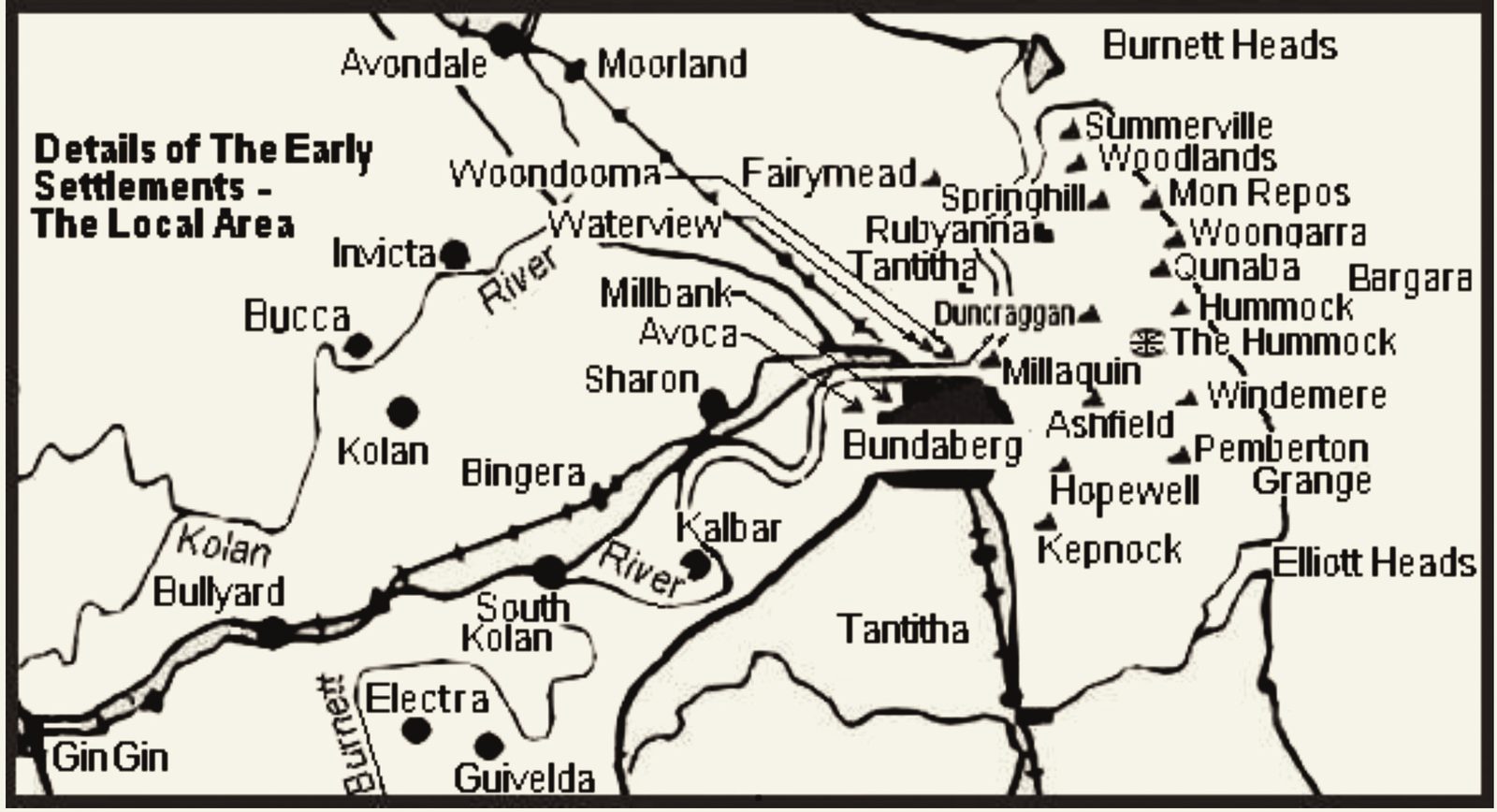
George Greathead – whilst running his shipping business – resided in Maryborough where he was a partner with Mr. F. W. Gladwell in the Central Sugar Factory. Following the sale of his shipping business he relocated to Bundaberg and took up two selections in what is now the Kepnock area. His eldest daughter Anne was born here in one of the selections’ slab huts in 1870. He purchased the Hopewell plantation and mill, but in the following uncertain times had a severe bout of anxiety and depression and committed suicide. His wife Ann and son George persisted with the mill to some modest success and George was later to pursue his own career in the sugar industry.