Chapter Eleven
Irrigation and a Flood
George Manus Adams, Walter and Mary’s eldest son, died of pneumonia, for which there was then no known cure, in Bundaberg on the 19th of November 1888 aged 33 years. His widow, Cecilia Mary (Lillie) Adams, was left with the care of her own four year old son, and of her deceased sister’s children, a twelve year old nephew and three nieces, aged four, two and a baby. Lillie became the licensee of the Metropolitan Hotel following George’s death and she was to hold this licence until 1898. In June of that year an experienced publican, Mr. Martin Moran, became the Metropolitan Hotel’s new licensee. In 1899 Lillie opened the Leichhardt Hotel in Bourbon Street which was renamed the Commercial Hotel upon her departure in 1904, the year of Mary Adams’s death. In 1907 Lillie relocated to Laidley and became the licensee of the Queensland National Hotel until 1910. She retired in 1911 and died in 1918.
The Year of 1889
The pros and cons of large-scale irrigation in the Bundaberg district were under fierce debate in the early months of 1889. The then current views, some of which are described below, document reservations as to the engagement of the services of a firm that had provided professional services, and had met with considerable success, in the South Australian and Victorian colonies. Walter’s proposal for the construction of a co-operative irrigation scheme would prove to have been well ahead of its time, but time itself was to verify the practicality of his vision. A description of the sometimes-conflicting views, as expressed on the floor of Parliament, follows:
The irrigation movement appeared to be making progress although it was claimed to be utterly devoid of original thought and to have based its considerations on the operations of the Chaffey Brothers Note 1 who were well known in both South Australian and Victoria. Their operations consisted of pumping waters from a river having a reliable flow (in this case the Murray) for irrigation purposes, preparatory to selling the newly irrigated lands at a profit that was claimed to be 200 per cent larger than the land’s original cost price. One opinion being expressed was that, with an unlimited supply of water, the design of the works involved in raising it to a height sufficient to allow for its gravitational flow through the distribution pipes and surface channels of any proposed irrigation area was one that should be within the capability of any competent firm of consulting engineers.
It was also claimed by the critics that all of the Chaffey Brothers’ credibility was derived from the application of the knowledge gained from their previous experience in California. Their approach was based upon the concept that the most barren land, in a climate like Queensland, required only the application of water to provide great fertility. Their promotional strength lay in their firm’s successful application of this knowledge in Australia’s southern states which raised the perception that, merely by acquiring their services, profitable irrigation schemes could be designed and constructed.
The irrigation areas of Renmark and Mildura were living illustrations of the enriching properties of water when delivered to dry, potentially arable, agricultural land and the transformation of these areas demonstrated the opportunity loss entailed in neglecting the potential enrichment. However, it was maintained that, while appreciating the results obtained from the Chaffey firm’s activities in the south, it did not follow that they held a monopoly in the ancient art of irrigation. They were not the sole depositories of the knowledge required to create profitable irrigation schemes and so it followed that there was no need for their engagement merely to obtain this expertise.
There was also, in some quarters, a fear that the giving of unreserved patronage to a firm of foreign capitalists might involve the affected communities and individuals in a vast amount of needless expense. The Chaffey’s minimum charge for sending one of their employees to provide advice to potential clients, including the travel expenses, was £1,000 and it was postulated that, should they become established as consulting engineers, then they may be in the position to demand excessively high charges.
Conversely, in a colony where abnormally dry seasons had caused every farmer to wish for irrigation to meet his most pressing need, the services of the Californian irrigators was seen as attractive both by the Minister for Lands and by Mr. Walter Adams, the former due to his responsibility as the relevant Minister and the latter on behalf of the farming interests of the electorate he so ably represented. The replies obtained, in response the Minister’s approaches to the Chaffey Brothers were described as being somewhat vague but Mr. Adams had managed to attract the attention of the Mildura irrigation consultants and to have induced them, for a consideration, to provide a report upon the potential for large scale irrigation in the Bundaberg district.
Opposition to the scheme appeared to hinge upon the (apparently unfounded) fear that major land grants would be issued either to the Chaffey Brothers themselves or to the syndicate, or syndicates, formed to undertake the irrigation project. It was recalled that some governments had obtained the construction of railway lines by issuing grants of Government land in exchange for the investment of foreign capital. The Queensland colony’s Liberal governments had always opposed this approach even though the alternative, the use of the Government’s own capital, resulted in either the creation of large deficits or in the absence of any funds for the construction of other infrastructure projects.
The co-operation of the relevant landholders in the provision of irrigation schemes was considered to be desirable but the opposition believed that an effective organisation could be far more desirably secured by modifying municipal laws to meet the varying circumstances of each district’s situation and that, by utilizing this approach, the benefits of irrigation could be made national. The benefits to the colony, in acquiring far more prosperous farming districts, appeared to have been ignored in this analysis.
The opinion of the Chaffey Brothers’ deputy, as to the feasibility of irrigating the Woongarra Scrub, was anxiously awaited and the progress of any consequential experimental scheme would have attracted considerable interest. The favoured area of superlatively rich, red volcanic soil was capable of yielding, under the influence of irrigation, a wealth of produce such as had not yet entered the imagination of any southern Queenslander. The only, but all important, question raised was that of being able to obtain an adequate supply of water for irrigation and, on this point, there was some doubt.
According to some relevant correspondence that had become public in connection with this aspect of the debate the Elliott River, hitherto regarded as a promising source of supply, was considered to have a surface flow that was far too small to effectively service the 10,000 acres of volcanic soil that had so recently underlain the Woongarra Scrub. It was also realised that the total volume of a river’s flow could not be calculated by measuring the volume of the surface water’s flow in isolation as such a measurement ignored the sub-surface flow which may have a significance equal to or greater than that of the observed surface flow. This characteristic would be applicable to the highly absorptive strata of the Elliott River valley. Note 2
It was also suggested that it may have been possible for the Burnett River bed, in the fresh water zone above the tidal influence, to provide a contribution towards the augmentation of the supply. Then arose the further question, were the Chaffey Brothers with their Californian experience the firm best qualified to cope with the difficulties inherent in the provision of an irrigation supply that met the local conditions; and could they devise the means to overcome them?
The opponents of the proposed scheme tended to discount the Chaffey Brothers’ achievements at Renmark and Mildura. They believed that the selection of those sites for use as examples was intended to take advantage of the juxtaposition of the most bountiful and permanent water-supply in Australia (the Murray River) with the most hopelessly barren looking district in southern Australia (northern Victoria and eastern South Australia) to achieve what was, admittedly, an astonishing result. They considered that the proposed local scheme was being compared to one in a region where, on the one hand, irrigation was easy to introduce and where, on the other, its effects were most striking.
They also claimed that it did not follow, from the Chaffey’s success in the south, that they possessed the qualifications needed to assist the Bundaberg farmers in availing themselves of intermittent, multiple, and possibly remote sources of supply. Indeed, they considered it to be self-evident, based upon the numerous published reports of interviews with the firm, that the Chaffey Brothers did not care to investigate an irrigation scheme for a district not naturally blessed with permanently flowing fresh water streams or large surface bodies of still, fresh water. In the absence of such abundant sources of supply it appeared, to the Government’s opposition, that the firm had formed a very poor opinion of Queensland’s irrigation potential in general. Under such circumstances they had concluded that the Woongarra farmers must rely upon their own ingenuity and perseverance to acquire a profitable, biennial cultivation.
Whilst not mentioned in the above discussions it is relevant that the major rivers in California and the Murray River derive a significant amount of their runoff from snowmelt which has the capacity to produce a predictable stream flow of considerable duration. To achieve a similar result from streams with intermittent flows, as produced by variable seasonal rainfall runoff only, the intervention of a dam storage, or of storages, having significant volumetric capacity is essential.
Following the above debates, and amidst stringent economic circumstances, political interest in the issue of irrigation abated and it would take the passage of nearly seventy years and the advent of stainless steel bore screens together with mechanically driven borehole pumps to tap the aquifer underlying the Woongarra Scrub for irrigation purposes. However, as with virtually all commercial aquifers, this source was very quickly depleted by over-demand and the first stage of a surface water supply was constructed over the period 1970 to 1988. The second stage was commenced in 1993 and completed in 1998 with the construction of the Walla Weir. The Paradise Dam followed in 2005.
Note 1: The Chaffey brothers, George and William, were native to Ontario, Canada and arrived in Australia in the late 1880’s. George arrived first, in February 1886. They were consultants in, and developers of, irrigation for arid areas in California and in the Mildura and Renmark districts of Australia. The techniques that they pioneered made a significant contribution to the implementation of succeeding irrigation systems for agricultural projects in other arid areas of the world. Both George and William Chaffey were engineers and George had developed and refined techniques in the use of large capacity centrifugal pumps to deliver water onto an irrigated property’s high ground thus enabling its subsequent distribution by gravitational flow through distribution channels, all at a commercially manageable cost, whilst William was a pioneer of the dried fruit and wine making industries at Mildura. The Chaffey techniques required a reliable source of water delivery during the crop’s growing season, a circumstance not compatible with the variable flows of Queensland’s streams in the absence of major water storages. A younger brother, Charles, arrived from California to manage their business in the Renmark area leaving William to carry on with his Mildura projects. Following financial difficulties George and Charles returned to the United States and Canada respectively. William remained in Mildura and established the Mildura (later Mildara) Winery Pty. Ltd. He was prominent in Mildura’s local government activities and was appointed a C.M.G. in 1924.
Note 2: With the wisdom of hindsight this was an extremely shrewd observation as it was this absorption, into the bed of the Elliott River, that would later recharge the irrigation bores of the Woongarra.
On the 14th of February Members of the Legislative Assembly Messrs. W. Adams M.LA. and W. B. O’Connell M.LA. together with Mr. James Powers the Mayor of Bundaberg, Messrs Michael Duffy and Andrew Goodwin representing the Bundaberg Municipal Council, the latter being also chairman of the Joint Ferries Board, Messrs. J. C. Walker and H. C. Young representing the Gooburrum Divisional Board and Mr. G. Buss were travelling to Brisbane via Maryborough as a deputation to wait upon the Chief Secretary Note 1 to discuss the terms of repayment of the Government loan proposed to fund the construction of the Burnett River traffic bridge. Mr. Adams introduced the members of the deputation to the Chief Secretary, Mr. Boyd Dunlop Morehead, and the following exchanges then ensued:
Mr. Powers said that the Bundaberg Council’s object was firstly to have the work connected with the structures commenced with as little delay as possible, and secondly to get the work made first-class instead of third-class, which would extend the repayment of the money borrowed over forty years in lieu of the projected twenty.
Mr. Morehead did not think there would be any difficulties lying in the way of the work being made first-class, and said that if the authorities interested had accepted the conditions laid down by the Government, and as set forth in their letter of November last, the preparation of the plans would have proceeded. The Premier had been advised that an Act of Parliament would have to be passed to deal with the Burnett, Maryborough, and Brisbane River traffic bridges, but that this would not preclude an immediate commencement of the preparation of the plans.
Mr. Powers said that if the work was made first-class the authorities were prepared to accept the loan.
Mr. Morehead: “And make it a free bridge?” (i.e. toll free)
Mr. Powers was not so sure of that.
Mr. Morehead considered that, given forty years to repay the money, they could surely make it a free bridge. They were getting £25,000 as a free gift (i.e. a subsidy) from the Government.
Mr. Walker thought that the bridge’s funding should be made as a free gift altogether.
Mr. Morehead replied that the Government could not do that, as they had to find so much money for this and other works. To impose tolls was like going back to a state of barbarism and his impression was that, as soon as the bridge was completed, people would want the toll to be removed.
Mr. Adams explained that Bundaberg’s north bank community was quite small and that the tax would therefore fall most heavily on those to whom the bridge would be of little benefit. (i.e. Bundaberg’s south bank ratepayers)
Mr. Morehead repeated that he was strongly opposed to a toll system.
Mr. Walker believed that the people would rebel against being taxed for the bridge.
Mr. Morehead said he had yielded a good deal in agreeing to make the work first-class.
Mr. Walker said that the people believed that the Government ought to go further and assume responsibility for the construction.
Mr. Morehead considered that the Bundaberg district had already received its fair share of public works and stated that he would not move from the position he had taken regarding the question of tolls. As soon as the authorities accepted the conditions laid down by the Government plans would be prepared and an Act to authorize the construction of the bridge, if such were required, would be brought forward early in the next session. Several members of the deputation thought that people in the district would have been quite willing to pay a toll to cross the river by bridge instead of paying a toll to the operators of the current ferry. The Government ought not to interfere in the matter as four-fifths of the traffic would be purely local, and the people on both sides of the river had expressed themselves in favour of a toll system and against the levying of a special rate.
Mr. Cowley explained that an insuperable bar to the levying of any interest rate on a loan raised for the bridge’s construction was that the Bundaberg population had already borrowed as much money from the Government as they were allowed to under the Act and Mr. Goodwin did not think that, if the Government insisted on the bridge being a free one, the authorities could authorize the loan.
Mr. Morehead considered that all these things should have been included in the papers on the subject laid before the Government. He would consult with the previous Premier, Sir Thomas M’Ilwraith, on his return to the colony, as Sir Thomas knew more about the initial stages of the project than he did and, in the meantime, the preparation of the plans could proceed. He would also consult with the Minister of Justice as to the necessity of introducing a separate Act to validate the bridge’s construction. If so the Act would be brought forward in the House early next session and, if not, he saw no reason why the work could not be commenced as soon as possible. The deputation then withdrew.
Political activity on the Perry Street (North side) to Quay Street (South Bank) cross-river bridge was to go into abeyance for a considerable number of years due to the colony’s lack of funds. The construction of the existing iron-trussed, cross-river bridge of eight spans commenced in 1898 and was completed to be ready for its much-delayed opening in August 1900.
Note 1: The position of Chief Secretary was created on the 1st of April 1886. This position ultimately became that of Premier and on the 7th of July 1898 the Chief Secretary’s Office became an independent Department entitled The Chief Secretary’s Department.
With heavy rains falling in New South Wales, and to the south of the colony, the Bundaberg district could not have expected to escape its share of the downpour. The Government Meteorologist had predicted unsettled weather for southern Queensland that would result in significant rainfall and, with the rain still falling at intervals, it was likely that further wet weather could be expected. There was every prospect of a mild winter to follow and the sugar crushing, proposed to commence in August, was anticipated to be a very successful one.
April 1889 marked the completion of one of Bundaberg’s major heritage buildings in Bourbon Street. A new and architecturally significant School of Arts building was completed by the builder Mr. Calvert under the direction of architect Mr. Hettrich. The building provided the town library, committee rooms and offices on the ground floor with a reading room, a museum (having a limited number of exhibits) and a chess room on the first floor.
The new bridge in Tantitha Street had been completed in May with the roadway open to light traffic. Works were then being undertaken in Quay Street and on the Kennedy Bridge repairs. The first Kennedy Bridge, that had been opened in April 1878, was of wooden construction and, following its opening, it had successfully promoted East Bundaberg’s development. The second, existing bridge of single span iron truss construction was to open in 1899 with a truss design almost identical to that of the present Perry Street-Quay Street Burnett River road bridge and of Brisbane’s, now replaced, Victoria Bridge.
Trivial issues from the June Sittings of the House:
Walter Adams: “Mr. Jordan says the Land Act of 1884 is perfect. I agree with him. It is a perfect disgrace.” and later
Treasurer Pattison to William Smyth: “You will find that the Treasurer will always keep his word.”.
Chorus of members – “What - always?”
Treasurer Pattison: “Er - almost - nearly always - some-times.”
The Government gave the House a clear intimation of its policy concerning the mooted five year extension of Polynesian labour employment. Mr. A. S. Cowley, of the Sugar Royal Commission, brought forward his promised motion in favour of such extension: “That, in the opinion of this House, it is desirable, early next Session, to adopt some means of encouraging the sugar industry.”
Mr. Cowley made a well worded speech giving his point of view by recapitulating the conventional arguments in favour of Polynesian (Melanesian) labour and giving much statistical information to show the immense value of the sugar industry in Queensland. Mr. Cowley spoke for about two and a half hours, and there was then a considerable hesitation as to who should follow him in addressing the motion. Not a Minister moved a muscle, and at last Walter Adams and Fassifern’s Mr. Salkeld both rose at once. On perceiving this the Opposition emitted a roar saying, “Let the Government speak”, while Ministers, nothing backward, shouted for Mr. Groom, the Chairman of the Sugar Commission, whose summation of the final report had differed from that of his colleagues, to address the floor. However, Walter Adams, caught the Speaker’s eye and rose to deliver a short speech in favour of the plantations’ use of Pacific Island labour following which Mr. Salkeld provided a somewhat aimless contradiction and the debate concluded.
Then Mr. Morehead rose and tantalized the leader of the opposition, Sir Samuel Griffith, a little on his view as to what the Government was not going to do - for instance they were not going to let Samuel import white labourers from Scandinavia or Germany. He then, in brief unmistakable tones, declared the Government policy as, “The Government does not intend to extend the present existing provisions of the Polynesian Labor Act”, though he then added that the Government was prepared to assist sugar-planters by assisting with irrigation, or other means of protection or conservation. No member on the Government side of the House desired to see Queensland a Polynesian country, added Morehead, with emphasis. Sir Samuel Griffith was thus compelled to forego his anticipated task of denouncing the Government.
The debate continued with little interest, although Archibald Archer, the patriarch of Gracemere, arose and sought reversed glory by declaring himself to be a champion of Islander labour. The debate adjourned with Sir Samuel Griffith having moved an amendment which, if carried, would have caused the motion to read: “That, in the opinion of this House, it is desirable, early next Session, to adopt some means, not involving a reopening of the coloured labour question, for encouraging the sugar industry.”
After Mr. Salkeld had expressed his own opinions on Mr. Cowley’s sugar industry motion, Premier Morehead rose to speak. Sir Samuel Griffith thereupon interjected: “We have drawn him at last!” Morehead promptly and good humouredly met the sneer: “I hope it is satisfactory to the Leader of the Opposition that I have been drawn at last, though I confess it is rather humiliating to have to be drawn by the Honourable Member for Fassifern.”
The Brisbane Courier in its edition of the 4th of June 1889 reported that:
“The crushing mill intended for the central district of Childers is to have double rollers and is to be otherwise provided with the most modern improvements, both in strength and in labour saving appliances. The juice will be conveyed by train to either Yengarie or to the Millaquin refinery, as necessity may require. It is a pity that the settlers already living in the vicinity of this central factory have, up till lately, not shown much alacrity in responding to the efforts of the Messrs. Cran. There are two causes for this. One is that, about five years ago, it was given out that a central sugar factory would be erected at the north end of this big scrub. The site for the intended factory was cleared and the adjoining farmers planted as much cane as they could afford; but the mill project fell through, and the unlucky farmers had the cane (crop) left on their hands. The second drawback to cane cultivation at the Isis is the present uncertainty of the kanaka labour question. It may be possible for small settlers to grow sugarcane for the central mills with the help of their families alone but, in most cases, the Isis people must employ white labour if they go in for sugar while the (tree) stumps of the (cleared) scrub are still standing and they naturally fear the consequences. Being practical they know the importance of being able to work with the plough.
It would be little short of a calamity if the present efforts of the Messrs. Cran fell through by reason of the apathy of the farmers of the scrub, for this central mill is to be one of the best examples of division of labour in the production of sugar that can possibly exist. First, the farmer need do nothing but grow the cane, which the mill-owners guarantee to take at the stump at a specified price, and secondly, the planter has the option of delivering the cane to the mill at a higher rate per ton if he so chooses to work.”
The Maryborough Chronicle in its edition of the 25th of July 1889 reported that: “We understand that Walkers Limited have received orders to construct a large double crushing plant, similar to that made for the Cran Brothers plantation Duncraggan, for Cran and Co.’s central mill at Barcumppl, Isis Scrub. Planting is now the order of the day for next season, when the first crushing on the Isis will take place. The juice will be conveyed in tanks by rail to Yengarie for treatment.”
The Isis Central Sugar Mill is now the only remaining sugar mill in the Childers district with its last remaining competitor, the Childers mill of the Colonial Sugar Refineries, having closed in 1933 during the Great Depression. Cordalba selectors had established the Isis Central Mill Company in 1894 and clearing of the land for their mill and the extension of the Childers branch railway line to Cordalba took place in 1896. The Isis Central was constructed by Walkers Limited for the shareholding selectors at a cost of £26,000. Its first crushing took place in September 1897 and produced 810 tons of raw sugar. Following the closure of the district’s competing mills the production of sugar at the Isis Central had doubled by the 1930’s.
The Bundaberg rowing season was opened on a Thursday afternoon, the 1st of August, with a series of scratch races between competing members, following the appointment of the new Bundaberg Rowing Club Committee in July. Those members elected to the new committee were: President, Sir Thomas M’Ilwraith; Vice-presidents, Messrs. Walter Adams M.L.A., Michael Duffy, Robert Fleming, and W. H. Fox; Honorary treasurer, Mr. W. Wyper, Honorary secretary, Mr. A. M’Intosh; Captain, Mr. B. Hull; Committee, Captain W. Collin, Messrs. Coglan, J. Fleming, J. Walden, J. Skinner, and W. C. Aiken.
The July 1889 meeting of the Bundaberg Chamber of Commerce was held at the office of the Chamber’s secretary, Mr. W. H. May. Those present at the meeting were: Mr. Curtis, the Chairman, with Messrs. A. M. Goodwin, D. J. Powers, W. H. Fox, Gillen, Woolley, White, and Payne (Members). Following the reading and confirmation of the previous meeting’s minutes the correspondence, which included the communications described in the following paragraphs, was presented:
From the Cooktown Chamber of Commerce, calling attention to the necessity for a better distribution system for harbour works expenditure throughout the colony, suggesting that an Act of Parliament be passed to create independent Harbour Trusts and asking the Bundaberg Chamber of Commerce to co-operate with it in securing this objective and, from Mr. Adams M.L.A., confidential correspondence related to dredging operations in the Burnett River which provoked much discussion and which was obviously well received as it ended in a vote of thanks to Mr. Adams being passed; and
From the Brisbane Chamber of Commerce with reference to forest conservation and with reference to this letter Mr. Curtis moved, “That Bundaberg being the centre of a thriving timber industry this Chamber is fully sensible of the need for Forest Conservancy, and cordially endorses the initiative taken by the Brisbane Chamber of Commerce towards securing it.”
The Year of 1890
Over the Decade 1890 to 1900 Some Significant Occurrences in the Home Country Were:
The arrival of American wheat in England marked the beginning of the end for the holding of England’s ‘Old Money’, as invested in the large rural estates of the landed squires, and the end of the traditional aristocratic lifestyle in general. The ‘New Money’ of the northern industrialists had become entrenched; and
The time of Oscar Wilde’s The Importance of Being Earnest; Beatrice Webb’s (née Potter) Peter Rabbit, with her enthusiasm for Fabian socialism and conservation; and of the recognition of the young artist, Aubrey Beardsley.
The following is a much foreshortened and edited version of an article that appeared in the 30th of January 1890’s edition of the Bundaberg Tribune its author and publisher being Mr. W. C. Aiken and its editor being Mr. J. Y. Walker:
The most calamitous flood that had occurred within the memory of the oldest inhabitant, whether of white man or aboriginal, reached the lower Burnett late in January. Prior to the early hours of the Friday morning there had been nothing unusual concerning the weather worthy of report but, later in that afternoon, telegrams were received from Mount Perry stating that several inches of rain had fallen during the day and the rain was continuing with no prospect of cessation. Gin Gin then reported an even heavier downfall and, during the Friday night, the effect on river levels was startling in the extreme.
There had been virtually no preparation on the wharves for a major flood, and it was not until nearly midnight that gangs of men were engaged to remove the goods stacked ready for export shipment or for town delivery. Then, between midnight and sunrise, the river rose a foot every quarter of an hour and, too late, it became evident that the labour at hand on Patrick Duffy’s wharf was insufficient to cope with the advancing flood. Had the firefighting bell been rung it would have rallied a few hundred willing hands and Patrick may have sustained no loss. As it was there were allegations made that most of the men engaged to transfer the goods were so indifferent to their employer’s interests that they had performed little work and seemed to regard the matter as a joke, evidently under the false impression that the longer they could prolong the work the longer their engagement at two shillings per hour would last. If this had been their prevailing idea then they were doomed to disappointment for, at about 6 a.m. on the Saturday morning, maize, flour and sugar, all to the value of £400 sterling were washed away.
The river continued to rise all day and Saltwater Creek, with its rising back-water, encroached rapidly upon all the low-lying southern areas of the town. Walla Street, Tantitha Street and Targo Street were soon closed to vehicular traffic and boats were requisitioned, two of which were supplied by the Municipal Council, at the order of the Mayor, to assist the threatened inhabitants. The misery and desolation then being experienced by hundreds of people almost baffles description and the night of Saturday the 25th of January 1890 was long remembered by those whose lot it was to endure such discomfort and loss. Within the short space of twenty-four hours scores of happy, comfortable homes were converted into unrecognisable, mud-polluted hovels.
Communication with Gayndah was cut off at 5 p.m. on the Friday so that no further information could be obtained as to likely rises in water levels. However, the rainfall must have continued upstream as there was a noticeable rising in the river levels up to midnight on the Sunday. Comparison with the marks made by the Customs officials in 1875 indicated that the 1875 flood, previously the highest recorded in the district, had been exceeded by 14½ inches (368 mm.); and on the north side of the river, from marks made in the Mulgrave Hotel, the water reached two feet (610 mm.) above the earlier register.
Most of the cylindrical columns of the Burnett River railway bridge, then under construction, had been displaced and those remaining required re-adjustment with a heavy financial loss to the contractor, Mr. Johnstone, who also suffered serious loss of equipment. Extensive damage was also inflicted upon the wharves with the shed on the Phoenix Wharf washed away on the Saturday night; a little while afterwards the shed on the south side’s Government wharf shared a similar fate and early on Sunday afternoon the capacious shed on Michael Duffy’s wharf also disappeared into the torrent. The removal of the contents from the wharf’s north side shed to the top of the riverbank on the Friday night had been near to completion and Mr. Christsen had considered that this was sufficient to ensure their security but, as the water rose, it became apparent that only complete removal from North Bundaberg would suffice. As this had become impossible a serious loss of maize and other produce ensued.
When the water approached the steps of the Mulgrave Hotel in North Bundaberg, recollections of the ‘early days’ entered the minds of the residents who had witnessed the flood of ‘75. No other course being open, preparations for an evacuation were made with all alacrity, and it is greatly to the credit of Mr. E. Daly, the station-master in charge, that without solicitation he had placed trains at the service of the large number of people, complete with their belongings, wishing to move on to the higher ground further inland. Others, headed and guided by the relief parties organised by Mr. J. C. Walker, relocated to the school house where they were to camp and Mr. Walker at his own expense, provided them with sustenance. Kenneth Buchanan, of Oakwood Plantation, invited all and sundry to take shelter in the houses and sheds on his property and provided them with abundant food to indicate his sympathy for his distressed neighbours in their hour of need. Mr. C. Henker supplied large quantities of pineapples and grapes; Mr. Mooney contributed gallons of milk and all of the settlers around rendered invaluable aid free of cost.
The river’s current in the neighbourhood of the north bank’s railway yards was estimated to have a velocity of at least ten miles (16.7 kilometres) per hour and four men, who had been linked together for security, were washed off their feet and carried a considerable distance before their eventual rescue. A large amount of damage, mainly consisting of holes and washouts, was inflicted upon many of the roads and streets in the Gooburrum Division and, following the flood, Mr. Amos had gangs of men restoring the thoroughfares to working order. The brother-in-law of the late George Manus Adams, Mr. Lewis O’Mara, had his commodious Railway Hotel with its billiard-room completely wrecked, and numerous other structures were displaced from their foundations. For the first half-mile from the North Bundaberg station the Mount Perry railway line resembled the celebrated Switchback Railway with graceful curves formed by the washing away of ballast and a number of trucks on the line, some heavily laden with timber logs, assumed every alignment other than that of the vertical.
Reports from up the country indicated that many struggling farmers were ruined. Crops, stock, household furniture, and even the houses themselves had all disappeared, some friendly gum trees affording shelter to various families until they were rescued by search parties. The most acute sufferers were those on the flats and scrubs within a short distance of the river and those effected were so numerous that the material wealth of the district had been considerably diminished, as their losses were subsequently passed on to the town’s trading businesses, and from there to the entire community.
The north side ferry’s approach was covered by a sand deposit several feet in depth, which necessitated the construction of a new approach. At the Bundaberg Foundry, the force of the current burst in one side of the building, undermined the foundations, wrecked the boilers and damaged the heavy machinery. No one had even imagined that floodwaters could reach the floor of the foundry, with its earth bank protection, but the current had washed the bank away leaving only a shallow basin.
At the Waterview timber mill and sugar-cane plantation the flood damage was appalling. Logs and sawn timber were carried away, buildings destroyed, machinery damaged and the previously magnificent crop of cane badly needed a good rainstorm to wash off the sludge. The Fairymead plantation suffered complete inundation with all of the property under one vast sheet of water. The Messrs. Young, with all of their staff and hands, had to seek shelter wherever it could be found. On the Sunday Mr. Robert Totten had very thoughtfully provided the plantation’s hands with a boat load of provisions. As at Waterview and Fairymead, Habbro and Woondooma were completely submerged with only the chimney of Mr. Gladwell’s mill and its surrounding gum trees remaining visible.
In East Bundaberg the river overflowed near Mr. Henry Skyring’s mill and the back water entered Saltwater Creek adding a vast volume of water to its channel and surrounds. The stacks of timber and everything else left unsecured at the mill were washed away and the machinery was extensively damaged. For some time past Mr. Skyring had been struggling with adversity and then, just as prosperity seemed to have arrived, he received another terrible blow. Mr. G. J. Young’s house at Beulah was entered by three feet of water and the residences of Messrs. Hamilton and Skyring were also flooded. Mr. Fleming suffered heavy losses owing to flood inflicted damage on his furniture and the effects of flooding on his gas-works. Mr. David Scott lost heavily, through the washing away of his logs and sawn timber, and the general effect upon the machinery in his mill.
At South Bundaberg the water reached as far as Tattersalls Hotel, and almost into Burnett Street at its intersection with Targo Street. Normanby Square was uninhabitable, and nothing live remained in the locality but a few stray fowls sheltering on the house tops. In West Bundaberg the river overflowed into both Quay and Bourbon Streets, coming in from above the hospital, though in these locations there was no strong current.
At Millbank M. T. Penny narrowly escaped drowning as he was on the way to inspect his mill and the accompanying workers’ housing when his horse panicked and began to plunge, forcing the rider to dismount and swim for about a quarter of a mile. It was some time afterwards before it was ascertained that he was safe. It was later discovered that the Millbank cane crop had been almost totally destroyed.
A man named Jacob Ernst, who had a wife and young family, tried to ford the water near East Bundaberg on horseback but lost his hold and was drowned. He had been repeatedly warned to desist from this foolhardy attempt, but all solicitation was in vain. About midnight on the Sunday a punt moored at North Bundaberg broke away from its moorings with the well-known shipwright, Peter Moar, on board. Viewers saw the punt’s light extinguished and a cry, as of someone in distress, was heard. Whether the punt was carried out to sea with the unfortunate Mr. Moar on board, or whether it collided with some object and was sunk, is a matter of conjecture. On the following Tuesday the steamer Lady Musgrave was chartered by the Government for harbour officials to make a thorough search of the river but there was no trace of the punt, or of its unfortunate occupant.
On the Sunday afternoon the view from the Sloping Hummock located about seven miles east of the town, presented a dismal scene. In the foreground the fields of the Woongarra were high and dry, well above the flood’s influence, but beyond and to the west, north and east the presence of flood water was everywhere to be seen. The turbid, red Burnett River flow discharged far into Hervey Bay, displacing its blue waters for many a mile, and leaving a clear line of demarcation. Towards the town, an occasional roof or isolated chimney indicated the site of a submerged mill or a rural residence.
Amongst the less serious inconveniences of the flood was the displacement of ants, spiders, grasshoppers, centipedes and scorpions. When an occasional snake was added, the annoyance became a matter of actual danger. Horsemen riding or swimming their horses through the flood waters in the suburbs were boarded by innumerable hordes of these vermin, which occurred in their myriads, crawling or swimming to escape the advancing flood. The partially submerged houses and fences provided this displaced vermin with refuge and their presence, on the reoccupation of the houses, proved to be both a serious hazard and an additional discomfort to those implementing the removal of the slime and mud that was defiling the residences’ interiors.
The Bundaberg Weekly Tribune of the 29th of June 1889 gave the following description of Bundaberg’s proposed third post office:
“The plans for the new Post and Telegraph Office, for which tenders close on the 12th proximo (of July), provide for a handsome and commodious two-storied structure at the corner of Bourbon and Barolin Streets, presenting an ornamental and well-designed facade of equal length to both streets; and not unworthy of being placed in juxtaposition with the School of Arts building across the way, or the probably ornate erections about to be placed on the Royal Bank and Royal Hotel opposite corners. At the angle of the building is a light and graceful clock tower, 93 feet in height, surmounted by a dome and topped by a flagstaff which will probably be utilised for the daily exhibition of a time ball, which, from the situation and elevation of the tower, will be visible from every part of the town. The ground plan shows that ample provision has been made as respects the convenient transaction of business, not only for present requirements but for such expansion as may reasonably be anticipated for many years to come. All the departments - telegraphic, delivery, money-order and private boxes - are conveniently connected by a covered arcade; and a large sorting room provides facilities not at present available for the expeditious delivery and dispatch of mails. Single storey wings at each end provide lumber and storage rooms etc. and the tout ensemble of the premises, no less than the convenience and completeness of the internal arrangements is highly satisfactory. The yard accommodation is unfortunately rather scanty, but this will scarcely be felt as an inconvenience unless the second storey be allotted as quarters to the two chief officers which has not yet, we understand, been settled. The estimated cost of the structure, for which amount the vote was passed in the last parliamentary session, is £7,000.”
And in 1890 Mr. J. Y. Walker wrote: “The progress of the town has since been so great and so entirely beyond the anticipations of the designers of the second new Post Office that a third new building has already been found necessary. This is now approaching completion; and is a much more costly and ornamental structure. Its cost will be considerably over £6,000 and it is expected to be sufficient for the public requirements for many years. It occupies a commanding and convenient position at the corner of Bourbon and Barolin-streets presenting an extensive and handsome brick and cement facade to both thoroughfares and is surmounted by an elegant clock tower a hundred feet in height.”
Bundaberg, in early 1890, was described by a special reporter of the Brisbane Courier, in its edition of Monday the 17th of February, as being a neat little town having massive public buildings, including its School of Arts, half a dozen good hotels and the handsome premises of the Queensland National Bank. He was also impressed by its urban streets which he described as being magnificent in their width. He noted that its current prosperity had been founded almost entirely upon the sugar industry’s successful introduction some ten or twelve years previously. Following its introduction to the lower Burnett it had, by 1890, virtually supplanted the preceding maize and timber industries. The following gives an abbreviated account of his very extensive and detailed report:
The special reporter credited the sugar industry with improving the values of the local lands and inducing speculators to construct expensive buildings on the town allotments. Capital from far and near had been attracted to provide the sugar industry with £771,199 worth of the machinery needed to manufacture its product. The amount of sugar exported from Bundaberg over the previous three years was: In 1887, exported and removed coastwise - 13,096 tons; in 1888, exported 7,792 tons & removed coastwise - 7,998 tons - a total of 15,790 tons; in 1889, exported - 3,770 tons & removed coastwise - 5,927 tons - a total of 9,697 tons. Add to this, say, 500 tons per annum for local consumption. The sugar’s export value for these three years, as calculated by multiplying the on-ship tonnages listed above by the reporter’s estimated ‘all round’ value of £15 per ton, gives an export value for the combined-on ship consignments of £578,745. These statistics illustrate that, for the previous three seasons, one was moderate, the next was middling, and the last one was decidedly bad. The 1890 season, however, was expected to outstrip them all with estimates of the pending yield being in excess of 20,000 tons.
During his visit to Bundaberg several matters relating to the sugar industry had created a marked impression. One impression was that the industry was not expanding and, if this was so, had it reached the meridian of its existence? There was no apparent decline, as there was in the sugar industry at Maryborough, and yet there was no expansion. The planters had told him that the cultivation of sugar was of such nature that white labourers were unwilling, or unable, to undertake the work of the fields and yet the government was denying the planters the right to engage Islanders who were willing and able to do this work. The Polynesian (Melanesian) labourer was referred to as being ‘reliable’ in contradistinction, presumably, to the white man who was ‘unreliable.’ At the end of the year 1890, and by the colonial government’s act of 1885, all further introduction of Polynesian labour was to be stopped. On discussing the matter freely with all the sugar-growers and manufacturers that he had encountered during his recent tour of the Wide Bay and Burnett districts he discovered that the topic of labour was the dominant topic.
In researching the labour question the reporter had talked with Mr. Angus Gibson, the managing partner of the firm of Gibson and Howes of the Bingera Plantation that was situated twelve miles from Bundaberg on the north side of the Burnett River. Mr. Gibson was regarded as being a representative Bundaberg planter who had given white labour access to his plantation. Mr. Gibson said that in the crushing season he employed 70 white men and that he retained 200 Islander men on the plantation all the year round. Fifteen years ago Mr. Gibson had cultivated 200 acres of sugar at Hemmant, near Brisbane, using only white labour and had made the enterprise, in a marked degree, successful. In reply to the reporter’s reference to that bygone experience Mr. Gibson stated that, “when the white labour was plentiful at £30 per annum and rations, and with sugar in demand at from £32 to £35 per ton, the industry paid fairly well when working on a twelve-hour day.”
In reply to a question as to whether or not implementation of the central mill principle would allow the industry to carry on with white labour only, Mr. Gibson said that the central mill system had been in vogue at Hemmant on a small scale but that he had found the farmers who were growing the cane were very unreliable and that, in those days, 14 to 15 shilling per ton was paid for cane delivered at the mill.
And in reply to the question, what are you going to do for labour at the close of 1893 when the Islanders are withdrawn, Mr. Gibson indicated that at Bingera a sugar production of 2,500 tons was anticipated from the 1,200 acres under crop and he gave the courageous response that he would never give up and that he would push on without Islander labour until he sank. Two classes of refined sugar were being produced at Bingera, the average net value of which was £17 per ton. To that date a return of from 9% to 10% per annum had been realized on a capital investment of £100,000 by the estate. Mr. Gibson’s closing remark was, “that the Bundaberg district was far more favourably situated than any other for the exclusive employment of white labour.”
Next the reporter obtained opinions on labour from Mr. Samuel Johnston of Waterview who had pioneered several different industries in Bundaberg, finally to become a sugar planter. Mr. Johnston thought that, without Islander labour, the sugar industry would experience a lingering death. In his own words, “The planters will get out of it as best they can.” Mr. Johnston further expressed the opinion that, even after the expiry of their agreements in 1893, the Islanders would remain in the district of their own free will to work for wages in the cane fields.
Mr. H. A. C. Young of Fairymead was a businessman, as well as a planter, and had a very large stake in the sugar industry. He took a gloomy view of the political situation. Fairymead, like Bingera, was a gigantic concern, its cultivated area being 1,250 acres. It manufactured only raw sugar yet so excellent was its quality that it successfully competed against the best refined sugars. The Young’s family business had refined the manufacture of sugar to a standard that none of their district contemporaries had yet attained. Mr. Young thought that, without some measure of compensation, the sugar industry would be in a very bad way following the withdrawal of the Islanders and claimed that, “Yes, the system of cane farming and central milling would be feasible if the colony had a tariff advantage over the sugars produced by black labour in other portions of the globe; but not otherwise.” He could see no prospect in the future that was not fraught with disaster for the sugar industry. Fairymead then employed 75 white men in the crushing season and 300 Islanders all the year round. The white men received double the money paid to the Islanders, notwithstanding the great difference in their respective numbers, but that did not include the clothes, rations, full year’s accommodation and passage money provided for the Islanders.
Mr. Hickson of Rubyanna, who employed 25 whites in the season and 70 Islanders all the year round, also took a very despondent view of the situation, and thought that the sugar lands would have to be converted to other purposes after the Islanders were withdrawn.
The reporter wondered if it was in preparation for the ‘great struggle’ expected to follow the closure of Islander indenture in 1893 that two of the largest industry participants were already adopting the central mill system in the Bundaberg district. The great refinery Millaquin, with its capital investment of from £150,000 to £160,000, had all along been a central mill of a kind and had been, for the most part, independent of Island labour. The rich plantations in the fertile Woongarra Scrub area were mostly provided with satellite mills that crushed the cane but did not convert the juice to sugar. After being ‘limed’ the extracted juice was conveyed, through an intricate system of underground pipelines, to Millaquin for the sugar’s manufacture. The giant mill, like the smaller manufacturing concerns in the district, only worked during the ‘season’, the time when the cane is mature and ready for crushing and the density of the juice has reached its maximum amount. The crushing generally began in the winter and lasted into the start of the ensuing summer. Over this period the refinery machinery worked day and night.
At Millaquin 170 white men and 18 Islanders were employed. Mr. John Cran, the manager, states that the Islanders were only employed at such work as white men had repeatedly refused to do, probably in the areas of molasses handling and sugar drying. The output from Millaquin during a good season was 10,000 tons, which resulted in an average market value of £21 per ton. It was in this mill that half the entire output of the district was manufactured and, in the main, with white labour so that the refinery was not directly involved in the Island labour question. However, Pacific Island labour was employed in cultivating the cane which produced the juice that Millaquin utilized for the sugar’s manufacture. The Millaquin planters community was located in the Woongarra Scrub which was the name given to 10,000 to 12,000 acres of rich volcanic land to the east of the mill. Less than a decade had passed since these fertile cane-fields had supported a mass of thick and luxuriant scrub. The land, in places, had borne a thick covering of rocks that, together with the rich red soil, had weathered from the decomposing lava deposits that had been ejected from the Hummock during its volcanic stage. Following the felling and burning of the scrub the rocks had been collected and converted into (drystone) boundary walls or used in road pavement construction. The execution of these works had converted the land into a state highly suitable for profitable cultivation. In viewing this situation, the reporter wondered, “Will not mechanical cultivation, in great measure, replace the system of hand cultivation?” Note 1
He had regarded the refinery as the huge progenitor of the central mill in the Bundaberg district. The other two relevant mills were Fairymead and Bingera, whose centralizing operations were then of a comparatively recent date. The Gooburrum Scrub was adjacent to the mill at Fairymead and its initial agricultural efforts had been confined to maize-growing which, until less than two years previously, had involved only a few settlers. It was then that the proprietors of Fairymead made overtures to the area’s farmers to grow cane. The farmers of Gooburrum had then planted 500 acres of cane and intended to plant 300 more for the coming season. The Messrs. Young had connected the scrub farms to their mill utilizing a tramway system and they provided the labour to cut the cane and to load the tramcars. They then paid the farmers seven shillings per ton for their harvested cane. This arrangement, however, was to last only if the Island labour was available. After that the farmers would have to derive their own labour from other sources under an entirely new arrangement. As it was, the farmers provided and planted the land and then kept the young cane free from weeds until the cane grew high enough to deprive the unwanted flora of moisture and sun light.
In a similar fashion, at Bingera, Mr. Gibson had entered into an agreement with twenty farmers to supply him with 500 acres of cut cane, 400 of which were then under crop. The farms were situated in the scrub three miles from the mill to which they also were connected by a tramway. The farmers were paid nine shillings per ton, without deductions, for the cane. Mr. Gibson admitted that he regarded this as only a partial solution to the labour problem. If the centralized mill system was to discover a permanent solution to the labour problem then, opined the reporter, agriculture would receive an impetus of a magnitude that it had never known before. There were, at the time, 2,350 Islanders in the Bundaberg district of whom 2,100 held formal agreements with the sugar planters thus giving a proportion of white to Island labour employed in the sugar industry a ratio of four white to ten Pacific Island workers.
In early 1890 the sugar industry’s prospects were regarded as being excellent, but only short term. The planters were counting on the certainty of four more crop harvests before the termination of the Islander indenture system and the first of these harvests would certainly be one of unparalleled magnitude in terms of local experience. The reporter had previously visited the sugar estates on the Herbert and Burdekin Rivers as well as those of Cooktown and Mackay, all in the far north, but had never seen cane superior to that which was then growing in the vicinity of Bundaberg. It could, on a rough estimate, be regarded as a two ton to the acre crop. The rum distillery, recently established at Bundaberg, bought molasses from its sugar-growing shareholders at 3d. per gallon. As hitherto the molasses had been entirely wasted the sale of this product meant profits to the distillery’s shareholders and additional profits to the growers of the cane.
In conclusion, the reporter remarked that the town of Bundaberg showed an extreme degree of commercial depression notwithstanding the magnificent prospects of the forthcoming sugar season. He had been told that this depression had resulted from the restrictive lending policies of institutions that had financial interests in the now uncertain future of the properties and industries in the town and district.
Note 1: A very perceptive observation. Mechanical harvesting was to arrive much later than mechanized ploughing and, for the unfired cane, had to wait until the invention of the first successful mechanical harvester by the Toft Brothers of Bundaberg in the mid 1900’s. Machines that could harvest the pre-fired cane only had been available for some years prior to this. Firing, or burning off, of the cane crop, whilst removing the unwanted leaves of the plant, necessitated the prompt harvesting and milling of the crop to avoid fermentation of the cane stalk’s contained sugars.
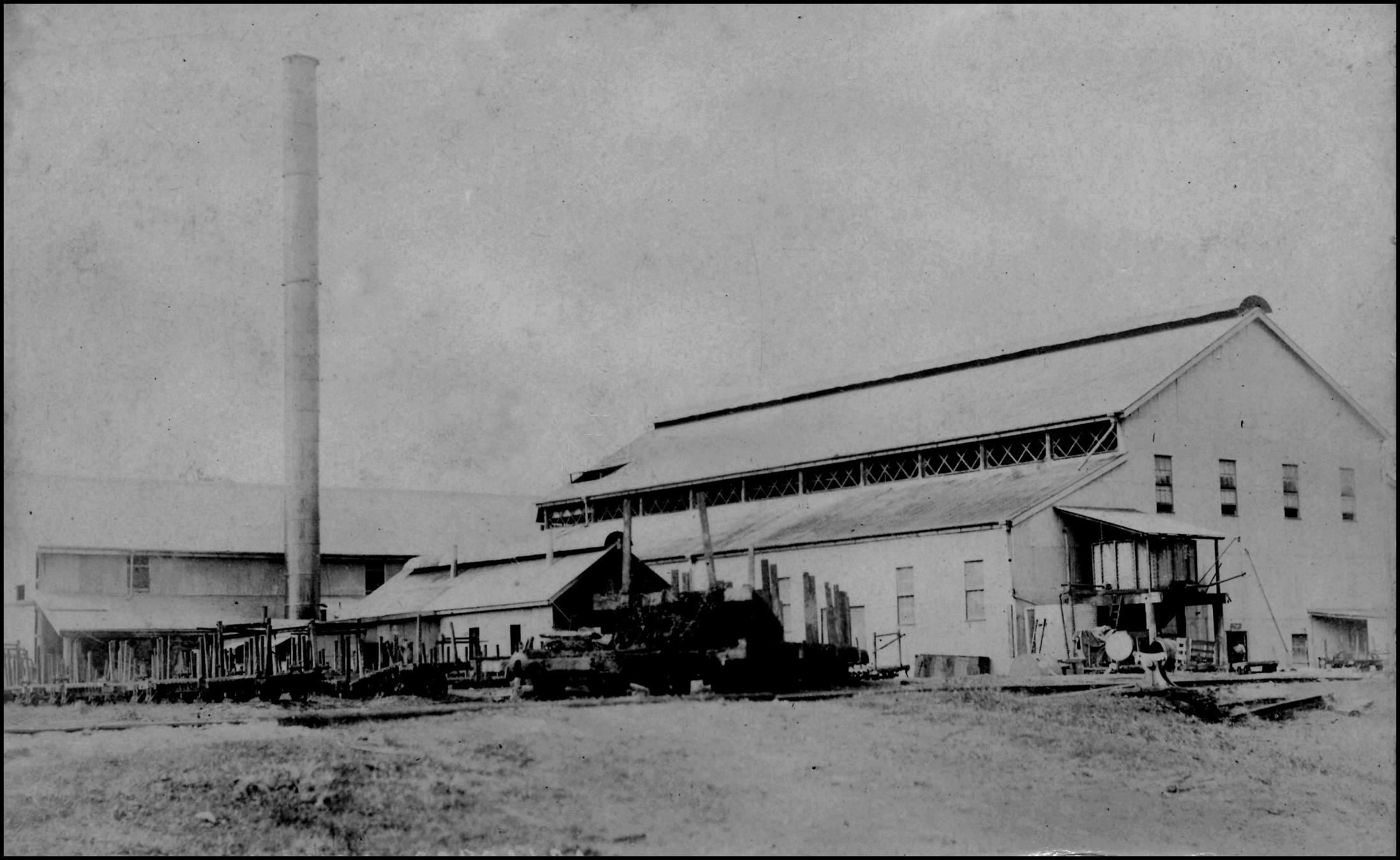
An Early Photograph - From the Jorgensen Family Collection
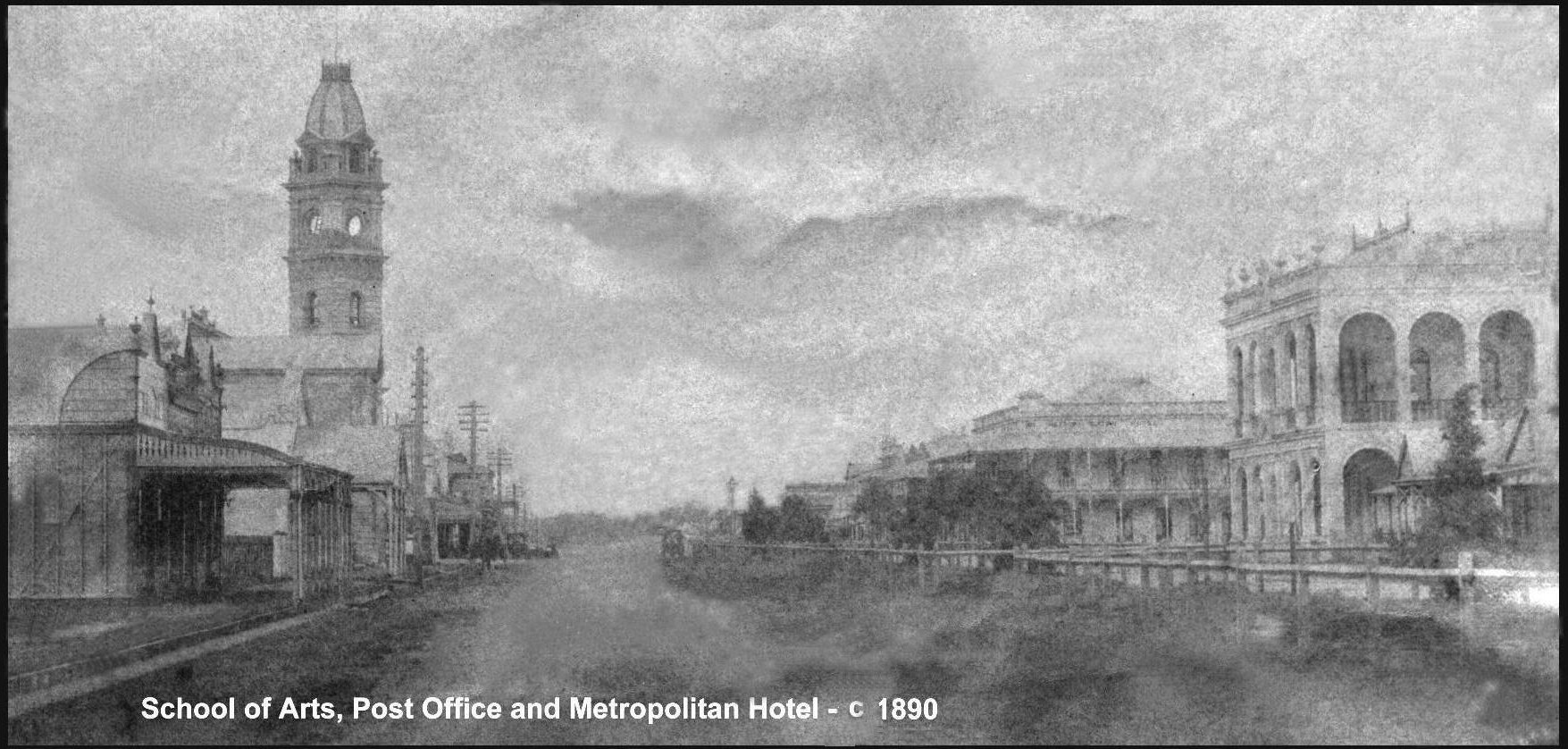
From J. Y. Walker’s HISTORY OF BUNDABERG – 1890 - Note the Empty Clock Tower
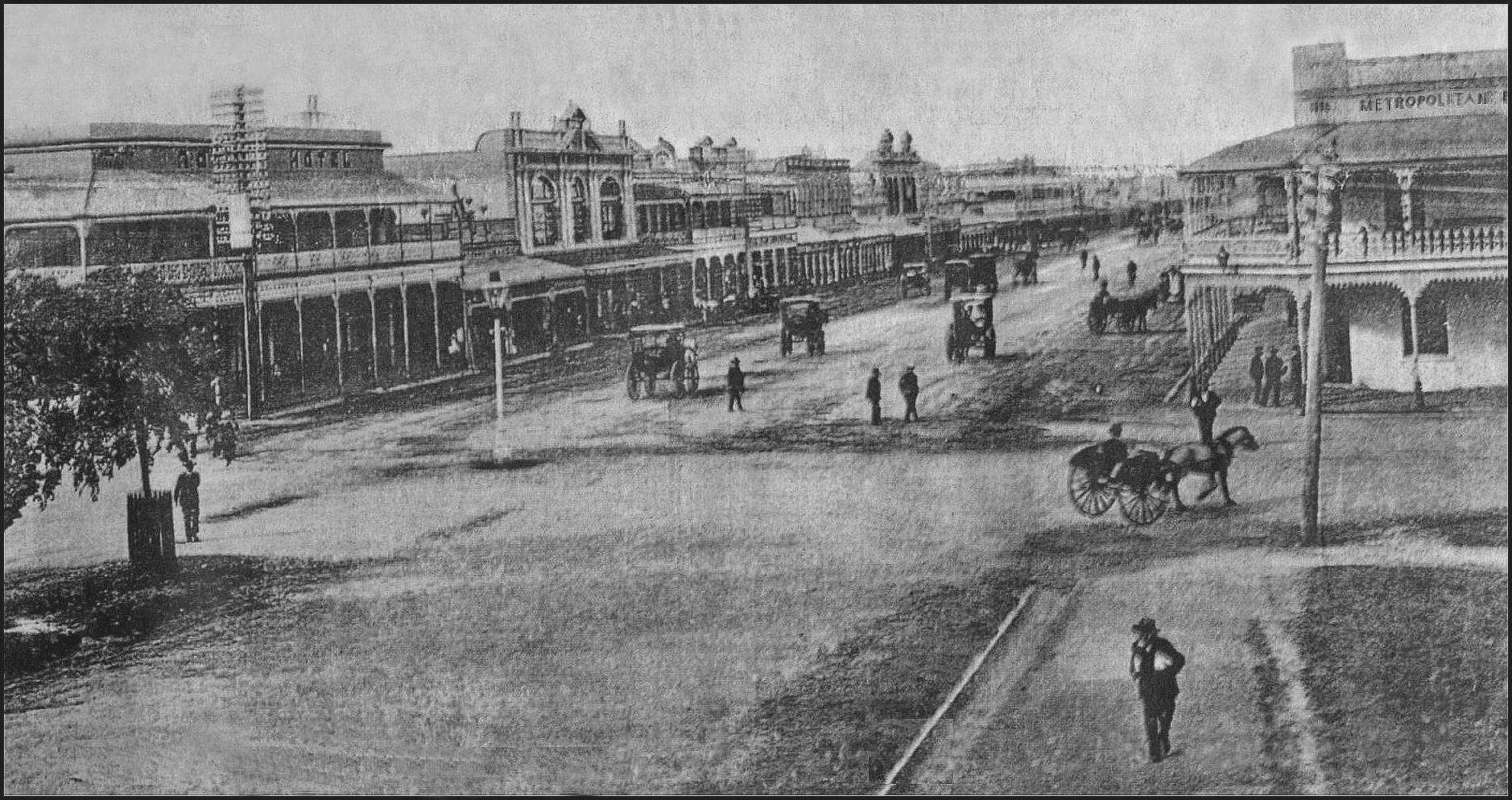
Note the Street Gaslight and Telephone Wires