Chapter Twelve
A Show and a Recession
In the August of 1890 a political crisis was to erupt in which the ministry of the Conservative Queensland Premier, the Hon. Boyd Dunlop Morehead, was to resign in favour of a cabinet that consisted of a combination of former Liberal and Conservative members, referred to at the time as the Ministerialist Cabinet. A ministry was formed under Sir Samuel Griffith, in alliance with Sir Thomas M’Ilwraith, despite these members’ previous careers having been in political opposition. The tenure of backbenchers, such as Walter Adams in the electorate of Bundaberg and Mr. W. O’Connell in the electorate of Musgrave, was not directly affected by the realignments. An edited report, giving the Telegraph’s description of these events, follows:
Given the narrow majority that had supported the Government in opposing Sir Samuel Griffith’s land tax amendments, as submitted to the Legislative Assembly on the previous night, a meeting of the governing party’s Ministers was held on the following morning, the 7th of August, at Mr. Morehead’s behest. Whilst Sir Samuel Griffith’s opposition to the tax had been viewed as one of expediency, Sir Thomas M’Ilwraith’s opposition to the tax was occasioned by his objection to its unequal distribution, as it was intended to be levied on holders of freehold, but not on holders of leasehold, land titles.
Following consideration of the situation at the morning’s meeting of the Government Ministers it was decided to hold a fully attended meeting of the Government party’s members including some of those who had voted in favour of Sir Samuel Griffith’s amendment. The press understood that, at this second meeting, the Premier had announced his Government’s intention to tender the resignation of its office. At the close of this meeting Mr. Morehead thanked the party’s members for the support they had given to his ministry.
Following the previous night’s division it was understood in the House that an arrangement may have been reached between the Governing party and the leader of the Opposition whereby, with the support of the latter, a Supply Bill to provide for the payment of government salaries should be passed immediately and the existing Ministry would announce its resignation to the House shortly thereafter. It was claimed that the opposition’s leader, Sir Samuel Griffith, would only accept office on the assurance that an early dissolution of the existing parliament was granted.
Shortly after 12 o’clock the Premier went to Government House to tender his resignation and that of his colleagues. Mr. Morehead advised the Governor to send for Sir Samuel Griffith and request him to form a Ministry. At 5.30 p.m., the resignation having been tendered and accepted, the His Excellency sent for Sir Samuel, and requested him to undertake the formation a new Cabinet.
The Legislative Assembly met at its normal hour and Mr. Morehead, in a short ministerial statement, said that, following the events that had taken place in the House the previous night, the Ministry considered it to be their duty to tender their resignation to the Governor. Samuel Griffith then rose and informed the House that he had received a communication from the Governor in consequence of which he had waited upon His Excellency and, in reply to the latter’s request, he would endeavour to form a new Ministry.
It was no secret that Mr. Morehead had been glad to be relieved of the cares of office and had seized the opportunity to walk out rather than be defeated. During the afternoon Sir Samuel called upon Sir Thomas M’Ilwraith to obtain his opinion of the crisis and to clear a way for the necessary steps to be undertaken to form the new Ministry. It is understood that Sir Samuel Griffith proposed to undertake the post of Chief Secretary (Premier), with perhaps the titular Attorney Generalship. In such an event it was probable that a Solicitor-General would be appointed to take ministerial charge of the Department of Justice. For this position the names of Messrs. Rutledge and Drake suggested themselves. Sir Thomas M’Ilwraith, if accepting office following the negotiations, was expected to apply for the ministerial position in charge of the Treasury.
Sir Samuel Griffith then asked that the House might adjourn until the following Tuesday to allowed him time to complete the new Ministry’s formation. The House agreed to the adjournment and an Appropriation Bill for £160,000 was then passed through all its stages. It was intended that another Appropriation Bill would be introduced on the following Tuesday that would provide for an additional amount. This sitting of the House occupied twenty minutes and was then adjourned until the following Tuesday.
At the request of their constituents both Messrs. O’Connell and Adams were supporters of Sir Samuel Griffith’s amendments. However, Mr. Adams was obliged to send a message to a party whip stating that he was too ill to take his place in the House but that he had intended to vote for Sir Samuel Griffith’s amendment. His absence gave the existing Government a majority of two instead of one.
It was generally believed that, following this disruption of the Parliament, a general election must ensue even though an attempt would be made to carry on with the present House as it was rumoured that several Liberals were greatly annoyed at the proposal to include Sir Thomas M’Ilwraith in the Ministry. It would have been no surprise if this annoyance had resulted in the defection of several of these members from the retiring government’s side of the house.
The Year of 1891
On the 26th of August 1891 a deputation from the Central Queensland and Wide Bay districts consisting of Messrs. Archer, Pattison, Murphy, Stevenson, Hyne, Murray, R. B. Jones, Annear, Crombie, Paul and Adams, M.L.A. waited upon the Colonial Treasurer to request the continuance of dredging operations in the Fitzroy, Burnett, and Mary Rivers until such time as harbour trusts could be formed to manage these waterways. The discussions that ensued clearly indicated the straightened circumstances under which the newly appointed government was labouring. An account of a segment of these proceedings is given below.
Following presentations by Mr. Archer and Mr. Pattison to the Treasurer, Sir Thomas M’Ilwraith, concerning the dredging of the Fitzroy River up to Rockhampton, the following discussion ensued:
Sir Thomas M’Ilwraith: “There were certain sums standing to the credit of certain places, but the deficit must be provided from somewhere. I had tried to borrow the money and could not get it. Could the deputation suggest where the money was to come from?”
Mr. Stevenson: “You yourself have indicated one way.”
Sir T. M’Ilwraith: “How?”
Mr. Stevenson: “By the sale of land.”
Sir T. M’Ilwraith: “If I had sold the land you need not have come here, because the dredges would still have been provided for, but I have not sold it.”
Mr. Stevenson: “Then the sooner it is sold the better.”
Sir T. M’Ilwraith: “Yes, if there had been an indication that the Government was able to sell land so as to buy up some of the Treasury bills, then there would be a good reason for a reconsideration of the matter. At the present time there is absolutely no money. There are certain sums standing to the credit of the Government in some of the banks, but this cannot be called in quickly and so is a matter which needs to be treated with the greatest caution.
It is useless for honourable members to talk about throwing men out of employment as, if I were to suddenly call in the money under discussion, the consequences would be just as disastrous. It is not want of will but want of money that is the problem. ------ . In the event of the colony’s Treasury being subsidized by land sales I would reconsider keeping on the dredges until such time as I could introduce a bill authorizing the formation of harbor trusts and I appeal for the members of the deputation to help me in forming trusts that would meet the local requirements.” -------
Though the submissions on the various rivers were lengthy the Colonial Treasurer’s only commitment was ---------- so far as Number 6 cutting in the Fitzroy River was concerned he would make inquiries which was all that he could promise. ---------- The Mary River was in a better position now than it was some time ago and the remarks he had made with regard to the Fitzroy River applied to the Mary River as well, with the Burnett River being in the same situation. These remarks would appear to be those of a treasurer who was under considerable financial pressure due to the serious recession in a major exporting industry and to the depleted state of the treasury coffers.
The first meeting of the newly revived Bundaberg Pastoral and Agricultural Society’s committee was held in early November 1888. Committee members present at the meeting were Messrs. N. Tooth, W. S. Sim, W. F. Harrington, J. Murray, J. Fairlie, W. Southerden, G. Stupart, J. Mahoney, and S. Bartholomew. The Committee received correspondence from the Colonial Secretary which included a cheque for an £11 5s. 9d. endowment to the 30th June and another from Mr. J. T. Annear, stating that he had attended to the matter of the deeds for the show ground. This correspondence also included a communication from the Minister for Lands. The Minister’s letter explained that the delay in the registration of the property had been precipitated by the action of the Surveyor-General in forwarding the title deed to the Crown Solicitor to obtain advice on the settlement of a legal point and that no clarification had yet been received. The committee resolved to inform Mr. Annear that the acceptance of the tender for the construction of the exhibition building would be withheld until the Society obtained the show ground title deeds. The committee asked Mr. Annear to inquire into the cause of the delay in acquiring these deeds and to expedite the matter. However, by October 1891 this legal issue would appear to have remained unresolved. The completion of the exhibition building did not occur until twenty years later, in August 1911.
On the 20th of October 1891 Bundaberg received a visit by the Queensland Colony’s Governor so that he may open the Bundaberg Agricultural Show. The show was the first to be held following a ten-year hiatus and was reviewed in an article that appeared in the Brisbane Courier that is reproduced below. The show was held in Quay Street with the Immigration Barracks and the Armoury, buildings that had been constructed in 1876 to service the boat loads of immigrants, then arriving in Bundaberg, being put into service to house the indoor exhibits. The press report of the 23rd follows:
“The Governor, accompanied by Lady Norman, Miss Norman, Miss Grace Norman, and Captain Strachey, arrived in Bundaberg from Maryborough on Tuesday for an official visit in connection with the revival of the Bundaberg Agricultural Show. The vice-regal party was met on the railway platform by Mr. W. B. O’Connell, M.L.A. who introduced them to the Mayor (Mr. J. C. Walker), the aldermen and others. The town clerk then read the address of welcome and Sir Henry Norman briefly returned thanks for their kind welcome to Lady Norman and his daughters. He had been to Bundaberg before, and was glad to be there again, and if they should not enjoy their visit he was sure it would not be the fault of these who welcomed them. The Governor was escorted from the railway station by members of the Mounted Infantry and also by a large number of buggies and horsemen and, on his arrival at the Royal Hotel, expressed his compliments regarding the appearance of the men who comprised the guard of honour and also of the mounted men. Many friends called upon the Governor during the day and, in the evening, the Chinamen of the town welcomed General Norman by letting off several crackers. In the evening a concert, attended by the vice-regal party, was provided by the local Lawn Tennis Club with most of the selections being of a meritorious nature.
THE SHOW’S PREPARATION: It was ten years since an agricultural show had been held in Bundaberg but the one at present being held was mooted by a few adventurous spirits. At first the idea was scoffed at; however, plans were laid, schedules issued, and prizes offered. The Governor was issued with an invitation to visit Bundaberg, which he cordially accepted, and ere the show committee quite understood what had happened, they found that they had acquired the responsibility for the conduct of a big event. Entries poured in, not only from residents in the immediate district, but also from many persons residing at a considerable distance and, apart from the Brisbane Exhibition, no show which has been held in Queensland this year can boast of as many entries as can the one under notice. As day by day the show gave evidence of expansion the committee found themselves in a partial difficulty.
Bundaberg, unfortunately, does not possess the regulation show ground and it was, therefore, necessary to obtain the permission of the Government to use the buildings of the Immigration Barracks which front the river. Part of the river esplanade was also temporarily closed and fenced off for use as a parade ring. Of course, the show lost much in compactness and convenience by such an arrangement, but the result overall was satisfactory. Much had also been done to brighten the external appearance of the old buildings and to lend a cheery appearance to the ground. Over the entrance gate an archway was erected, bearing on the front the motto “Welcome to Bundaberg” and on the reverse “Advance Queensland”.
A grandstand was erected opposite the parade ring for the use of the vice-regal party and distinguished visitors. Adjoining this was a flower stall presided over by ladies selling buttonholes and sprays on behalf of the local hospital. Around the depot yard cattle, horse, dog, and poultry pens were erected and the buildings were gay with sugar cane and flags. On Wednesday morning a special train arrived from Brisbane bringing Messrs. H. Tozer (the Colonial Secretary), M. Hume Black, J. T. Annear, W. North, J. B. I. Isambert, W. V. Brown, W. Paul, J. Crombie, M. Battersby, J. P. Buckland, D. H. Dalrymple, and J. Campbell, M.L.A. The town hotels were all full to overflowing with many visitors from Maryborough, and not a few from Brisbane.
THE SHOW’S OPENING: A few minutes after noon his Excellency and Lady Norman arrived on the show ground, being escorted by members of the Wide Bay Mounted Infantry under the command of Lieutenant Reid of Gympie, while many members of the Second Regiment from Howard, Maryborough and Bundaberg formed a guard of honour. The regimental band was also present. Accompanying the Governor was the mayor of the town, Mr. W. B. O’Connell, the Member for the Musgrave district, and others. The Governor was formally introduced to Mr. W. Adams, M.L.A., the president of the association, and warmly welcomed to Bundaberg.
The Governor said he had been requested by the president of their association to officially declare the show open. Generally, he had to do so without being afforded an opportunity of seeing the exhibits, but on the present occasion that had not been the case. The exhibits were so numerous as to be confusing as the show had obviously turned out to be a bigger affair than had been anticipated. This was perhaps to be expected as there had not been a show held for several years. Although the district was not as prosperous as they may have wished considerable progress had apparently been made. The Governor was likely to see something more of the district during the next two days than he had done on his last visit, when the mist and rain prevented him seeing anything. He declared the show open and wished prosperity to it and to the district.
Hearty cheers were then given for the Governor, Lady Norman and the Misses Norman. The attendance during the day was large, and the ground always presented a very animated and bustling appearance. There was a full programme of events, so that the general public experienced no weariness though judging was carried out very tardily and was not completed until late in the afternoon. In this respect all the arrangements were faulty but, when there was so much excellence, it would be unfair to complain. The committee worked very hard and did all in their power to satisfy exhibitors and visitors but the pressure of work at the last moment had proved to be a little too much for them. In the afternoon the usual parades of stock took place and the display of the hacks ridden by the ladies was surprisingly great. Twenty-four ladies cantered their horses round the ring and competition for the blue ribbon was unusually keen.
The jumping competition brought out six horses and first honours fell to Miller’s Harkaway, which cleared the four foot six-inch-high hurdles without any trouble. The other competitors were Bergin’s Painless, Collins’s Boyne, Stappleton’s Miss Glanmire, and Tanner’s Doctor. Much interest was manifested in the draught stock exhibits, and the animals shown were of exceptional quality. Ponies were well represented, and not a few stylish buggy pairs were driven round. Five squads of lads from the local schools competed in the physical drill exercise. Each squad was dressed in an appropriate costume and the exercises were closely watched and healthily applauded by the crowd of spectators. Messrs. Woolley, Bergin and Company and Mr. H. Schliemann had working windmills and pumps which received close attention from the many practical agriculturists present at the show.
THE LUNCHEON: Shortly after one o’clock over seventy gentlemen sat down to a first class luncheon laid out on the balcony of the Federal Hotel. Mr. Walter Adams occupied the chair and Mr. Angus Gibson was vice-chairman. The triple toast of “The Queen, His Excellency the Governor and our Guest” was proposed in a short fulsome speech by the chairman who expressed great pleasure in having the Governor in their midst.
His Excellency was enthusiastically received. He said he was in the unprecedented position of having to reply to three toasts at once. He had great pleasure indeed in being amongst them. It was nearly ten years since they had held a show, and he trusted no such long interval would elapse before another show was held. Much had been said respecting the too frequent holding of small shows and criticism had been offered from some quarters, which they were bound to respect. Bundaberg, however, was a great agricultural and pastoral district, and had also important manufactures which deserved to be frequently shown, and which he was sure they would be all pleased to see. Sir Thomas M’Ilwraith had fully intended to be present but only the previous day had sent a telegram indicating that pressure of work would prevent him coming to the show and visiting a district for which he had a high regard and love. He proposed, “Prosperity to the Bundaberg Agricultural and Pastoral Society.”
Mr. W. B. O’Connell, M.L.A. said that if the effort made that day was prophetic of what was going to happen in the future, they were likely to have a very live agricultural society indeed in Bundaberg. They had never anticipated having such a collection of exhibits, and when the show was first mentioned it had been pooh-pooed. Considering the many disadvantages under which the society had laboured, he thought the Agricultural Society deserved all credit, and he was sure visitors would carry away with them pleasing recollections of the show. The society also had proof of the great facilities existing in their district capable of producing wealth, perhaps more so than of any other district in Queensland. He thanked the Governor and members of Parliament for paying them a visit.
Mr. Angus Gibson proposed the toast of “The Parliament of Queensland” coupled with the name of Mr. Annear. He had a strong opinion about our Parliamentary representatives and also about the members of the Ministry who were, he thought, equal to the difficult task of steering this country through its present unfortunate situation.
Mr. Annear announced that Mr. Tozer had requested him to reply to the toast in his stead. After complimenting the present Government, and more especially the Colonial Secretary, he remarked that he was a representative of the honest working man and went on to comment upon the show being a credit to Bundaberg.
Following the Chairman’s remarks the proceedings then terminated. The Governor and party, accompanied by many of the more prominent citizens, left for an afternoon’s drive through Woongarra, via Mon Repos and the Hummock, a charming corner of a beautiful district.
THE EXHIBITS: It was impossible, owing to the arrangements, to make more than a rapid survey of the exhibits during the opening day. Blood horses and mares were fully represented, and the breeding and quality were undeniable. They were mostly all locally bred. Draught and farm horses were numerous and of a serviceable stamp; good upstanding beasts fit to be exhibited in any show ground in the world. Thirty ladies’ hackneys were exhibited with most of them having fine paces and good looks, and while there was nothing very special in any of them they were shown to be hacks of a sound character. A few good ponies paraded, but only two of them were of superior quality. As a class the cattle were perhaps superior to anything seen outside of the Brisbane show. Ayrshires largely predominated, and they were all handsome beasts, the bulls especially being well proportioned, and compactly built. The cows were fine in quality and would probably yield from 8 pound to 12 pound of butter each per week. Only one Durham was penned, but much interest centred on a pen of grand little Jerseys from Brisbane.
Of sheep there were none, and the pigs were of inferior quality and badly bred. The poultry section, as is now usual at all shows, was strongly supported with exhibitors from all parts of the district having sent in birds. Nothing better could be desired than these seen in the game classes while there were also on exhibition some choice silver-gray Dorkings, a few good Polands and not a few handsome Coochin China. Black Spanish cattle dogs were in evidence, and there was also quite a score of kangaroo dogs. The retrievers were warmly admired, and one fine collie dog had many appreciative friends. Terriers were to be found tied to every convenient stick or post and, taking into consideration their current discomforts they were remarkably well behaved.
The one weak point in the show was the exhibit of farm and garden produce. A few of the vegetables were superb, more especially for this part of the growing season, but otherwise the display of corn, hay, and farm produce generally was not up to the mark. Fruit was poorly represented, astonishingly so, for such a district as the Musgrave. Bacon and ham were well to the front, nearly all of it being well cured and dressed. The butter also had many admirers, and the cheese was tasty and mellow. Honey was shown in great quantity, and one exhibitor had arranged a very neat trophy, alongside of which the bees were to be seen in active work. Such articles as soap, eggs, cordials, and locally brewed ale, all found a place and helped to bear testimony to the producing capabilities of the place. In a district like Bundaberg a sugar trophy might have been looked for as the central point in the annual exhibition. No such trophy was visible; however, refined and unrefined sugars were in abundance but were arranged in bags on the floor where they were frequently overlooked.
Many choice cut flowers and plants were entered for competition, the majority of which came from Maryborough. In the linocut art section, the exhibits were numerous and exceptionally good. One of the small buildings was tastefully decorated with scores of oil paintings, water colours, drawings in sepia, Indian ink, crayon, pen and pencil, architectural and mechanical drawings, photographs, etc., until it had all the appearance of a picture gallery. The Misses Johnston, of Colanne, showed several oil paintings of merit. Art has evidently many hard-working conscientious followers in Bundaberg. Neither space nor time will permit of a detailed description of many of the articles shown in the building set apart for exhibits in line art and industrial handicraft.
A case of birds shown by Mr. Charles F. Skyring should, however, be mentioned. It stood nine-foot-high by six foot in width, with fine glass front, and contained over 200 Queensland birds, all charmingly grouped on the spreading branch of a tree. Close by were several handsome chiffoniers, wardrobes, and bookcases, all locally manufactured, denoting the presence of many skilled woodworkers in the district. Hundreds of articles were shown by the ladies including puzzles in wool work, conundrums in macramé and quaint yet pretty devices in crewel work. There were also specimens of netting, tatting, arrasing, leather, splash work, a hand-made shirt, and a pair of knitted socks together with many other interesting exhibits.
THE BANQUET: A banquet was tendered by the citizens of Bundaberg to his Excellency the Governor in the evening. The large hall of the Bundaberg Post Office was set apart for the spread, and quite one hundred ladies and gentlemen attended. The chair was occupied by Mr. J. C. Walker, the Mayor, who had the guest of the evening on his right and Lady Norman on his left.
The Governor’s response to the toast of his health was enthusiastically received. In a very felicitous speech, he returned thanks for the sonorous hospitality which had been extended to Lady Norman, the Misses Norman, and himself. He referred to the gallant struggles made by the sugar industry and trusted that brighter days would come. In future Bundaberg was sure to be a great place.
Alderman Curtis proposed the toast of “Government and Parliament” and, by easy stages, got from politics to poetry and then retraced his steps. Reference was made to the desirability of extending the period for the sugar industry’s retention of Pacific Island labour, to the necessity for a Harbour Trusts Bill, irrigation, and other matters.
Mr. H. Tozer was well received and apologized for the absence of Sir Thomas M’Ilwraith, who was detained through momentous business, and also for the absence of Mr. Cowley. The representatives of Parliament who were present were from every quarter of Queensland and had never received more generous hospitality than they had in Bundaberg. He thanked them for their complimentary remarks regarding the Government. They had had an arduous time, he himself having had a great share of that trouble (Cheers) and had endeavoured always to repress crime and to maintain order. (Cheers)
He would not touch politics, but he must refer to the town clock. (Laughter) Tenders had been received for the clock; a gentleman had gone to England and had promised to send out the best clock that he could procure. He was glad to be amongst them, and he was pleased to be the first Minister who could congratulate them on the opening of the through (railway) line between the town and the metropolis. They would now have many more members of Parliament visiting them to partake of their generous hospitality.
Mr. Hume Black, replying on behalf of the Opposition, said that his side of the House was really the component part of the Government, and as long as the latter did what the Opposition desired they would strongly support them. So far they had done so. Referring to the Bundaberg Show, he said it was one of the best rural shows he had ever attended. He hoped that the time was not far distant when the working men of this colony would see that the establishment of the sugar industry on a sound footing was to their best interests. (Cheers)
Mr. W. V. Brown, M.L.A. proposed “The Agricultural Interest” and said that he was pleased to see the planters there were trying to solve an interesting problem, this being “Could the white race successfully grow sugar-cane?” If it could not be done in Bundaberg it could not be done anywhere. In a lengthy speech he traversed many of the arguments used against the sugar industry, advocated a bonus system, and spoke of the necessity to foster our industries.
Mr. Angus Gibson gave a brief response after which many Parliamentary representatives departed to catch the special train for Brisbane. At the conclusion of the banquet the room was cleared for dancing, which continued until an early hour in the morning.”
On Wednesday the 28th of September 1892 the Bundaberg Agricultural and Pastoral Society’s annual exhibition was opened by his Excellency the Governor on the newly established Show Ground that was located west of the railway line and to the south of Saltwater Creek on the southern extension of Burrum Street. The Railway Department issued return tickets that offered cheap fares to attendees from Brisbane, Gympie, Maryborough and intermediate stations. An additional inducement for Brisbane residents to visit Bundaberg was the considerable attention given to Bundaberg’s exhibits at the National Association’s show, held the previous month in Brisbane. The interest displayed on this occasion had given every indication that the Bundaberg show would be well worth attending.
Events in the evolution of the Bundaberg Show Ground of 1911 occurred subsequent to 1892. In recognition of their significance some of these events are described in the following passages:
In 1898 the Bundaberg Pastoral and Agricultural Society encountered financial difficulties and became defunct. The Society’s Deed of Grant to the Show Ground land was converted by the Government into a Certificate of Title which was issued to Bundaberg Council in recognition of the Council’s purchase of the land. As a courtesy, representatives of the former society Mr. G. Noakes, Dr. Thomas and Mr. A. M’Intosh were invited to attend the 1898 exhibition.
In January 1909 Mr. H. E. Ashley, the President of the Bundaberg Agricultural, Pastoral and Industrial Society, called upon the Mayor, Ald. Ruddell, at the Council Chambers. He indicated that, following the Council’s acquisition of the adjoining reserve, the Society wished to secure a lease of the Show Ground as its area had become, by this time, inadequate for the show’s requirements as space for many more stalls was required. No transfer of land ownership appears to have resulted from the negotiations that were to follow.
In July 1910 a five-acre extension to the show grounds was proclaimed by the Government and placed under the control of the Bundaberg Council. Over the period 1909 to 1911 there were debates and disagreements between the Society and the Bundaberg Council, and within the Council itself, as to ownership of the title to the show ground’s lands and to the requirements and maintenance of the ground’s structures and other appurtenances. In 1911, the first year in which the show ground’s exhibition building became available, the show was held not in the show ground but at the Bundaberg racecourse which was suitably located to accept guests arriving by rail.
The Year of 1892
As the representative of what had, by then, become one of the most important sugar growing areas in the colony Walter Adams had been continuously and heavily involved in the so-called “Kanaka Question”. This was a debate in the colony’s political arena which had flared up once again and was to rejuvenate the political activity directed against the hire of Pacific Island labour over the period from 1889 to 1892. This activity resulted in the virtual termination of the supply of finances available to the planters, and to its reliant businesses and industries, given the political antagonism towards Pacific Island labour engagement, the lack of a viable alternative and the consequent depressed state of commerce in the sugar growing districts of Queensland. Early in his career Walter Adams had been a determined opponent of the use of Pacific Island labour. However, his experiences as a planter, white labour’s lack of reliability and the industry and honesty of the Melanesian labourers had compelled him to modify his views.
An article in the Brisbane Courier described a visit to Bundaberg, on the 19th of February 1892, by the Premier Sir Samuel Griffith and attendant ministers when the use of Islander labour in the sugarcane fields was again a burning issue. Details of this visit are given below:
The Government steamer Lucinda arrived at the Bundaberg wharf shortly before 8 o’clock. The Chief Secretary (Premier) was met by a crowd of up to 1,000 people who gave him some hearty cheers. The Labor Party was in evidence but the demonstration they made was feeble compared to the warmth of the reception generally accorded. A proposal had been made by wire to hold a banquet, but this Sir Samuel Griffith refused, being very weary following his recent long travels. The proceedings therefore took the form of a champagne reception at the Grand Hotel, where a large crowd of people had gathered. The Mayor, Mr. John Rowland, presided and, in proposing the health of the Chief Secretary, said that true and self-reliant workers had no better friend than they had in Sir Samuel Griffith. His sympathies had always been with the workers of the colony and he had made democracy a power in the land. At the risk of opprobrium, he had issued his manifesto Note 1 (Loud applause) which had greatly raised the hopes of the residents of Bundaberg and district.
Mr. White, chairman of the Chamber of Commerce, read a letter which had been formulated at an influential meeting of that chamber, endorsing the Chief Secretary’s manifesto, and expressing a hope that the legislation, legalizing the extension of kanaka labour, would be passed during the coming session. There had been abuses in the past but if the most ardent discipline of Exeter Hall Note 2 had seen the ceremony on the river bank at Bundaberg the other day, when 100 Islanders were baptized by immersion, the subsequent service being attended by 600 Islanders, he would have been compelled to admit that Queensland was one of the greatest civilizing nations on the face of the earth as, in addition to being taught Christianity, the Islanders had been introduced to the practice of agriculture.
The Chief Secretary’s response met with a most cordial reception when he claimed that the more he observed the feeling that existed all over the colony the more he was convinced that he had acted rightly in issuing his manifesto. At the present time there were too many in the colony living upon the few who cultivated the ground and although of late the colony, by the expenditure of loan money, had been able to cut a dash it was time this came to a stop. To borrow more money would only intensify the evil and, therefore, they must turn to agriculture (for wealth creation). They must turn to the lands to produce more, not in the way of actual revenue, but in the products of the soil. There were thousands of acres of coast lands lying idle for want of proper labour and the only thing left was to obtain the labour that was both at hand and willing to come to the colony and which would not interfere with the future political or social welfare of Queensland.
He said of course he would be charged with turning his coat, but he was prepared to answer not only to his detractors but to his own conscience. As the late Sir Anthony Musgrave had remarked, “Things are what they are, and words will not alter them.” Some people thought they could alter things by electing themselves to the receipt of a £300 a year position, but it was a fallacy that would soon be found out. Wages could not be kept up by artificial means, and therefore they must fall to the level at which the industries on which the country depended could subsist. Sometimes he had been led astray, he admitted, by being too hopeful of bringing about an altered condition of things but now he had to face the inevitable.
In Australia they had arrived at a condition of things when the best men had to consider how to get their house in order, and he felt the greatest confidence that they would meet the difficulty, leaving on one side the old party fights they had seen in the past. He had made mistakes, the greatest of which was in thinking that he was able to bring about a great deal in a limited time. Still he was not too old to learn, and he hoped he would yet learn a great deal. He could not yet say what would be the best time and mode of giving effect to his manifesto as he had not met his colleagues for many months. They, however, approved of the draft of the manifesto and he, as Premier, believed effect would be given to it before the end of the year. (Loud cheering) He believed that it was as absolute a certainty as if it were an already accomplished fact. (Cheers) Whether men had European or Islanders servants was a matter of trifling importance compared with the settling of a large white population on the soil. Messrs. Annear, O’Connell and Adams also spoke and were well received with all of the proceedings taking place in a very enthusiastic atmosphere.
Note 1: Legislation favourable to the re-introduction and/or the extension of the period for Pacific Island labour engagement.
Note 2: Exeter Hall was in London, located on the northern side of The Strand, on the site previously occupied by Exeter House, the London residence of the Earls of Exeter. It held two auditoriums The Freemasons Hall, having a seating capacity of 1,600, and the main auditorium of capacity 4,000 persons. Meetings of a religious and philanthropic nature were held there and, though legislation banning slavery throughout the British colonies (the Slavery Abolition Act 1833) was of long standing, the practice of slavery was still rampart in many non-British territories. The Anti-Slavery Society held meetings in Exeter Hall, and in the public’s mind, this connection linked the name of Exeter Hall to the anti-slavery lobby group.
A meeting of the farmers of the Gooburrum, Fairymead and Bingera districts was held on the 11th of March 1892 in the Gooburrum State School. The meeting was held to consider the Chief Secretary’s manifesto on the proposed extension of Polynesian (Melanesian) labour with about thirty farmers in attendance. Mr. W. Adams, M.L.A. and Mr. John Rowland, the Mayor of Bundaberg, were also present and, to commence proceedings, Mr. Rowland was voted to the chair. The Chairman declared that the meeting had been called to ascertain the opinions of the settlers as to the extension of Islander labour for another term and that the object of their meeting was to give their support, however feeble, to the present Government in their action in proposing to reintroduce the Polynesian Labourers Act and have it remain upon the Statute-book for the following ten years (i.e. to the year 1902). Details of the meeting, commencing with Mr. Rowland’s address and as described in the Courier’s report, follow:
“They had all read the manifesto that the Chief Secretary had issued a few weeks earlier, telling the people of the colony the intention of the Government with regard to the Act and there could be no question that the Ministry would stand or fall by it. He took it that it was their duty, as sugar growers, to accord the Government their hearty support and to put that in a practical shape he would move the first resolution, “That this meeting of sugar-growers cordially approves of the Chief Secretary’s manifesto, proposing the extension of kanaka labour for ten years.” The manifesto, he said, was, from beginning to end, a fair, manly and statesman-like declaration of the intention of the Ministry, and he felt sure that when Parliament met a substantial majority of the members would heartily endorse the action.
Confidence would again be restored to the colony, not only with regards to the sugar industry but in all branches of trade, and prosperity would again prevail. They were aware that a short time ago he had engaged in a newspaper controversy with Mr. Angus Gibson on Pacific Island labour, and he held, and still held, that, from the multiplication of small farms such as they had in Gooburrum with a central mill to crush the cane, would come the solution of the labour problem. They had, however, to deal with the subject as it was at present, as it was likely to be for the next few years, and as Sir Samuel W. Griffith and equally conscientious men had dealt with it. The best way to grapple with the matter was undoubtedly the way that was now open to them. He hoped to hear Mr. Adams express himself on the subject. The resolution was then seconded by Mr. D. Mahoney.
Mr. Adams, M.L.A. said he had great pleasure in being present and in hearing the reading of the resolution. They must not anticipate too much, at the present time, but he thought the resolution would meet with the approval of nearly every person in the district. He believed that the labour should not only be available for those who were growing sugar, but also for those who were preparing to do so. The extension of labour meant the extension of industry, and that meant prosperity. They had only to look at the conditions in the district before the interference with Islander labour. The farmers were assisted by the availability of capital and were able to do well for themselves. Some people had said “Down with capital” but if there was no capital there was no money to pay labour. Men were walking about the towns idle. In the North works had been stopped and over a thousand men had been thrown out of employment owing both to the want of capital and to a lack of confidence that the estates would be worked in the future. With confidence the money would return and there would be work for those now walking about unemployed. He was glad Sir Samuel W. Griffith had the stamina in him, when he had discovered he had been wrong, to turn round and acknowledge it.
He hoped they would not go long into next session before the extension was an accomplished fact. They would have to be careful in the next general election that men were not returned who would do away with the whole thing. The aim should be to do good for the whole colony. When the planters were prosperous so were the farmers. The farmers could sell their cattle, were engaged in cutting firewood, and had a good market for their maize. What did they get for their maize now? The reason for this was that there was no confidence in the land and so the planters would not extend their cultivations. Brisbane saw now that, as sure as the sugar industry went down, the South would go down also. If they could not grow cane they would grow the produce that was grown on the Downs, and they would flood this market, for they could send produce to Brisbane for 10 shillings per ton by water, when from the Downs by rail it was 25 shillings per ton. It was not only to the interest of the sugar-planters but to the whole colony that the labour should be extended.
In reply to a question from Mr. Aiken, Walter Adams said that he did not believe that the sea passage costs of the Islanders (who had been returned to their islands to meet the provisions recently introduced in the colony’s legislation and who were to return to Queensland under the newly proposed extension of Islander labour) should be met by the plantation owners who were to re-engage them. Instead this expense should be met by those plantation owners who were to engage them for their full three years of service.
The Chairman said he did not think the Chief Secretary was wrong in giving white men an opportunity to do the plantation’s fieldwork, but they would not tackle it and could not now complain at the lack of opportunity. A resolution was moved by Mr. Tobin, seconded by Mr. J. S. Story and was carried unanimously by the meeting. It declared, “That the resolution be forwarded to the members for Bundaberg and Mulgrave electorates for presentation to the Chief Secretary.” The chairman having received a vote of thanks, three cheers were given for the Parliament of Queensland and Mr. Adams, M.L.A.”
Another well attended meeting of farmers, as reported in the press on the 22nd of March 1892, was held in Avondale to consider the “kanaka labour question” with Mr. Hugh Fraser in the chair. There were present several who had, until recently, been opposed to Pacific Island labour. Two resolutions were moved and carried unanimously: the first, “That this meeting cordially approves of the manifesto issued by the Premier extending kanaka labour, under proper restrictions, for a period of ten years,” was moved by Mr. J. Smith of Maxwelltown seconded by Mr. D. Hull. Then Mr. William Knight of Woodbine, on Yandaran Creek, moved, and Mr. James Clarke of Beenleigh, Kolan, seconded, “That the foregoing resolution be transmitted to the members for town and district for presentation to the Premier.”
Also on this date the details of a Bundaberg Mail reporter’s interview with Mr. O’Connell, M.L.A., the member for Musgrave, was published and is outlined below. The interviewer wished to determine Mr. O’Connell’s views on the impending Queensland Parliamentary deliberations and their potential to influence the sugar industry’s fortunes particularly with regard to the indenture of Pacific Island labour on the local sugar plantations.
Q. As Parliamentary duties will call you South in a few days, Mr. O’Connell, will you kindly favour me with a few opinions on the present crisis in the sugar industry, and what you think will be the decision of the House on the reintroduction of Islander labour?
A. Yes, with pleasure. On this question there will be only one party in the House. The leading men of the Opposition will sink their differences with a view to pull the country out of the difficulties under which we now suffer. We are in a hard corner and cannot waste time quarrelling amongst ourselves while an enemy is at the gates outside.
Q. Are you satisfied the Government will have a majority?
A. Yes, quite satisfied. The feeling of the House, from information I obtained last session when trying to work it up on the question of the sugar industry, was that Sir S. W. Griffith then had nearly two-thirds of a majority. More cohesion has asserted itself since then among members and, I am convinced, there is no fear of the majority being less. Last session, when I returned from England, I felt it was necessary, for the continuance of prosperity to the sugar industry, that Islander labour should be retained and with that view I sounded the advocates of it in the House. The opinion expressed by the majority was decidedly favourable and even the Southern Members had recognized the force and wisdom of the planters’ requests. There had (previously) been a great revulsion of feeling among the southern farmers on the employment of Islander labour in the sugar industry.
The planters, they know well, are their best customers for maize, nor must it be overlooked that the planters also make large demands for their (maize consuming) draught horses. At that time, I intimated my intention to bring forward a measure expressing the need for the reintroduction of Islander labour, but I was advised that it would be unwise unless Sir Samuel Griffith would consent to my doing so. The proposition I wished to make was an indefinite extension of the Act, terminable at any time, by the Government giving twelve months’ notice. Recruiting would cease at the end of twelve months from the date of proclamation, the Government having to lay their programme before both Houses for confirmation, and the passage of any consequent motion would require two-thirds of a majority. This would have given a guarantee to capitalists and investors that there would be no cessation of the necessary labour unless a thorough revulsion of public opinion proclaimed against it. Under the present proposition it is quite feasible that, if passed, a majority of one might be sufficient to have it repealed. I have no fear of the Government faltering and am quite convinced they will pull through. I am aware a characteristic opposition may adopt a species of stonewalling and thereby block - purely, simply, and maliciously block - all the business of the House. That, however, I do not think likely. It might have been possible if public opinion had not expressed itself so largely in favour of the planters’ requests.
Q. What do you think will be the immediate effect on the country?
A. If you can satisfy investors and capitalists that protection will be assured for the next ten years I believe there will be an immense amount of money immediately expended on improvements and extensions locally. I know of one place a little way from town where, if this provision be assured, an initial expenditure of £100,000 will be made. That is only one place and one sum; there are several others on which smaller sums will be launched.
Q. You have had a very intimate connection with the South Sea Islanders have you not?
A. Yes, I have had an experience extending over ten years, and am thoroughly conversant with the subject. I know what I am talking about. For five years I was inspector and, for a similar period, agent of Islander ships. I think it would not be to the advantage of the Government to take recruiting into their own hands, and I don’t think the Government would be able to work recruiting cheaper than it has been done by private enterprise. The great point the Government has to look to is to secure reliable, honest, trustworthy agents. Yes I know that there were many abuses in the past, but you must bear in mind the remuneration offered the men who filled these positions was insufficient to tempt good men to accept such situations and (so) the irregularities are not to be wondered at.
Q. Now, Mr. O’Connell, do you think there is any possibility of dissolution in the near term?
A. The Government, to my thinking, is strong enough to carry the question and retain office; I go further and state as my conviction that, if a general election is forced upon the country, they will be strong enough to come back even then.
Q. Have you a word to say of the stoppage of immigration?
A. Under present circumstances I consider the action of the Government perfectly justifiable. Though there are, I am sorry to say, a large number of unemployed in the colony, I still hope to see Queensland with a larger population than at present, whether they come voluntarily or in response to any inducements we can offer them. The employment of Italians is not at all likely to solve the question of tropical agriculture in Queensland and I think it would be a bad day for Queensland if we ever got a large influx of Italians or others foreign to our own people. A small number may undoubtedly introduce agricultural pursuits of which we at present know nothing.
Q. Do you anticipate any powerful opposition?
A From a certain section, the Labor party, there is sure to be pronounced opposition, as well as from a subsection of Sir Samuel Griffith party’s following, a subsection who are bitterly dissatisfied with the present Ministry, and whose dissatisfaction springs from disappointment. These last have lately availed themselves of every opportunity to ventilate their opinions and have practically shown their hand, but their efforts are futile as the country is recognizing the gravity of the situation too keenly to be talked over by any party or parties.
Q. As prominence will be given to land-grant railways during the session, what is your opinion regarding them, Mr. O’Connell?
A. Land-grant railways answer the query of railway construction for no expenditure at all, and I am of opinion the benefit to the country from them would be great and lasting. I, for one, think it has been a great pity the Transcontinental Railway was not carried through on the land grant system. The country would have been saved from the heavy depression under which it has been groaning for so long.
Q. One more point and I have done, Mr. O’Connell. Irrigation is likely to come to the forefront of public attention, is it not?
A. Undoubtedly it is, and I am glad to be able to say so. Extensive irrigation works are quite in the near future. Note 1 There is the Woongarra Scrub where irrigation would mean the redemption of an immense area. Then again there is Gin Gin, Isis, Kolan, &c, all of which, under irrigation, would give the farmer a better chance of livelihood than maize. This district is undoubtedly one of the richest in Queensland and its possibilities have no limit that I am aware of. I speak hopefully because I know it to possess very great natural facilities. It covers a wide area of first-class, rich agricultural land which only requires capital and confidence to provide happy homes for thousands of people.
Note 1: Though correct over the long-term Mr. O’Connell’s prediction of the “near future” proved to be overly optimistic. A visit by the Governor and senior Queensland Government ministers to inspect Bundaberg’s severely drought ravaged cane crops and to reconsider the irrigation issue took place in August 1902. The visit did not appear to have resulted in any promise of government financial support for an irrigation project as proposed for the Woongarra area by the Hon. F. I. Power, Mr. W. G. Farquhar and the Irrigation Committee. An experiment with a shallow hand dug well, conducted at that time by the Qunaba Estate, produced brackish water and another, 45-metre-deep, well dug for Messrs. F. and T. Buss on their Ashfield plantation encountered unsolvable problems with a loose, collapsing formation.
A letter, written by the Bundaberg representative of the Brisbane Courier published on the 22nd of March 1892 gives a clear picture of the prevailing, depressed economic situation in the Bundaberg district and of the crucial position that the availability of Pacific Island labour held in maintaining the productivity of the sugar lands. The letter expresses the opinions of a person who would appear to have no reason to hold a bias and, for this reason, it is reproduced in the following paragraphs:
“As this will be my last letter from Bundaberg I propose to make in it, as far as possible, a resume of my observations in the district during the past fortnight. I have written but little concerning the various plantations, because my work has been amongst the farmers rather than the planters, though under the development of present circumstances there is not unlikely to arise some confusion in the term ‘planter’ and ‘farmer.’ I have seen enough, however, of the large estates to satisfy me that they are important, not only to the district, but to the colony generally. So far the majority of these estates has been intelligently and economically worked and is, taking one reason with another, returning a fair profit. Some of the estates are lying idle, the proprietors having been victims to the loss of confidence which followed on from the legislation, providing for the stopping of Polynesian (Melanesian) labour, and thousands of pounds worth of machinery has, for some time, been allowed to remain in disuse. The cleared land in those places is already over-run with weeds, and hundreds of white men have lost employment, simply because it was ordained that the Polynesian should have no part in the development of the sugar industry. And, of the estates which are at work still, in the majority of cases the past few years have been times of great care and anxiety. There has been, in great measure, a suspension of improvements and the curtailment of expenditure has been severely felt in the district. In a few cases work has gone on almost without interruption but the enterprising proprietors of the estates concerned state that they had never anticipated a complete stoppage of the Polynesian labour; they knew that the sugar industry was of too much value to the country to be driven to the wall.
To those who, with glib tongue and without any sense of responsibility say, “If the sugar industry is dependent upon coloured labour for its existence then let it die,” I can only say, after a fortnight’s close observation and inquiry in a sugar district, “You know not what you say.” This district, even in the present depressed times is, I think, second to no place in the colony for bonafide agricultural development. The whole area from the sea back nearly twenty miles is closely settled and the cane farmer, I venture to say, is to-day the most prosperous man in Queensland. In the agricultural areas where cane is grown the Polynesian is employed, but there are comfortable homes made by the white settlers and there is work for hundreds of white artisans and labourers. The large plantations cover areas which, a few years since, were used as runs for a few head of cattle. Fairymead, which a few years since gave employment to a stockman and an aboriginal, now helps some sixty white men to find work all the year round, and the number is greatly increased in the busy season. Over £100,000 has been expended in machinery and buildings and in opening up the land and a good proportion of this sum went into the pockets of Queensland white workers. At Bingera where white men on the estate earned over £6,000 in wages alone last year and where the white farmers draw thousands annually in cash for their cane, there was a humpy and a stockman or two. Can any thinking man fail to see the part the industry has played, and with fair treatment is likely still to play, in the prosperity of the country?
During the past few weeks there has been a strong expression of opinion in this district in approval of the manifesto of the Premier which proposes to extend Polynesian labour for ten more years. I have given the views of the farmers in the various districts I visited, as expressed individually, and in assembled meetings. There was a deputation to the Minister for Lands at Woongarra and meetings at Gooburrum, Gin Gin, Bucca Crossing, North Kolan, and Avondale. At each meeting there was a cordial approval of the manifesto, and in all there were only three persons who were at all opposed to it. The farmers are practically unanimous upon the point that, for cane cultivation, they must have the Polynesian labour. They think that, in the course of time, the sugar-grower and the manufacturer will be separate and that there will be no large estates under cane.
The agitation is no less keen in the districts where maize is grown. The farmers who are planting maize have observed the prosperity of their neighbours and are anxious to get mills in their neighbourhood so that they may grow cane. I take it that the opinions and wishes of those farmers are worth respecting. They have, with the assistance of the planters, transformed a wilderness into a flourishing agricultural district, and the cane growers are the best instances I know of the people being successfully put upon the soil. For the benefit of those farmers, who have to toil and pinch from year’s end to year’s end in the Southern districts, I will give a typical case of the Bundaberg cane grower. Take a selector holding an area of good agricultural land with scrub. He is within fair distance of a sugar-mill. The owner of the mill sends a gang of men to the selector, knocks down and burns out the scrub, plants it with cane, keeps the selector going while the cane is growing, runs a tram siding on to the selection, sends a gang of men to take the crop off, and buys it at such a price that the selector has got his land paid for, cleared, a crop in for four or five years and, in the majority of cases, a nice little cheque to the good. This is, as I said, a typical case. Nearly every successful cane-grower in this district has been liberally helped by the so called ‘planters’. The effect has been to place upon the land an independent class of men, hard workers, living in comfort and laying by, year by year, provision for the days when they can work no more.
I have during the past fortnight had plenty of opportunity of judging the treatment of the Polynesians on the plantations and farms in and around Bundaberg. The Polynesians, though in many cases having nice comfortable quarters, prefer the little grass huts which they build themselves, and to which they have been accustomed all their lives. This is but natural, but in some cases it gives rise to the idea that the comfort of the ‘boys’ is not regarded. This idea is simply absurd in fact, altogether the old cry of ill-treatment or neglect has long since ceased to have justification as far as the planters and farmers are concerned. The Polynesian of today will not put up with injustice, to say nothing of ill-treatment. He wants his ‘rights’ and if any of them are infringed he will march into town to the Polynesian Inspector.
I have visited many places in this district, large and small, and in no case have I seen the Polynesians otherwise than well fed, well cared for, and a happy contented lot they are. They live well. Their bread is precisely the same as that which the planter eats at his own table. It is made from the leading brands of flour that I saw in use at Dunn’s, Duffield’s and Brunton’s. The bread was as good as that on the table at the Imperial, or the Gresham, or at any of the Brisbane hotels. I saw in Toowoomba and Warwick papers recently that sick boys are treated worse than any decent man would treat his horse or his dog. This statement is a libel on our common humanity. Is the sugar planter an ogre, a careless brute, without an atom of manliness in his constitution? On the contrary, the majority consists of kind, considerate men, and many of whom with their families are doing noble work in Christianizing the ‘boys’. On every plantation there is an earnest group of Polynesians who have taken their places in the ranks of Christianity and, increasing in number, these worshippers assemble every evening to read the Bible and to pray. At Fairymead the good work started by Miss Young, Note 1 who is at present a missionary in China, continues and the evening services there in the schoolroom would astonish some who think the Polynesian neglected.
The death rate of the Pacific Islanders in Queensland is higher than that of whites, but it is not higher than in the South Sea Islands. The Islander in Queensland at first will find food and clothing disagree with him, and a few do not have good health, but after a time they become accustomed to the change and the death rate amongst the ‘old boys’ is less than in their own land. It is satisfactory to know that their death rate is not increased by their residence in Queensland. On the islands, phthisis, other forms of disease and tribal wars make up a bill of mortality which has provoked a good deal of consideration. My own opinion is that the general body of Polynesians who come to Queensland leave the country better men in every respect. Their own anxiety to come back again after a brief stay in the islands is a strong answer to those who libel their country with baseless stories of cruelty, and neglect. And many of the ‘boys’ re-engage when their terms of service have expired. Would they do so if they had hard taskmasters or if they were badly used?
During my journeying in this district I have been frequently asked by farmers how it is that the Southern farmer is in many cases opposed to coloured labour. My reply has been that only a proportion of the Southern agriculturists are opposed to the extension of Island labour and that, in some cases, the opposition is a matter of conscience and in others that the Southern men fancy that they would be at a disadvantage if their Northern brethren could employ Polynesians. The matter of conscience the farmers here can understand, for they have heard the silly tales which have been told of late as to the Polynesian death rate and the cruelty of his employers, but they fail to grasp the feeling of the Southern farmer who opposes the coloured labour from motives of self-interest. This district is without doubt one of the finest maize growing areas in Australia, and the cheap steamer freights will enable the grower here to beat the (Darling) Downs farmer not only out of the North but out of Brisbane also.
As Mr. Adams, M-L-A- said, at a recent meeting, the Bundaberg farmers could flood the Brisbane market with produce if they were not growing cane. Now what I wish to point out to the Southern farmers, especially in this matter, is that every additional acre of land put under cane here makes a consumer of maize instead of a producer. What is the experience in the Isis Scrub? This year the farmers there have flooded the market with maize but, if the labour extension is granted, their broad acres will next year be under cane. The same remarks apply to the North generally. And maize is not the only item to be considered. A passing thought may also be given to potatoes, pumpkins, and other products. It is only here on the spot that one can fully realize what the prosperity of the sugar industry means to the Southern farmers.”
Note 1: Miss Florence Young was later to help relocate those Pacific Island farm workers, who did not wish to return to their native islands, from the Bundaberg area to a Church of England mission on the southern side Moa Island in Torres Strait. Moa is the largest island in the Strait, and its availability for settlement was said to be the result of the removal of its previous inhabitants following a period of tribal warfare. Being relatively large and rugged in topography Moa would have been a difficult island to defend.
During the speculative boom in the property market of the 1880’s Australia’s commercial banks had lent heavily. In the days of separate colonies there was no central bank to oversee their operations and there were few legal restrictions on their operations. Consequently, by the commencement of 1892, two of these banks had either temporarily or permanently closed their doors. This activity was to peak over the 1892-3 period during which a further fifteen Australian banks followed suit which had the unavoidable effect of increasing the fragility of the Lower Burnett region’s economy. Institutions that temporarily or permanently closed their doors during this financial crisis included: the Commercial Banking Company of Sydney, the Australian Joint Stock Bank and the National Bank of Queensland
On the 21st of March 1892 Walter Adams, M.L.A. addressed a crowded hall in Bundaberg and received a rather hostile reception from an unruly assembly which caused frequent interruptions. When asked if he was if favour of extending the use of Islander labour without first appealing to the country Mr. Adams said that he would support the extension and also that he favoured placing the matter before the country prior to the Parliamentary consideration as otherwise the next Parliament might just overthrow any decision made. He thought that “There would be no confidence until it had been before the country.”
At the close a vote of confidence in Mr. Adams was proposed with the mayor, Mr. John Rowland, saying that he feared it would be difficult to count hands on the proposal, and upon any counter-proposal, but if the meeting divided, one side to the right the other to the left, this difficulty might be overcome. This suggestion encountered much hooting and hissing, and the mayor then said that he would endeavour to count hands instead but that he would first take a vote as to whether they should divide. A majority was against the division.
Next a proposal was put to have a division upon an amendment re a vote of no confidence but only a small number raised their hands, and no reckoning was taken of the fifty or sixty gentlemen on the platform. Amid cries of boycott and victimizing the mayor maintained that he was still of the belief that it would be better to divide the meeting and requested them to clarify their reasons for objecting. On not receiving this clarification the mayor then repeated his offer that, if the meeting would divide, he would endeavour to count the results. However, by this time the meeting was breaking up and Mr. Adams thanked those attending for the hearing that they had accorded him but then went on to declare that he was ashamed of their want of British fair-play and assured them that, if he was not wanted by the people of Bundaberg at the next general election, he would be quite happy to remain at his home. It would seem to be obvious that the early pioneering days of civil co-operation were coming to an end. Following this disappointing town meeting Walter was to stick by his guns and, in his last Queensland Parliamentary sitting in April 1892, when contributing to the debate on the Pacific Island Labourers (Extension) Bill, was to declare to the floor - as reported in BUNDABERG history and people by Janet Nolan: “------ following the sugar came ------ many comforts, and the means for educating the children. The owner of the selection became an employer of labour, and is now beginning to provide for the rainy day -------- One can hardly wonder that as a man gets land of his own worth cultivating, and near a sugar mill, his objection to Island labour very much disappears.”
The Act itself, as introduced under the Sir Samuel Griffith government, had the effect of extending the legal employment of Melanesian field labour for an additional ten years.
It is a matter of some relevance that, within one year of the creation of the Australian Federation, on the 1st of January 1901, the sugar industry was to apply for, and to receive, tariff protection as legislated by the Commonwealth Government in October 1901. The sugar industry, at this time, was also being impacted by a debate on the repatriation of Islanders that was intertwined with the debate on a white Australia policy. It was also exposed to the early effects of the mechanization that was beginning to be introduced in the cane fields.
Between 1906 and 1908 the Australian Government, under the Pacific Island Labourers Act 1901 together with its 1906 amendment, repatriated most of the Melanesian field workers to their islands of origin though a significant number, approximately 2,500 or 25% of the Islanders then present in Australia, were to remain in Queensland on various grounds such as having been married to an Australian citizen or upon other grounds including resettlement as previously mentioned.
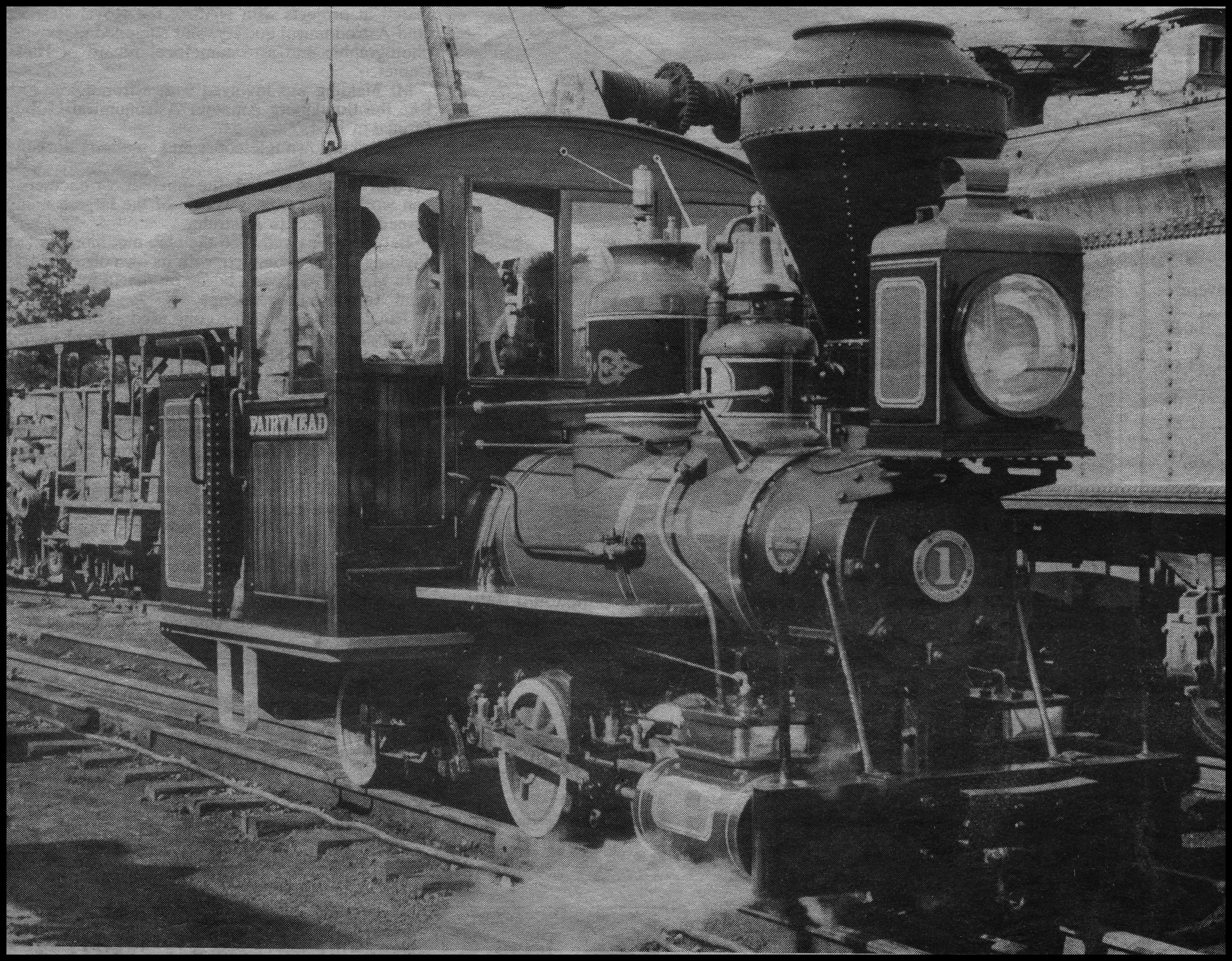
Photograph from the Bundaberg News Mail
Note: This was the first steam locomotive to haul sugar cane in the Bundaberg district. It was one of three locomotives in use at Fairymead from the early 1890’s to the mid 1950’s. It has been restored by the Thirlmere workshops of the NSW Rail Transport Museum.
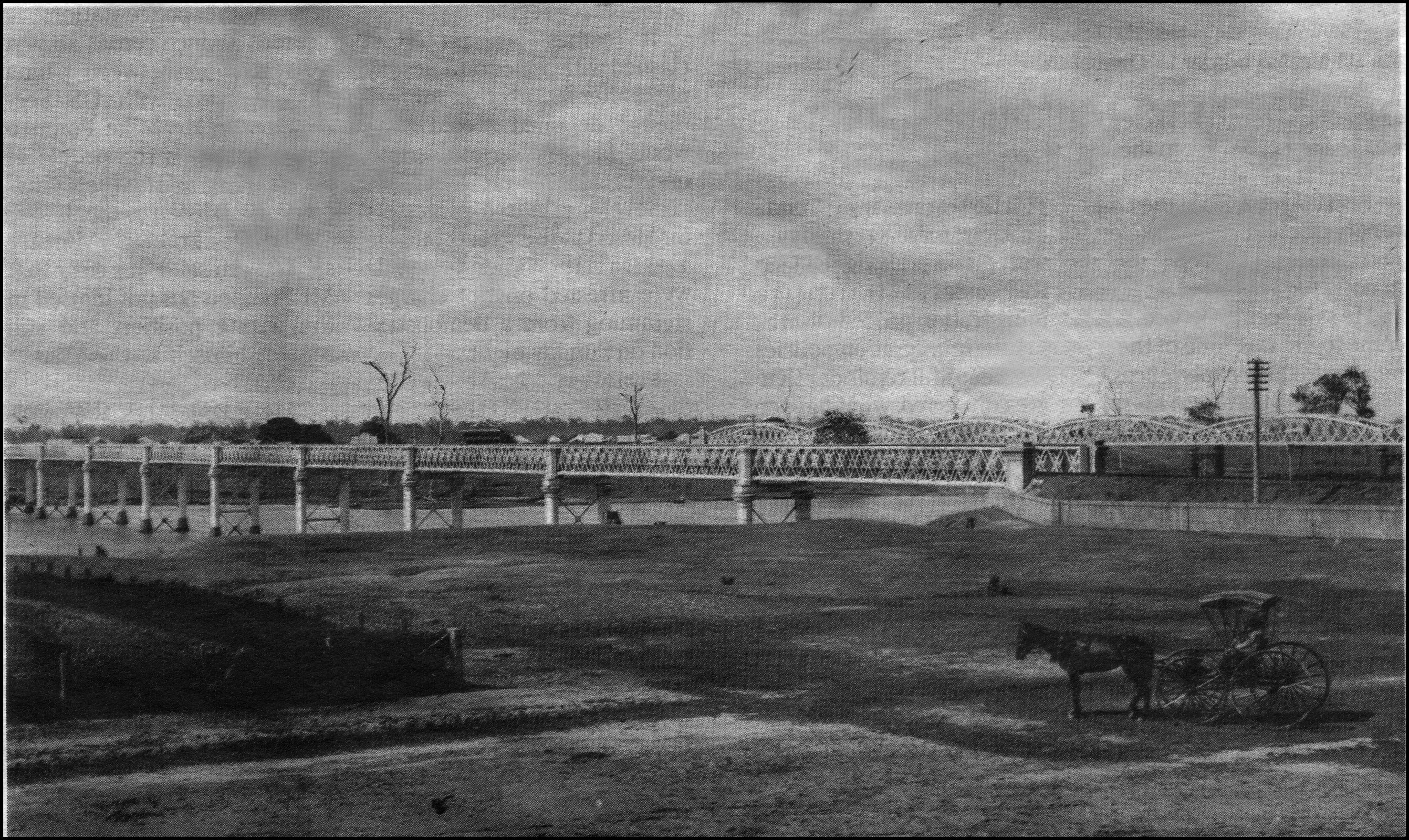
With the railway bridge in the foreground.
Picture from Picture Bundaberg
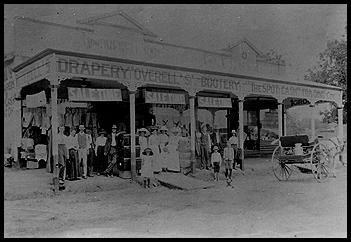
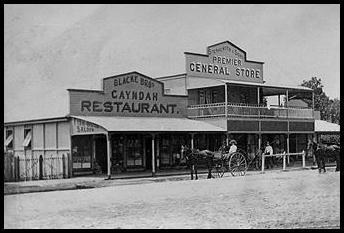
Photographs from the John Oxley Library
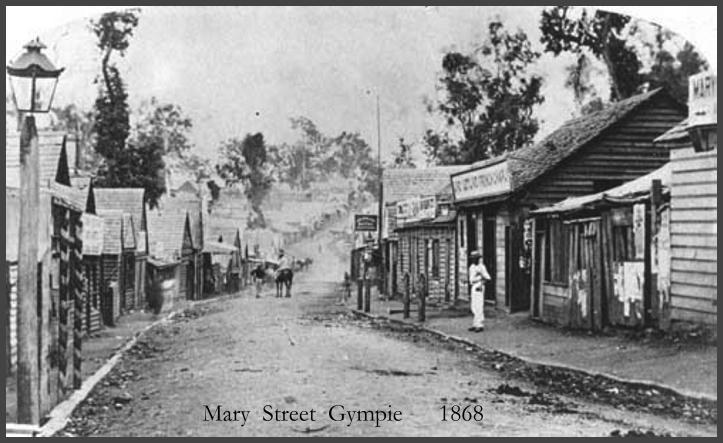
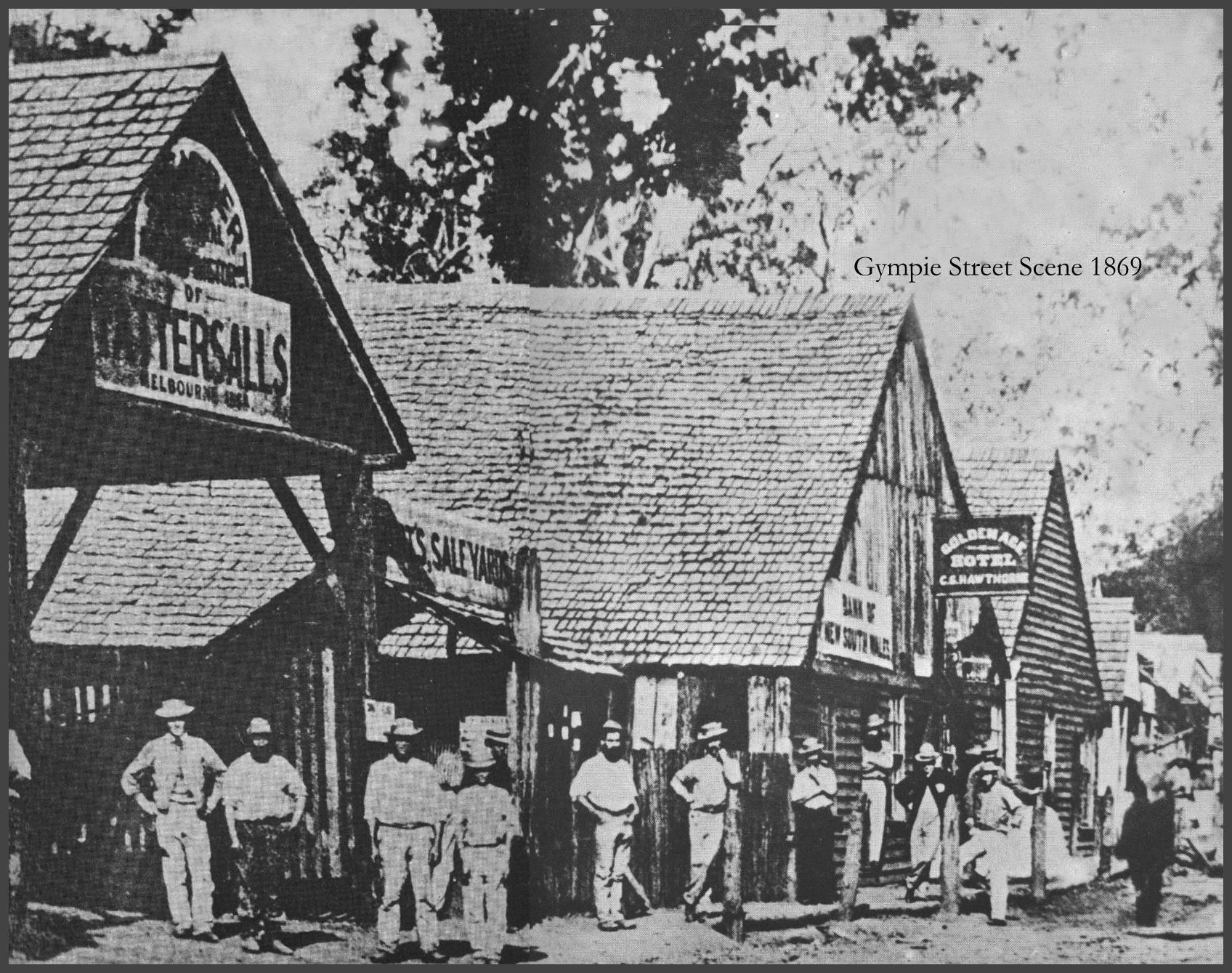
The Main Street of Gympie in 1868 – Top; and 1869 Shop Fronts – Lower
From Gympie Regional Libraries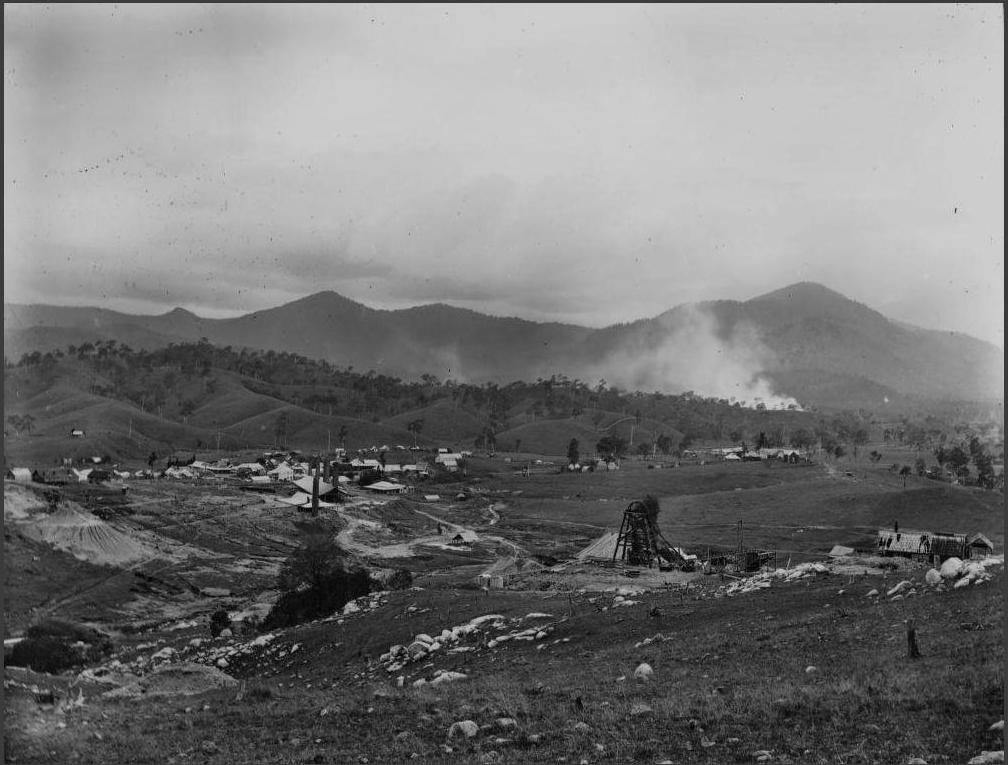
A View of Mount Perry in the 1890s
John Oxley Library
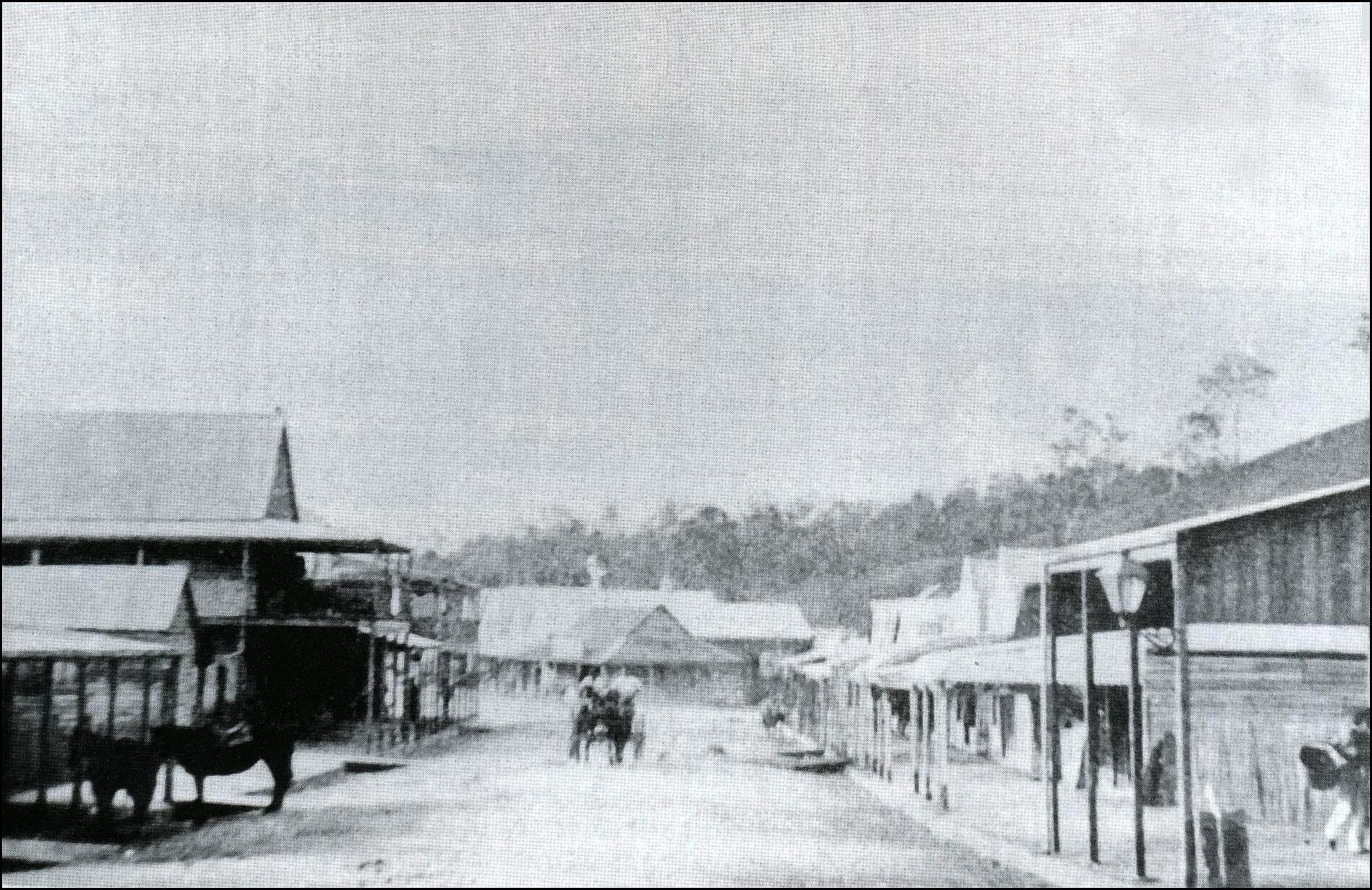
Photo: Miss. K. Bennett - The Moore and Bennett photographs
Copied from “PERRY’S PAST” (1998 reprint) by M. Royle
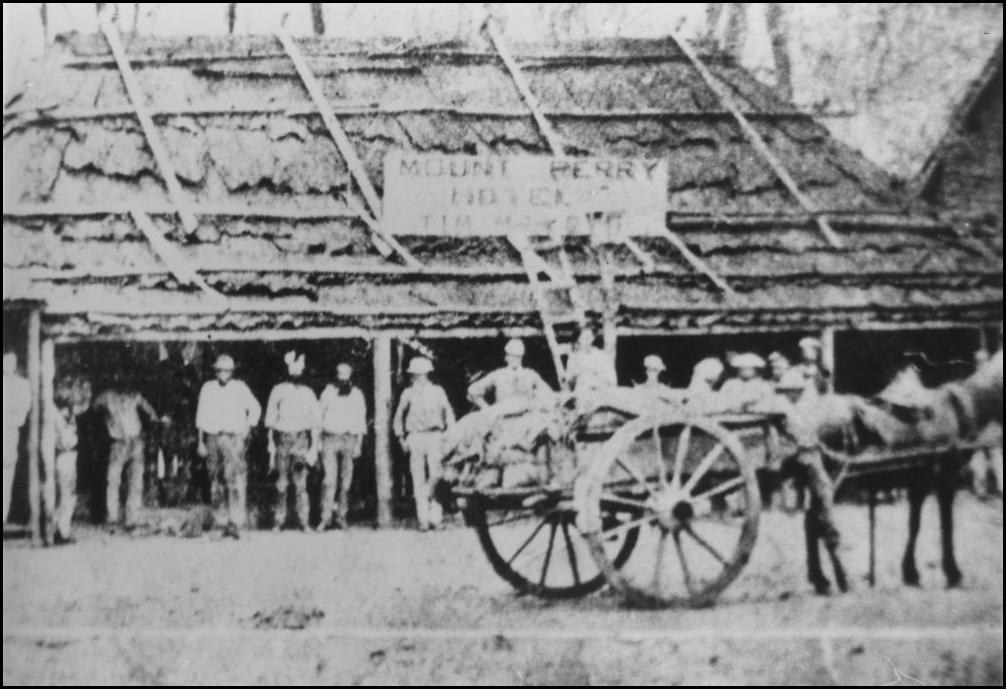
Mount Perry Hotel in 1871 – Photograph by C. H. Moore
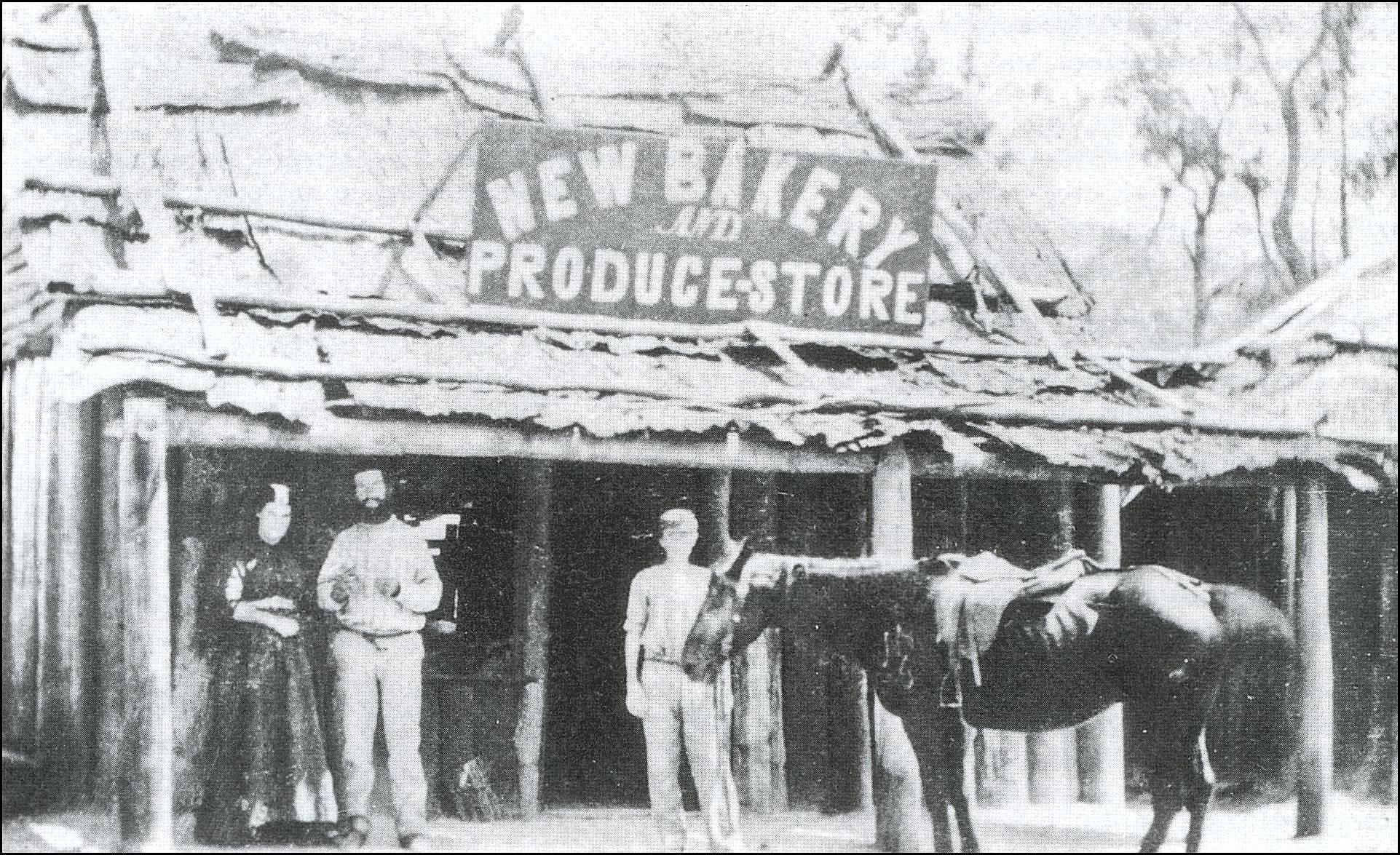
Mullins’s Mount Perry Store 1871-2. Photograph by C. H. Moore
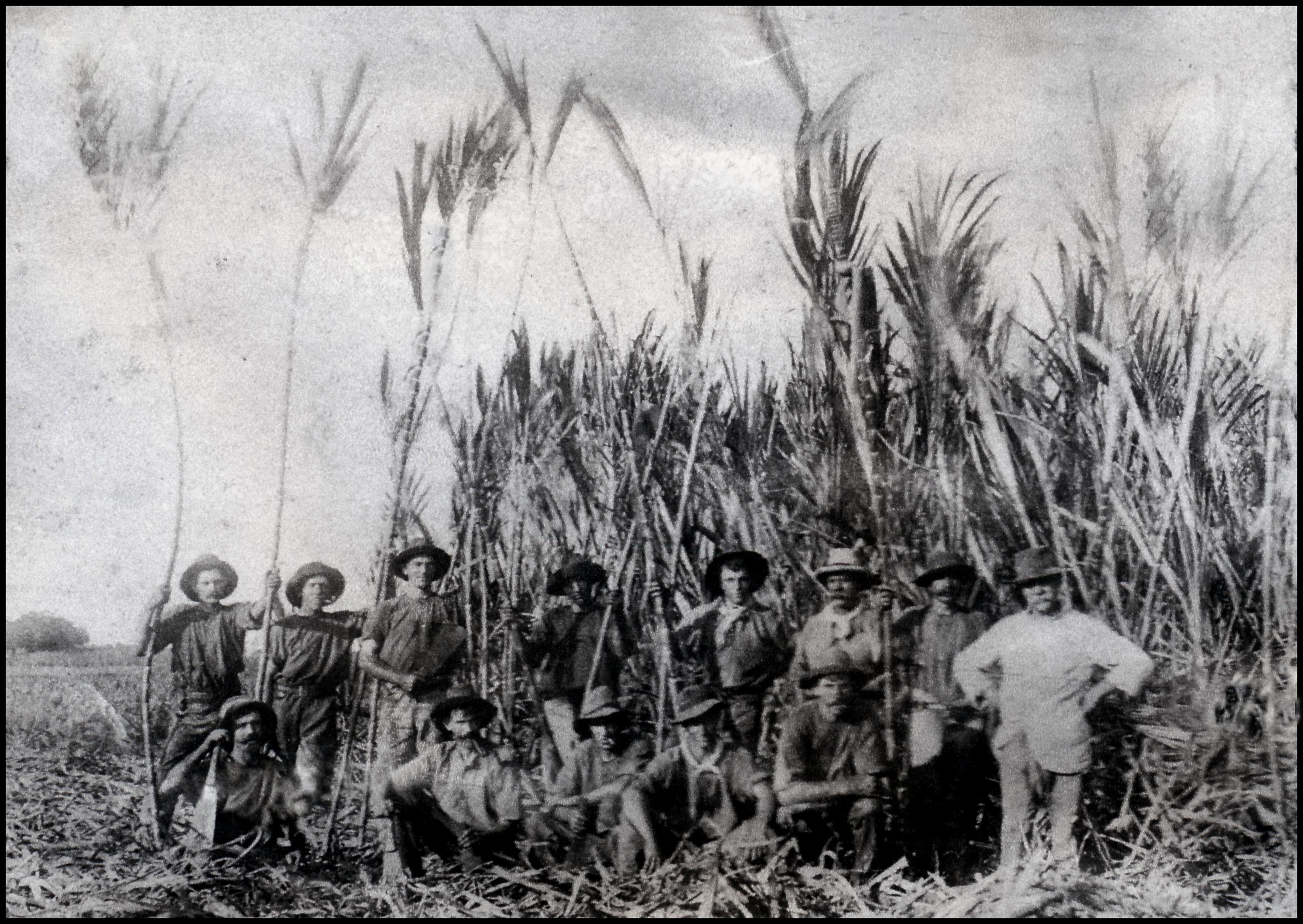
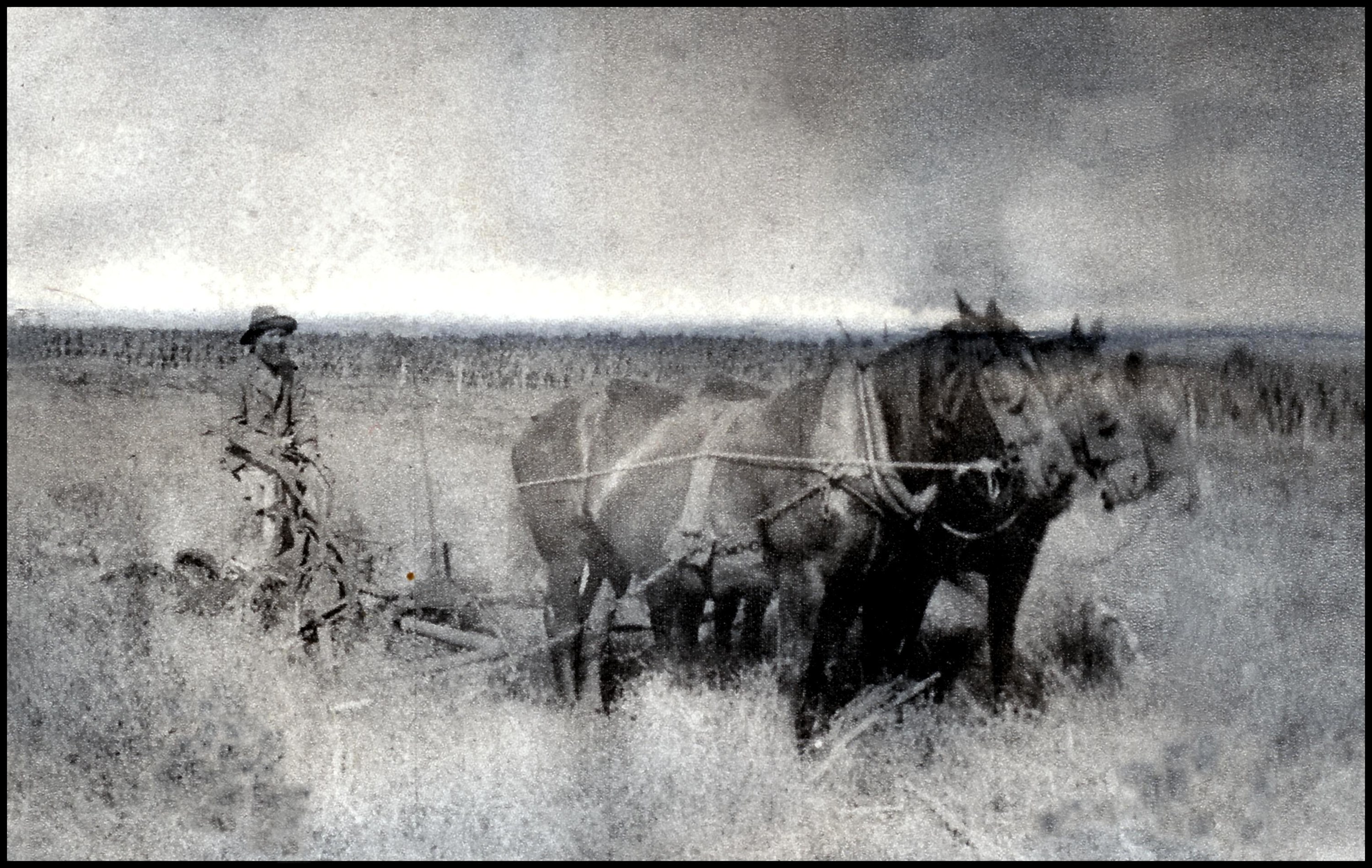
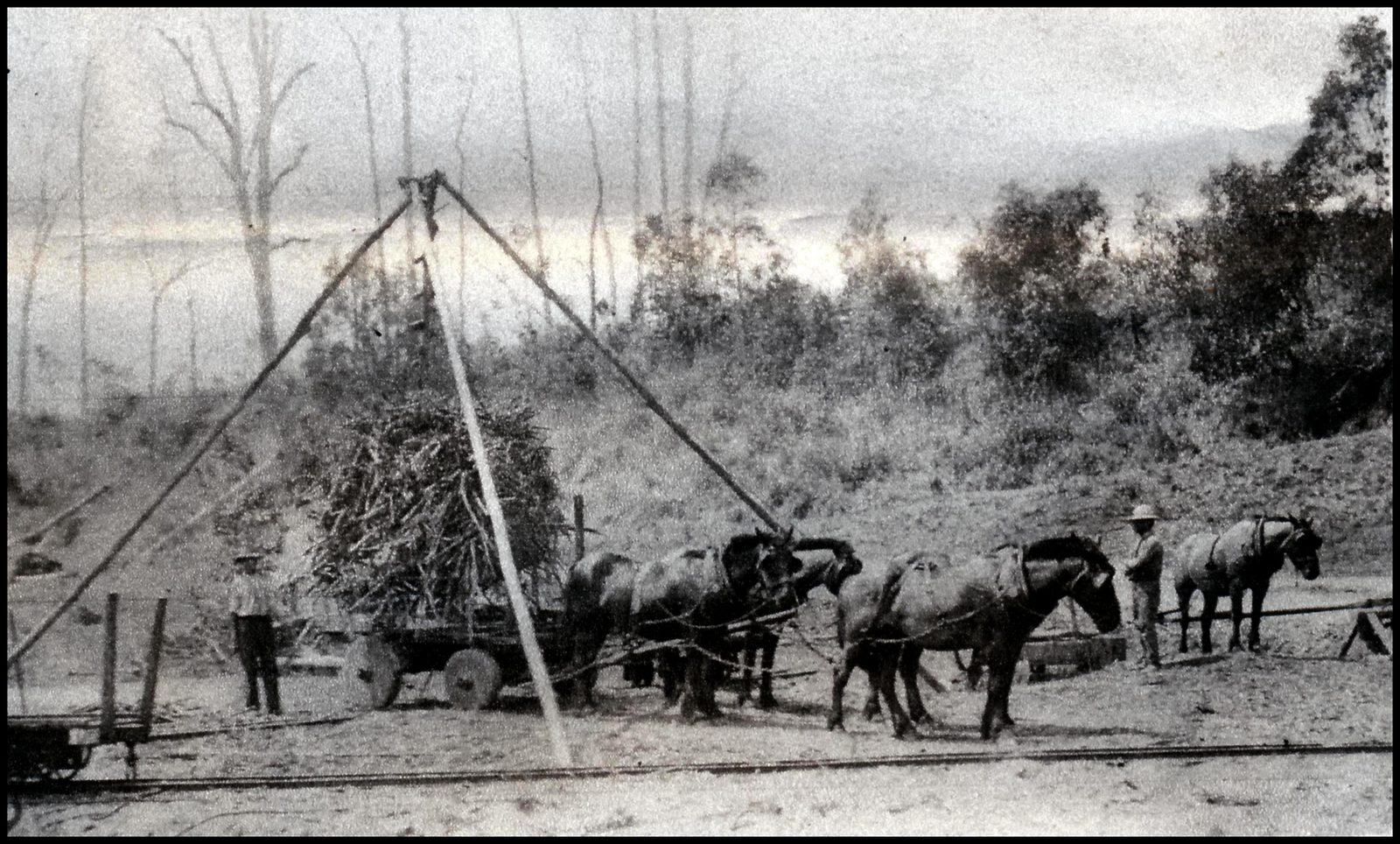 European Farm Workers in the Woongarra
Shortly after repatriation of Pacific Island farm workers in
1906/08. From the Jorgensen family collection
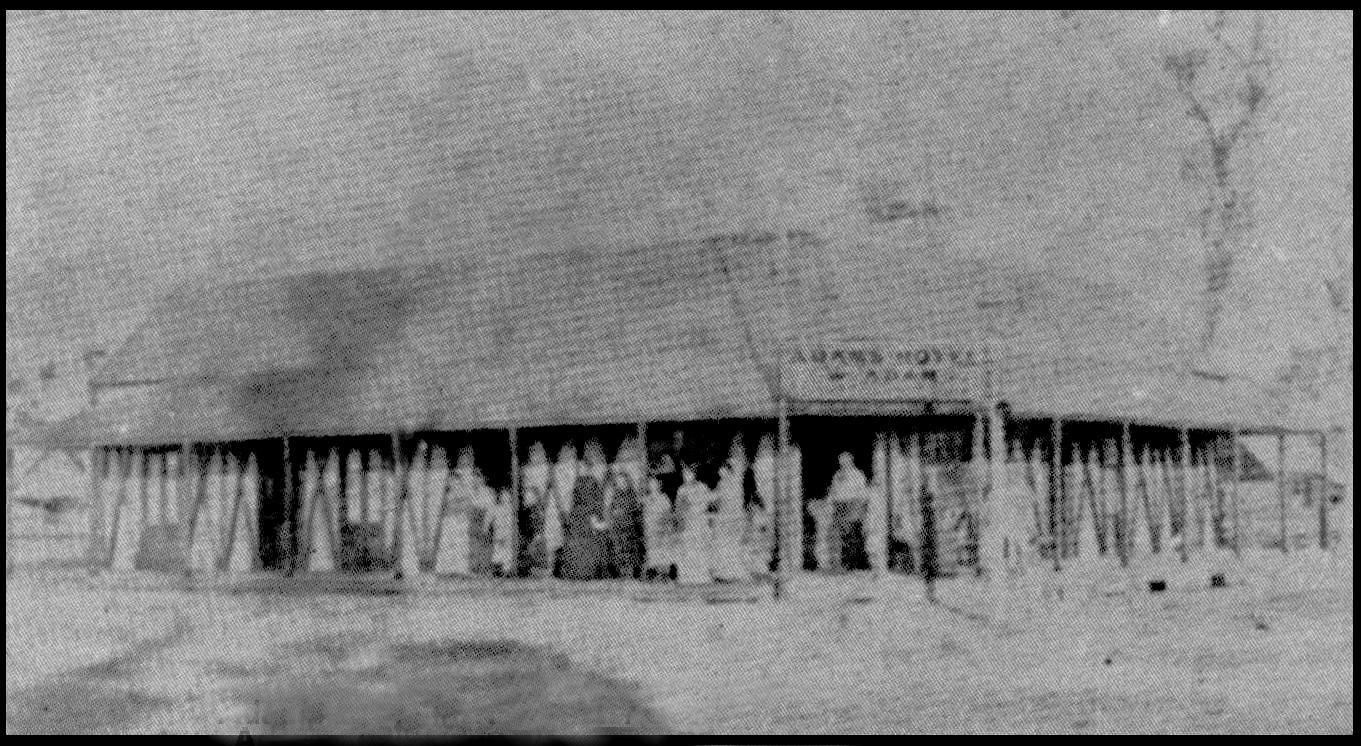
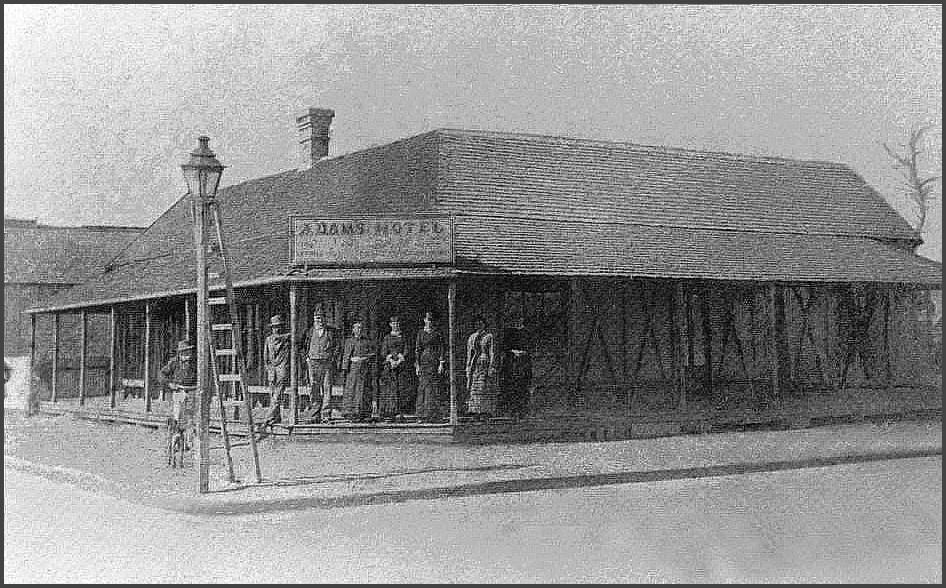
Above - shortly after construction in 1873.
Below - Shortly before its demolition to allow for the construction of the new Metropolitan Hotel
in 1884-1885.
Note: The street lighting, kerbing and new building in the background.