Chapter Ten
A Tale of Two Elections
The Year of 1886
From the Queensland Figaro and Punch of 2nd January 1886. Samuel Rowe, a Bundaberg cane grower, was issued with a summons by an Islander named Waltser for wages due. Waltser stated that he had been engaged on wages of 12 shillings and 6 pence per week, had been employed for five months and had, during that time, received nothing but one half a pound of tobacco and a blanket for which he was charged £1 2s. 0d. by Mr. Rowe. However, Samuel Rowe averred that he had agreed to pay Waltser 8s. 0d. a week; that he was to charge Waltser 1s. 0d. per week to depasture Waltser’s horse in his paddock and that Waltser had further agreed to forfeit 5s. 0d. a day for every day he absented himself from work. On this basis Samuel Rowe alleged that he only owed Waltser l1s. 3d. The Bench ordered Rowe to pay £5 18s. 3d. for wages and £1 4s. 6d. costs to Waltser, in default 14 days’ imprisonment. Samuel, given little choice, paid the amount awarded.
More on the subject of “the father of Bundaberg”. An old Bundabergian revived this issue by claiming that the true father of Bundaberg was Alexander Walker of Bingera station. Another old-time resident, Thomas Watson, was still living in North Bundaberg in 1886 and was in a hale and hearty condition. Although he did not claim the title of ‘the father of Bundaberg’ for himself, Thomas said that at Bundaberg (in 1872), he had ground sugarcane in a mangle and boiled the juice produced in a saucepan. The article also claimed that Walter Adams had grown the first sugarcane in Bundaberg well before this, in 1864. Note 1 Mr. Watson also said that he grew the first ‘taters’ in Bundaberg, but that he was not the father of Bundaberg as this happened to be John Steuart who had installed a sugar-mill on the Burnett River’s north bank and had since moved to the Daintree River where he was doing well and had acquired a thrifty young wife. (Ann Hart Robbins, a remarkable, pioneering woman.)
Note 1: It had been in that year but at The Pocket in Maryborough. Walter Adams credited Edward Thomas Aldridge with growing the first experimental crop of cane near Maryborough in 1860. Richard Palmer has been credited with the first commercial crushing of sugarcane in the Bundaberg district during his 1872 crushing at Millbank.
The 48 by 24 feet (15 by 7.5 metre) second, wooden Catholic church in Barolin Street had been inadequate in capacity almost from the day of its completion. In 1886 the Reverent Dr. Dunne, Bishop of Brisbane, laid the foundation stone for a much larger Romanesque church to be designed by the very competent colonial architect, Frances Stanley, and constructed by a local contractor, Mr. E. Boyle, at a cost of £3,600. Works were completed in 1888 with the opening service being held in May. The Adams family also contributed an ornate carved wooden pulpit (now removed) and a large, stained glass window.
Walter Adams was to retain his association with the Catholic Church and with its local representatives until his death on 15th of May 1892. Sad to relate Father Rossolini himself died a year later, in 1893. While much detail of the association between the two has been lost over the years, the degree of co-operation and level of mutual respect between them must have been very high. There remains in the old Adams’ red-cedar bookcase Volumes I and II of Australia Illustrated inscribed for presentation to Walter Adams by Constantine Rossolini.
Walter and Mary Adams’s last residence was on a George Street allotment, adjacent to allotments owned by Father Constantine Rossolini. The family subsequently acquired these allotments and they became the land on which Walter’s daughter Ellen and her husband Richard Walter Adams built their residence Newnham at 116 George Street. Descendants of Walter and Mary, who would never have met Father Rossolini, still spoke of him with much affection long after his death. This affection also extended to the memory of the original Sisters of Saint Joseph whose impact on the lives of the citizens of Bundaberg greatly exceeded the brevity of their stay in the early township.
Walter Adams’s Metropolitan Hotel, completed in March/April of 1886, was (and still is) a fine two-storey brick edifice constructed on the original Adams Hotel site. At the time it was considered that its arrival had rendered a great improvement to the corner’s visual aspect. Walter was one of the early pioneers who had acquired land when it was cheap and, during the previous year when there had been some excitement in land development, he had disposed of his large horse-paddock for £6,300 using a portion of this amount to rebuild the Met. His hotel was located on one of the best commercial corner sites in the town’s main street which guaranteed a secure income. The architect, Mr. Hettrick, had produced plans for the construction of a very well designed and furnished establishment. Following the demolition of the earlier Adams Hotel, which had become the Metropolitan by name change, one at a time, Bundaberg’s original timber buildings, those constructed in the early 1870’s, were progressively disappearing.
By 1886, Gin Gin, now with a population of 78 persons, had acquired a Court House with lockup and officers’ quarters, a School of Arts complete with library, a racing club, a railway station, another general store, a butcher’s shop, two timber mills and a school which, under the management of Mrs. McCrae, had increased its enrolment from twelve to over thirty students. Three years later two hotels had been constructed the designs of which were judged to be of a high standard: the Queens Hotel owned by Mr. A. F. Walker and the new Gin Gin Hotel owned by Mr. A. Lund. Mr. Lund hotel’s construction had also incorporated an entertainment hall. By this time the town also had an Oddfellows Hall, three stores and two blacksmith shops.
Wonbah station was held by Messrs. Hughes and Shand and then by Messrs. Shand and Buchanan over the decade to 1886 at which time it passed into the hands of Thomas Province. It later became the property of his grandson Eric P. Campbell whilst another grandson, Thomas J. Campbell, who was a prominent member of the Kolan Shire Council, restored Kolonga station.
The creation of the Colony of Queensland had been approved by Queen Victoria on 6th of June 1859, with the Queen then appointing Sir George Ferguson Bowen as its first Governor. On the 10th of December 1859 the Governor arrived in Brisbane and officially proclaimed the new Colony of Queensland. He then appointed Sir Robert George Wyndham Herbert as the Colonial Secretary - a position equivalent to that of an unelected Premier. Sir Robert Herbert’s appointed government then presided over Queensland until April 1860 at which time the Governor issued the writs for the first Queensland election.
Because of the limitations imposed on the electoral process by the basic nature of the colony’s communications combined with that of the coach or coastal steamer transportation, this first Queensland election was held over a period of fifteen days from the 27th of April to the 11th of May 1860. To be eligible to vote, or to be a candidate, for this election it was necessary to be a landholding male. The voters of the 16 declared electorates were to vote for 26 Members of the Legislative Assembly with some electorates having two representatives. The 11 members of the Upper House were not subjected to an election and were appointed by the Governor himself. The Parliament first met on the 22nd of May and was officially opened on the 29th of May. Sir Robert was elected Premier having won in the electorate of Leichhardt.
W. Frederic Morrison’s 1888 publication, The Aldine History of Queensland, gave the following details of the colony’s legislature:
“The Queensland Government has its seat at Brisbane, a city of about 90,000 inhabitants, including its suburbs. The colony itself has a population of about 400,000 besides an estimated population of about 15,000 coolies and natives. The Governor is appointed by the Crown at a salary of £5,000 p.a., together with a paid staff. The Executive Council forms a Cabinet responsible to the Assembly.
Parliament consists of two Houses, the Upper and the Lower, known as the Legislative Council and Legislative Assembly. The Legislative Council is composed of thirty-six members, who are nominated and appointed by the Governor for life. Any elector is eligible for membership therein. The president of the Council is appointed by the Governor and is paid a salary of £1,000 whilst the Premier is the vice-president thereof. One-third of the above number, exclusive of the President, constitutes a quorum. Seats may be vacated by resignation, absence for two years without the permission of the Queen or Governor, allegiance to any foreign state or power, becoming insolvent, being attainted of treason, convicted of felony or any infamous crime. Qualification for membership therein is being a naturalised or born subject of Her Majesty, of full age of twenty-one years, or having become naturalised by special act of the Imperial Parliament or that of New South Wales before Separation, or by special act of this colony. Four-fifths of the membership of this Council must consist of persons not holding any office of emolument under the Crown, except officers of Her Majesty’s Sea and Land Forces, on full pay, or retired officers on a pension.
The Legislative Assembly consists of seventy-two members, elected by sixty districts, and chosen by ballot, and the qualifications for nomination are, any person who shall be qualified and registered as a voter, not being a minister of religion or a member of the Legislative Council, or holding any office of profit under the Crown. The duration of Parliament is limited to five years, subject, however, to dissolution by the Governor. The qualification of electors is as follows: every man of the age of twenty-one years, being a natural born or naturalised subject of Her Majesty, or legally made a denizen of Queensland, is entitled to have his name entered on the electoral roll of a district upon meeting any of the following qualifications: first, six months residence; second, ownership of freehold estate of the clear value of £100; third, six months household occupation in a leasehold estate of a clear value of £10; all being in that electoral district. Members of both Houses are styled Honourable (abbreviation Hon.).
The Government departments are the Colonial Secretary, Treasury, Public Works and Mines, Public Lands, Attorney-General, Public Instruction and the Postmaster-General. The commercial policy is restrictive, a tariff on about ninety articles being imposed ad valorem of five percent on all articles of import, and an export duty of two shillings is imposed on every log of cedar leaving the colony.”
Walter Adams had revealed his political colours as early as 1878 as it was in this year that he had provided support to the Conservative candidate for Mulgrave, Thomas M’Ilwraith, both in the press and by the chairing of public meetings in Bundaberg. In June 1886 the Mulgrave electorate became vacant on Mr. M’Ilwraith’s resignation. As a consequence, a representative caucus of Conservatives met on a Friday night to consider making overtures to Messrs. Andrew M. Goodwin, J. G. Young, Fredrick Buss, and Michael Duffy in order to obtain a volunteer to nominate in the coming election. However, all of those selected had declined the overtures for nomination and Walter Adams was then approached. Walter accepted the honour with some reluctance and the meeting was adjourned until the following Monday.
Whilst Walter had a good flow of speech, some objections to his selection had been based on the uncultivated nature of his vocabulary and, as some people thought, his rather brusque manner. On the other hand, he was regarded as being a successful businessman and the owner of a fine hotel, the Metropolitan, besides other town properties and a plantation. Although agreeing to contest the election as a Conservative candidate Walter, in conformity with his initial reservations, had no desire to cover the expenses that would be involved in contesting the election with contributions from his personal finances.
On the other hand the Liberal party made the selection of their own candidate at their caucus meeting on the following Monday and it was James Court Walker, who had purchased Henry Ford’s north bank store in 1872, that was put forward for nomination. Prior to this Mr. Andrew M. Goodwin had, on mature consideration and for declared business reasons, declined to apply for nomination as the Conservative candidate even though he had received very substantial offers of pecuniary and moral support. He gave a lengthy explanation for the adoption of this position in his journal with the entry also expressing his belief that the Liberals had not issued him with a formal request to nominate.
A large number of electors had been keen for Augustus P. Barton, of Moolboolaman cattle station and Mon Repos plantation, to stand for the election as a Conservative. In ability and in education he was one of the most prominent men in the district and he had the potential to fill the position with credit. Henry Palmer, earlier a member for the Maryborough electorate, was also considered as a possible candidate.
As mentioned above, the Liberal candidate chosen to contest the election in opposition to Walter Adams was Mr. J. C. Walker who would be journeying through England over the period of the election campaign. It had become known that Mr. George Skyring may run as an independent candidate and, if so, this would have the potential to dilute the Conservatives vote. Mr. Skyring had previously run as an independent during the Mulgrave electorate’s contest between Thomas M’Ilwraith and Edward Tanner eight years before and he was thought to have forfeited his electoral deposit at the time. Since then Mr. Skyring had acquired additional funds at the death of his father, a Brisbane resident. George Skyring was, together with his two brothers, joint owner of the Robertson’s Baffle Creek cattle station, and of a lucrative butchering business in Bundaberg.
With Walter Adams suffering from a temporary incapacitation, which had precluded his travelling and which had caused the closure of the Metropolitan Hotel for the previous two or three days, Mr. Goodwin of the Mail travelled to Mount Perry to act as Walter’s deputy. Andrew Goodwin had acquired a good deal of influence with the locals of the mining town and was able to put this influence to good use.
Walter Adams had undertaken to give his first public speech on a Monday evening and curiosity was rather rife as to what attitude he would adopt in response to some of Mr. Skyring’s utterances of the previous Saturday night. It was obvious that Mr. Skyring had not communicated effectively with the electors as Mayor Duffy, who had presided at this meeting, expressed his regret that the show of hands, following Mr. Skyring’s speech, had not been in the candidate’s favour. In the opinion of most of the meeting’s attendees the Mayor himself had made a speech which, for practical hard-headed common sense, would be very hard to surpass by any of the competing candidates.
Mr. Skyring had made it clear that he was willing to meet his own campaign expenses and, if elected, he was prepared to give support to the Government whilst sitting as an independent member. He was strongly in favour of allowing farmers to utilize Islander labour; he was strongly opposed to the Land Act; he regarded the Licensing Act as being little better than a farce and, following his Saturday’s oration, it was understood that, if he was going to be a friend of the Government, he would be one of those good-natured friends who could do a great deal more damage to the administrators they serve than many straight Oppositionists. Mr. Skyring was a supporter of the Burnett River bridge and the Mount Perry railway line construction and it was understood to be part of his plan first to cajole and then to bully the Government by utilizing the leverage occasioned by his ability to change allegiance from one party to the other.
Following his second Saturday night meeting, at which he had managed to engender a considerable degree of enthusiasm, Mr. Skyring had undeniably created a more favourable impact upon the campaign’s attendees. The meeting’s hall had been packed, though largely with the local larrikin element of the population and, standing as he did on an essentially independent basis, it was perhaps not surprising that they regarded his chances very favourably. His comprehension of the audience made him comfortable with the engagement of repartee, as some discomforted Liberals were to learn on that night and, in addition, he was recognised as a practical agriculturist who had previously maintained a successful business in the Gladstone district.
Although Mr. Skyring’s campaign had been off to a fair start he then made an offer to discontinue his campaign if Mr. Adams would agree to do the same but, if this offer was to be accepted, it was apparent that Mr. Walker should win ‘at a canter’. Mr. Skyring’s proposition was for Mr. Adams to speak at the Victoria Hall and for his committee to then confer with that of Mr. Skyring with a view to deciding which of the two candidates would retire from the competition.
A new issue then arose. The sum of £350 had been promised, with signatures provided, at the Conservative’s meeting to assist with the group’s campaign. Following Mr. Skyring’s advent upon the scene, some of the signatories to the Conservative’s campaign funding had been racking their brains as to how to they could avoid meeting their funding commitment. The individual amounts varied from £10 to £30 and it was not hard to imagine to which side self-interest would lean. There would have been a good deal of relief if this little difficulty could have been amicably resolved. The dilemma resolved itself when it was discovered that the ability to recall the funding commitments had lapsed on the midnight following the Conservative’s meeting.
The Liberals’ casual approach to the election process had been maintained throughout the campaign with no telegram dispatched to the absent Mr. Walker giving confirmation of his nomination. However, subsequent to his selection a group of Mr. Walker’s friends, including Mr. Rowland of the Star, had addressed electors at public meetings in their capacity as the representatives of their chosen candidate.
By the 3rd of July the political situation in the Mulgrave electorate had been clarified. Following Mr. Skyring’s pliable campaign and his ensuing retirement from the hustings the issues then lay between Mr. W. Adams and Mr. J. C. Walker. Walter Adams did not need an introduction to the electorate as he had been so well known for the past generation or more in the Mary and the Burnett districts. He would have been the first to admit that he was not a brilliant candidate but he was an avowed supporter of Sir Thomas M’Ilwraith’s political policies and, under the guidance of the ex-Premier, his progress in civic representation had been of a steady and progressive nature.
It is true that the larrikins at Mr. Adams’s meetings in Bundaberg had been able to make a send-up of a vote of confidence, but it was of some consolation to Walter’s friends to know that the same treatment was meted out to Mr. Skyring, whose very elastic ideas of party allegiance might have been expected to find favour in the eyes of the hoy-poloi. It is only fair to assume that, even if Mr. Walker had appeared in Bundaberg during the campaign, the Bundaberg juniors’ desire for a larf would have so far weighed against any perceived notion of the district’s prosperity that the Liberals, as represented by Mr. Walker, and who were considered to be an anti-sugar industry Government, could also be expected to have experienced an adverse vote from this group.
In describing the relevant issues, the newspapers had kept the general electorate informed of the candidates’ varying policies and this had allowed the thinking portion of the population to form its own judgement. Mr. Walker’s supporters, acting on his behalf, repeated an address that he had made several years ago in lieu of a contemporary declaration as to his stand on the current issues with respect to time-altered circumstances. This address was consistent with the inherent spirit of economy, which some voters regarded as an expression of downright meanness, and that was considered to be a feature of the recent Liberal Government. The press was of the opinion that Mr. Walker had no knowledge whatever of the electioneering activities that had been undertaken in his name and it was not improbable that, when he received the results of the election by wire, he may have taken it into his head to repudiate the whole thing and to continue to enjoy his well-earned holiday in England. There was an impression in the electorate that, although the Conservatives had made the financial side of government rather too prominent there was, on the other hand, insufficient enthusiasm in the Liberal camp regarding their willingness to address the current financial issues.
It was also supposed that, if Mr. Walker were to accept the electoral victory, which in some haphazard fashion may have fallen his way, he would not be able to take his seat in the House until that Assembly had been in session for some months into the remaining season. In other words, the people of the electorate would not benefit from his services for a third of the then remaining short parliamentary session and one of the services he would be expected to render, if he were to be elected, would be to inhibit the use of Pacific Island labour which could have resulted in the destruction of the sugar industry and the return of the Mulgrave district to its former state of chronic insolvency.
It was, from a non-political point of view, a matter of some relief that the potential for Mr. Walker’s time in office would be, of necessity, very short owing to the proximity of the forthcoming general election. There was a widely held feeling in the agricultural areas that, if any farmers were to vote for the Liberal’s champion in Mr. Walker, they would receive a shilling a bushel for their maize with nothing but white labour at twenty five shillings a week to assist them. They would then have to bear the consequences of knowing that, in many people’s opinion, they had voted to ruin their own district’s agricultural prospects. Many were also aware that the Government’s enormous financial deficit should not be increased by sacrificing an industry that it was the current Premier’s declared objective to make unviable.
There was no surprise in the news that had come from both Reid’s Creek and Mount Perry where Sir Thomas had been, if at all possible, more revered than in any other part of his ex-electorate that the votes of confidence in his potential successor had been both cordial and unanimous. It was therefore to be expected that, at least in this portion of the electorate, the electors considered that the recent rumours in circulation critical of his potential successor were untrue and henceforth they would question any further rumours of a like nature. Against Walter Adams there was a very ‘one-horse’ form of canvassing with the prominent advocate of this approach being Mr. Rowland who could hardly have been said to take a disinterested view of the matter. Walter was next to tour the remainder of the Kolan district utilizing his successful, personal approach towards the canvassing of local issues.
In recognition of the large populations in and about the mining fields of Mount Perry, Mr. Adams, accompanied by Mr. George Greathead, arrived there on Tuesday for an early July campaign meeting. On Wednesday they viewed the newly constructed railway tunnel and were then conducted on a tour of the goldfield to view the active mining claims. Some of the party descended into the shafts to examine the workings in more detail and, on returning to the surface, expressed their confidence in the field’s great potential.
The miners had stopped work on that afternoon to attend the Mount Perry area’s first meeting of the current political campaign. The meeting was presided over by Captain Bennett who introduced Walter Adams to the gathering of assembled miners. Walter then addressed the gathering on the divergent issues of the day and explained his political views in a straightforward manner. Following the address Mr. Dennis proposed, and Mr. Clark seconded, that Mr. Walter Adams was a fit and proper person to represent their electorate in the Legislative Assembly. This motion was carried unanimously.
At eight o’clock that night a large concourse of people had assembled in Mount Perry’s School of Arts to attend the day’s second campaign meeting with the chairman, Captain Bennett, introducing Walter Adams to the meeting. Walter then addressed the assembled electors and delivered a very effective speech that was well to the point and which lasted for about three quarters of an hour. By the conclusion of the speech there was no doubt that he had made an extremely favourable impression. He had given very satisfactory replies to each of the different electors’ questions and one noticeable aspect of his speech was the entire absence of any mention of his opponents, a precedent which the other candidates would have done well to emulate. He received a unanimous vote of confidence as being a fit and proper person to represent this constituency.
On the following Saturday the representatives of Mr. J. C. Walker, the Liberal candidate, consisting of Mr. George Walker, Mr. John Rowland, Mr. Totten and others, arrived at Mount Perry for their presentations to the electors. As soon as the doors of the School of Arts were opened, the institution was filled from one end to the other. W. H. Cogzell Esquire, J.P. was in the chair and, in his opening speech, said that he trusted the meeting to give the deputation a fair and impartial hearing. He then explained the reason for the absence of Mr. J. C. Walker who was continuing with his English travels.
In reply to the question raised by several gentlemen as to how he, Mr. Cogzell, knew that Mr. James Court Walker would be willing to stand if elected, he informed the gathering that Mr. Walker had previously assured his representatives that he was at their service and willing to contest an election at the first available opportunity. Mr. George Walker, Mr. Totten, and Mr. Rowland all spent a considerable amount of time in explaining the views of their candidate in as far as they were able. There was no doubt that they had done their best, but the views they expressed did not appear to meet with the approval of the majority of those at the meeting. Following the presentations, Mr. Michael Bennett moved that Mr. Walker was a fit and proper person to represent the electorate.
Sir Henry Mitchell proposed, as an amendment, that Mr. Adams was instead the proper person to represent the electorate and this was seconded by Captain Bennett. Amid much enthusiasm the chairman declared the amendment carried, with only eleven hands being raised in support of Mr. Walker. Following the traditional vote of thanks to the chairman, the meeting broke up at 10.20 p.m. On the following day Mr. Walker’s deputation moved on to Reid’s Creek.
As to the prospects of the two candidates, it was apparent that Walter Adams had performed soundly in Mount Perry, and in its surrounding districts, where a significant portion of his campaign funds had been committed. It was indisputable that he had, over the years and under practical circumstances, obtained a very considerable amount of experience in civic planning. What Mr. Walker might know, and how he may perform in this area, was not clear although it was universally conceded that he was a far better orator than Mr. Adams.
The gentlemen who had deputised for Mr. Walker, in advocating his cause, had not succeeded in arousing any excitement in the district’s voters. The impression acquired by the press was that the farmers, in the main, approved of Mr. Adams’s presentation especially when they considered that the professed Liberals, who had not invested a cent in the sugar industry, would vote for Mr. Walker.
It appeared odd to many of those present on the Monday night, when the pride of the Liberal party - described at the time as being the persuasive and warlike Mr. Lamb, the sage and seasoned Mr. Rowland, the democratic and aggressive Mr. Totten and the calm and introspective Mr. Howe - were assembled, that there had been considerable differences of opinion as to what Mr. Walker’s sentiments on the agricultural labour question really were. One gentleman had obviously spoken more to his own opinions than to those of the candidate and it was reported that the others may well have done the same. If Mr. Walker was to have read of the event it was thought that he may have felt inclined to say, “Save me from my friends”.
A strange, and ongoing, matter for consideration by the electorate was the concern that Mr. Walker appeared to be completely ignorant of his own nomination. Since his departure from Bundaberg he had neither sent nor received any messages and, if he had decided to do a little travelling while overseas, it is possible the news of his supporter’s campaign activities may not have reached him prior to his return to London. Conversely, he almost certainly would have known that Sir Thomas M’Ilwraith had resigned as this would have been mentioned in the colonial cablegrams that were published in the London newspapers.
The great fray between the electoral representatives had come and gone and the early voting returns for Mount Perry showed that Walter Adams had been victorious in that district. The weather on the polling day had been all that could be desired and buggies and other vehicles were despatched by both parties to bring their supporters into Mount Perry from the Reefs and from Drummers Creek. The atmosphere in the town was very lively with a party feeling that was, as the Americans would have said, “tall on both sides”.
On the day itself the advocates of either side of politics had been feeling sure of obtaining a verdict that was in their favour. Under the Returning Officer, Mr. O. Armstrong, the polling continued steadily throughout the day until 4 p.m., when the polling room doors were closed and the work of counting the votes commenced. The counting was by no means a herculean task as only 83 votes had been recorded. At 4.30 p.m. the Returning Officer, accompanied by the two scrutineers, emerged onto the Court House veranda and announced the numbers to be as follows: Walter Adams, 45; J. C. Walker, 37; Informal, 1.
These were relatively small totals when it was considered that there were 361 electors on the district’s electoral roll but, against that, returns had still to come in to Mount Perry from the Dalgonal, Roselyn, Yarrol, and Cania Diggings. In Mount Perry there was then a rumour that Walter Adams had a majority in the Bundaberg area of 98 votes. When the above Mount Perry numbers were announced Captain Bennett proposed three cheers for the local Returning Officer which were heartily delivered. It was noted that there was no evidence of drunkenness in the town throughout the polling, the whole proceedings having been conducted with both good order and good feeling, which reflected great credit on all concerned. The overall tally for the election, at the conclusion of counting, was 541 votes for Walter Adams and 435 votes for Mr. J. C. Walker.
As an offset to the locals’ interest in the election, a footrace had been held along the riverbank, and past the Bundaberg Courthouse, for a prize of £10, with one runner being a local athlete named Moore.
The Gooburrum Divisional Board had requested a loan from the Government to construct a wharf on the northern bank of the Burnett River to service the farmers on that side of the river. These farmers were severely handicapped both by the delay in waiting for the old rattletrap of a cross-river punt to ferry their produce across the river and by the high cost of this ferrying. Storage at a north bank wharf would have enabled the produce to be loaded and transported directly to Maryborough or Brisbane with no double handling. It is possible that the Government may have been waiting to ascertain the result of the election in the local area before committing to this project, especially when the history of Burnett River flooding was considered.
During the course of Walter Adams’s Parliamentary terms two of the accomplishments closest to his heart were the passage of the Bundaberg School of Arts Enabling Bill of 1887, which resulted in the construction of the building which still stands in Bourbon Street, and the construction and opening, in June 1891, of the Burnett River railway bridge. (The road traffic bridge opening was not to occur until 1900)
The technological age had finally arrived in Bundaberg with the introduction, in early July 1886, of Alexander Graham Bell’s invention, the telephone. Following its introduction, the limited number of business and household installations had functioned well. However, the local press reported that some were to regret the telephone’s use was not confined to strictly commercial purposes as on one particular morning, very shortly after installation, a large number of frivolous messages were said to have been transmitted through the wires, all related to the previous night’s ball. It was alleged that this, the first peak in Bundaberg’s usage, had inflicted a severe workload on the lady in charge of the central telephone exchange.
The Mount Perry mining field was maintaining a healthy rate of production and, as a consequence, a highly optimistic atmosphere prevailed throughout the field. The following is a reproduction of a progress report that is typical of the Mount Perry mining field reports being issued at the time and is indicative of the prevailing atmosphere:
“The assay of a parcel of stone obtained from the Caledonian reef at Reid’s Creek, and crushed at Olympic, had resulted in the production of l ounce 3 penny-weight of free gold to the ton, not including the mundic Note 1 tailings that, when treated, should produce in the order of four additional ounces to the ton.
Some really excellent work had been conducted on the Nos. 3, 4 and 5 Welcome reefs at Reid’s Creek and the energetic manager had, by then, sunk the main shaft 72 feet below the first level, making a total depth of 147 feet from the surface. On reaching a depth of 96 feet a very favourable change of ground occurred. The prior 21 feet encountered had been of very hard rock and breaking through this would have been very tedious and expensive. However, the favourable change mentioned above required an entirely different evaluation as to the nature of the ground.
From the 90 feet to the 147 feet level the reef averaged about 16 inches in thickness and was composed of soft granite and argillaceous (clay like) matter traversed throughout with veins of rich mundic material. This reef was highly mineralised and the manager, going by the appearance of the country, expected to strike a large deposit of auriferous sulphides. He was then opening out the workings towards the south at the bottom of the line of reef and on considering the dip of the cross course he expected, at about 20 feet from the shaft, to intercept the same offshoot of the stone that had been passed through at the upper level and from which about 250 ounces of free gold had already been taken. It was anticipated that the free stone would give way to pyrites and, from the nature of the reef in which the shaft was being sunk, he was confident that these sulphide bearing ores would be rich in proportion to the sulphides obtained from the shallower depths.
The whole plant was in very good order and, in Mr. Henry Mitchell, the company had evidently acquired the right man for the job. He was a thoroughly practical man and took every precaution for the safety of his men and for the economical working of the mine.”
Following a period of growth, the Mount Perry mine’s viability entered a decline in large measure due a falling copper price. This culminated in the mine’s closure in 1891. In 1898 the London-based Queensland Copper Company purchased the mine and this occasioned a significant town revival so that, by 1904, the population in the mining field had reached 2,000 persons. Following this expansion, the demand for copper again proceeded to fall away resulting in the progressive closure of this and many other copper mines. With the mining venture at Mount Perry in a state of collapse the copper smelters closed in 1915 which caused a major diminution of the population and, as a result, many buildings in the town were either demolished or removed.
Note 1: A Cornish miner’s expression for pyritic (copper and/or iron sulphide) mine waste normally retained in the mine’s tailings.
An extract of interest from The Brisbane Courier reported that, in the Parliament’s Legislative Assembly Notices of Tuesday the 5th of August, Walter Adams was off to an early start when he moved:
“That there be laid on the table, Mr. Surveyor North’s report on the Mungar and Gayndah Railway” and, in the same extract, a further item of interest was Mr. Kates proposal to move: “That, in the opinion of this House, it is desirable that, to promote the agricultural, pastoral and mining industries of this colony, immediate steps should be taken for the conservation of water and the preparation of a comprehensive scheme for irrigation and general water supply”; and “That, in order to give effect to the foregoing resolution, it is expedient that a Royal Commission be appointed to make a diligent inquiry into the best method of conserving the rainfall and of searching for, and developing, the underground reservoirs supposed to exist in the interior of this colony, Note 1 and of conserving the waters in our various river and mountain streams for the purposes of irrigation and general water supply and to avert the disastrous consequence of the periodical droughts to which this colony from time to time is subject.”
Note 1: They certainly did exist, in the enormous, multi-layered and laterally dispersed aquifers of the Great Artesian Basin.
Another item raised in the Parliament at this time was related to the government’s issue of the experimental Californian seed corn. On this issue Mr. Moreton replied in Parliament, in answer to a question from Mr. Stevens, that the seed corn for distribution in the colony was expected to arrive from California the next day and that the basis upon which the Government proposed to distribute this grain had not yet been decided. There were 650 applicants for the 200 bushels ordered with the applications being principally received from the Moreton, Darling Downs and Wide Bay Districts and he was to provide further information re the distribution on the following Tuesday.
Following his temporary absence from the aldermanic ranks, whilst electioneering in the Mulgrave electorate, Walter had returned to his Bundaberg Council duties. However, it was considered by at least one interested ratepayer that “the time had now arrived for Mr. Adams M.L.A. to contemplate his resignation from the Council appointment so as to provide the opportunity for another aspiring townsman to contribute to the Council’s deliberations.”
A prominent land transaction of the year was the sale of the agricultural land in the Isis Scrub, known as Ramsay’s where Mr. Curtis was to auction ninety farm blocks of various sizes on Saturday the 28th of August. The sale had been expected to meet with considerable success, as there was a great demand for first-class scrub land and it was felt that closer settlement in the Isis, and the placing of such a large area under crop, would improve the commercial prospects both of Bundaberg and of Maryborough. The price of maize remained at 3 shillings and 6 pence per bushel and the August supply of grain remained steady with no likelihood of a price change into the near future.
Mr. Walter Adams M.L.A.’s activities were being well reported in the local newspapers which were speculating that the electorate may have secured a representative who would, perhaps with a little toning down, provide a significant amount of practical advice to the debates held in the Assembly. It was at this time that Walter Adams had, in September 1886, transferred his licence as proprietor of the Metropolitan Hotel to his son George Manus, probably to meet the legal requirements demanded of a Member of the Legislative Assembly. In October the Queensland Figaro and Punch opined that Walter Adams M.L.A. for the Mulgrave, may have disappointed a lot of people who thought that he would not find the Assembly to be another edition of the Bundaberg Council and that he would therefore find his opinions suppressed in that gathering. If such was the case, they would have been bitterly disappointed by the very tangible work that Mr. Adams had already carried out in the Assembly, and they now found themselves in the situation where they could not speak well enough of him.
Following the close of the parliamentary session Walter Adams with his family arrived back in Bundaberg aboard the vessel Leichhardt at 3.30 p.m. and was warmly welcomed by his friends and by others who thronged the river bank also anxious to extend a welcome. The steamer was gaily decorated with all her bunting flying and, on nearing her destination, she gave three loud blasts on her whistles perhaps to warn the townsfolk of the approach of their respected representative and his family all of whom looked fresh following their short absence. A very small pair of cream coloured ponies and a palanquin Note 1 of light build belonging to Mr. Adams were offloaded. The palanquin was much admired by attendees who considered it to be quite a novelty.
Note 1: It was highly unlikely to have been a palanquin unless the meaning of the word held a different connotation when used in the colony in those days. The presence of the “small pair of cream coloured ponies” suggests it was much more likely to have been a chaise.
The Year of 1887
The year 1887 commenced with a succession of minor floods. Intermittent but heavy rainfall prevailed for many months which resulted in the production of an uninterrupted succession of twenty wet Sundays. This sequence of events carried through into late November and acted as a significant detriment to church attendance from the outlying areas.
It was in this year that George Greathead acquired Hopewell plantation and mill. Unfortunately, in common with many plantation owners of the time, George found the industry to be suffering strong headwinds and, in a period of severe depression, committed suicide. His redoubtable wife Ann, assisted by their son George, persisted with the plantation and subsequently achieved commercial success.
It was also in 1887 that the fourth Police Magistrate was appointed to Bundaberg in the form of Mr. Theopilus Parsons Pugh“------ one of the oldest pioneers of Queensland, a gentleman of light and learning and the original author and compiler of Pugh’s Almanac.” The Police Magistrates who had preceded him were, in order: Joseph Hughes, appointed in 1871, followed by Horace Burkitt and then Robert Johnstone.
Mr. Pugh was born at Turk's Island (in the Caicos group of islands near the Bahamas) in 1831. Educated at Old Kingswood School near Bristol and at Wesley College at Taunton, he served a short apprenticeship as a printer, and then joined the Southern Times at Weymouth. and later the Mirror at Salisbury, and the Herald at Swansea. He arrived in Australia in June 1855 and became a correspondent to the Empire of Sydney before becoming the editor of the Moreton Bay Free Press in 1855 and maintained this position over a period of four years. In 1859 he was appointed editor of the Moreton Bay Courier (now The Courier Mail), then a bi-weekly publication, and which, in May 1861, was converted into a daily publication. After leaving the Moreton Bay Courier in 1863, Mr. Pugh was engaged in various journalistic enterprises and became the first editor of the Brisbane Telegraph following its creation in 1872 a position he retained for slightly over a year. Pugh's Moreton Bay Almanac appeared in sheet form at the close of 1857, and in book size the following year. In 1860 the scope of the almanac – or, rather, directory – was enlarged, and came out as Pugh's Queensland Almanac.
Theopilus Pugh was also the first publisher of the Queensland Government Gazette, from 1861 to 1863, and was elected to represent the Town of Brisbane in the second Parliament of Queensland. He was re-elected in 1867 and became Chairman of Committees. In the following year's election, Mr. Pugh was re-elected, but very shortly thereafter resigned from Parliament. He then entered the civil service, and was appointed Police Magistrate at Goondiwindi in 1874 and afterwards filled this position at Rockhampton, Warwick, Bundaberg, Beenleigh, and Nanango.
The Victoria Hall was well attended on a Friday evening in mid-February in response to the invitation from local amateurs, consisting mainly of those who had officiated at the Robbie Burns’ Concert of the preceding week, to participate in a second concert in support of the victims of a recent Burnett River flooding. Virtually all of the audience bought three shilling tickets and Mr. Adams, before the concert was to commence and in his role as the local M.L.A., spoke feelingly of the victims’ plight and congratulated the audience on coming to the aid of those severely affected flood victims who had been “left without anything to stand up in.” The Queensland Figaro and Punch’s music critic gave a description of the evening’s musical performances, however, as his opinions are, by their very nature, subjective they will receive little mention here where the main intention is to give details of the musical talent, and of the music itself, that was then popular in Bundaberg. In later years Bundaberg was to acquire a very favourable reputation in the development of its musical talent.
The quartette of Messrs. Gill, Williams, Blaikie and Coombe, performed All Among the Barley;
Captain Schofield a popular local tenor was unavailable to perform owing to ill-health;
Miss Totten sang melody Dreaming of Home;
Mr. Dunbar recited Phaudrig Crohore;
Mr. M. W. Blaikie sang Nil Desperandum;
Herr Becker gave a Vichy-like left-handed performance on the pianoforte, giving variations on the Last Rose of Summer;
Miss Nellie Walker sang Carissima;
Messrs. Gill and Williams presented Larboard Watch, the former performing for the occasion following some years of retirement;
Mr. J. Faragher played a cornet solo;
Miss Chamberlain essayed Shells We Gathered Long Ago; and
The performance by an instrumental quartette consisting of Messrs. Blaikie, Beckett (violins), Burgess (cello), and Beckett (piano), provided the conclusion for the first part of the concert;
Messrs. Gill, Williams, Blaikie, and Coombe performed the opening of the second half with a rendition of Farewell;
Mr. Coombe sang Lassie;
Miss Chamberlain sang Strangers Yet;
Mr. Anderson’s rendering of The Old Brigade earned an encore;
As did Mr. Blaikie’s violin performance of The Last Rose of Summer;
Mr. Moss afforded a treat in his rendering of I Seek for Thee in Every Flower;
Miss Totten sang Kiss Me Ere I Fall Asleep;
Master Bennett, Captain Bennett’s son, brought the house down with his rendition of the Curfew Must Not Ring To-night;
Herr Becker gave an excellent imitation of a banjo on the piano;
Miss Walker sang Who Can Say;
The trio of Messrs. Moss, Blaikie and Coombe sang an old number called The Wreath; and
Mr. Dunbar gave a serio-comic song without accompaniment, The Emigrant’s Return, which electrified the house and, “although suitable for the more primitive times of the town, is hardly adapted to the more cultured requirements of the present” claimed the, perhaps somewhat straight laced, music critic.
The concluding item was a performance by an instrumental quartette, and this was followed by the National Anthem.
Walter Adams M.L.A. then gave thanks to the amateurs and public on behalf of the Relief Fund, which had received substantial financial benefit from the proceeds of the concert. Inclusive of these proceeds an amount of £120 had been subscribed to the fund ensuring that Bundaberg’s well-known reputation of having a willingness to donate to charitable causes was maintained.
Later, in February, Walter Adams M.L.A. moved to examine some papers that related to mineral land selections at Mount Perry in which six men had been allocated mining leases by the Goldfield Warden over ground subject to a forfeited mineral selection. The selection had been marked “forfeited” both in the official books and on the lithographed plans. Everything had proceeded smoothly until payable gold was encountered and then it was suddenly discovered that the selection had not been forfeited and that a Deed of Grant had been issued on the selection to the prior holders though they had done no work on the selection in question. Walter would not have been so surprised by these events had he been a regular reader of the Queensland Figaro and Punch, according to its editor, who maintained that, had he been a regular reader of that journal, he would have known that a working miner has no right to a payable claim under a ‘Liberal’ Government.
Towards the end of February M.L.A. Adams, as the representative of the Mulgrave electorate, received a reply from the Postmaster General in response to his renewed request for details of the position regarding Bundaberg’s promised post and telegraph office. The member and his constituents were advised that “the matter will receive careful consideration”. The citizens of Bundaberg were only too well aware of the meaning of that convenient phrase.
At this time communication between Bundaberg and the township of Howard had become somewhat erratic. The daily horse drawn coaches left from either end with unerring regularity, but the timing of their return was decidedly uncertain. The ongoing, almost continuous, rains were maintaining both the Gregory and Isis Rivers at flood levels, so that the outgoing coach could not cross the Isis River and the incoming coach could not cross the Gregory. This inclement weather also called to a halt the operations of the contractors working on the Bundaberg to Howard railway line as they were unable to procure timber for the bridges that they had under construction.
Messrs. Steindl and Fleming, the local brewers, Mr. R. Ruddell of soap fame, Mr. W. Adams M.L.A., sugar planter, and others were awarded diplomas and medals by the Colonial Exhibition Commissioners, in Walter’s case for open-pan sugars. The willow had been formally buried for the season and the time had arrived for the town’s footballers to arrange for their oncoming practice and games. Given the nature of the prevailing wet weather the washing of the football players’ uniforms would have constituted a major undertaking.
Other events at that time were the Sunday opening of a new building on the north side for the Church of England and, at the Friday Caledonian Society’s annual meeting, those elected were: John Young president and J. C. Walker and G. S. Mackay vice-presidents.
A 100 foot wide channel that had been dredged by the Saurian through the outer bar of the Burnett River in the latter part of the previous year had silted up as a result of the recent flooding and a replacement dredge the Maryborough was co-opted to reinstall the channel. The flooding had also eroded a sandspit and this had considerably altered the angle of approach to the navigable lead into the mouth of the Burnett River. Fortunately, the earlier improvements to navigation in the remainder of the river had remained undamaged. The Pacific Island labour schooner Helena sailed from the Burnett Heads for the South Sea Islands on Sunday the 17th of April after having been docked in port for three months.
In response to requests from several ratepayers, a representative meeting was convened by the Mayor, Mr. Daniel McConville, and held in the Victoria Hall in late April. The meeting’s objective was to petition the Municipal Council to refuse the issue of liquor licences to Chinese, Pacific Islanders, Cingalese, and other aliens. Several speakers had dwelled at length upon the increase in drunkenness amongst the local Islander farm workers with a consequential increase in disturbances during their Saturday night visits to the town.
The calling of the meeting had been precipitated by a recent disturbance, with speakers at the meeting attributing its cause to the existence of the lodging-houses maintained by Chinese and Cingalese proprietors. The meeting determined that a decided and prompt effort should be made to nip the cause of such conduct in the bud. Some held the opinion that referring the matter to the Council would be a farce and hence a decision to place a petition before the Colonial Secretary, in order to obtain an act of Parliament, was proposed by Mr. Curtis. The meeting’s intention was to make provision for farm workers to conduct their purchasing during daylight hours. The meeting’s proposals were carried, with close to unanimity, by the packed house.
In its mid-May response to this petition the Government declined to assist in the establishment of a ‘home’ (as an alternative to the existing lodging-houses) for farm workers visiting the town from the surrounding plantations as it considered that, so far from remedying the evils complained of, such a ‘home’ would tend to induce the labourers to visit the town more frequently, and to remain there for a longer period of time. For better or for worse the Colonial Government had affirmed the Islander farm labourers’ right to visit the town on a Saturday night and to spend their wages on hard liquor.
The Brisbane Courier in its edition of 5th of July 1887 (Abridged from a Wide Bay News article) reported that:
A public meeting of Isis farmers was held in the church building at Hortontown on Monday the 27th of June, at which about sixty people were present. The object was to discuss with directors of the Isis Investment Company the practicability of establishing a sugar mill in their midst. It was suggested that the Government should be invited to put a sum on the Estimates to establish a central mill. Mr. Morgan said that, on behalf of the Farmers Union he would guarantee to grow enough sugar cane if the company was prepared to erect machinery to crush and to manufacture the sugar. Mr. Stupart pointed out that there was no proposal for the Isis Investment Company to become a sugar grower. The idea was to form an independent company with a capital of £100,000. He thought that it was time for the people to band together for their common good and that they should get their members to pledge protection for the colony’s industries. He pointed out that it was no use attempting to grow sugar without the introduction of a crushing facility and he believed that the Millaquin refinery was the plant that possessed the best process for sugar production. Mr. Morgan did not expect the project to become a reality for over two years, but it could be commenced at once. ---------- . Others to express their opinions at the meeting were Mr. Cocking, Mr. Barry, Mr. Mellor, Mr. Bailey, Mr. Annear, Mr. E. Booker, Mr. Thompson and Mr. W. Howard.
In its issue of the 30th of July 1887, the Queensland Figaro and Punch described Walter Adams as being a sturdy specimen of the bush pioneer who had acquired hard, bushwhacking experience. He was described as being a shrewd man who had been connected with land settlement all of his life and that anything he did not know about the current, or any previous, version of the Land Act wasn’t worth knowing. Walter was also described as being an eminently practical man and although he was not an eloquent orator, as his grammar tended to get a grip on him too often and his words were not the cultured tones of a college educated youth, yet his ideas were all solid and, when shaped into the forcible current of spoken English, were worth more than those of a dozen or more legislative lawyers. His was a working man’s practical view of the land bill, and his homely illustration of it as a Dummier’s (i.e. using a dummy applicant to extend lease holdings) Bill was more eloquent than all of the Government spokesmen’s verbose and ingenious apologies that had accompanied the introduction of this bill.
The following text details Walter’s comments on the bill to the House:
Mr. Adams: The same honourable member said that the Act would prevent dummying. Will any honourable gentleman tell me whether it is not really a Dummier’s Act?
Mr. Dutton (the Minister for Lands): It is not.
Mr. Adams: If I was a man of capital, and had five or six sons, I could go myself and select 20,000 acres of land, picking the eyes out of the country. If I did not get all the good land in that 20,000 acres, my son of twenty-five could select 20,000 acres adjoining; and my other sons who were old enough to select could each do the same, until we got amongst us a whole countryside. Does the Hon. gentleman not call that dummying? It seems to me that before very long we shall have a change in our land laws. This is seen by the dummiers, and they have the idea that they will have the first right of purchase. Do you see the idea? Select the land largely with the almost certainty that, under the next Land Act Amendment Act, you can get the freehold. Glorious dummying.
The article went on to say that Dutton lived in an ‘Opium Paradise’. He thought that every independent and impartial person would admit that the working of the Land Act had been very satisfactory indeed. Dutton said that he “never interferes outside his Department” and it was alleged that there existed a body of opinion that considered his colleagues were probably not rent with anguish that he did not and that, if he were never to interfere in the workings of his own department, the people of the colony would almost certainly have been grateful.
Mr. Adams then went on to remark upon the comments that Mr. Foxton had made concerning settlement under the Land Act and maintained that: “It seems strange to me that a gentleman holding the position of a Queen Street lawyer should know very much about the settlement of people on the land and the operation of the Land Act” and Walter, an authority on matters of the bush particularly with regard to the acquisition of property under the requirements of the act and of its precedents, added “I can inform the hon. gentleman that the Land Act is a perfect failure”.
It is of note that a peculiarity of the debate on the Address in Reply within the Queensland parliament was that, when making their case, Government Members holding Ministerial positions were allowed to refer to any papers, documents and statistics tabled in the House and/or currently being printed by the Government Printer, while Opposition Members had no such access to this material.
Walter Adams’s comments on the Colonial Treasurer’s performance at this time made it obvious that he regarded the Treasurer, the Hon. Mr. Dickson, as being vastly overzealous in his pursuit of taxation increases (and expenditure?). He said that Dickson had £311,000 to start with but that wasn’t enough; then he taxed timber and machinery, but that wasn’t enough; and then he added a 2%, ad valorem (added value) tax, but even that wasn’t enough. He then to took endowments away from the Board of Health, but again that wasn’t enough, and Dickson still found himself the loser of close to half-a-million pounds. Walter would like to know how much it would have taken to satisfy Mr. Dickson. How many more millions would be required to enable him to balance the budget in the following year?
In the August of 1887 an attempt was made in the House to debar publicans from sitting on Divisional Boards. An argument had been presented that publicans would, by gaining election to Boards, acquire an influence that could be used to bring additional trade to their own licensed establishments. However, it was pointed out to the House that the same argument would apply in an even greater degree to storekeepers and tradesmen. The Licensed Victuallers Act had become so stringent that a publican had no choice but to be a respectable person of proven good character before he could obtain a license, while a storekeeper could be a man of no character at all as far as his submitted credentials for a position on a Board were concerned. It was far from likely that bad men would be elected to Boards as they operated in districts where everyone knew everyone else. There have been publicans who had made excellent Members of Parliament. Walter Adams, then present in the House, had been a good publican, another publican had become a C.M.G. in Sydney and yet another a Minister of the Crown in a neighboring colony. In his presentation Mr. Macfarlane was considered to have made himself look ridiculous when he opined that a publican “holds an office of profit under the Crown” because he is licensed. It could be contended that such an interpretation would apply equally to a paid Member of Parliament, a hawker or even to a shoe black (polisher) for that matter.
In September Walter Adams, in refuting a report that he was about to retire from public office, advised his electors that he intended to offer himself for re-election in the forthcoming October election. Mr. James Court Walker, of Bundaberg, the storekeeper who had unsuccessfully opposed Walter in the previous election, announced that he would also be willing to try his luck for a second time. Mr. Walker’s sponsors, supporters of the Liberal leader Sir Samuel Griffith, believed that they had fully consolidated their ranks since the previous election and were keeping a close eye on movements in the electoral roll.
The Cape York Telegraph Line north from the town of Laura was connected to Thursday Island via the west coast of Cape York in 1887. This telegraph line was of considerable significance to sea-port towns on Queensland’s east coast, such as Gladstone, Bundaberg, Maryborough and Brisbane, as this was well before the advent of ship to shore communications. Notice from the Torres Strait pilots’ base would give these towns about a week’s notice of a ship’s arrival versus the two to three months’ notice received from such points of departure as the Port of London issued by ships on route via the Suez Canal.
The Year of 1888
By January 1888 action was underway for the redistribution of the Mulgrave electorate into the newly declared electorates of Bundaberg and Musgrave. In the subsequent election, conducted in early May, both of the conservatively inclined candidates, Walter Adams in the Bundaberg electorate and William Bligh O’Connell in the Musgrave electorate, were elected and went on to serve in Premier M’Ilwraith’s government. Mr. O’Connell had been a leading businessman in Bundaberg, a representative on the town council and had been the Polynesian Inspector from 1882 to 1887. He was succeeded in that position by Henry St George Caufield. He had earlier been employed by the Bank of New South Wales and was thought to be a nephew of the late Sir Maurice O’Connell. Mr. O’Connell had been elected as the Member for Musgrave unopposed, following the withdrawal of Mr. J. W. Phillips from the contest, and Mr. Adams was elected, also unopposed, as the first elected member of the Bundaberg electorate.
The Howard to Bundaberg railway line had been scheduled to commence its Bundaberg service in February 1888, however, this schedule was lengthened due to the unusually heavy summer rainfall then being experienced. On completion, the line was a boon, not only to mail and passenger travellers, but also to the transporters of agricultural produce. An additional economic benefit was its ability to convey commercial quantities of other heavy and/or bulk commodities such as timber and coal.
On April 15th 1888 a committee was formed at Moolboolaman, Mr. A. P. Barton’s cattle station, to establish a Provisional School utilizing the funds that had been donated by the local population for the construction of a school building. Application had been made to the Department for Public Instruction to provide a teacher but the Minister, Mr. Moreton, declined to provide the necessary assistance. There were twenty-two children between the ages of five and thirteen years in the catchment area of the proposed school and all but one or two of these children resided a distance greater than eight miles from any other school located in the Moolboolaman district.
The school committee then forwarded a petition via Walter Adams acting in his capacity of the past Member for the late electorate of Mulgrave. The petition was signed by thirty residents, who asked that an inspector be sent to investigate and to report on their application. It was later claimed that the inspector who had been dispatched to undertake the inspection was quoted as saying that he had received definite instructions not to report in favour of any new schools as the Government, needing to reduce its expenditure, intended to abolish as many provisional schools as possible.
Consequent correspondence on the matter was of the view that the Government would have received more credit by reducing expenses in other areas rather than by denying bush children the privilege of attending a local school. The Government was considered to have made a harsh decision as its implementation forced these children to walk more than eight miles to and from school, with the chance of getting drowned in a creek after sudden storms, or being exposed to one of the many bush fires prevalent in the district during the fire prone dry season from August to October.
The press of the day found it refreshing to be able to report upon an agreement between the pulpit and the bench. In this instance there was a minister of religion who had issued a very charitable commendation and, on the other hand, a police magistrate with whom he was in harmony. Henry Plume, M.A., Archdeacon of North Queensland, was reported as having declared: “During my long bush tours I have come across many wonderful cures effected by Warner’s Safe Cure for fever that is so prevalent in the bush - it seems to be a certain cure. I have never had occasion to try it myself but, from what I have seen on my last trip, I shall never start on a journey without my pack being furnished with Warner’s Safe Cure.”
And Robert Johnstone, Police Magistrate for Tiaro and Howard via Maryborough, Queensland contributed the following commendation:
“For the past 26 years I have been subjected to complicated liver complaints. I suffered from general languor of body, weariness, loss of appetite, and other painful symptoms, characteristic of a torpid state of the liver and I despaired of ever getting well again. Seven months ago, when very ill indeed I, at the instance of Mr. Adams M.L.A., procured Warner’s Safe Cure. The first bottle made me sick, but I persevered with it and, with the third bottle, my condition greatly improved. Last April I had altogether consumed a case of 12 bottles of the Safe Cure and ever since I have been in the best of health, in fact I am enjoying much better health than I did during the past 26 years of my sojourn in Queensland.”
It is perhaps to the misfortune of later generations that this highly recommended and remarkably efficacious product no longer appears to adorn the shelves of our apothecaries.
A large crowd assembled on the night of June 9th to escort the Members for Bundaberg and Musgrave, Messrs. W. Adams and W. B. O’Connell, to the wharf where they were to board the Glanworth steam-boat for their passage to Brisbane. Coloured fireworks were activated, and rockets discharged from various riverside buildings and from the Glanworth steamer itself. A procession was formed which was headed by the local band accompanied by its torchbearers. Mr. Adams and Mr. O’Connell addressed the crowd from the bridge of the steamer, which then left amidst loud cheering and the discharge of cannon.
The Maryborough to Bundaberg railway service’s inauguration in 1888 resulted in the closure of Mr. C. J. West’s stagecoach run that had been providing the passenger service since August 1876 and the mail service since January 1878. The coastal railway’s extension to the Burrum coalfield from Baddow Junction had earlier replaced the stagecoach service’s run from Maryborough to Howard and Goodwood. Whilst it seems to be counter intuitive, the first section of the coastal railway, which was eventually to run from Brisbane to the far north, did not commence in Brisbane. To further emphasize the importance of the Gympie goldfield to the infant colony the initial section of the north coast railway ran from the Gympie goldfield to the port of Maryborough and was opened in August 1881. An extension to service the Burrum coal mines had its construction commenced in 1883. Economics were very relevant to the overall railway extension programme as the construction of lines over the western plains was much cheaper per mile than one following the more difficult terrain of the coastal strip with its many river valleys and ranges.
By December 1867 the Central Sugar Mill at Yengarie had passed into the ownership of John Meiklejohn who then installed new machinery and a distillery but, from 1877, the Central Mill was being operated as a juice mill only, the juice being transported to Tooth and Cran’s nearby Yengarie Mill for refining. William Gibson, operator of the Clydesdale Mill at Hemmant in Brisbane, purchased the Central Mill in 1869/70. Later, in the mid-1880s, Mr. Gibson sold the mill to Tooth and Cran and redirected his endeavours to Bingera west of Bundaberg.
The Bingera sugar plantation and mill occupied the space which, just over four years previously, had been covered by dense scrub and timber forest. The new plantation boasted one of the finest sugar mills and refineries in Queensland and radiating from the centre of the plantation were neat cottages, fresh new tents and over 1,400 acres of cultivation that contained many different varieties of robust sugarcane. The firm of Gibson and Howes had entered the sugar industry on a commendably sound basis, their capital expenditure being well in excess of £100,000. A principal of the firm, Angus Gibson, had arrived in Queensland with his father in 1863 under the system by which emigrants who had paid for their own passage were granted land of value equivalent to the cost of their passage. The Brisbane Courier, in its edition of June 13th, provided the following report on an official visit paid to Gibson and Howes’ Bingera plantation by the Governor during his party’s visit to Bundaberg at the commencement of the 1888 crushing season. The report of the visit contains a brief description of the Bingera complex in its original configuration.
“With their characteristic enthusiasm the Bingera people prepared to give the party a right royal welcome. On the Saturday morning the population of Bingera was early astir, kanaka and white eagerly vying with each other to make the least important part of their department give a highly respectable appearance. Two months prior to this, when surplus hands had been dispensed with during the off season, a census was taken of the estate and it was found that the population then consisted of 171 whites and 170 islanders giving an overall total of 341. However, in anticipation of the crushing due to commence the following week, there had since been an influx of additional white labourers and South Sea Islanders.
The visit of Sir Anthony Musgrave and party had been arranged to commence at 11 a.m. and long before that hour the decorative work had been finished, and so there had been enough leisure time to arrange for the reception. In front of the main entrance from the railway a grand triumphal arch had been erected. The structure was supported by two handsome pillars, festooned, wreathed, and neatly hung with evergreens. Along the arch, in large letters was the word “Welcome”, and over that in a crescent shone conspicuously the words “Sugar Industry”. High above, at the lookout, were flags streaming gaily, and all round the works bunting of every colour fluttered in the breeze. Along the road at intervals from Gibson’s siding to the works were stationed goodly troops of workers. At the entrance to the works were ranged the crowd proper. On one side were the white population of men, women, and children with the South Kolan school children under the direction of Mr. Corry and, on the other side, the neat, clean and orderly Islanders.
Punctually, at the hour named, his Excellency arrived at the works. On alighting from the special carriages that had been improvised for the occasion three ringing cheers were given for the Governor of Queensland followed by three more for Sir Samuel Griffith, K.C.M.G. and then the National Anthem was sung by the entire crowd. The vice-regal party comprised Sir Anthony Musgrave K.C.M.G., Sir Samuel Griffith K.C.M.G., Walter Adams M.L.A., W. B. O’Connell M.L.A., Captain Baden-Powell A.D.C., Mr. T. P. Pugh P.M. (Police Magistrate), Mr. M. Duffy, Mayor of Bundaberg, Mr. J. Y. Walker, Chairman of the Woongarra Board, Mr. P. Kilner, Sub-collector of Customs, Mr. E. Daly, traffic manager Bundaberg and Mount Perry Railway and others including the police escort under Sergeant Kelly.
His Excellency in a few warm, earnest sentences thanked the gathering for the hearty reception that he had been accorded. Glancing up at the triumphal arch, he seemed intensely amused to notice a stalwart white man painted on one of the pillars and on the other a sturdy specimen of an Islander, with a very grave expression, playing on a concertina. Having the islanders and white workers placed on each side of the words “Sugar Industry” typified the doctrine held by the firm that, for the industry to be thoroughly successful, it must employ the labour of both races. The party then proceeded on their inspection of the works, and of its machinery.
Under the guidance of the members of the firm the inspection proceeded. Beginning with the portable trams, trucks, shoot, and cane carrier, the entire process of sugar manufacture was followed in all its ramifications from the crushing rollers up to the finished article stored in the sugarhouse. The ponderous and intricate machinery astounded even those accustomed to the sight of first-class sugar mills. Each party in turn visited the look-out on top of the building from whence the magnificent view fairly enthralled the various members.
When the sight-seeing had been completed the party were conducted to the improvised luncheon hall, which had been laid out on a most generous scale in a beautiful, versatile and commodious building, which served as a church, a school, a concert-room, a theatre and as a function room for the Bingera Working Men’s Institute.
At the close of the visit his Excellency and party expressed themselves as thoroughly delighted with their special trip to Bingera, and with the free, cordial and warm reception accorded them. As the party left for town ringing cheers came from the crowd, which were responded to with counter cheers and waving of hats and handkerchiefs. To all, the day was a most enjoyable one and, as a holiday to the workers, it was celebrated with zeal and with pleasure. In the evening a well-attended grand concert was given in the function room of the institute which served as an excellent wind-up to the day’s proceedings.”
In the House and during the August address in reply, Walter Adams queried Sir Samuel Griffith’s financial competence and deplored the manner in which Sir Samuel, in his time as Premier, had expended the budget’s financial buffer of £400,000, previously accumulated by Sir Thomas M’Ilwraith, and which had included the Burnett River railway bridge construction allocation of £30,000. This had been withdrawn from the Bundaberg constituency’s allocation during Sir Samuel’s tenure in office.
An article that appeared in The Brisbane Courier of the 5th of October gave some details relevant both to conditions in the Queensland colony and to the Australasian colonies in general. Here the parliamentary reporter appeared to be sympathetic to complaints made in the House that the revenue levied by the government on alcoholic beverages was too low. This issue was a matter of considerable importance to Bundaberg with its recently constructed rum distillery as it was the major component of the newly created molasses-to-rum industry that was to provide a significant boost both to the local planters and to the district in general. It was also of some relevance that the newly established electorate of Bundaberg had Walter Adams as its local member and that this electorate had, until recently, been a part of Sir Thomas M’Ilwraith’s old Mulgrave electorate. Neither of these Honourable gentlemen were considered to be self-effacing members of Queensland’s legislature.
An edited and abbreviated description of the 5th of October report on the Tariff Proposals of the Government in Committee of Ways and Means deliberations as presented to the Legislative Assembly and as reported upon by the Brisbane Courier follows:
It was claimed to be a matter for extreme regret that the Treasurer did not see his way clear to accept the amendment to increase the duty on spirits from 12 to 14 shillings per gallon as the latter rate was not exceptional. In every Australasian colony, excepting Victoria and Tasmania, the duty had been raised to fourteen, fifteen and even sixteen shillings per gallon, and the Treasurer could well have followed this general example.
The main desire of the premier, Sir Thomas M’Ilwraith, in revising the tariff, as set forth in his Financial Statement, was to obtain sufficient revenue to meet the deficiency for the then current financial year and, in the course of a further year or two, to wipe out the total accumulated deficit of £602,011 that had been inherited from the previous Administration. His secondary objective was to impose taxation that would encourage the establishment of local industries, or would give a fillip to existing industries, but the elimination of the deficit remained his main objective. In raising revenue, it was deemed desirable to tax luxuries rather than the necessaries of life whilst maintaining a wide enough margin to protect local industries.
Alcoholic beverages were considered a luxury in most countries and so were normally the first of the commodities to be taxed and, because of their wide and too frequent consumption, they were perceived to be the source of many of the evils afflicting society. The reporter thought that a finance Minister, who was in desperate need of revenue, would readily seize upon a tax that would afford him, in one fell swoop, from £50,000 to £60,000 per annum. He had no doubt that the other tariff proposals would be an oppressive burden on the majority in the community with his loose calculation indicating that the weekly cost of living to a family of five would increase by six to eight shillings. He would have supposed that any opportunity for a reduction of this cost would have been pursued by the government’s Premier and Treasurer.
Sir Thomas M’Ilwraith claimed that (alcoholic) spirits were already yielding more than their due proportion of the revenue raised by the colonies and in no other colony in Australasia did intoxicating liquors, including spirits, wine and beer, contribute as much to the taxation revenue as it did in Queensland. Here intoxicating drinks yielded 25 shillings per head of the population, while in New South Wales they afforded 18 shillings per head, in New Zealand, 13s. 6d., in Victoria, 13s.8d., in Tasmania, 11s. 7d. and in South Australia 6s. 8d.
In South Australia and in Victoria the low revenue contribution was due to the large consumption of locally produced wines and in Tasmania and New Zealand it was due to the propensity of their people to drink beer rather than spirits. In Queensland wine imbibing was not common as its vignerons had not learnt how to produce a good quality drinking wine under local conditions and the importation of southern wines was uneconomic. Beer drinking was also unusual as its delivery to consumers was impeded by the limited output and distribution of the breweries as these circumstances rendered uneconomic the transportation of bulky commodities such as beer to the far reaches of the colony. Spirits, with their higher alcohol content, yielded the largest proportionate sum to revenue and were Queensland’s staple drink.
Mr. Philp moved an amendment in the House that proposed a compromise: that the suggested increase to the duty on spirits be reduced to one shilling per gallon and applied to offset a reduction of the 15% duty on the heavy machinery that was then needed to assist in the development of the North. Note 1 The temperance party supported an increase in revenue on the ground that it would lessen the consumption of spirits, while Mr. Sayers pleaded for an additional two shillings per gallon increase in the hope that it would encourage the distillation of whisky relative to that of the other spirits consumed in the colony.
The report claimed that some of the most curious reasons ever heard in Parliament were raised against the increase of the duty. Mr. Goldring contended that raising the duty from twelve to fourteen shillings per gallon would increase the price of a valuable medicine utilized both in the west and in the northern scrub lands, while Mr. Adams said it would inhibit the usage of a well-known snake-bite cure. This homeopathic treatment of the tariff would have beaten anything Hannemann Note 2 ever propounded according to The Brisbane Courier’s reporter. However, the Treasurer remained resolute in his attitude and even refused to entertain Mr. Philp’s compromise proposal to increase the duty by just one shilling per gallon and, when the division was taken, the then current duty of twelve shillings was maintained by an overall majority of 39 votes against, versus 26 for, the increased duty.
Note 1: Walter Adams would almost certainly have supported a specific and separate motion in this regard as regional development was one of his leading priorities.
Note 2: Hannemann in the 1880’s was a well-known homeopathic hospital situated in Liverpool, England.
In November Ernest Stevens, the Member for the Logan, succeeded in gaining the assent of the House to the consideration of an address to the Acting-Governor, praying His Excellency “to direct that a reward of £5,000 be offered to the person who first manufactures 5,000 yards of calico in the colony.” Mr. Stevens’ motion did not stipulate that the cotton from which this calico was to be manufactured was to have been grown in Queensland but he indicated that this, of course, was what he meant and an amendment embodying the fact would be inserted in the address. The prior Government had experimented in the application of agricultural bonuses, as applied to the installation of central sugar-mills, but the conditions laid down as to the employment of white labour had been so blatantly disregarded that the outcomes had no relevance what-so-ever to the stated objectives.
Upon the growing of cotton in Queensland opinions among the experts of the time seemed to be fairly equally divided, one group saying that the cotton crop could be successfully and economically grown and another group maintaining that the cotton plant could not be regarded as an economic crop if grown in the Queensland farm lands. While the Government itself had no commitment on the issue Walter Adams gave direct testimony that he had grown cotton at an overall cost of £10 per bale, and had sold it for £7 10s. per bale, an experiment that, if duplicated in practice, would render the proprietors of any cotton plantation insolvent.
It was estimated that two looms, which together would be capable of turning out 5,000 yards of calico in two months, could be installed for £1,200 and, this being the case, it was evident that a speculator would be paid very well to meet the conditions required to claim the £5,000 bonus, even if this entrepreneur was never again to grow another pod of cotton. Some of the older legislators could have refreshed the memory of the House with regards to a cotton-growing experiment that had previously been conducted in the colony. They could also have recited the history of a, by then defunct, cotton company that had been run by a gentleman who had abandoned cotton growing in favour of oyster cultivation. Attempts to apply bonuses in the promotion of new industries had revealed that every proposal submitted to the government should be carefully evaluated on its own merits, with regards to the relevant industry’s specific conditions and with every item of prior history being considered.
The question as to how the proposed bonuses could be terminated, once in place, was raised by Mr. Morehead. There was also a concern expressed that some honourable members, who would vote for the introduction of the cotton manufacturing bonus, may see in it a means to then apply for bonuses to finance their own hobbyhorses.
In early November the local press was reporting that the representative of the famous medical company of Messrs. H. H. Warner & Company had announced his arrival on his regular visit to Brisbane. Since his October last visit to the Queensland colony Mr. Elsasser had been touring the southern Australian colonies and New Zealand, to promote his firm’s new preparations. These comprised Warner’s Safe Rheumatic Cure, Warner’s Safe Asthma Cure, and Warner’s Safe Nervine, the latter being described as a very vigorous nerve tonic.
These medications, accompanied by the firm’s great liver and kidney specific, the Warner’s Safe Cure, and also Warner’s Safe Diabetes Cure, and the Warner’s Safe Pills, were said to be the only proprietary medicines sanctioned by the German Government and also by many leading members of the medical fraternity. The reception given to these specifics throughout the colonies were considered to provide ample evidence that they possessed properties of a highly curative nature. Since Warner’s Safe Remedies had come into general notice, the treatment of domestic health was said to have been almost entirely reformed by the introduction of these exceptionally effective remedies that, it was claimed, were of an absolutely harmless nature.
Their high efficacy was documented in a vast number of testimonials including powerful endorsements by the Hon. Geo. Thorne, M.L.A., Mr. Walter Adams, M.L.A., the Rev. William Poole of South Brisbane, the Rev. Walter Roberts, M.A., the Rev. William Powell of Rockhampton, the Rev. Henry Plume, M.A., Archdeacon of North Queensland, the Rev. Bassenden of Charters Towers, Mr. Alfred Compigne the Police Magistrate of Beenleigh, Mr. Robert Johnson the Police Magistrate of Maryborough, Mr. Hanrahan the ex-mayor of Townsville, Mr. Castling another ex-mayor of Townsville, Mr. John Savage, the Mayor of Cooktown, and a host of other well-known colonists.
It had become accepted (or so it was claimed) as an undisputed fact that most diseases incidental to hot climates in civilized countries emanated from the liver and kidneys. For centuries false doctrines prevailed when, for a thousand years or more, Note 1 the false philosophy of Aristotle had enslaved the minds of civilized men, but it had now perished forever and passed away “like a tale that is told.” The timely application of proper means had checked the inroad of disease. Warner’s Safe Cure, was claimed to be a thorough specific for complaints arising from disorganization of liver and kidneys, including Bright’s disease, while the firm’s newly developed medications were considered just as effective in achieving their own, specified objectives. Warner’s representative had distributed up to 50,000 pamphlets in Queensland. These pamphlets explained to the citizens of the colony the nature of health, disease, and dietary regulation and, together with the number of testimonials from distinguished personalities in Queensland, had the potential to make all these medications extremely popular with a population conscious of its health.
Following the dramatic advance in the development of effective medications and in the understanding of the causes of many diseases over the last century it is easy to overlook the high degree of reliance (sometimes unjustified) that people placed on the usage of patent medicines. Warner’s ‘cures’ were obviously very prominent examples of this reliance in the 1880’s. In my own Bundaberg school days such preparations as Waterbury’s Compound, Carter’s Little Liver Pills and Buckley’s Canadiol (Cough) Mixture come to mind.
Note 1: Records appear to indicate that Aristotle had been born 2,272, not 1,000, years earlier than 1888.
By the close of 1888 Summerville was one of the medium sized plantations in the Bundaberg district, having 120 acres under cane of value £10,000, eight European male employees being paid a combined £402 per annum and 27 Islander males and three Islander females being paid a total of £845 15s. 0d. per annum. By comparison Fairymead, the largest plantation, had 1,252 acres under cane valued at £75,000 and employed 47 European males and four females, paid a combined £5,000, and 267 Islander males paid a total of £5,860.
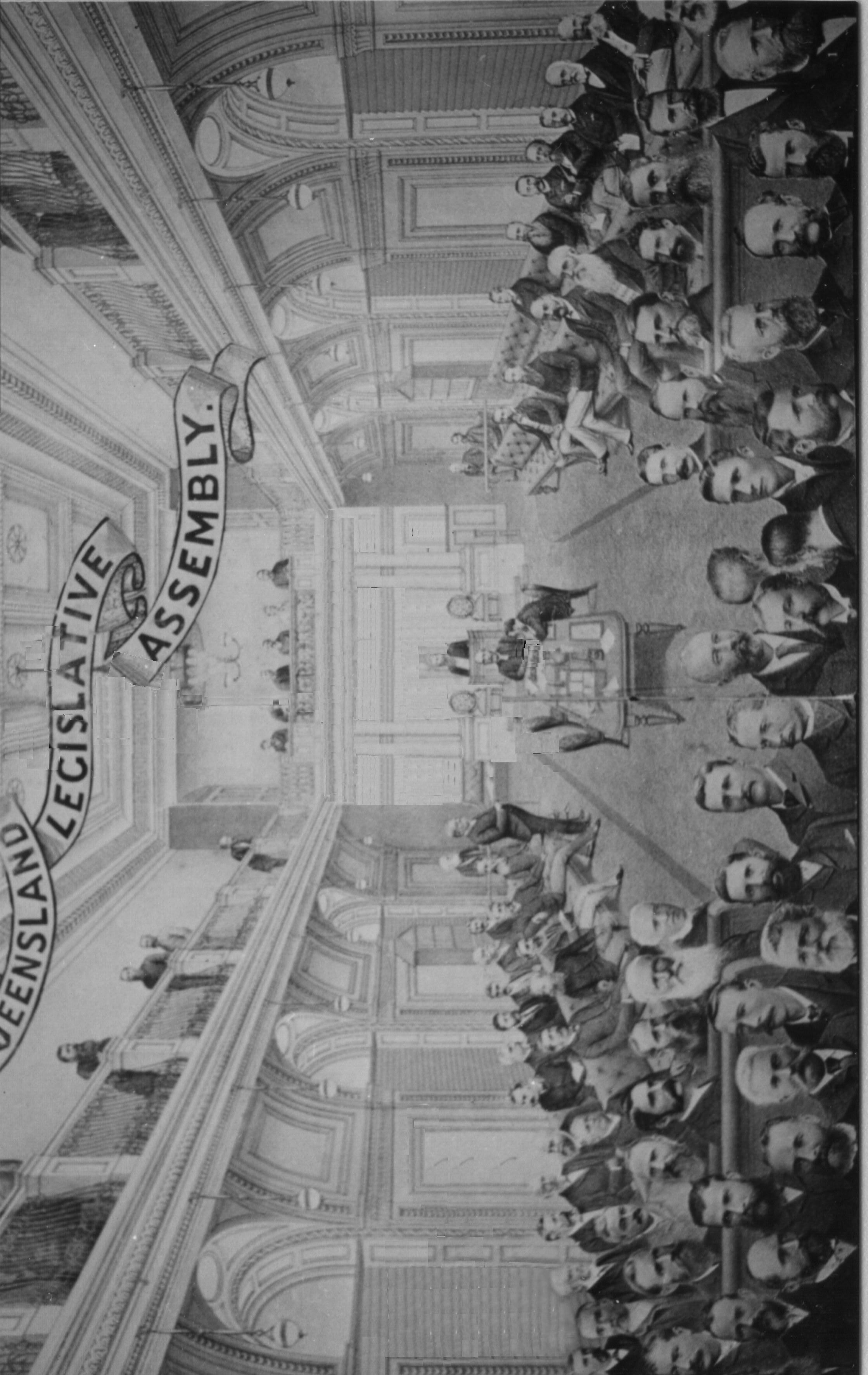
An Official Photograph - Walter Adams Is Third from the Left in the Back Row