Chapter Seven
An Alderman of Bundaberg
Over the Decade 1880 to 1890 Some Significant Occurrences in the Home Country Were:
The cholera microbe was identified by Robert Koch which confirmed the accuracy of Dr. John Snow’s 1849 prediction, as described in his book On the Mode of Communication of Cholera. A legacy of this identification was the widespread adoption of effective sewage and drainage works and a greatly reduced death rate;
Progression in dry-plate photography, combined with advances in photographic techniques in general, considerably increased the popularity of this medium;
The ideas and philosophy of Marx were reaching a wider audience;
Agitation for Irish home rule, the parliamentary impact of Charles Parnell and the effect of Irish Australian, and Irish-American articulation of Ireland’s grievances;
The killing of General Charles (Chinese) Gordon in Khartoum precipitated a war in the Sudan;
The colonisation of Africa and the formation of the British East Africa Company;
Rudyard Kipling’s India;
Queen Victoria’s Golden Jubilee of 1887;
Arthur Conan Doyle’s Sherlock Holmes debut in A Study in Scarlet;
The Whitechapel murders of Jack the Ripper; and
London’s five weeks duration labour dock strike led by Ben Tillett.
The Year of 1880
Walter’s daughter, Matilda Jane, married Thomas Riedy, a native of Newmarket-on-Fergus, County Clare, in 1880. James Adams and Thomas were the first to work as teamsters on the Colosseum Mountain, initially called Mount Walsh after William H. Walsh an early owner of Monduran cattle station. Tom became well established in the sawmilling and timber industry in Bundaberg and was the proprietor of two hotels. Thomas Riedy and his family later relocated to Wondai.
The first Bundaberg Divisional Board was gazetted in March 1880 with Messrs. F. L. Nott, Chairman, J. Gillen, C. F. Jensen, A. G. Hamilton, J. F. Boreham, J. M`Shea, J. Lamb, W. B. O’Connell, and J. Gill as its members and with Mr. R. Thompson being appointed as clerk. Following their gazettal the district’s boards set to work to expedite the requirements of the Divisional Boards Act of 1879 so that they could then concentrate their resources on their high priority public works. In Bundaberg the ongoing works to clear the streets of tree stumps and to improve the town’s sanitary conditions were expedited following its Divisional Board’s appointment.
Following its tender evaluation meeting the Bundaberg Divisional Board was forced to call fresh tenders for the position of valuator when the person initially accepted for the position proved to be unable to meet his conditions of contract. The Board also disapproved of the Government’s selection for the proposed site of the new Bond Store, and advised the Minister for Works accordingly. It was considered that building it in the nominated position would ruin the appearance of the town’s river frontage. A telegram from the Minister, Mr. Macrossan, in reply notified them that their request could not be accommodated.
The Barolin Divisional Board held its meeting on a Saturday afternoon and Mr. E. B. Jeune, of Branyan, was unanimously elected chairman for the current year. In response to the calling of tenders for the positions of clerk and valuator several applications were received and that of Mr. R. Thompson, at £80 a year, as a clerk providing boardroom and office, was accepted as was Mr. W. H. Atkinson’s tender of £40, as valuator. Members of each of the board’s sub-divisions were formed into finance committees to represent their respective districts. It was resolved to apply to the Government for a grant of £500: £350 to repair the Maryborough road, which was in a very poor condition, and £150 to renovate the Adams Bridge which, following wear and the passage of time, required extensive renovation.
The Kolan Divisional Board’s meeting was held on a Tuesday with Mr. John Forrest of Gin Gin being appointed chairman. The Board decided to merge the offices of clerk, valuator and road inspector into one position and issued circulars advertising the position and inviting tenders. As the circulars were issued at 5 p.m. on Tuesday, with a closing time of 9 a.m. on Wednesday, only four applicants provided tenders and two of these tenders were declared to be informal. Complying tenders were received from Mr. J. I. Gammie, who tendered £200 per annum, and from Mr. H. G. Franklin, who’s tender of £220 per annum allowed for the provision of a boardroom. Mr. Gammie’s offer was accepted. Following a disagreement at the evaluation meeting, the board decided to exclude the public from the tender evaluation process. This gave rise to a suspicion that favouritism was being exercised and, consequently, the board was to receive an unfavourable local Press.
During the years 1877 and 1878 discussions were held with Robert Cran with the view to establishing a central sugar mill in the Woongarra. Probably due to the large amount of finance that was required to be raised, approximately £160,000, no immediate activity followed.
In April 1880, John Walker of Walker and Company Maryborough visited Bundaberg to inspect, select and negotiate the acquisition of a suitable site for a substantial sugar mill adjacent to the Woongarra farm lands. In negotiations with the planters he indicated that he was prepared to erect a mill provided that his stipulated conditions were met. These included a legal guarantee for the provision of cane from a minimum area of 200 acres being supplied to the mill over the full crushing season. He was negotiating for the purchase of 200 acres of Woongarra land and, although he did not wish to cultivate his own cane, in the event of non-fulfillment of the minimum supply agreement, he would be compelled to do so to recoup his £8,000 outlay.
In the last season, from the 405 acres of cane harvested and crushed, 1,008 tons of sugar had been manufactured at an average of two and a half tons of sugar per acre, an amount that would meet the mill’s financial requirements. Under the then prevailing conditions it was estimated that Woongarra’s standing crop would realize a return in excess of £28,000. Unfortunately, John Walker’s land purchase negotiations fell through leaving his conditions unmet.
In August 1880 the growers’ hopes for the mill construction were revived following a visit by Robert Cran and his engineer Mr. Thomas. Following this visit, Robert Cran Snr. departed for England to acquire the Millaquin mill’s machinery.
The third annual show of the Mulgrave Pastoral, Agricultural and Horticultural Association opened on the 17th of June 1880. The cattle display was poor, and the number of agricultural and horticultural exhibits meagre, though the industrial section was ‘fairly filled’. Probably due to the lack of participation by local exhibitors, there were to be no further Mulgrave district shows held prior to 1890.
The Year of 1881
John Henry Edma Bertheau, Mary Ann’s (née Adams) husband and Walter’s ex Summerville bailiff, acquired his first land grant, one of 124 acres, on the Gregory River near Childers in 1881.
The annual election of the Bundaberg Divisional Board, which was held in February 1881, produced the following results: Messrs. F. L. Nott (re-elected chairman), Nugent Wade Brown, A. M. Goodwin, M. Duffy, J. M’Shea, C. F. Jensen, J. Gillen, J. F. Boreham and J. Gill. The first real-property valuation initiated by the new board gave the annual ratable value of town properties as £6,075. Experience gained in administering the Bundaberg Divisional Board’s finances had made it apparent that Bundaberg would be better administered under the Local Government Act of 1878 rather than under the Divisional Boards Act of 1879 and so, shortly after its election, the Bundaberg Divisional Board petitioned the Government to have the town declared a Municipality under the Local Government Act.
The Borough of Bundaberg was gazetted in April 1881 and the first municipal poll, which was held on the 7th of June under the Local Government Act of 1878, had “caused some genuine excitement.” There was no agreement as to who the successful candidates might be, and popular opinion miscalculated the result with a rank outsider eventually topping the poll. Eleven out of the thirteen original nominees proceeded on to the election with the two withdrawals, John Gillen and James M’Shea, recognizing the probability of defeat. The final nominations as recorded by the Returning Officer, Mr. H. Burkitt, were: Walter Adams, publican, Bourbon and Barolin Streets, Patrick O’Brien, publican, Targo Street, Frank Isambert, contractor, Targo Street, Christian Gaffell, produce merchant, Bourbon Street, Joseph Wright, builder, Walla Street, William B. O’Connell, farmer, Frederick Coleman, hotel-keeper, Quay Street, Richard Ruddell, soap manufacturer, Walla Street, John Gill, carpenter, Toonburra Street, John Rowland, printer, Bourbon Street and John Boreham, saddler, Bourbon Street.
To meet the Colonial Government’s requirements voters eligible to participate in the Council election were limited to those on the Queensland Parliament’s electoral roll, with a further limitation that only leaseholders and freehold landowners could vote. Now the great majority of ratepayers were listed on the electoral roll under the six months residence qualification and were thus excluded from voting in this election. Under these restrictions there remained only 55 persons eligible to vote for the remaining eleven candidates which gave a ratio of only five voters per candidate. It was estimated that these 55 voters constituted only one sixth of the number of electors eligible to vote for the preceding Bundaberg Divisional Board, and the number of electors then on the Divisional Board roll was considered to be a much more realistic one in providing an accurate estimate of the electorate’s base.
The successful candidates, together with their number of votes, were: Richard Ruddell, 31, John Rowland, 28, Christian Gaffell, 27, W. B. O’Connell, 27, Walter Adams, 25, and Frank Isambert, 25. A review of the election results indicated that, with one exception, those elected were considered to be men who would make sensible decisions, ones that would be of benefit to the whole town. No one could have anticipated the fiasco that was to follow.
The number of votes cast by the 55 eligible voters, when distributed between the successful candidates, totalled 163 which indicated that each eligible voter had cast votes, on average, for three candidates. It proved to be extremely unfortunate that the very restricted number of voters, together with the associated politics, would seem to have dissuaded many of the town’s public-spirited elders, those who had guided it through its infancy, from nomination.
To compound the problem, the choice of six aldermanic positions to form the full council proved to be an extremely inauspicious decision, partly because of its small size, but largely because six is an even number. The signs of things to come were displayed in the public utterances of successful candidates made shortly after the election. Mr. Gaffell launched the first salvo when he announced that this was his proudest day and that he did not belong to those who had retarded the progress of the town. Adams had done that and he was not fit to be an alderman. Following Mr. Gaffell’s address Walter Adams said it was not the proudest moment of his life because he had not been elected by the voice of the people. He promised he would challenge his aldermanic colleagues to resign with him as soon as a representative voters’ roll was completed so that all the ratepayers could vote to determine who should be their genuine representatives.
The tone was now set, and worse was to come, as the warring parties were evenly split, three against three: Gaffell, Isambert and Rowland v Adams, O’Connell and Ruddell. It had even required three meetings to elect Richard Ruddell, the poll leader, as Bundaberg’s first mayor on 18th June. In July, however, by a rare, unanimous vote it was agreed to petition the Government to increase the number of councillors to nine.
With unabated acrimony the six-member Council ground on until the 5th of October 1881 when it was to suffer its most serious deadlock. During an evaluation of tenders, called for the formation and paving of the town centre’s road, the evenly divided council could not reach agreement on the standard of construction required. This resulted in a walkout by Messrs. Rowland, Isambert and Gaffell. The limits of the ratepayer’s patience had finally been reached. As a result, the Mayor was petitioned to hold a meeting of ratepayers to determine their opinion with respect to a satisfactory resolution of the obviously untenable situation. This meeting, which was duly held in the Victoria Hall, was well attended. A resolution by Mr. W. E. Curtis “That this meeting request that the Council take no further steps in street-making until after the next election”, was seconded by Alderman O’Connell and carried by an overwhelming majority. The Victoria Hall meeting’s message was heeded and the existing aldermen, then under the mistaken belief that a representative roll had been compiled by the government, resigned as a body on the 2nd of November 1881.
However, in taking this action they were doomed to disappointment as the procedures necessary to finalize the revised roll were still incomplete and, as a result of their precipitous action, the second poll would be held under virtually the same conditions as had applied on the first occasion, though with a minor variation in the number of voters. All of the retired aldermen offered themselves for re-election and, following the election, held on the 26th November, the successful candidates to the second Bundaberg council were: John Lamb, William O’Connell, Joseph Wright, Frederick Nott, Richard Rowland and Walter Adams. John Lamb, the candidate with the greatest number of votes (42) was unanimously elected mayor at the first council meeting, which was held on the 29th of November. This council displayed relative competence for the two months of its existence.
The Year of 1882
By early February 1882 the official list of rate-payers eligible to vote in the Bundaberg electorate had at last been revised and this resulted in a significant increase in the number of potential voters from the original council’s 55. This revised number was influenced by a population increase and should, therefore, have been in excess of the previously estimated Divisional Board’s roll of 330 - say to 440 persons or thereabouts. The subsequent, and third, Bundaberg election incorporated the previously proposed, and highly desirable, modification of the ratepayer representatives to the uneven number of nine aldermen. This election was held on Thursday the 9th of February 1882 and, of the fourteen nominees, the elected candidates were: Walter Adams, 183 votes, William O’Connell, 173, John Lamb, 163, Michael Duffy, 155, Frederick Nott, 143, Richard Ruddell, 141, Andrew Goodwin, 126, William E. Curtis 121 and Joseph Wright, 121. The five unsuccessful candidates were William H. M’Cann, John Bertwistle, Frank Isambert, Albert Dean and J. R. Woodall.
On the 18th, Walter Adams, who headed the poll, was elected mayor. The rate payers now believed that Bundaberg had a representative Council, one consisted largely of those who were really the civic ‘elder-men’ of the settlement. With commendable energy this council set itself to redeem the time necessary to recover the leeway lost by previous mischance, to zealously and efficiently perform their legitimate functions and to restore the somewhat smudged escutcheon of aldermanic dignity. Walter Adams was re-elected mayor in 1883 and remained on the Council until his election to the Legislative Assembly.
Realising that current income was inadequate to meet the urgent requirements of the growing town, and rejecting a policy of patchwork street improvements, the new Council resolved to make application for a loan of £4,500. The opponents of this loan were defeated by a substantial majority and, in October 1883, a further loan of £2,500 was raised to complete the Bourbon Street construction.
Early mayors of Bundaberg were appointed following the council election dates as listed below. Where there was no council election the date is the date of the appointment to mayor by the aldermen.
Mayor Ruddell - 18th June 1881;
Mayor Lamb - 29th November 1881;
Mayor Adams - 18th February 1882;
Mayor Adams - for a second term on 10th February 1883;
Mayor Curtis - 9th February 1884; resigned in December of that year with Mr. A. M. Goodwin as Acting-Mayor in June and July during Mr. Curtis’s absence;
Mayor Goodwin - 3rd February1885;
Mayor Duffy - 6th February 1886;
Mayor M’Conville - 5th February 1887;
Mayor Duffy - on or prior to 9th February 1888 with Mr. Rowland Acting-Mayor in October and November;
Mayor Powers, the resident partner of the legal firm of Morton and Powers - 6th February 1889;
Mayor Goodwin - for a second term on 5th February 1890;
Mayor J. C. Walker - 3rd February 1891; and
Mayor Rowland - late January or early February 1892.
Robert Thompson was Bundaberg’s Town Clerk over an uninterrupted period from 1881 to 1892.
In addition to his position on the Council other civic positions held by Walter Adams about this time were: President of the School of Arts Committee; president of the Agricultural and Pastoral Society; trustee of the Racecourse Reserve; member of the Botanic Gardens Trust; member of the Bathing Company Committee (which had supervision of the public baths constructed by Mr. E. Crowe for the Council in 1881 at the creek end of Tantitha Street); and, in 1882, the inaugural president of the Bundaberg Chamber of Commerce.
Early in 1882 the partnership of Thomas M’Ilwraith and Mr. John Forrest installed the plant and machinery for the Avoca sugar plantation that they acquired in late 1880. Owing to an unfavourable growing season their first harvest and crushing produced disappointing results.
At a meeting convened by Mr. A. C. Walker as far back as the 7th of March 1878, a committee comprising Alexander Walker, Walter Adams, Edward Tanner, Andrew Dunn, John Nott and Richard Jones had been formed to promote the construction of a central sugar refining venture in the Woongarra district. Initially the lack of risk capital, followed by the necessary negotiations, investigations and preliminary works had caused delays but, by January 1882, the machinery for the proposed crushing mill and refinery had finally arrived from England allowing Millaquin’s eagerly awaited construction to proceed.
The machinery for Walter Adams’s Summerville plantation satellite juice mill arrived in August 1882. Other satellite mills Note 1 were purchased in this year for plantations in the Woongarra including one by Mr. Fredrick Buss. Mr. Buss had been born in Kent in 1845 and had moved to Queensland in 1861. He arrived in Maryborough via Gympie and obtained employment in Mr. William Southerden’s store. He subsequently relocated to Bundaberg where he acquired the Bonna and the Pemberton Grange plantations in 1880. In 1886 he established the drapery store of Buss and Turner in partnership with his brother George and Mr. Turner. In the same year two employees of the drapery branch of the company, Michael Joseph Reddan and William Mellor left the company to form their own Bourbong Street drapery business of Reddan and Mellor.
Note 1: Unlike the Tooth and Cran’s Maryborough installation, that had the planters’ produce delivered as cane stalks or in tanks mounted on river barges, Woongarra’s satellite mills delivered their produce to the Millaquin refinery as a juice by the use of positive displacement (piston) pumps discharging through approximately 20 miles (33 kilometres) of dedicated pipelines from the satellite mills to Millaquin.
Bundaberg’s first privately constructed hall, the Victoria Hall, had been erected in Targo Street and was available to be hired for meetings, for entertainment and to meet the requirements of large gatherings in general. An early user of this hall was the Presbyterian congregation which used it for their services over the period October 1881 to August 1882. It was purchased in 1888 for £1,150 by Mr. George Shorrock who then had it enlarged and embellished. Following several further business transformations, it became the well-known Old Curiosity Shop in Targo Street. Also in 1888 the Queen’s Theatre, an impressive brick structure with a plastered finish, was constructed in Woongarra Street. This theatre could be hired for such events as public meetings, stage productions, dances and balls and, following the turn of the century, picture shows. A later development was the leasing of the Queen’s Theatre for the showing of moving films by Birch and Carroll.
Meanwhile, in or about 1908 a Catholic priest, Father Mimnagh, had a large, two-story hall of wooden construction, the Austral Hall, built on the Woongarra and Maryborough Street intersection’s south-east corner. The hall was altered in 1910 to make it suitable for stage and moving-film presentations. Birch and Carroll later leased the Austral Hall for their moving-film presentations and extended their operations to the open-air Olympia Theatre constructed in 1910. Still later was the acquisition and extensive restructuring of the Paramount Theatre on the northern side of the eastern end of Bourbon Street by Mr. Douglas Rattray in 1926 and the relocation of the Austral Hall, by the Catholic Church, to the north-western corner of the Barolin and Woondooma Streets intersection in 1928 to make way for the construction of the more ornate Wintergarden Theatre by Birch, Carroll and Coyle Limited on its original site. A long serving and popular manager of this theatre was Mr. James Flanagan.
A meeting in the Victoria Hall was held on the 24th of October 1881 where Mr. R. Hamilton proposed, and Mr. R. Cran seconded, that a congregation of the Presbyterian denomination be formally established in Bundaberg. At the first congregational meeting, held on the 3rd of January 1882, Messrs. R. Hamilton, Ruddell, Callaghan and Aiken were nominated as elders, and a committee of management was appointed consisting of twenty members, with Mr. J. S. Meiklejohn, of the Commercial Bank, being appointed Treasurer and Mr. J. Y. Walker, Secretary. A roll that listed about seventy members was then established.
Alexander Walker, of Bingera, had obtained a potential site for the future Presbyterian church which was then held in trust by himself with John Steuart of Woondooma and James Henderson of Tantitha as co-trustees. However, this site proved to be unsuitable and it was replaced by half an acre of land in Maryborough Street that was regarded as being more appropriate for the purpose. This land was purchased in December at a cost of £250 and action was then taken to obtain plans and estimates for the erection of a suitable building.
The original plans as submitted by Mr. L. Scott were modified to accommodate a congregation of two hundred and fifty at a cost less than £500. The final design was for a hardwood church building 61 feet long by 31 feet wide with 10-foot-high walls. Mr. Scott’s tender of £476 for the construction of the church building was accepted. Following construction, the formal opening took place in August 1882, the church having by then been provided with seats, an organ and fencing at a cost of £190. The total cost, including land and incidentals came to £1,003. The opening service was conducted by the Rev. Principal Colin M’Culloch with Rev. J. Sterling appointed as the first minister.
Later developments were the purchase of a site for a manse in 1889, at a cost of £200, and the construction of a £600 residence on this site in July 1890. St. Andrews Church, located at the north western corner of the Maryborough and Woongarra Street’s intersection, was designed by Mr. L. L. Powell and was constructed in 1932. This impressive structure was built on the land that had been purchased in 1882 and held in trust by the three previously mentioned senior members of the congregation on behalf of the Presbyterian Church in Bundaberg.
The opening of the Gin Gin Provisional School Note 1, on the 26th of June 1882, occurred seven years after the opening of the Gin Gin Post Office on the 15th of March 1875.
Note 1: Where the provision of a National (present day State) School could not, in the judgment of the Colonial Government be justified based on the anticipated student attendance, a Provisional School was an alternative. In this case parents in the school’s catchment area were expected to finance the building’s construction. In either case the parents were expected to meet some of the teacher’s salary.
At the July 1882 opening of Parliament the Premier, Thomas M’Ilwraith, who was opposed to the engagement of Melanesian labour, introduced amendments to the British India Labourers Protection Act of 1862. There had been virtually no enactment of the provisions of this act over the previous twenty years and the need to amend its provisions, and to engage Indian labour, was immediately opposed by the leader of the opposition, the Hon. Mr. Griffith.
The steamer Devonshire arrived at the Burnett Heads in October, 1882 with a consignment of labourers from Ceylon, imported at the instigation of some of the local sugar plantation managements. The arrivals ‘excited a perfect furore of excitement and indignation’ and so, to avoid scenes of violence, they were landed at Burnett Heads for distribution between the several promoters of the enterprise who had then to arrange for conveyance of the imported labour to their intended fields of employment. However, the execution of this conveyance was not to be as, ‘the working man rose in his wrath, marched to the Heads and with unseemly violence boxed all the lots’, and so the unfortunate Ceylonese were marched to Bundaberg and given protection in the yard and outbuildings of the Queen’s Hotel. Riotous scenes and collisions with the police ensued, with one ‘respectable’ citizen being arrested. His share in the proceedings ‘was mulct in a penalty of £5’. The Ceylonese labourers were later to receive employment allocations of sorts, but the experiment could not be regarded as being in any way successful and was never to be repeated in the Bundaberg district.
The Year of 1883
An issue of a contentious nature was to arise in January, relating to the subdivision and sale of allotments on locations at the river mouth and on the bay front adjacent to the southern side of the Burnett (River) Heads, with a view to the creation of a new township. The proponents of the scheme were somewhat provocative in their presentation by suggesting the virtual demise of ‘Old’ Bundaberg and the relocation of domestic and commercial activity to their ‘New’ Bundaberg location. Bundaberg’s then current Mayor, Walter Adams, was the owner of a 240 acre block directly adjacent to the proposed development and would have derived a considerable financial benefit from this holding had the development proceeded. Nevertheless, his position as Mayor, his own commitment to the development of the ‘Old’ Bundaberg and his loyalty to his associates in maintaining the ‘Old’ Bundaberg’s development prompted him to dispatch a ‘Letter to the Editor’ opposing the methods being adopted to promote the ‘New’ Bundaberg scheme.
Judging by the way in which the New Bundaberg proponents were to draw out the resulting correspondence via news media and by its calculated, personal nature this approach may have been a deliberate strategy to obtain free advertising for their project. If so, the tactic was extremely effective when judged by the results at auction of the extremely large number of allotments in their subdivisions. Though the subdivided land in question was very successfully auctioned in the early 1880’s there appears to have been no subsequent civic infrastructure development and significant settlement on the New Bundaberg and Barolin Marine township allotments did not occur for many years. Some details of the relevant reporting together with copies of the ‘Letters to the Editor’ follow. This article in the Maryborough Chronicle, Wide Bay and Burnett Advertiser of Friday the 5th of January 1883, (From an Occasional Correspondent), to which Walter Adams responded, appears to have initiated the media campaign, if such it was:
“The hotels were crowded with visitors during the Christmas holidays, and amongst them we noticed members of the Barolin Syndicate and some of their friends. The principal topic of conversation here, especially where the members of the Barolin Syndicate were present, has been the probable removal of our (Bundaberg) township to the (Burnett) Heads, at the site called New Bundaberg. The Syndicate seem thoroughly in earnest, and are firm in their belief in the new township, whilst the mortgagees, who have advanced money on (Bundaberg) town allotments and also the large (Bundaberg) land-owners, are scared at the idea, and attempt to ridicule the possibility of any such occurrence. There is no room for ridiculing the idea, for it is admitted that the site and position are exceptional, and that the town would never have been placed at the head of navigation if the Barolin Lands had been open to the public. The facilities the site affords to residents in the Woongarra Scrub will alone be enough to establish it as a township of some importance. The chart shows a depth of 26 feet at low water alongside the proposed wharf at New Bundaberg and, as the bar is very narrow, there can be very little doubt that ocean-going steamers will be able, before very long, to load and unload at the new township.”
It was evident that the ‘Occasional Correspondent’ was promoting New Bundaberg not as an adjunct to Bundaberg but as a replacement for the existing township. The Bundaberg Mayor’s response was published in a following edition of the same newspaper on Friday the 12th of January.
Sir,
I see by your impression of the 5th inst. that an occasional correspondent has thought fit to vilify and slander a large number of the inhabitants of Bundaberg. Although he is only an occasional (correspondent) if he had, in good faith in what he wrote, asserted the place to be called New Bundaberg and put in his name one should likely have found the letter (actually article) published above his first effusion to your valuable journal. One should also very likely have found that, if not one of the syndicate themselves, he was an agent of theirs; who knows but it may be an auctioneer.
Now the people here have no objection to the syndicates putting up their property, as their long advertisements and flowing lithographs tend to bring Bundaberg itself under notice, but they do object to be libelled and while the syndicate keeps within the range of a legitimate puff they may blow their own trumpet as hard as they like. Now it comes within the range of my knowledge that the principal topic of conversation about New Bundaberg was among the members of the syndicate themselves, and when the probable change was mentioned it was by a member of the said syndicate; the people here knowing all about the locality of the proposed new township and its surroundings do not give it a thought for one moment and the syndicate and their agents had better not create a discussion upon it. The letter (article) I refer to has been indiscreet, to say the least of it.
Your correspondent writes: “The syndicate seem thoroughly in earnest and are firm in their belief in the new township.” So they may. This we do not dispute, but when he continues, “Whilst the mortgagees who have advanced money on town allotments here and the large landowners are scared of the idea (of the New Bundaberg township development) and attempt to ridicule the possibility of any such occurrence.” The fact is, the people here do not wish to ridicule anything, neither is it my wish to say anything about the suitableness of the site adopted for the township. But what I want to know is, where are the mortgagees to be found who are scared? Or, who are the large landowners? It may be your correspondent, as he seems (to be) in everyone’s confidence; or your correspondent may have borrowed money on his town residence (if he has one), and the mortgagee wants his money and, because it may not be convenient to pay, he (the mortgagee) is put down as being scared. Allow me, therefore to tell your correspondent that, so far, his writings are a gross libel on the town for there are but few indeed that cannot call the land their own and those that have property in the market will not come down one penny and property here has a firmer tendency every day. A case in point - a month ago I sold an allotment in a back street for £200. Fourteen days after the same allotment was sold for £300, and on Friday last the adjoining allotment, with a house on it worth not more than £100, was sold for £700 cash; this gives your correspondent the lie at once.
I wish no mistake to be made, there is plenty of water opposite the site of the proposed new township, and so there is at the wharf at Bundaberg, 26 feet at low water. One of our (river) flats has 9 feet of water at low springs (tide), the others will soon be the same, while on the (river-mouth) bar they cannot boast of near that; therefore, what can come over the bar will be able to come up to town as well as to New Bundaberg. I may mention ‘en passant’ that vessels drawing 15 feet have come up to the wharf before any dredge came into the Burnett River. I trust, therefore, that the syndicate with their agents, will rest satisfied with letting off their surplus gas on their own property without interfering with and libelling their neighbors. I shall then remain their sincere friend and well-wisher.
Walter Adams
Bundaberg, January 8, 1883
The subsequent, and long drawn out, war of attrition in the form of ‘Letters to the Editor’ was about to commence. Some excerpts follow, the first from a representative of the Barolin Land Company:
Sir,
We notice in your issue of today a letter from Mr. Walter Adams, Mayor of Bundaberg, taking exception to some remarks made by your (unnamed) Bundaberg correspondent about the proposed township of New Bundaberg. Although we do not accept the responsibility of all the remarks which your special and occasional correspondents may choose to make about proposals, we are bound to confess in this particular instance that your correspondent - whoever he may be - has very faithfully reflected the public opinion in Bundaberg.
Regarding the proposed township which is attracting so much notice, not only in Bundaberg but also in Maryborough, Gympie and in their districts, we have always been inclined to listen to Mr. Adams’s remarks with attention, and we are willing to grant that no better authority exists in Bundaberg upon the value of property there than Mr. Adams. But if we compare the statement in Mr. Adams’s letter of today to the effect that the people of Bundaberg do not give the new township a thought for one moment and that the syndicate and their agents had better not create a discussion upon it, ---------- .
---------- , but in the face of a warning like this made by the Mayor and the Chairman of Commerce, and made with no uncertain sound, he can scarcely expect us to believe that the inhabitants of Bundaberg do not wish to give this project one moment’s thought. We have no desire to puff the township of Bundaberg; we invite inspection and we feel certain that we shall continue to receive the same verdict that we have up to the present received upon all sides, namely that the projected new township is probably in one of the finest positions upon the coast of Queensland, having as it does the immense advantage in a climate like ours of being within 10 minutes’ drive (by horse drawn coach or similar) of the open sea, and of fronting a noble river with a depth at low tide of 26 feet with no flats to impede navigation. ---------- . In conclusion, we are glad to hear that Mr. Adams feels so confident in the firmness of his Bundaberg property, a view which some others, notably your correspondent, do not seem to share. But can Mr. Adams deny the fact that the whole of his Bundaberg property is at the present moment in the market for sale? We do not think Mr. Adams will eventually have any cause to regret the sale of that back allotment in Bundaberg which he so proudly refers to. There are many persons still living in Maryborough who remember investing their money in ‘Old Maryborough’. In those days there were far-seeing men like Mr. Adams who sounded a note of warning. We know the fate of those that heeded ----------.
(For) The Barolin Land Company.
To which Walter Adams, following an expression of disagreement with the representative of the Barolin Land Company re navigation in the Burnett River channel in his reply, was to continue:
The letter in your impression of the 13th, signed the Barolin Land Company, in reply to mine of the day previous ------------.
The Land Company want to know if I can deny that all my property is in the market for sale - to this I say yes, I do deny, and so can their auctioneer, who only yesterday asked would I sell. Note 1 It is, with some people, no use to contradict one statement to bring out another (both) glaring and untruthful; but to show that I am unbiased in the matter, and that it is not in my interest to condemn the so-called New Bundaberg; I have 240 acres alongside it Note 2 and therefore, if it is such a wonderful place as represented by the owners, I must benefit by it also. Time is the revealor of all truths, and the first land sale of the so-called New Bundaberg will prove what the people here think of it.
Following further discussion on the Burnett River’s navigability the letter went on to say:
----------- . Now, Mr. Syndicate, about your shifting ‘Old Maryborough’. Behold, I tell you a mystery. After the old Albion had left the Maryborough wharf for Sydney, a 100 ton boat, mind, and three months after it had to send a boat up (the Mary River) for provisions, and after similar incidents it was thought, by those wise men you write of, that they must have deep water. The Government was memorialised, a town was surveyed, and they called it, not New Maryborough, but Bingham. (Refer Chapter 3) At the time of the sale there was great excitement, the bidding was brisk, and would you believe some quarter acres brought £100. Ask those wise men where is the town of Bingham now and if they are ashamed to tell, then history will echo where. The last part of my secret is, do not vilify Bundaberg but take warning in time, for we know the fate of Bingham, and yet we don’t blush that history may yet repeat itself in the lifetime of a younger man than
Yours sincerely,
Walter Adams
The news-paper war on the New Bundaberg and river mouth bar affair was to continue particularly with regard to access by sea traffic. It should be recalled that, in the days of the New Bundaberg proposal, sea traffic was all important as the slow bullock, or draughthorse, teams provided the only other means of transporting bulky or heavy goods throughout the Colony. We now know that the main coastal railway line was to reach Bundaberg in 1888 and this connection would make the existing Bundaberg town site considerably more attractive to commercial activity than one such as New Bundaberg, situated as it was at a location removed from direct railway line facilities.
The Maryborough Chronicle of Monday the 19th of February 1883 describes the results of the first auction of the New Bundaberg allotments. Unsold allotments were later put up for sale at a follow-up auction held in Maryborough on the 16th of March 1883. A listing of the participants in the Bundaberg auction is given in Appendix 3.
The Victoria Hall was filled on Wednesday the 14th of February, with intending purchasers and those curious to see how the properties, so well-advertised by the Barolin Land and Tramway Company, would sell. Before commencing the sale the auctioneer, Mr. Curtis, explained that his instructions were to pass any allotment not promptly bid for up to the reserves and to reserve several other blocks for the next sale in Maryborough. He also explained that, immediately after the sale by auction, all the unsold New Bundaberg allotments would be withdrawn for later auction at Maryborough, but that the allotments at the Barolin Marine township site would be open for selection at the reserve price for one week after the auction.
The bidding for the lots in New Bundaberg was very spirited, as the auctioneer knocked down the allotments as soon as the bidding flagged. The bay side Barolin Marine lots did not sell so well as the Bundaberg bidders seemed to regard the reserve prices as being too high. It is possible that, if the reserve prices had been lower, every allotment may have been sold. The company seemed unconcerned at the objections to their high reserve prices, and it expressed a determination either to retain its fixed prices or to keep the land.
The large Barolin Marine blocks together with the farms attracted no bids, intending buyers preferring to deal later and in private with the Company. Large blocks of 360 acres at £6 5s. 0d. and 100 acres at £7 per acre were sold to Mr. A. P. Barton following the auction. The Company retained a reserve for a tramway through the development and for the coastal frontage. It also thought that eighteen pounds per acre was too low a price for them to consider the sale of the small suburban scrub blocks at the Barolin Marine Township.
The number of lots purchased at this auction, the names of the buyers and the amounts of their respective purchases are given in Appendix 3 together with a locality plan of the New Bundaberg proposal (on the southern river bank just upstream of Burnett Heads) and of the Barolin Marine subdivisions (on the bay front just south of Burnett Heads).
A ten pounds per acre offer for a block of 1,100 acres, opposite the Hummock plantation, was received from a Bundaberg syndicate that wished to establish a rival township. This proved to be insufficient to tempt the Barolin Syndicate to part with the block, that had no coastal frontage, even though it had a reserve price that was considerably less than that for the blocks on the sea front.
An auction to sell the remaining New Bundaberg allotments, took place in Maryborough on the 16th of March. The initial sale of 157 allotments on offer at Bundaberg had met with success, the allotments and blocks being auctioned by Mr. Curtis in one and a half hours at prices considered satisfactory by the developers. Following this initial auction additional blocks had been surveyed for sub-division and it was claimed that the allotments to be auctioned in Maryborough were better situated than those that had been on offer in Bundaberg as they were on higher sites fronting onto deep water.
At the Maryborough auction the Barolin Marine township allotments that had been withdrawn from the original auction were also put up for sale. The enthusiastic participation of Maryborough residents in this auction was anticipated as the site of the proposed township was within one and a quarter miles of New Bundaberg, within eight miles of Bundaberg, and within half a mile of a proposed branch railway line to Maryborough which, it was anticipated, would connect to the proposed main northern line at the Elliott River. With the land surrounding both New Bundaberg and the proposed Barolin Township being the splendid agricultural land of the Barolin plains and the Woongarra scrub it was considered that the location would have provided an additional attraction to the Maryborough bidders.
In closing this review on the New Bundaberg affair, and with the wisdom of hindsight, we know that the land in question, though fully surveyed, subdivided and auctioned at the time under discussion, had to wait for many years to acquire any proximity to a port (the existing sugar terminal at the river’s mouth) and considerably longer for it to be considered for seaside residential (not town) construction. These circumstances would seem to confirm both the accuracy of Walter Adams’s judgment at the time in question and of his confident predictions as to the progress of the Bundaberg district over the longer term.
Note 1: Apparently the Land Council had made an offer for Walter Adams’s Bundaberg allotments that it thought he could not refuse.
Note 2: Walter’s Summerville plantation in the Woongarra near Burnett Heads was in very close proximity to the developments in question. Refer to Locality Plan - Appendix 3.
Also, in this month Walter Adams was unanimously re-elected as Mayor of Bundaberg. His proposer and seconder for the position, Alderman Budge, spoke highly of Walter’s energy, impartiality and public spirit, and the whole Council gave proof of its confidence by giving him its unanimous vote. The newly elected Mayor, on taking the chair, thanked them for their confidence and support. Although it was a position of a very worthy character, and one that he felt proud to hold, he informed the Council that he had not intended to stand for the position again, but as a consequence of the many requests received he had finally agreed to do so. He also declared that his preference was to see other deserving councillors share in the honour. He trusted the Council would continue to work as well for the general good as it had done in the previous year - and to achieve this they must all work together. Whatever evils had been committed in the past he promised that he would endeavour to remedy in the future, and he hoped they would all work together as amicably as in the past to spend the ratepayers’ money both economically and efficiently. He did not think there was a council in the colony that had worked as economically as had their council in the previous year. He thanked them once again and asked them for their cordial assistance in the fulfillment of the duties of his office.
The growing season of 1883 marked the beginning of the large-scale planting of sugar cane, and of the production and refining of sugar in the Bundaberg, mainly Woongarra, area making this year one of very considerable significance to the commercial life of the whole district.
In 1882 a Lutheran church with a secular school attached had been erected in Tantitha Street and in May 1883 a Lutheran pastor, the Rev. Johann Friedrick Kohnke, arrived from Toowoomba to provide clerical services to the increasing number of Lutheran settlers arriving in the Lower Burnett. Following the Rev. Kohnke’s death he was replaced, in September 1884, by a second pastor from Toowoomba, the Rev. J. A. Giezendauner. Unfortunately, the attached school had a limited lifespan.
On Tuesday the 7th of August 1883 the Premier, Sir Thomas M’Ilwraith, met his constituents in Bundaberg’s Victoria Hall to launch his campaign for the coming election. The hall was filled to near capacity with an attendance of at least five hundred persons. Most of the leading residents of the town and district were there with Walter Adams, in his capacity as Mayor, occupying the chair to introduce the speaker. The Premier in a very lengthy speech gave to the assembled gathering a detailed description and justification for the implementation of his government’s policies as they related to the development of the colony. A list of the speech’s main subject headings follows; the leading points raised under these subject headings, but not the speech itself, are given in Appendix 4:
The Opening Remarks;
On the Land-grant Railways;
The Current Financial Position;
On the Railway Guarantee Principle;
Kanaka, Coolie and Other Labour; and
Past Legislation.
Mr. Samuel Johnson proposed, and Mr. George Greathead seconded, a vote of confidence in Sir Thomas, with Mr. John Lamb then proposing, and Mr. Frank Isambert seconding, an amendment which was the direct opposite. When the original motion was put to the meeting the Chairman, to loud cheers from the floor, declared it to be carried by a large majority. All told the Premier had received an excellent hearing.
Due to Sir Thomas M’Ilwraith’s popularity it was proving difficult to enlist a rival candidate for the Mulgrave electorate in the forthcoming election. An acceptable candidate, Mr. James Court Walker, a north Bundaberg shop-keeper and Chairman of the Kolan Divisional Board, finally agreed to accept the nomination and was duly selected. The extensive Mulgrave electorate included Mount Perry and extended through the Bundaberg area on to the coast.
The Year of 1884
In 1884 Walter Adams’s eldest son, George Manus, was granted the licence of the Sydney Hotel located on the corner of Bourbon and Toonburra Streets. George maintained this licence until taking over the licence of the family’s Metropolitan Hotel from his father in 1886. It was also in this year that Charles Skyring joined his brother George in Bundaberg. Two years later, in 1886, he joined his brother in the running of the Bourbon Street butcher’s shop.
On February of that year Walter Adams, retiring after serving two terms as Mayor of Bundaberg, was replaced in the position by William E. Curtis. Following disastrous fires in Bourbon Street in both 1882 and 1883 the Bundaberg Fire Brigade was formed under government regulation on the 13th of March 1884. A fire brigade meeting, held in March with Mayor Curtis in the chair, resolved to spend funds that they did not have on their books, a circumstance that Walter viewed with some concern, and which prompted him both to object to the proposal and to provide to the meeting some advice on sound financial management. Later in the proceedings he gave additional advice to the meeting on the subject of procurement of water from the Burnett River by allowing the fire-fighters to harvest water for discharge onto a Bourbon Street fire by utilizing a fire-hose connection between the pumps of two separate fire engines, coupled in series, to obtain the necessary hydraulic lift while retaining the same volume of flow.
Mr. Adams’s election to the position of the brigade’s treasurer was later proposed at the meeting and a motion to this effect was raised and seconded. However, Mr. Curtis is reported to have ignored this motion and stood to propose a motion of his own which he then unilaterally declared to have been carried. The substance of Mr. Curtis’s motion was reported to be that some person, other than ex-mayor Adams, should be appointed to the position of treasurer. Walter is said to have stood on his dignity and resigned from the committee to Mr. Curtis’ parting comment of “Adams, I don’t care. We can get on without you.”
On the Friday evening of the 16th of June a well-attended public meeting was held in the Pioneer Schoolroom to obtain expressions of opinion on the question of France’s proposal to transport convicted criminals to the French Colonies in the Pacific Islands. The meeting was convened by the mayor, Mr. W. E. Curtis, at the instigation of the mayor of Brisbane. In presiding at the meeting Mr. Curtis briefly explained the reasons for, and the objective of, the gathering, and then Mr. A. M. Goodwin introduced the first resolution that: “This meeting is of opinion that the proposed action of the Government of France in deporting their relapsed criminals to the South Pacific Islands is prejudicial to the interests of Australia generally and to the Colony of Queensland especially.” He spoke at length, from an Australian viewpoint, respectfully and emphatically against the transportation scheme for the recidivists. Mr. D. F. Johnston, of Colanne, seconded the motion and related personal experiences with bushrangers such as Morgan and Ben Hall, who had terrorized wide areas of the Australian countryside. The motion was carried unanimously.
Mr. J. C. Walker proposed the next motion: “That this meeting cordially endorses the action of the people of Brisbane in petitioning the Imperial Parliament through the Government of Queensland, against the French Government’s scheme for depositing its recidivists to the South Pacific.” Seconded by Mr. John Rowland, and carried. The remaining resolution was moved by Walter Adams and seconded by Mr. Lamb: “That the chairman be requested to forward a copy of the forgoing resolutions to the Colonial Secretary and the Mayor of Brisbane” and this motion was also carried. A vote of thanks to the Mayor for convening and presiding at the meeting then concluded the most harmonious and unanimous public gathering that had been held in the Bundaberg district for a considerable period.
A prominent Bundaberg town feature of many years duration, located just to the east of the existing Kennedy Bridge’s location and on the southern side of the road, was Robert Fleming’s gasworks. Mr. Fleming had constructed these works in 1884 and they had, as their most visible constituent, the large gasometer for the storage and pressurizing of methane gas derived from coal distillation. This gas was initially used to service the lighting demands of the town’s principal streets, followed by connections to Bourbong Street’s commercial buildings and then by connections to domestic users. By-products of the methane gas production that were also of considerable value to the developing community were coke and bitumen. Construction of the gasworks had, by the Saturday night of the 1st of November 1884, advanced to the stage where the first commercial customer to avail himself of the facility, Mr. G. J. Young, had been able to utilize the reticulated gas to illuminate his shop. Mr. Fleming’s product for street lighting and domestic use had now become available to provide a steadily increasing proportion of the town’s residents with gas for lighting, cooking and heating purposes.
At the same time as Bundaberg was installing its gas reticulation system the politicians in Brisbane had ordered Thomas Edison’s direct current (DC) based underground electrical distribution system, to illuminate the government buildings in William and George Streets. The electricity was carried by three copper cables encased in buried copper tubing. This replicated a system that had first been installed in Manhattan, New York, closely followed by London, in 1882, with considerable cost and effort being involved in the installations. The Brisbane electrical system was installed in 1883/4 making Brisbane the third city in the world to install an operative electrical distribution system. By comparison, the installation of Bundaberg’s electrical distribution network commenced in 1915 with the generation of Edison’s preference of a direct current (DC) from a power station in Woongarra Street. This system remained in service until replaced in 1951 by the alternating current (AC) as promoted by Tesla, a commercial rival of Edison, and supplied by a coal fired power-station situated 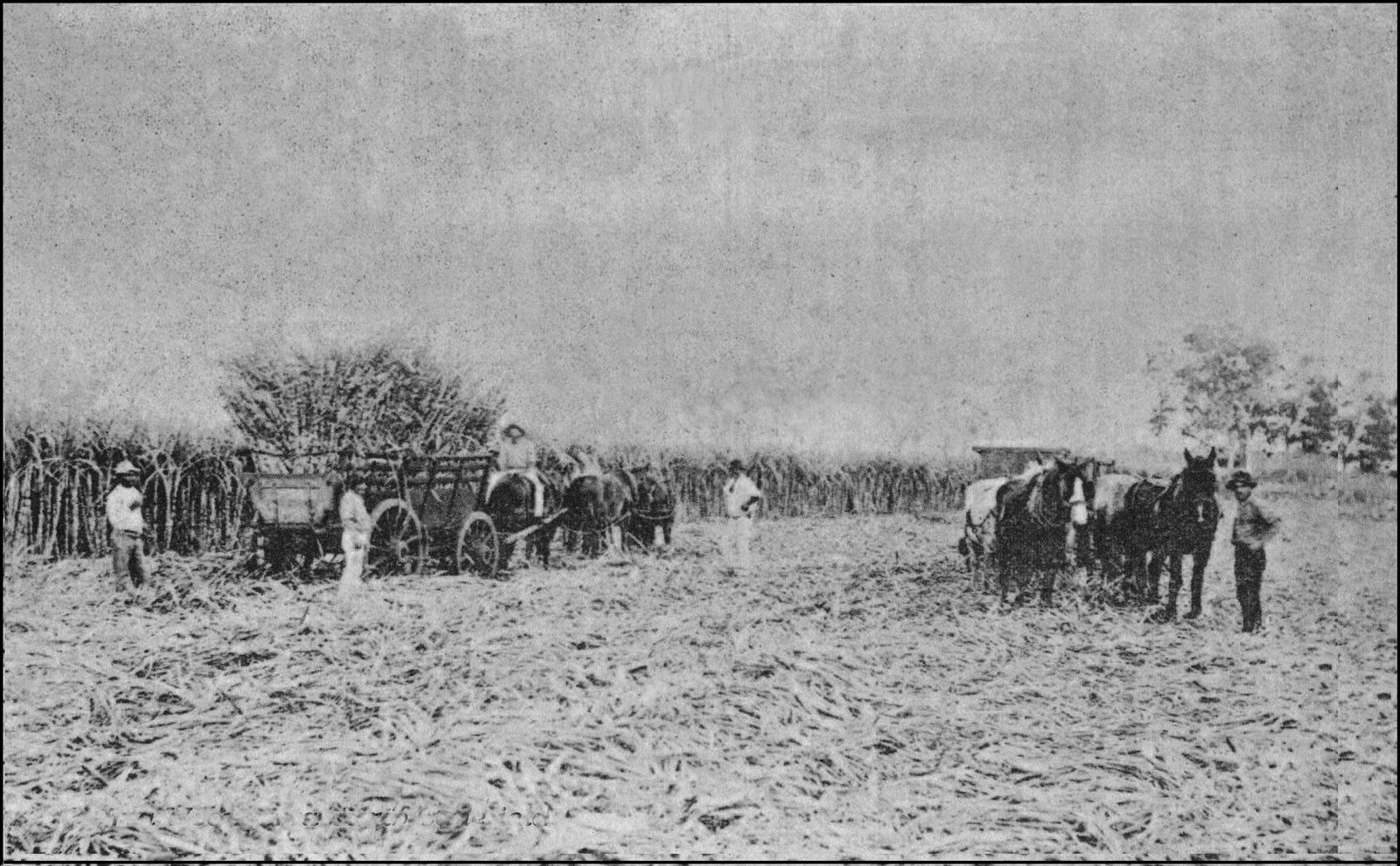 at a location in the vicinity of the Howard coal mine promoted by Tesla, a commercial rival of Edison, and supplied by a coal fired power-station situated at a location in the vicinity of the Howard coal mine.
From THE HISTORY OF MARYBOROUGH AND THE WIDE BAY AND BURNETT DISTRICTS FROM THE YEAR 1850 TO 1895 by George E. Loyau
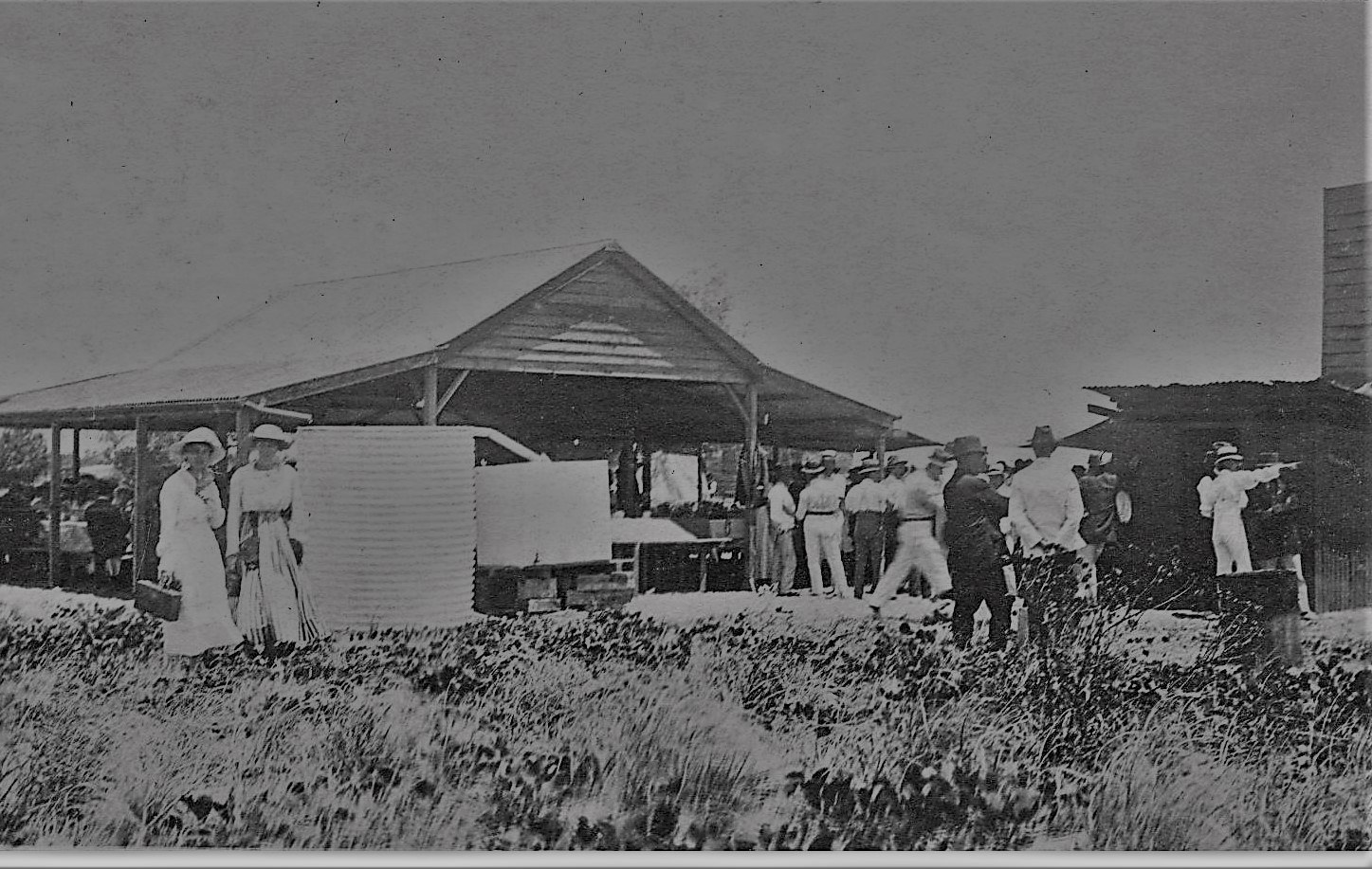
W. Adams’s Summerville Plantation in the Woongarra
(A social gathering is taking place)