Chapter Six
The Mount Perry Railway Line
In February 1876 Thomas White established a newspaper in Bundaberg with the all-encompassing title of Bundaberg and Mount Perry Mail and Farmers and Miners Journal, Mulgrave, Burnett and Wide Bay Advertiser. Mr. White was reputed to be of a generous but trouble prone nature having a theatrical background and to whom living with controversy was a not unfamiliar experience. Having established Maryborough's first newspaper the Wide Bay and Burnett Times, Maryborough, Gayndah and Northern Ports Advertiser in 1860 he very shortly thereafter, in 1861, relocated his business to Gayndah under the banner Burnett Argus Gayndah and Central Queensland Advertiser. Following a further relocation and a brief, and unprofitable, sojourn back in Maryborough Thomas again relocated, this time to the then thriving mining town of Mount Perry to set up the Mount Perry Mail and Burnett Advertiser. Whilst there he was a vigorous supporter of Bundaberg's claim to act as the port of dispatch for Mount Perry’s production. Subsequent to a somewhat lively time whilst in Mount Perry Mr. White then relocated to Bundaberg to establish the aforementioned Bundaberg and Mount Perry Mail and Farmers and Miners Journal, Mulgrave, Burnett and Wide Bay Advertiser. Following an equally controversial time during his Bundaberg sojourn Thomas sold the Mail to Mr. A. M. Goodwin in 1878. Thomas White died at Bundaberg in 1890, as reported by Mr. Loyau.
On the 19th June the Bundaberg Star published a series of letters, received in response to communications initiated by Walter Adams, acting as the honorary secretary of the Progress Committee, regarding the Mount Perry line’s construction. Letters in reply that promised co-operation with, and support of, the Progress Committee’s endeavours to acquire the proposed railway line were received from Mr. W. Scott, the local Member, from Mr. William Gill Bailey, the Member for Wide Bay, who had been present at the Committee’s meeting and from John Douglas, the Member for Maryborough.
On the 22nd of June 1876 the Progress Committee requested delegates from Mount Perry to co-operate with the Committee in lodging an appeal to the Government. The intent of this appeal was to request the inclusion of an amount, not to exceed £3,000 per mile, in the Government’s Financial Estimates for the construction of a railway line from Bundaberg to Mount Perry. On receiving a favourable response from Mount Perry, the committee organized a public meeting to be held in the School of Arts on a Wednesday night.
As reported in the Maryborough Chronicle of Tuesday the 27th of June the Wednesday night meeting was convened in a room crowded to capacity and with Mr. William Bligh O’Connell being nominated chairman. Captain Datson, of the New Moonta Mine, was the first to move a resolution: “That in the opinion of this meeting it is imperative that the Government immediately take measures for the construction of a line of railway from Bundaberg to Mount Perry, believing that any further delays are calculated to prove ruinous to the whole of the mining and a large portion of the agricultural interest of this district, and of the colony.” Captain Datson then augmented his motion with the following observations: “The people of this district naturally felt sorely disappointed and, much discouraged, and had good reason to complain of unjust treatment. The procrastinating policy of the Government has been the means of the temporary closing of many mines to the detriment of the whole colony for, had there been a cheaper mode of transit, those mines would be now in operation, finding employment for hundreds.”
He went on to claim that a businessman, speaking to him on the day of the meeting, had advised that his business could not rely upon the supply of produce from farmers in the large scrub, through which the requested railway was to pass. This lack of reliability resulted from the major difficulties being experienced by the scrub farmers in transporting their produce to Bundaberg. Owing to the poor state of the road between the scrub and Bundaberg the transportation expenses encountered in conveying a crop from farm to market were virtually equal to the full sale price of the crop itself, even when the crop was a good one. He also said that he could not resume his seat without commenting upon Mr. Palmer’s recent speech in Parliament.
That gentleman (Mr. Palmer) in the last Parliamentary session had severely taunted the previous Government as being unfaithful to the districts of Maryborough and Bundaberg, but the same gentleman now doubted the policy of giving the districts a railway that he claimed would be of little use to them. Such utterances as these, coming from a man of Mr. Palmer’s political standing, showed not only political hypocrisy but also a want of the knowledge that he, as the leader of the Opposition, should have acquired. Captain Datson’s motion was seconded by Mr. Mirls and carried unanimously.
The next motion as proposed by Mr. Walter Adams was: “That this meeting believes a line, such as would be required, could be constructed for £3,000 per mile, and such line would be acceptable to the inhabitants. They also deem it advisable to call for tenders both in the colony and in America.” He then proceeded to refer to the remarks made by Mr. William Gill Bailey, the member for Wide Bay, when passing through on a recent tour of the district. Whilst on tour Mr. Bailey said that he would like to see an American principle trialled in which tenders were called to establish an economical basis for the construction of railway lines. Mr. Adams believed, after reading the report as tendered by the committee in the last Parliamentary session, that the construction of the line could be effected for £2,000 per mile and, in submitting his resolution, he wished to see the construction undertaken following a call for tenders not only in the colonies but in the various cities and entry ports of America. That wish was strengthened by the remarks of honourable members in the House of Assembly, during the Maryborough to Gympie railway debate, when it was openly avowed that the line could be made for £2,000 per mile.
Later in his presentation Mr. Adams quoted from the speeches of Messrs. James Foote, the Member for West Moreton, of James Morgan, the government’s Chairman of Committees, Mr. William Bailey, the Member for Wide Bay and others and expressed a hope that both sides of the House would assist in providing the region’s agricultural selectors with something that would do much to benefit the whole colony. He then resumed his seat amidst a great deal of applause. Mr. J. Rowland seconded the motion and followed on in the same strain and at great length. His comments were also applauded throughout their delivery and the motion was carried by acclamation. Mr. S. Johnstone moved the third resolution: “That a copy of the foregoing resolutions be sent to Walter Scott, Esq., and to the members for Maryborough, Gympie, Wide Bay and Burnett, and a further copy to the Minister for Works.” This motion was seconded by Mr. B. Thompson following his own delivery of a very lucid and forcible address. The chairman’s vote of thanks then terminated the meeting.
Six months later, on the 26th of December, 1876, an agitation meeting was called to denounce the action of the Upper House in its rejection of the railway legislation but, perhaps dissuaded by the inopportune arrival of a heavy thunderstorm, there was a disappointingly low attendance of approximately thirty persons and these seem to have held more of a passive interest in the subject rather than a desire to denounce the rejection by the Upper House. The meeting’s chairman was Mr. Samuel Johnston, of the Waterview saw-mills, and Mr. E. Tanner, Messrs. J. Rowland of The Bundaberg Star, Mr. Datson and Mr. Adams were all in attendance to address the meeting in which the following resolutions were proposed and passed:
(a) That it is desirable for the welfare of the colony that the Upper House be made elective; and
(b) That this meeting condemns the Legislative Council for their obstructive policy in throwing out the Railway Bills.
The Reverend Edward Tanner, when he had officiated at the Gayndah marriage of Walter and Mary Adams in 1854, was the Rector of St. Paul’s Church, Maryborough, a ministry that he was to relinquish, to resume again at a later date, and finally to permanently retire from it in June or July 1875. Mr. Tanner, in relinquishing the St. Paul’s ministry, settled on The Grange plantation in the Woongarra in 1877 from which base he was to become a prominent contributor to Bundaberg’s early civic and political activities.
The work of clearing the native timber from the town’s streets had commenced, as had the work of repairing district roads, including the road to the Woongarra Scrub farmlands. The seasonal weather was very favourable with sharp thunderstorms delivering plentiful daily rainfall and there were abundant signs of the potential for a splendid end of season crop. It was conjectured that, if only the price of maize was to rise, the prosperity of the local agriculturalists would be ensured for some time to come and that this would, in turn, greatly improve the district’s prospects. The one disadvantage of the plentiful rainfall was the diminution in the storekeepers’ and publicans’ Christmas trade.
On Wednesday evening the 16th of December 1876 Walter Adams read a paper on “Potato Culture” to the members of the Mulgrave Society and a prize of five shillings was offered for the best sample of potatoes on exhibit. He was endeavouring to prove that, under the prevailing market conditions, growing potatoes would be more profitable to the farmers than growing maize. In support of his argument he presented the statistical material that he had assembled, together with cost and selling price data, that he had acquired from his own growing and marketing experience. Unfortunately, neither the paper’s presentation nor the offer of the prize had attracted to the meeting many of the farmers who had the most to gain from their attendance and this lack of attendance proved very discouraging to the dedicated society members. Other speakers at the meeting delivered papers dealing with their own experiences in the cultivation of different types or varieties of cereals.
At the time the local market for maize was very depressed with buyers expressing little interest, even at a price of 1s. 9d. a bushel, so that the ship Tinonee transported a trial shipment, exceeding 700 bags of the district’s maize, to the port of Rockhampton. However, the prospect of a profitable return from that market was also in doubt.
By 1876-1877 the Burnett maize growers, in addition to the low price of maize, were suffering from three additional impediments to their standards of living and to the development of their industry. These impediments were high freight charges, irregular shipping accommodation and exorbitant, uncertain commission charges. A maize consignment of 472 tons that had been consigned to Cooktown, then the northernmost port of Queensland, exemplified the nature of the excessive commission charges. The cost of the maize ex Bundaberg, plus freight and commission charges to Cooktown, less sale proceeds, gave an overall loss of £156 16s.10d.
An additional problem that then arose was due to either the avarice, or poverty driven short-sightedness, of growers who had shipped consignments of maize that were unripe, insufficiently dried and/or imperfectly dressed in attempting to obtain a premium price for early to market grain. A few bags of green or moist grain in a consignment would cause overheating in the closely packed hold of a ship and this heating could, over a few days, destroy the whole grain consignment. This practice gave the Bundaberg maize such a bad name that it had become impossible to sell other than at auction.
Mr. George Skyring, who had opened a butcher shop in Bourbon Street in the early 1870’s, and who been a large buyer of maize in 1876, convened a well-attended meeting of the local farmers in January 1877. Mr. Skyring was regarded as being an outstanding horseman in a country of good horsemen and, more notably perhaps, was recognized for the assistance that he had given to needy and/or financially stressed settlers, even to the extent of opening a store specifically to provide them with rations. He had lost nearly £1,000 on the previous season’s commercial maize transactions, due to the honourable fulfilment of his pre-commitments to the growers, and this demonstrable integrity had earned him the gratitude of the struggling farmers. At the meeting he proposed the establishment of a local market that would buy only sound maize on the shoot and allow a limited margin for all charges. He also gave an assurance that he would personally assume the responsibility for all risks associated with the shipment and sale of that season’s crop.
This proposal commended itself to the farmers who then accepted all the proposed conditions and, consequently, the maize buyers returned to the market. At a later date a co-operative association of Wide Bay and Burnett maize farmers was formed to establish local markets that would both protect their special interests and sell their produce. In combination, these activities helped to provide much needed stability to the local maize industry.
The Year of 1877
The original planting of maize in the virgin soils of Summerville had produced two harvests per year, each of very high yield, and the market price per bushel had also been quite high at six to seven shillings. However, in 1876 the maize price plummeted to a low of one shilling per bushel and this catastrophically low price coincided with a crop failure due to weevil attack. The time had clearly arrived for the local farmers to consider diversification and, as a consequence, Walter Adams had experimented with crops of both wheat and sugar cane and had met with some success with both types of crop. Encouraged by this success Walter sent samples of the produce from both of these crops to the Paris Exhibition of December 1877.
The Annual General Meeting of the subscribers to the Bundaberg School of Arts took place on a Tuesday night in February 1877 to review the committee’s report and balance-sheet, to elect officers and to conduct any relevant, general business. The meeting was well attended and Walter Adams, in moving for the report’s adoption, congratulated the subscribers on the flourishing state of the institution. Notwithstanding the indifferent financial climate then prevailing in the district the Society had a positive bank balance exceeding that of any previous year by an amount of £21 4s. 6d.
The Annual Report recommended that the Government be asked to pass a bill that would delegate power to the trustees authorising them to lease, or to sell, surplus School of Arts land. The cash resulting from this activity was intended for use in constructing a replacement for the dilapidated, existing building that could no longer meet the town’s requirements. The building proposed for construction was to become the imposing School of Arts building now resident in Bourbon Street.
The committee did not wish to mislead members and Walter told the committee that there were grave difficulties to surmount before a bill that would achieve this purpose could be passed through the Houses of Parliament. When reading a report in Hansard he had discovered that the government considered their proposed bill to be a private one and, to dispose of some of their land, an institution in Maryborough similar to their own had to pay a fee of between £40 and £50 before being allowed to undertake any sale or lease. Hence, if the incoming committee could not sell or lease without the passing of such a bill, it would be folly to proceed. On the other hand, it was obvious that something must to be done to obtain a more suitable building if the institution was to progress. A motion to adopt the annual report was seconded by Mr. J. Lamb and carried unanimously.
The election of officers then took place following the payment of subscriptions by several of the attendees who wished to qualify for the voting. Mr. Adams moved that Mr. W. Scott, M.L.A. be President, but was informed that as the post was only open to subscribers and, as Mr. Scott’s subscription was not current, he was ineligible to stand. Mr. Alexander Walker was then proposed but was also found to be in the same predicament. Mr. A. Mirls said he would like to see a local man who was known to have the town and its institutions at heart as President and he therefore proposed that Mr. Walter Adams be elected to the position. No other subscriber’s name being put forward, the chairman, Mr. J. C. Walker, declared Walter duly elected. Mr. D. F. Johnston, of Kolan station, was then elected to fill the position of Vice-President, with the remaining positions being filled by ballot.
On the 22nd of February 1877 the Brisbane Courier printed the following report of the visit to Bundaberg by the Premier, the Hon. George Thorn on Thursday the 8th of February:
“As soon as the townspeople had been made aware of the Premier’s intention to visit Bundaberg they appointed a deputation, comprising some of the leading townspeople, to acquaint him with details of the town’s public works requirements. A large number of people were at the wharf when the Premier disembarked from the Lady Bowen just before five o’clock. At 8 p.m. the deputation waited upon the Premier at the Custom-house Hotel and Mr. J. C. Walker was called upon by the Police Magistrate to open the discussion.
Having delivered an excellent introductory speech Mr. Walker then pointed out to the honourable gentleman the numerous benefits to be derived from the construction of a Bundaberg to Mount Perry railway line. He referred to the large amount of fine agricultural land that it would open up to settlement; to the rich and almost inexhaustible number of copper prospects that only required the construction of this railway to attract the thousands and tens of thousands of pounds of private investment that would be provided for their development; to the impetus immigration would receive as a result of these developments, and to the many indefinable outcomes from which the community at large would benefit. Emphasis was given to the justness of the township’s claim, which Mr. Walker regarded more as a right than as a favour Note 1, and he then requested the honourable gentleman to provide the deputation with clear-cut advice as to the Government’s intentions with respect to the Mount Perry railway line. Mr. Datson, an experienced miner, then followed and supported Mr. Walker’s claims. He expressed his firm conviction that at least a dozen extra mines, of a similar nature to Mount Perry’s existing major mine, needed only the construction of a railway line from Mount Perry to a shipping port to initiate their full development.
The Premier, in reply, said that the Government fully intended to introduce the Railway Bill during the first week of the Parliamentary sittings and that the measure would be similar to the one brought forward in the previous session with a few additions. He expressed his opinion that the Bundaberg to Mount Perry line was the weakest of the railway construction proposals being considered by the Government and it was the one that was least favored both by the Government’s supporters and by the Members of the Opposition. As an individual submission he considered that it would stand no more chance of passing the Legislature than he had of flying to the moon. The Premier maintained that it was of little use reading the newspapers to obtain the true opinion of the House on this matter. Anything said by the leader, or any prominent member of the Opposition, against the Mount Perry line was seldom reported in the Brisbane papers, and most especially not in the Courier, which had a policy of consistently withholding information of this nature. He believed that the railway, once in place, would assist by greatly increasing both the local population and settlement of the district and, for this reason, he had included the line’s construction in the Government’s railway policy. The members from East and West Moreton and others, in all about seventeen in number, were opposed to this line and it was with very great difficulty that they had been stopped from vetoing it in the previous session. He thought that the House was to meet later in April though he could not ensure that the Railway Bill would be one of the first measures to be introduced.
Messrs. Bell (the Bundaberg shipping agent) and O’Connell were then called upon to speak about the necessity that existed for the dredging of the river. Mr. Bell dealt with the subject most exhaustively and said the large amount of produce exported from the Burnett fully entitled Bundaberg to have the Ministry give serious consideration to the undertaking of this dredging. In the previous year no less than fifty thousand bags of maize had been shipped seaward from the wharf and, with the exception of two or three navigation lights and a buoy, nothing whatever had been done to improve the river channel. The Premier said he would confer with the Colonial Treasurer on the matter and see that Mr. Nesbitt was sent to Bundaberg to report on the best means available for river improvement. He thought that, for his own part, if £100,000 were expended on improving the river channel the very first flood would refill it and restore it to its previously pre-dredged condition. However, he promised to consider the matter.
Messrs. Colley and Rowland then pointed out to Mr. Thorn the very unsuitable quality of the water currently being provided for the town’s domestic water supply while, at a very short distance from the town, there was a never failing source of excellent spring water called the Bywash. The conservation of its flow by means of a small weir at the Adams Bridge location would enable it to be used as the source of supply for the town’s residents and they thought that a sum of about £2,000 would be ample to provide for the spring’s utilization. Mr. Thorn thought, going by what he had seen, that the town already had water of an excellent quality, far better than in many other towns in the colony. Governments were always desirous of maintaining the good health of their inhabitants, but he thought that very little expense would be needed to provide for the conservation of this water. He considered that only a few ship-tanks and a hydrant were all that was needed and that the whole job could be done for £100. At any rate he promised that Mr. Smith would prepare a report to determine what measures could be undertaken.
Mr. G. Skyring drew the Premier’s attention to the state of the goods-shed on the wharf. Its capacity was quite inadequate to house the outgoing maize consignments, and the open sides and ends of the structure ensured that the grain became wet with any shower of rain, thus making the shed unsuited to the purpose for which it had been erected. He was quite willing to spend £600 to build his own wharf if the Government would give him a lease of from fifteen to twenty-one years on the land needed for its construction. The Premier promised nothing here as he considered that the A.S.N. Company should use its own resources to provide such a facility.
The next issue raised concerned the condition of the roads leading through the Woongarra scrub. Walter Adams explained, very lucidly, how difficult it was to travel on these roads in unfavourable weather. He detailed the number of farms that were serviced by these roads whereupon the Premier ordered an extra £300 to be allocated towards their maintenance. The Premier also informed the delegation that he had telegraphed Brisbane to have the wooden bridge across Saltwater Creek constructed forthwith to promote East Bundaberg’s development.
Mr. Gladwell wished to know if the Premier would grant a police quarters with lock-up and a post-office at North Bundaberg, as these were really needed by the north’s population. Mr. Thorn thought the suggestion idle, frivolous and absurd and he failed to recognize any necessity for amenities of this kind. He did not see why a constable was required on the north side of the river as he considered that the town proper was a more suitable location and, on the subject of post-offices, he then went on to indicate his opposition to petty post-offices claiming that the less of them there were the better. He would therefore not grant any of the requests as proposed by Mr. Gladwell.
The next subject to be introduced was on the acquiring of rights to lease out land belonging to the School of Arts so that the proceeds could be used to pay for the erection of a new building. Mr. Thorn said the dedicated land could be used for nothing other than for School of Arts purposes. If they wanted a new building he saw no reason, or difficulty, in the way of obtaining one. The Premier observed that there seemed to be a lot of liberal gentlemen present in the room who would surely not object to subscribing a respectable amount and, if this was done, he guaranteed that the Government would provide a three-fold subsidy. People should not expect that the Government do everything for them. “Help yourselves and let us see that you are in earnest and then, undoubtedly, you will be assisted.”
There had been widespread confusion over the status of early grazing leases in the Branyan area that had been issued in the 1850’s with sometimes vaguely defined, unsurveyed and/or overlapping leases and of leases where the conditions for retention had not always been met. Agricultural land was of considerably greater value than grazing land which was why the Woongarra Scrub’s volcanic soils had been so highly prized. With these scrub lands largely cleared for planting, and with no more of this land available for settlement, attention was diverted to the lightly timbered country closer to the Barolin sea front.
With the above issues in mind, Messrs. Tanner and Skyring introduced the vexed question concerning the use of the seafront land, currently dedicated to grazing in the Barolin selections between the Burnett and Elliott Rivers. They wished to know by what right the brothers Alfred and Arthur Brown now held this grazing land, and why they had dared to fence it off, as agricultural land was being eagerly sought after in the district and yet here was the best land on the Burnett being kept from them by ‘unlawful’ owners.
Their ire was further aggravated by the advertisements that had appeared threatening prosecution if they dared to destroy the fence that the Brown brothers were having erected. The Premier said that, as the matter was subjudice, nothing could be done until the decision of the Privy Council became known. He made it clear that this decision would soon be known, and then all the outstanding matters could be settled. Note 2 Until then the present occupiers of the land were the owners, pending the Council’s determination of ownership.
Some other questions were asked, one being on the Government’s intended response in the event of the Legislative Council again not passing the Railway Bill. This elicited the following response: “We shall see; such a contingency has been partly provided for already.” Walter, on behalf of the deputation then thanked the honourable gentleman for his kindness and courtesy and the delegation withdrew.”
The Lady Bowen, with the Hon. George Thorn on board, left for Rockhampton the next morning. Following the Premier’s visit, the public was left somewhat disappointed with respect to the railway’s prospects. Prior to the visit the citizens of the district had assumed that ‘their’ claim was well recognized by the government and that the portion of the Railway Bill relevant to their district’s ‘wants’ had been destined to pass both Houses of Parliament with little impediment.
Note 1: Mr. Walker’s assessment was a very optimistic one. The eventual construction of the Bundaberg to Mount Perry line coincided with that of the Maryborough to Gympie goldfield line (in 1881) with the latter, now a component of the main northern line, proving to be an infrastructure work of much more durable and frequent usage. Both constructions were influenced by the logical consideration of the government to use the limited financial resources available for rail construction to connect the revenue producing mineral fields with marine exporting facilities.
Note 2: The orderly breakup of the large and often ill-defined pastoral leases into the much smaller agricultural holdings was finally enacted by legislation following the Privy Council’s ruling.
On the 29th of April the steamer Tinonee delivered a bag of seed wheat that was intended for trial plantings in the Bundaberg area. It had been consigned by Walter Hill, Esq., Brisbane to Walter Adams, following his application for a trial sample of wheat’s seed stock, as Mr. Adams had been very active in encouraging local farmers to cultivate a crop to acquire practical knowledge as to the suitability of the Bundaberg district for wheat’s production. It was considered that wheat should be given a fair trial to determine if it could be grown east of the ranges and if so, as an agricultural product, it would have the potential to provide the district with much-needed crop diversification.
By May Mr. Hill’s consignment of four bushels of trial wheat, plus an additional bushel that had been procured at Walter Adams’s expense, had been distributed amongst twenty-seven local farmers who were expected both to undertake the trial planting and to give their account of the resulting crop’s yield. If the trial proved to be a success it was anticipated that the all-pervading maize could be relegated to the position of that of a secondary grain crop. By June 1877 particularly healthy patches of the trial wheat shoots were visible in the fields.
A Mr. McCann had informed towns-people that he had grown wheat at Splitters Creek some years previously, with highly satisfactory results, and that he had never seen a better sample of the grain than that produced in this locality. A successful completion of the trial, then underway, would persuade many of the maize growers to switch to wheat crops. There were high hopes that hundreds of acres of the crop, then under trial, would soon be planted and that this crop’s successful harvest would reward the pioneering growers. The local Agricultural Association had extended the date for its next agricultural produce display from the 23rd of August 1877 to the 1st of January 1878 so that the early wheat growers could exhibit their samples at what was to be the association’s first wheat grain competition.
The twenty-seven volunteer farmers who had planted the trial seed wheat forwarded by Mr. Walter Hill to Mr. Walter Adams for local distribution had a wheat crop that, by mid-June, had reached a height of up to six inches and its condition looked first rate.
Many Bundaberg inhabitants had taken the occasion to visit the Maryborough Agricultural Show of 1877 where a North Bundaberg resident had been awarded the silver Mulgrave Cup for the best Queensland made agricultural implements on exhibit at the show.
The Government confirmed that the location selected for the proposed construction of the first, wooden Saltwater Creek Bridge was to be at the eastern end of Bourbon Street. This decision was well received as there had been public concern that a less suitable site may have been chosen even though the Government’s allocation of £2,000 towards this project had been made six months previously. The contractor, Mr. Bragg, whose competence was recognised by those familiar with his previous work in the district, now had the authority to commence the bridge’s construction which took place in August 1877.
In the Saturday’s edition of the Government Gazette, issued prior to the 7th of May 1877, George Skyring and Walter Adams were appointed trustees of the Bundaberg racecourse reserve whilst Theodore Mirls, William Sheldon, J. F. Boreham, and R. H. Datson were appointed as supplementary trustees.
By mid-June the sugar cane crop was looking remarkably healthy and this augured well for the coming harvest. Following seven months of growth the yellow sugarcane was fully eight feet in height, having exhibited a very satisfactory growth rate. Prior sugar cane plantings in the district had produced over two tons to the acre of sugar, with no moth or rust infestation, and the local farmers were anxiously awaiting the result of Robert Cran’s visit concerning the proposed sugar mill as much good land was currently occupied by an uneconomic crop.
By the end of June, the most commonly asked question was, “Shall we get our railway this time?” as the chief topic of conversation concerned the probability of the £100,000 vote for the initial funding passing the Assembly. The majority of the townspeople were of the opinion that the Parliament would pass the measure and they considered that the political opposition to the Mount Perry - Bundaberg line was very small; the minority thought otherwise.
A town meeting, one of the largest held for some time, took place in the School of Arts on Monday the 16th of July 1877. The meeting was held to discuss, as the main issue, a request for the Legislative Assembly to enter a sum of money on the estimates for the erection of a new Bundaberg Post Office. Walter Adams was called to the chair, and his opening remarks included a hope “ ---------- that the meeting would give each speaker a fair and impartial hearing, and if not agreeing with what is said to try to suggest something better.”
Mr. George T. Bell, Bundaberg’s shipping agent, was then called upon, and on rising indicated that he had strong feelings on the issue that he was about to address. Mr. Bell spoke at length on the subject and declared that had no hesitation in saying that the reason given for rejecting Bundaberg’s application for an adequate post office building was a pure shuffling of issues by the head of the Queensland Works Department. He spoke at length on the deceptive conduct of the Postmaster-General, Mr. C. S. Mein, in dealing with the rejection and indicated that the Postmaster-General had been made aware of their indignation. He pointed out that the proposed petition would show that, up to the month of April 1877, the increase in the combined number of letters, papers, and book packages was 6,542 more than in the month of July 1876 and that a tabulated statement to this effect had already been sent to the Postmaster-General. The sitting member, the Hon. Mr. W. Scott, on presenting the letter, had wired back to say that the Postmaster-General still refused to approve the requested office. Mr. Bell then moved that a petition requiring that £2,000 be put on the supplementary estimates for the construction of the new post-office be referred to the House.
Mr. J. C Walker, in seconding the motion, said he could quite endorse the remarks of the previous speaker. A new post office, as the department knew and as the petition would point out, was badly needed and why Ministers had such an aversion to granting such a just boon to Bundaberg was above his comprehension.
He pointed out that Bundaberg had over 700 inhabitants none of whom could even obtain a postal delivery. Anyone fortunate enough to come into town when the small post office, that had been constructed in 1875, was open and who only wanted a penny stamp had to pay four pence for it and, if they came from a distance, they frequently had to spend the night in town just to obtain the stamp. This state of affairs had been described in a representation to the proper quarter by a petition sent through their Member, Walter Scott, some twelve months ago. In his answer Mr. Scott sent a reply to the following effect: “Petition put in and I got a favourable answer, I will fully report to you next mail.”
But since then, although keeping the matter under close review either the mails had been at a standstill, or Mr. Scott could not have seen the Postmaster-General, for his report had, perhaps mercifully, never come to hand. Mr. Walker hoped that this current meeting would have the desired effect and bring not only the Post-office but also the requested North Bundaberg accommodation (of a petty post-office?). A motion proposing the forwarding of a second petition was moved and seconded and was then carried unanimously by those attending the meeting.
Mr. J. Rowland then raised the issue of a safe domestic water supply. In moving a petition for an improved water supply he pointed out that there was a spring of pure water near the end of Tantitha Street (from the Bywash) from which over 40,000 gallons of clear water per day flowed to waste. He asserted that the only equipment needed to harvest this flow was an intake pump delivering to an elevated storage tank from which the carters could obtain their cargoes of water for distribution to their customers Mr. R. H. Datson seconded the resolution to obtain this equipment which was carried unanimously.
Mr. Diamond followed and proposed that a petition be sent to the Colonial Secretary, asking that the sum applied for by the Trustees of the Cemetery, namely £250, be granted as without this sum there could be no possibility of the cemetery trustees meeting the cost of the ongoing expenses. The motion was seconded by Mr. J. Higgins and was carried with cheers from the attendees.
A new and enlarged Progress Committee was then elected, the old committee’s two-year term having expired. The new committee consisted of James C. Walker, President, Walter Adams, Vice-President, Andrew M. Goodwin, Secretary, with John Rowland, Alexander Walker, Henry J. Ford, George T. Bell, G. J. Young, Samuel Johnston, J. Diamond, Richard H. Datson and Frederick Smith as the other committee members. Following a vote of thanks to its Chairman the meeting dispersed.
The local political agitators were dropping hints concerning the choice of a replacement candidate for the next election as Mr. Scott was considered to have exhibited little interest in his Mulgrave electorate. Some were in favor of having a local man represent them and this idea was gaining ground, fostered by the indignation at Mr. Scott’s neglect of local issues. When Mr. Scott then announced his intention not to seek re-election it provided Thomas M’Ilwraith with the opportunity to campaign as his replacement in the Mulgrave electorate where he would have much better access to political influence and capital in an area where he already maintained significant financial interests, including his Gingin cattle holding and his investment in the Mount Perry Copper Mine.
Rainfall had only been enough to slightly replenish the waterholes and the residents were eagerly waiting for the completion of the new town water supply. The water reserve had been surveyed and then cleared by Mr. Bragg; the town’s water supply tank was in place and the installation of the delivery pump at the Bywash intake, that would enable the water-carriers to undertake their loading and distribution, was to take place in the following weeks.
Local trade was still very depressed; publicans were closing their bars through the slow periods and a prominent storekeeper announced an intention to relinquish his business. The closing of two of the town’s public houses, whilst making their erstwhile patrons disconsolate, pleased the increasing numbers of Good Templars. The want of private enterprise and self-help in the district was then under debate as it was considered, in some quarters, that there had been entirely too much dependence on the Government for the construction of rural infrastructure. An example was given of a local man who, on taking up a selection only one chain from a main road, tolerated losses, annoyance and procrastination while waiting for the Government to construct his road extension rather than enlisting his neighbors to join him in undertaking the work for their own direct benefit.
A situation in New South Wales was referred to where it was observed that a traveller could ride along fine selectors’ roads for twenty miles and never see a section of road that had been funded by Government money. Some were to advocate that the colony could only develop its full potential if the current attitude was to be discarded and some of the American self and mutual help principle infused, a proposition that Walter Adams would, no doubt, have heartily endorsed. Some degree of self-help was indicated when it was announced that Bundaberg exhibitors were to contribute to the Paris Exhibition with Mr. W. Hill indicating that Walter Adams would be both collecting and providing exhibits and that Mr. R. Ruddell would be manufacturing samples of his celebrated soap especially for the occasion.
Two evenings in mid-November delivered good thunderstorms and these provided a considerable amount of extremely useful rainfall. The resultant rapid grass growth had greatly improved the condition of the grazing livestock in comparison with the very lean condition that it had exhibited a few weeks earlier. However, the storms did not have general distribution and the districts of the Upper Burnett were still experiencing severe drought.
The Mount Perry Copper Mine ceased its operations in October 1877 following financial failure due to low copper prices and high production costs. There was an expectation in the district that the mine would not be re-opened prior to the completion of the proposed Mount Perry railway line which would provide a much more economical linkage from Mount Perry mines to the port of Bundaberg.
In our time, following the agricultural revolution in plant genetics, improved fertilization and farm mechanization that has caused crop production in India and elsewhere to increase by a factor of about nine since the 1880’s, the consequences of the disastrous droughts of the 1870’s in India are difficult to imagine. In 1874 India experienced a famine in which approximately one third of the then population of Bengal died of starvation and its allied diseases. On this occasion the results of the drought were mitigated, to some degree, by the construction of granaries, the instigation of relief works and the distribution of free food supplies. However, during the catastrophic drought of 1876 a calamitous decision was made at the official level by the English viceroy, Lord Lytton, Note 1 to rely upon the local resources to feed the starving population. Over the period 1876 to 1878 the combination of drought and human error resulted in severe crop failure, a massive famine and the death of an estimated 5½ million people on the Indian sub-continent.
On Sunday afternoon the 18th of November 1877 a public meeting was held in the School of Arts building in aid of the Queensland Indian Famine Fund. The attendance was low but all those present seemed to be fully convinced that the time had arrived for Bundaberg to make its own contribution towards the accumulating fund. In the absence of the Police Magistrate the chair was occupied by Mr. J. C. Walker who had originated the district’s version of the scheme. Excellent addresses in favour of the fund were delivered by Messrs, Lamb, Goodwin, Adams, and Bell and it was unanimously agreed that “a branch fund should be established here, and that we aid the sufferers as much as our means would allow”. The ministers of the Primitive Methodist and Congregational churches also promised to donate the moneys from one of their daily collections to the fund.
Note 1: It is highly probable that the Brisbane suburb of Lytton, initially a pilot station site, and Bulwer Island, home to the Port of Brisbane, were named after Edward George Earle Lytton Bulwer-Lytton, 1st Baron Lytton, the father of Robert Bulwer-Lytton, 1st Earl of Lytton and viceroy of India. Edward Bulwer-Lytton had previously held the role of Secretary of State for the Colonies from June 1858 to June 1859. He had utilized a prolific, and profitable, literary career to finance his somewhat extravagant lifestyle and his best-known introduction to a literary work is (perhaps unfortunately) “It was a dark and stormy night ……….” from his novel “Paul Clifford”.
By December the maize marketing situation in the district had undergone a profound improvement with virtually no stocks remaining unsold and with the steamship Queensland transporting the small amount of remaining stock to southern markets. The excellent quality of the sugar crop had resulted in a highly successful crushing and this had allowed the Palmer brothers to ship out one hundred and fifty tons of sugar. Samuel Johnston’s sugar exports had added a further significant tonnage to this amount.
It became evident that a much more intense storm season, with heavier than normal rainfall, had been experienced. Fortunately, no wind, lightning or hail damage had ensued, and much more tolerable temperatures followed. With this change in the weather pattern past fears were banished and the farming activities exhibited a vigorous response. The maize plantings were ongoing and existing crops had acquired a much healthier appearance. The rapid growth of grass, including the couch grass in the town’s thoroughfares, greatly improved the condition of the local horses and cattle as a result of their access to the best grazing conditions that had been experienced over the past twelve months.
Tenders had not yet been called for the Mount Perry railway but a reply received from the Engineer-in-Chief in response to a request from a public meeting, asking for notification of the scheme’s approval, indicated that tenders were soon to be called. An imminent visit from the Colonial Treasurer was anticipated at which it was expected that he would give his own opinions as to the railway’s progress. The Progress Committee also intended to make use of the opportunity presented by the Colonial Treasurer’s visit to obtain his views on their proposals for river improvements, as these also came under the jurisdiction of the honourable gentleman’s department. Most of the local population held a firm conviction that the provision of improved conditions of navigation in the Burnett River would greatly assist marine traffic and consequently encourage an increasing service.
On the 11th of December Bundaberg’s quota of exhibits for the Paris Exposition left via ocean steamer for Brisbane. Despite Walter Adams’s best efforts to encourage local participation in the promotion of the district the limited number of exhibits that had been collected was a disappointment. A small bag of sugar from Farquhar and Dunn’s mill, a sample of arrowroot, two packets of wheat and a cedar-box with a glass top displaying Ruddle’s prize soap were all that Walter could muster. Several others who had volunteered to provide display samples failed to meet the deadline for the dispatch of their exhibits and this added to the disappointing result.
Rainfall was again becoming sparse, but the growing maize appeared to be in good condition and some of the crops were within a month of harvest. The local price for maize was seven shillings per bushel which exceeded, by a factor of four, any price that had been obtained in the recent past.
During the period December 1877 to January 1878 Thomas M’Ilwraith purchased the Mount Perry Copper Mining Company from the liquidators and reappointed Captain Israel Bennett as the mine manager who was then instructed to arrange for the recommencement of mining operations. It was hoped that the reduced transportation costs that would result from the utilization of the Mount Perry railway line for the provision of supplies, working materials and for the transportation of the copper ore would reinstate the mine’s profitability.
The Year of 1878
The first Agricultural Exhibition to be held in the Bundaberg district was staged by the Pastoral, Agricultural and Horticultural Association in June 1878. In the lead up to the exhibition all indications were that it may prove to be a failure as little observable enthusiasm was demonstrated on the part of either the citizens or the exhibitors. However, late on Wednesday night the country people, with their exhibits of stock and produce, began to arrive and all through the night the streets echoed to the noise of the carts and wagons bringing all sorts of agricultural produce to the town. Early on Thursday morning spectators sprinkled the esplanade, eager to view the stock exhibits as they arrived, and by 10 a.m. there was a crowd on the promenade that was much bolstered by the country attendees. Agricultural produce was exhibited in the immigration barracks building with the stock being judged in the yard behind. Owing to space restrictions many of the stock entries including hackneys, plough horses, blood and draught entries had to be judged on the open promenade. Judging began at 9 a.m. with a listing of the recorded exhibitors being:
EQUINE ENTRIES:
All-aged blood stallion - Mr. A. H. Brown;
Colonial breed blood entries - Mr. Sheldon and Mr. White;
Best blood mare - Petunia;
Best three & under four-year-old colt - Young Chancellor;
Heavy draught horses* - Mr. Gilbert, Mr. Arthur H. Brown, Mr. West, Mr. Sheldon and Mr. (name unrecorded);
Two-year-old stallion - Mr. Alexander Walker;
Two and under three-year-old fillies - Mr. Jones and Mr. (name unrecorded);
Best blood fillies - Maid of Athens, Lady Constance and Primrose;
Plough horses - Mr. Pringle and Mr. Sheldon of Rubyanna;
Buggy horses and stallions - Mr. Nugent Brown;
Special prize, draught stallion producing the best three progeny of three years old and under - Mr. R. G. Gilbert’s Silver Cap v Duke from Barolin; and
Arabs - two entries by Mr. Johnstone.
(* The reporter lamented the fact that Suffolks and Clydesdales were always exhibited together and pointed out that, though the Clydesdale would always win such a competition, he regarded the Suffolk a better all-round performer for Queensland conditions.)
BOVINE ENTRIES:
All age Durham bulls - Mr. W. Brown of Barolin, Mr. A. Walker and Mr. Rendall;
Yearling Durham bulls - Mr. T. M’Ilwraith of Gingin;
Short-horn cows - Mr. G. M’Pherson;
Short-horn heifer - Mr. T. M’Ilwraith and Mr. G. M’Pherson;
Hereford bulls - Mr. A. H. Brown and Mr. J. Broom;
Yearling Hereford bull - Mr. A. H. Brown;
Hereford heifer - Mr. A. H. Brown;
Best bull, any class, owner of less than 100 head - Mr. Rendall; and
Dairy cows - Mr. M’Pherson.
PORCINE ENTRIES:
Boar - Mr. Sheldon;
Sow - Mr. Davidson and Mr. S. Budge.
POULTRY ENTRIES:
Spanish - Mr. Dunn;
Brahmas - Mr. Walker;
Couchin Chinese - Mr. Gammie;
Bantams - Mr. Gammie;
Geese - Mrs. Barns; and
Ducks - Mr. Thomas Watson and Mrs. Barns.
FARM AND DAIRY ENTRIES:
Best variety of Sugarcane - Mr. H. Palmer with Black Java variety;
Sugar Samples - Mr. H. Palmer and by a Polynesian maker entered by Mr. A. Dunn; and
Two bushels of maize - the A. H. Brown prize to Miss. Wood.
AGRICULTURAL PRODUCE, ALL SORTS:
The Larkin prize to Mr. R. Kendall.
JAM ENTRIES:
Mr. Kendall and Mrs. C. L. Barns.
IMPLEMENT AND MACHINERY ENTRIES:
Mr. Smith; and Mr. Child’s ploughs.
At the Progress Committee’s 5th of July 1878 meeting the following were elected as the new (and as events transpired, the last) committee members: Messrs. J. C. Walker - President, W. Adams - Vice-President, T. Manchester, J. Rowland, S. Rowe, M. Duffy, J. Lamb, G. J. Young, D. M’Conville, G. T. Bell, R. Kendall and A. M. Goodwin - Secretary. Up to this time Bundaberg’s funds for the town’s public works had been obtained by the activities of the Progress Committee at public meetings and by petitions to the Colonial Government or to its visiting Ministers. At an earlier committee meeting the issue of council incorporation had been raised and, consequently, a public meeting was arranged to discuss the desirability, or otherwise, of the town’s incorporation. At this public meeting, held in the School of Arts building on Monday evening of the 15th of July 1878, Mr. John Lamb moved, “That the time has arrived for incorporating the town of Bundaberg and that the same be proclaimed a municipality early in January next.” Mr. Rowland seconded the motion; the arguments that he presented in support being based on his perception of the excellences of the impending Local Government Bill.
Under the then current legislation, the Municipal Institutions Amendments Act of 1864, town councils had been given the responsibility for the “care, construction and management of roads, public streets, bridges, ferries, wharves, jetties and public thoroughfares.” Walter Adams pointed out the absurdity of attempting to work under an act which was not then in existence and produced figures to demonstrate that incorporation was not in the interests of Bundaberg in its current state of development. He went on to introduce a counter resolution “That this meeting stands adjourned for two years”.
The logic behind Walter’s speech was based upon the following calculations: During the previous six years the town and district had enjoyed an endowment allowing for an average expenditure of approximately £1,400 a year on roads, bridges and other public works whereas, if it were to adopt incorporation, their funds available for expenditure on works would be severely reduced. To arrive at this consideration, it was assumed that there would be 170 houses on Bundaberg’s combined north and south riverbanks each paying rates of £1 per annum (not considering the many houses that would not pay rates of even 10 shillings per annum) that’s £170. Unimproved properties would contribute a further £50 giving a total of £220 in revenue from rates. When the government endowment of £440 was included a grand total of £660 would result. However, the elected councillors to be would require a respectable chamber for their meetings and, if they could obtain a suitable place for £26 per annum then Walter thought that would be very reasonable. In addition, they would need a town clerk at say £50 per annum. Then there were other expenses including assessors at £5, rate collector and inspector of nuisances £20, town surveyor £100, safe and seal £20, stationery and advertising £20. These items alone came to £241 and had to be deducted from the gross revenue, leaving a much-diminished amount for the six elected aldermen to expend on the works listed above. Mr. Adams’s resolution was seconded by Mr. Duffy. A second amendment by Mr. R. Thompson, “That this meeting stand adjourned to the second Monday in January next,” was put and defeated. When the original amendment was put to the meeting every hand in the body of the hall went up in unison. The chairman declared this amendment carried to a background of many cheers and much relieved laughter.
On the 26th of September, having been nominated by Alexander Walker, Walter Adams was appointed the Chairman of a meeting in support of the election of Mr. M’Ilwraith, now the leader of the opposition, and the Chairman started the proceedings by requesting that the candidate receive a fair and impartial hearing.
The electoral campaign had actually commenced months earlier when the Mount Perry citizens had passed a resolution favouring Mr. M’Ilwraith as the Member for Mulgrave. Edward Tanner who, in the previous election nearly three years earlier, had indicated his intention to stand for election in order to combat the ‘Barolin selections’ and to advocate white immigration from Victoria, then entered the campaign. A fierce ‘war’ was to ensue between the Mail, a staunch supporter of Mr. M’Ilwraith, and the Star which extolled Mr. Tanner’s virtues. Having previously signed a requisition in Mr. Tanner’s favour George Skyring was then to present himself as a third candidate.
Mr. Tanner used the opportunity of his meeting at the Pioneer Schoolroom on the 31st of October to upbraid the Barolin squatters and those who differed from his views. His friends blocked all queries with noisy interference and the meeting broke up in considerable confusion with no vote of confidence having taken place. The indignation experienced by other attendees at the meeting, in reaction to the actions of Mr. Tanner’s supporters, would have inflicted a considerable amount of damage upon his electoral prospects.
In a farewell to his Maranoa electorate supporters Mr. M’Ilwraith had explained that his major reason in transferring to the Mulgrave electorate was to avail himself of the extra time that travel from the Mulgrave electorate would provide in fulfilling the duties of Opposition Leader and of Premier of Queensland, if he was elected to that position. At the 26th of September’s Bundaberg campaign meeting Mr. M’Ilwraith explained that his other reason for transferring to the Mulgrave electorate was to meet a request that he had received as current leader of the Opposition. Mr. M’Ilwraith then expressed his belief in the importance of railways to the colony’s development and followed with a broad outline of his railway policy Note 1. He also expressed his views on the Land Act of 1876 and upon the South Sea Island v white labour question in which he advised the Government to repeal the Polynesian Laborers Act. He also indicated that he occasionally changed his mind when there was a good reason to do so.
At the conclusion of the meeting Mr. Bell proposed that Mr. M’Ilwraith was a fit and proper person to represent the Mulgrave electorate and the motion was seconded by the Rev. Gammie. An opposing amendment was proposed by Mr. Rowe and seconded by Mr. Lamb. There were 25 raised hands supporting the amendment versus 32 for the original motion with an allegation that some attendees had raised both hands. For the two weeks prior to the day of the election Mr. M’Ilwraith confined his electoral campaign to meetings in Mount Perry, the Bundaberg area and to George Greathead’s barn to Bundaberg’s south.
The election results as recorded on the 25th of November were (with some votes still outstanding):- M’Ilwraith - 411; Tanner - 247; Skyring - 16. This outcome had given Thomas M’Ilwraith a marked majority notwithstanding the exclusion, at that date, of the voting results from the Maryborough, Kolinga and other, minor polling locations.
Note 1: M’Ilwraith’s Land Grant Railway Policy was based on the highly successful funding procedures that had first been adopted by the Illinois Central Railway, opened in the late 1850’s, to create a linkage between the water-borne transport systems at the confluence of the Ohio and the Mississippi Rivers with the developing commercial centres of Chicago and Rock Island. Government allocated land along the route of the railway line was developed into standard sized plots for sale by the development company and the money thus raised was applied to the railway line’s construction. Additional benefits of this policy were that the purchasers of these plots would both contribute to the region’s overall development and would generate their own freight and passenger custom which would enhance the railway developer’s revenue. Following the American Civil War, the same procedure was adopted to fund the construction of transcontinental railway lines connecting the United States’ east and west coasts.
The long-awaited moment had finally arrived. The Mount Perry line’s construction over the period 1879 to 1884 by the contractor J. and A. Overend and Company, following the signing of the contract in November 1878, invigorated the whole Bundaberg district as railways were great initiators of employment and, apart from the direct engagement of navvies and miners for rail-line and tunnel construction, timber getters and millers were required to produce the large number of sleepers required in the laying of the track.
The Year of 1879
By 1879 the traffic through Gin Gin had increased to such an extent that two public houses had been established in the emerging township to meet the increasing demand.
Bundaberg plantation owners had been slow to avail themselves of the benefits of the Pacific Island labour force, the effectiveness of which had been well demonstrated by the plantations of the north in the planting and harvesting of sugar cane. However, the arrival of the first boatload of this labour in Bundaberg ushered in a year of transition, away from the extremely variable profitability of the maize market, into that of commercial sugar production. The economics of Pacific Island labour had been well documented for at least fifteen years in other sugarcane growing areas of Queensland and experience on the cane crop’s behaviour had been gained by a sufficient number of the Woongarra plantation owners, including Walter Adams, to demonstrate its potential commercial viability when planted in the rich, volcanic scrub soils. It was evident that the ability to engage Pacific Island labour would create the commercial conditions necessary to produce sugarcane crops over a large enough area to justify the construction of a large capacity crushing mill in the Woongarra.
A public meeting was held in the School of Arts on the 20th of May to consider the desirability of lending additional weight to earlier submissions that had been made to impress upon the Government the necessity of extending the unfinished railway line, then extending out from the town’s railway terminus, in North Bundaberg, towards Mount Perry. The meeting was well attended and Mr. R. C. Barton was voted to the chair. Walter Adams made a well-received opening address and he then read from a petition that had been prepared for signature in anticipation of the receipt of the meeting’s approval. The mention of Mount Perry occurred frequently in the document and a telling point was made of the fact that the section of railway line so far constructed was of little use to the residents of that mining centre, which remained beyond the existing railway line’s reach. Mr. Lamb warmly seconded the adoption of the petition. A motion to endorse and to distribute the petition was adopted with a unanimous vote and it was signed by a considerable number of supportive citizens. Copies of the motion were forwarded to influential people throughout the extended district and it was expected to achieve a favourable result. It was anticipated that, within a fortnight, the motion would be ready for transmission to Mr. M’Ilwraith, who had become leader of the Opposition on the 24th of April, 1878, for his presentation to the Assembly.
Man proposes; God disposes. Whilst history tells us that the transport of copper ore from Mount Perry’s mines was never to be a major contributor to the Mount Perry’s railway line’s usage, the line managed to play a significant role in the development of the inland agricultural and pastoral areas and in the delivery of the timber getters’ product to the Bundaberg sawmills.
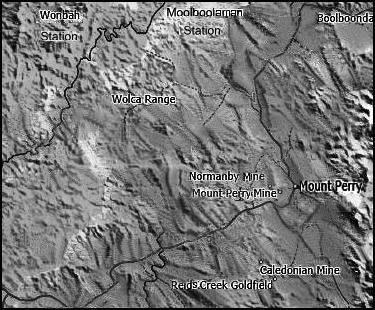
The development of the Queensland colony’s major gold/copper venture began operations in 1882 at Mount Morgan, approximately 275 kilometres north north-west of Mount Perry. Here mining was to continue for the following one hundred years, up to the year 1981. Over its operational life, this mine was to yield approximately 260 metric tons of gold, 37 metric tons of silver and 387,000 metric tons of copper and was, at one time, the largest operational gold mine in the world. By comparison the output from the Mount Perry mines was 0.775 tons of gold (with no records of production prior to 1900), 22.15 tons of silver (with no records of production prior to 1895) and 23,411 tons of copper.
The weather was then fine and cold with light frosts and an equitable daytime temperature. The condition of the district’s cane crop held great promise, with excellent financial returns being anticipated. In the coming season there would be two new sugar mills constructed, one to be located on Mr. Jeune’s Branyan property and the other on Mr. Johnston’s Waterview. The condition of the maize crop was, however, not so promising and in some areas the crop was barely worth harvesting. However, the general farming population had, year by year, still managed to increase its overall prosperity.
Homesteads in the farmlands had been improved with more household comforts added and, in each year, an additional area of scrub or native bush had given way to the extension of cultivated land. The rich volcanic Woongarra soils continued to give handsome returns whilst utilizing a relatively small amount of labour and, although prices were low, the high productivity of the crops made up for any deficiency in their sale price. Up to this time the planting of the maize crop had continued as, despite its disadvantages, it was the crop that could be grown with the least trouble and expense. The district’s commercial trade was improving with sound business transactions and with the number of food and clothing stores increasing to meet the expansion in the number of customers entering these stores to purchase their goods.
In this year the Member for Mulgrave, Thomas M’Ilwraith, was elected Chairman of the Bundaberg Hospital Committee. Under his leadership the committee undertook activities both to obtain public support, and to attract donations, in order to call tenders for the construction of the town’s first hospital which was completed in February 1881. In 1879 Doctor Sugden, Bundaberg’s long-standing Health Officer, had been appointed as the surgeon of a temporary hospital. He was replaced in the following year with the appointment of Doctor Thomas H. May to the position of Bundaberg’s Medical Superintendent. Doctor May was to remain in the Bundaberg district and to maintain a close association with the town’s hospital over many years.
And also in 1879 a replacement for the inadequate wooden Telegraph Office in Targo Street (built in July 1876) was constructed, with Mr. John Kelly as Postmaster and Mr. H. E. Young as Telegraph-master. The new, and much larger, Bundaberg Post Office was located on the north-west corner of Bourbon and Barolin Streets, on the site of the existing post office, at a cost of £587. Mr. H. E. Young the Telegraph-master had previously been housed in a small office in Targo Street. Mr. Young died in July, 1878 and in May, 1879 Mr. Charles Smith was appointed as Post and Telegraph Master to take charge of both the Post and Telegraph offices. The Post Office was then in operation at its new location, but the telegraph facilities remained in the original Post and Telegraph office building that also retained its accompanying officer’s residence. Upon Mr. Smith’s retirement Messrs. R. S. Stiller and W. O’Connor were appointed Post and Telegraph Masters respectively.
John Houston Cathcart ceased conducting the post office business from his Post Office Stores in October 1875. In 1876, he developed a serious medical condition and resigned his position as a Justice of the Peace in July. In November of the same year he appeared before the Supreme Court regarding the insolvency of his estate, an insolvency that many regarded as having been due, at least in part, to his philanthropic activities. He died in July 1877 at the early age of thirty nine years and the industrious and popular pioneer’s funeral procession was over a quarter of a mile in length, a remarkable turnout when considering the town’s then population, and with all of the town’s business premises being closed for the day. During his presence in Bundaberg Mr. Cathcart was considered to have been identified with every progressive and beneficial movement. For a relatively short time he had carried on a prosperous business in competition with Bundaberg’s first storekeeper Mr. H. J. Ford’s establishment on the river’s north side. Following his death his former store’s building on the corner of Quay and Targo Streets burned to the ground in November 1887. Prior to the fire the stocks of the business had been purchased by Fredrick Buss and his son-in law William Henry Williams.
The Mulgrave Pastoral, Agricultural and Horticultural Association Society’s second annual show opened on Wednesday the 9th of July 1879 on a fine and cloudy day and its presentation was generally considered to be a success. There were 230 exhibits in all, and some of their classes gave a very favourable impression of the district’s capabilities. The quality of the sugar cane exhibits was judged to be superb and that of the maize and farm products very good. The cattle and horse displays were weak and the agricultural department’s display was not extensive, but what there was displayed some excellence. The showing of manufactured and miscellaneous articles was considered moderate to fair, but the horticultural industry was poorly represented.
The Progress Committee’s term of two years had not been quite completed before local incorporation was forced on the district by the Divisional Boards Act of 1879 under which the whole of the colony, outside existing municipalities, was subdivided to meet local government purposes. The boundaries of the several new Boards were published in the Government Gazette in November 1879. The incorporation into divisional boards marked the demise of local progress committees, their function having become redundant. The Bundaberg Divisional Board was constituted and gazetted in March 1880 and the civic administration of the agricultural and grazing lands adjoining the town were then divested from the Bundaberg town administration and became the responsibility of the newly constituted Barolin and Kolan Divisional Boards.