Chapter Five
Setbacks and Achievements
The Year of 1872
On the 28th of January 1871, Walter Adams purchased three allotments in the fledgling town of Bundaberg at an auction held in Maryborough. The population of the Bundaberg township would then have numbered about two hundred, and the population of the combined town and adjacent districts approximated five hundred persons. The number of females in this pre-residential population was a very small.
The settlement of agricultural and pastoral land in the Lower Burnett was well underway by the year 1868, the year in which the surveying of the future town’s allotments had commenced. Initially, Bundaberg’s allotments were auctioned in Maryborough, the first auction held in Bundaberg not taking place until August 1872. Mr. J. Y. Walker claimed the town’s name was a hybrid construction, the ‘Bunda’ component being derived from the name of the local aboriginal clan which had adopted into its midst the surveyor, Mr. Edwards, who had been engaged to peg out the layout of the town with Bunda having become his ‘nick’ name. The berg Note 1 may have been a corruption of either ‘burg’ or ‘burgh’ hence the name Bundaberg or Bunda’s Town.
Note 1: An alternatively proposal was that berg could have been of Germanic origin as could be the prefix bund (meaning an assembly).
A proposal by the Mt. Perry Mining Company, operating under Mr. Vickery’s direction, for the construction of a road from the Mount Perry mine to Bundaberg was opposed by William Henry Walsh, the owner of Monduran and the Member for Maryborough from 1865 to 1873, as he preferred the construction of a road that led the mine to his own electoral base in Maryborough. The construction of a railway line from Mount Perry to Bundaberg, to be held under private ownership, was also proposed by the Mt. Perry Mining Company in 1872. Construction would have been under the ‘land grant principle’ but this was also opposed by William Henry Walsh who was then both Member for Maryborough and Minister for Works under the Palmer government.
In March 1872 Walter Adams selected a block of 240 acres comprising 75 acres of agricultural land and 165 acres of second-class pastoral land between the Burnett River and Mon Repos on the northern edge of the Woongarra Scrub. This property, that was to become his principal rural holding and future plantation, was named Summerville
In January, 1872 the Acting Commissioner of Lands approved the allocation of 10 acres of agricultural land and 230 acres of pastoral land under conditional purchase in the Barolin Run, County of Cook to Mr. J. E. Noakes and the allocation of 150 acres of second class pastoral land of the adjacent surveyed area to his brother George Noakes. The holding of Charles Faulkner was between Summerville and the James Noakes property. In the following month the name of Mr. J. E. Noakes was added to the list of aldermen elected to the Maryborough Council.
The blocks of land adjacent to Summerville, as selected by Charles Faulkner and the Noakes brothers, consisted of holdings south of Walter’s selection. These blocks were located further from the river and, following the clearing of the scrub, would have held a larger percentage acreage of the highly productive volcanic, scrub soil. Proximity to river transport might have been a factor in Walter’s land selection and if so this consideration may have been suggested by his friend George Greathead who, in 1868, had set up the first regular coastal shipping service between Maryborough and Bundaberg. This service followed an earlier Maryborough to Bundaberg coastal service established in 1866 by the captain of the ketch Enterprise, William Collin, to transport timber from the Bundaberg area. Alternatively, the cost of land may have been a consideration in Walter’s selection as Woongarra’s prime, volcanic soil was more expensive and covered by dense rainforest that involved an additional expense of £10 per acre to clear. The Summerville plantation was cleared by its first Bailiff, Mr. D. Kennen, over the period February to June 1872 with Walter’s sons, George Manus and James Walter assisting. By 1872 the captaincy of the Enterprise had passed into the hands of Captain Johnson.
At full development Charles Faulkner’s Woongarra plantation employed 10 Europeans and 60 Islanders. It cultivated 372 acres, mostly under cane, and had crushing and milling equipment worth £4,000 that had a daily production rate of 8,000 gallons of juice which was later conveyed by seven miles of pipeline to the Millaquin Refinery.
In his anxiety to acquire an income producing business in his newly adopted district Walter proceeded to rent the Burnett Hotel from Mr. Campbell and announced his determination to be second to none in providing thirsty Bundaberg citizens with good quality liquor. This is Walter’s first known venture into the world of the publican. It preceded the construction of the Adams Hotel, in 1872-73, on the corner of Barolin and Bourbon (now Bourbong) Streets and exemplified his adaptability to the conduct of business in general.
In May 1872 William Southerden transferred his Quay Street Bundaberg store’s operation to Mr. J. H. Cathcart, who had previously been its manager, and redirected his energies towards Mount Perry mining ventures, auctioneering and brokerage activities. His interest in the mining ventures included the position of acting director for the Normanby mine and as chairman of the Mt Clara copper mine.
Walter Adams’s first major construction work provided valuable infrastructure for the use of all settlers to the east of Bundaberg which, of course, included himself. In 1872 he, together with the other residents of the rapidly developing Woongarra Scrub, had to travel to town via a lengthy route: south-east of the town to skirt the Baldwin Swamp and Saltwater Creek waterholes, west to a causeway probably in the vicinity of the present Targo Street, then north to the township’s centre. Walter’s solution was to prepare a tender for the construction of a bridge across the creek at the Bywash where the discharge from the fresh groundwater fed Baldwin Swamp, then a great habitat for platypus and brown snakes, flowed into Bundaberg Creek. As it appeared that he was the only person in the settlement in a position to carry out the construction he prepared, and then submitted, a tender to the Government with an appended application for the funds necessary to commence the work. The tendering presented him with a quandary as the proposed bridge would be an asset not only to the community but also to himself and so he submitted a tender that he knew to be low and which he was assured would therefore be acceptable to the Treasury.
As all were keen to have the bridge constructed, he went ahead using his own funds. Unfortunately, a cash-strapped Treasury claimed that the cost was too high, and it took a considerable amount of time and effort for Walter to obtain a financial settlement of £329. The Adams Bridge was the first bridge built in the Bundaberg district and it was the one that did most to satisfy an immediate need. This early bridge was later to be replaced by the combined weir and bridge, located on the Bywash adjacent to the site of the Steindl and Fleming’s brewery that was to open in 1883. This weir boosted the town water supply’s capacity both by increasing the freshwater storage and by acting as a barrier separating the fresh and, in those days, spring-fed Baldwin Swamp water from the intrusion of tidal, turbid river water.
Walter’s connection with his old town was reactivated in August, 1872 when a boiler explosion at a Maryborough sawmill killed three workers, left nine others severely wounded and rendered fifteen children orphans. A meeting convened by the Mayor of Maryborough to establish a relief fund for the families of the men who had been killed or maimed by the explosion was held in the Maryborough Court House. The meeting established a committee to collect and distribute aid to the needy victims. Approximately eighty persons throughout the lower Mary-Burnett River Districts were appointed to carry out the meeting’s financial objectives. This list included the names of Messrs. William Southerden, Robert Cran, Henry Palmer, James Noakes, Walter Adams, Dean Tissot and Richard Palmer.
Walter Adams’s selection of a homestead block of 140 acres on the north bank of the Burnett River located approximately 14 miles south-west of Bundaberg in South Kolan and another selection of 320 acres in the Gin Gin area were acquisitions that he later came to regret. There are no known records of his attempt to develop the Gin Gin district block and, in a letter to the Land Commissioner on 7th of October 1872, he sought to forfeit this holding’s lease. By mistake the South Kolan lease was cancelled instead and Walter then sought its reinstatement.
Subsequent developments were to demonstrate that he would have been better off not going to this bother as the acquisition of the Kolan property was to result in an extremely costly and frustrating experience. This experience was also to be encountered, in varying forms, by many of the early settlers due to the serious, though given the existing constraints probably inevitable, lag in the official survey of their selections. Walter’s letter of the 17th of March 1875 that was addressed to the Land Commissioner describes the nature of the debacle that was to follow. A copy of this letter is presented below:
Sir,
On the 25th of November, 1871 I selected a homestead selection for the purpose of actual settlement by myself and family on the Kolan run and, on the 18th of January following, left Maryborough and proceeded whither to settle upon said selection. Before leaving I was promised that my selection should be surveyed as soon as possible. I was also informed if I was to erect my buildings and make my improvements as near as possible to a marked tree that I should then be in about the middle of the said selection. After arrival on the spot selected, and with a great deal of trouble and delay I found the tree as described and commenced operations. After spending four months, from January to May, on the spot selected erecting a four roomed slab house at a cost of about £20, a stockyard at £30, besides felling five acres of the timber where the best of the land was located I was informed by the surveyor that, when the block was surveyed, my improvements would be out of the lease. Note 1 I was then left in a dilemma and, not knowing what to do, I left to reside in the town of Bundaberg and from that day I have had no official notice of its survey and, as you are aware on inquiry at your office, I was informed that it was not marked as surveyed on the map and neither has there been any official notification of it having been surveyed. Seeing now that nearly four years has elapsed since selection and that I have spent in improvements over £60 and that now the land is useless to me, having to shift my labor and capital elsewhere, I would beg that I may be allowed to transfer it for the selection lately forfeited by Symonds on the Barolin run being selection 307 portion (...?) and against the selection owned by me and where I am now working and have worked since it was surveyed although in doing this I shall lose my improvements on the other, yet I am prepared to do so, not for the essential value of the land mentioned but simply because it is adjoining the site of my other operations. I am emboldened to ask this transfer as I believe the present Government wishes to do justice to all bonafide selectors and I am sure they cannot fail to see that it would be a great hardship for me to lose my homestead and improvements without being able to take other in its place and letting the rent and survey fee go as payment – the improvements I am willing to lose (with) the land, through the delay, becoming useless to me.
I have the Honour to Be, Sir, Your Humble Servant,
Walter Adams
The “selection owned by me” was Summerville. The “selection lately forfeited by Symonds” was Lot No. 207, not 307, selected by Frederick Lewis Symons and forfeited on the 19th of February 1875 which consisted of approximately 112 acres in a triangular block on the northern boundary of Summerville. Walter Adams was unsuccessful in gaining this Symons selection. However, his request to transfer the fees to Barolin was granted on 1st of June 1875. It was Joseph Gillen who was to successfully apply for the Simon(d)s land, and his Certificate of Fulfillment of Conditions was granted in 1877.
Note 1: Walter had indeed erected the house and yards on a property adjoining his own, one selected by John Nolan, and so he proceeded to seek the transfer of the lease on his Kolan selection to a recently relinquished block adjacent to his existing Barolin property.
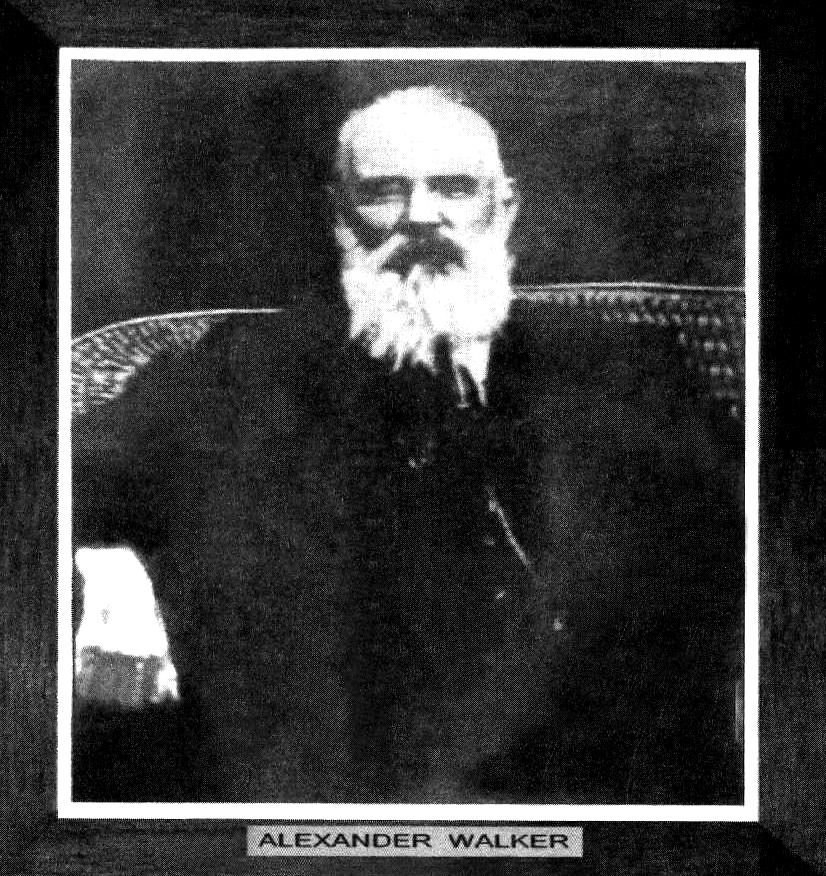 Alexander Walker was an early and prominent citizen of both Gayndah and Bundaberg, He was born in Garrock, Scotland in 1826 and migrated to New South Wales at 22 years of age arriving in Sydney in 1848 in the sailing ship Emperor. He arrived in the embryonic settlement that was to become Maryborough in the James and Amelia a small coastal vessel reputed to be only the second ship to enter the Mary River. Following a short period of station experience Mr. Walker relocated to Norton’s Camp, shortly to become Gayndah, where he erected the town’s fourth building, which was to become its first general store. Mr. Walker became the district’s first postmaster, the proprietor of the Gayndah Hotel and the owner of two nearby pastoral stations - the Mount Cyrus and Woodmiller properties. In early1862 he led an expedition to explore the Burnett River from Gayndah to its mouth, returning to Gayndah in mid to late February of that year. He was subsequently to acquire, and to stock, the Bingera pastoral runs formerly held by Mr. Marshall.
A contract was entered into in October 1872 to transport Mount Perry copper to the port of Bundaberg and the projected construction of a dedicated road from the copper mines to Bundaberg gave a significant boost in confidence to the area. Agitation for the construction of this road had been led by Alexander Walker with Walter Adams contributing assistance by applying the experience gained whilst Chairman of the Maryborough Works Committee. Storekeepers no longer talked of selling out and relocating to Mount Perry and one storekeeper, who had covered his premises with multicoloured advertisements announcing his intention to clear all stock at any price, changed his mind and removed the unsightly posters. As there was no cross-river bridge at this time another storekeeper erected a branch store on the Mount Perry side of the river close to the newly constructed hotel. Bundaberg, in recovery from its prior depression, was on the way to renewed prosperity.
Consequent to the confirmation of the government’s intention to construct the Bundaberg-Mount Perry road a meeting was held at the School of Arts to create a Road Board and to obtain nominations for the board’s representatives. At the commencement of the meeting Mr. Adams elicited from the chairman, Mr. J. Steuart that, in the chairman’s opinion, owners of property on both sides of the river were entitled to vote, and to be voted on, for Board positions. Acting on this information, Walter Adams proposed “That Messrs. A. Walker, J. Steuart, R. Randall, J. Foley and himself be nominated as fit and proper persons to act in conjunction with the Government in expending the expected grant.” The motion was seconded by Mr. Coleman and carried. Following the provision of advice by Mr. Adams on the advisability of communicating with the relevant Government departments as a matter of some urgency the meeting concluded.
In November Mr. W. Southerden retired from his store-keeping business in Maryborough, sold the Kent and Richmond Street premises to the National Bank of Queensland and, in February,1873, resigned from his representation of the Maryborough Council’s North Ward.
In December 1872 it was reported from Maryborough that, while searching for fireclay, a discovery of copper ore had been made in the vicinity of Yengarie in what was known as Tooth and Cran’s big paddock. The discovery was described as “a fine lode traceable on the surface for a considerable distance.”
The Year of 1873
On the 3rd of January 1873 the first step was taken to formalize the district’s civic development process with the establishment of a Bundaberg Progress Committee, its formation considered to be essential in the absence of a legislatively registered board or council. Its membership was John W. Steuart (Chairman), Walter Adams, George T. Bell, Samuel Johnston and Alexander Walker. The committee’s purpose was to establish and maintain communication with the Colonial Government by liaison with its heads of departments and the relevant parliamentary representatives on all significant issues likely to affect the interests of the town and district.
At the first committee meeting, a ten-point list of the most urgent requirements was compiled. The listed requirements were:
(a) Roads Note 1 to the Pilot Station at Burnett Heads, Gayndah and Maryborough;
(b) Telegraphic communications;
(c) Allocation of a fair share of immigrants with quarters for same;
(d) A punt to traverse the Burnett River;
(e) Beacons at the river mouth;
(f) A bridge to extend Bourbon Street over Saltwater Creek;
(g) Bi-weekly mail services to Maryborough and Mount Perry;
(h) The principal streets to be cleared of timber;
(i) The placing of roads under the control of a road trust; and
(j) Reserves for the hospital, cemetery, school, grounds for cricket and other recreation purposes, botanical gardens and racecourse.
The first Bundaberg Progress Committee had a short life; its last minutes being recorded in March 1873. However, prior to that date it had established priorities for the acquisition of the Bundaberg community’s most crucial amenities. On the urgent list were projects that Walter Adams himself had agreed to undertake. These were the commencement of work on the town’s most trafficked roads and the construction of a telegraph line from the township to the pilot station at Burnett Heads. In addition, he had undertaken the construction of the Bundaberg to Bingera road which could serve as the first stage of a road through to Mount Perry. These last two undertakings were completed in January 1875 and March 1873 respectively.
Note 1: Given the concepts and conveniences bestowed upon us by the 21st century the meaning of the word “road” in this context should be viewed with some caution. In the bush of the 19th century a “road” would be viewed merely as a conduit for the passage of travellers, or more appropriately goods, between settlements. In the absence of roads, whilst travellers may obtain passage either on foot or on horseback, goods required haulage either by packhorse, wagon or water transport. In 19th century Queensland the clearing of vegetation and the removal of solid objects such as tree stump, logs or rocks combined with basic grading, in order to create a means of passage between settlements for horse (and bullock) drawn vehicles, would be classed as ‘road’ construction.
The cultural side of the new town’s development was an issue that was no longer to be ignored. The first annual meeting of the School of Arts Committee members took place on the 28th of January 1873 with Mr. R. Stephenson occupying the chair. The annual report was read by Mr. W. E. Curtis who had, in 1870, established a private school in the town, and the motion for its adoption was moved by Walter Adams, seconded by John Cathcart and carried. The results, as reported, were regarded as being highly satisfactory, especially from a financial point of view, with a positive balance of £55 which included an allowance for the purchase of books that had been ordered but not yet delivered.
During the preceding year the enlargement of the library’s book hall had made room for installation of the bookcases needed to house the books on order and other acquisitions. Since the previous July the library had been well patronized with about 450 books being issued to borrowers. In addition to the books the reading room was supplied with the Graphic, Illustrated Sydney News, Punch, Home News, Saturday Review, Australasian, Sydney Mail, Queenslander, Maryborough Chronicle, Wide Bay and Burnett News, Mount Perry Mail, Port Denison Times, and also the Cornhill and London Society magazines. The annual report thanked the ladies and gentlemen who had assisted in the organization of some very successful entertainments and the proprietors of the Wide Bay and Burnett News, Maryborough Chronicle, Mount Perry Mail and Port Denison Times newspapers for placing the library on their free distribution lists. The meeting then proceeded with the election of members to form the coming year’s committee. Those elected were: President, Alfred H. Brown, Vice-president, Joseph Hughes, Honorary-secretary, W. E. Curtis with Committee members, Messrs. R. Stephenson, G. T. Bell, J. H. Cathcart, J. J. Phillips, and F. W. Long. The meeting terminated with a vote of thanks to the outgoing committee proposed by Walter Adams and seconded by Mr. F. Long.
In March 1873 a telegraph office was established on Gin Gin’s future town site as a component of the telegraphic connection between Mount Perry and Bundaberg that was completed in May of that year. By October 1873, the Gin Gin telegraph line had been extended north to Gladstone and then to Rockhampton and, by 1874, the line had been extended south to Maryborough, then to Gympie, and on to Brisbane by 1875. Bundaberg was now connected, not only to Brisbane, but also to London and to the world at large via the overland telegraph line to Darwin with its linkage to the British undersea cable network.
In the meanwhile, development on the north side of the river continued with two additional freight receiving stores under construction. This construction emphasized the need for a reliable cross-river ferry service the necessity for which was being felt more acutely with each passing week. With cross-river trade steadily increasing it was thought that an evaluation of the ferry’s demand would have resulted in the issue of a favourable report to the Government by its representative, Mr. Bragg. Two parties, one of whom had held the lease of a Maryborough ferry for some time, had written to the Minister for Works undertaking to provide both the passenger boats and a punt provided that they were granted a license to run the service for five years and were awarded reasonable royalty payments.
Following the return to government of the Liberal Party in 1873, and of the subsequent replacement of Thomas M’Ilwraith by Mr. King as Minister for Works, a much more enthusiastic and pro-active railways policy was adopted. The focus shifted from M’Ilwraith’s policy to construct the Transcontinental Railway under ‘land grant’ principles to the construction of numerous, smaller railway connections including those from Gympie to Maryborough and from Mount Perry to Bundaberg. However, government finances were then in a straightened condition and Mr. King was to resign.
The Bates family acquired farming land on the Walla Run to trial the farming of wheat in 1873 but later turned to cattle grazing. This decision may have been due, at least in part, to the presence of the Bingera Falls that were only navigable to commercial river traffic during times of healthy river flow.
Walter Adams, relying upon his Maryborough Council experience and on his conviction that “the future of Bundaberg no man can predict”, became a prime agent in securing the necessary reserves for public purposes while the most suitable land could still be obtained at affordable prices. Up to this time only the reserves for the race course, School of Arts and the national school had been secured and the pressing need for the cemetery’s relocation made the acquisition of a suitable reserve of the highest priority.
The urgent need of a suitable cemetery reserve had again been brought to the fore by the recent burial of an old gentleman who had been interred to join the few others who had died, and been buried, in the fledgling township. The location of the then current, and controversial, cemetery site was on an allotment diagonally opposite the site of the present Anglican Church in Woongarra Street. The Progress Committee had included this and other issues in a general representation to the Government on the immediate needs of the district but the nature of the Government’s response to the petitions had been one of both circumlocution and of the resort to red-tape. This had not been at all helpful in obtaining an appropriate cemetery site and raised the question as to why the local surveyor could not be directed to exercise his own discretion in selecting and in surveying a replacement site.
A minority of the townsmen believed that the existing burial ground was sufficiently distant from the town centre and that the town would never extend beyond it in their own, or in their children’s, lifetimes. Never-the-less a trust was established and Walter Adams, in co-operation with Alexander Walker of Bingera station, selected the present General Cemetery site and then lodged a request for the reserve’s dedication. A slight hiccup then arose with the need to challenge a Lands Office application, by the district surveyor John Charlton Thompson, for an agriculture block in a location that coincided with the site of the proposed General Cemetery reserve. This problem was overcome and it was to occur that, by chance, Mr. Thompson’s wife Hannah was the first person to be buried in the new cemetery, the reserve’s dedication being gazetted in September 1873.
Walter’s attention was then drawn towards the establishment of a racecourse on the recently designated racecourse reserve held in trust with Alexander Walker, J. Hughes and R. Stevenson as its designated trustees. Walter Adams and Thomas Watson co-operated in the collection of £30 to cover the cost of surveying and clearing the course. The local surveyor’s quote for a survey to mark the circle of the track was £10 and this expenditure would have left too little in the kitty to complete the remainder of the works. It fell upon Walter, John Foley, and Frederick Coleman, between 9 o’clock one morning and 3 o’clock that afternoon, to mark off the running ground for that which still remains the Bundaberg race course. Family lore maintained that enthusiasm for the clearing of the track had been obtained by the provision of suitable sustenance to the voluntary workers present at the end of the day’s clearing. This sustenance was supplied by Walter’s recently opened Adams Hotel. A Christmas Races Committee was formed in 1875 and the first, and very well attended, Christmas races were held in December of that year
Mr. Bradford, who had been appointed to superintend the erection of the telegraph line between Bundaberg and Gin Gin, arrived in Bundaberg as a passenger on the steamer Queensland to inspect the country in the vicinity of Bingera and to select the location of the most suitable Burnett River crossing for the telegraph line. The route to the north of the river had already been selected by Mossman and Maunsell and the line’s erection was then proceeding along this route in a southerly direction from Gin Gin. From the south side of the selected river crossing’s location the completed line would follow a route into Bundaberg as cleared by Walter Adams under contract.
With the workings of the alluvial goldfields at Gympie having given way to the hard-rock mining of the larger, well capitalised mining companies the attention of the smaller miners in the Mary River district switched to the copper rich area at Ban Ban between Maryborough and Gayndah. However, it was possible that there were other, undiscovered mineral resources that could be commercially exploited. Being well aware of the implications of the Industrial Revolution, by virtue of his Somerset, Hunter River and Maryborough experiences, Walter Adams was very eager to acquire for Bundaberg the same energy source that had supported the introduction of manufacturing industries in Maryborough ten years earlier. This consideration would have influenced his decision in early August to make an application to the Lands Office in Maryborough for a 140 acre mineral selection near Bundaberg over land that possessed coal bearing potential. Frederick Coleman, John Butler and James A. Murray applied for tenements in the same vicinity and in the same week.
From August 1873 to August 1874 George Manus Adams, Walter’s elder son now eighteen years old, acquired useful, practical experience whilst acting as the Summerville plantation’s bailiff.
The Year of 1874
In January 1874 Thomas M’Ilwraih was appointed to the position of Secretary for Public Works and Mines and, being a civil engineer as well as a professional politician, this seems to have been a very appropriate appointment. From Bundaberg’s point of view the appointment boded well as, in the following month, the newly installed Secretary departed from Brisbane to visit the towns of Gympie, Maryborough, Bundaberg, Gladstone and Rockhampton.
In August 1874 Walter Adams wrote a ‘Letter to the Editor’ of the Maryborough Chronicle stoutly defending Bundaberg’s claim to a wharf that would enable it to compete with Maryborough’s existing wharf in the transportation of the Mount Perry district’s imports and exports. The following letters give an indication of the degree of rivalry over this issue then in existence between the two townships.
Sir,
It would appear by your leading article of the 13th that your railway whistle was blown before the steam could be cut off, or you could never have worked yourself up in such a fright as to imagine such engineering difficulties existed between here and the Mount Perry mines. Had you written on reliable authority, or personal inspection, you would have found the difficulty only existed in your fertile imagination. It would be best for them to bide their time and leave their claim to survey for, to convince a man against his will, he will be of the same opinion still. As to the Australian Steam Navigation Company Note 1 being afraid to risk their larger boats up our river, and your argument about one or two ominous groundings of the (ship) Queensland, it seems absurd and this could, with very little trouble, be proved. Was the captain of the Queensland, on a very dark night to miss the channel and try to cross a portion of Woody Island you would then have a similar case as when she struck on the sand bank here and, as to the mud banks, they are nil. Sand banks there are, as there are in the Mary, which cannot be got over at low water. It is not beyond the memory of man when that able seaman, Captain Knight, left Maryborough with the City of Melbourne, steamer, and seven days afterwards returned for provisions and afterwards (a similar incident occurred) with the Waratah steamer. No one will be so foolhardy as to accuse Captain Knight of trying to blast the interest of Maryborough, or question his seamanship, yet this happened on more than one occasion.
The Brisbane people raised a cry that large steamers could not, with safety, go to the Maryborough wharf and remunerate the Company, yet years of experience show that vessels of large tonnage can, with perfect safety, go to the Maryborough wharf and remunerate all concerned - as instance the Omeo. Maryborough being now established as a port, you deem to be walking in the footsteps of others in endeavoring to haul down everything that would not peculiarly advance its interest. No steamer has, as yet, been detained in the Burnett a single night, nor are they likely to be. Our port will prove itself to be, if not better than, equal to Maryborough.
I am, Sir, Yours Truly,
Walter Adams
To which the Maryborough Chronicle’s Editor replied:
We have no doubt that, under the able championship of the writer, Bundaberg will develop into a port before which Maryborough will “pale its ineffectual fires.” Meantime, we would remark that, for a place gifted with so much self-assertion, it is very early to begin petitioning the Government to deepen the river, and the necessity for doing so is rather inconsistent with the magni-eloquence of our correspondent on its behalf. Our river, too, wants deepening but we have had to develop our commerce without any such assistance during more than twenty years and Maryborough is assuredly not going to relinquish, without a struggle, her well-earned claim to be regarded as the entry port of the district and the ultimate terminus of its future railway system.
The Editor,
Maryborough Chronicle.
Note 1: Normally referred to in the local press by its acronym A.S.N. Co. Its Bundaberg operations were initially based on the first north bank wharf as constructed by the Steuart Brothers.
In October 1874 the Colonial Government accepted the tenders for construction of the various telegraph lines listed below:-
Bundaberg and Burnett Heads, Mr. Walter Adams;
Keppel Bay and Cape Capricorn, Mr. Joseph Martindale;
Palmer and Cooktown, Mr. William Strickland;
Charleville and Tambo, Mr. Bernard M. Flynn;
Waterview and Lower Herbert, Henry Simmonds.
On the 29th of October 1874 Walter Adams was granted the conditional purchase of a lease on 157 acres 2 roods of second-class pastoral land at South Bundaberg in an area which is now bounded by the Bundaberg-Maryborough Railway, Thabeban Road, Walker Street and an extended Faldt Street. This block was Portion 32, Parish of Bundaberg, County of Cook and had been occupied from on or about July 1873. Records of the 14th of October 1876 indicate that James Adams, Walter’s son, was appointed as the Selector’s Bailiff responsible for the land’s development with George, his elder brother, providing any further assistance that may have been required. The inspector’s report contained what was probably Jim’s first work reference being rated as “generally useful and attends school” and “not employed elsewhere.”
Improvements as described in the Letter of Fulfillment were:
About 150 chains split post and rail fence, two rails - £135
Stockyard three rails and cap with calf pen - £15
House weatherboard and shingle - £24
Two acres garden, stumped and cleared - £20
To a total value of £194, everything in good order.
This property was used both as the family’s horse paddock and as a holding paddock for the working horses when on agistment. Hector Burkitt in a letter of 10th of June 1876 to his superiors at the Land Office enclosing the Certificate of Fulfillment expressed concern that his predecessor had been mistaken in classifying this property, together with the adjacent allotments, as Second Class Pastoral. He maintained that the land was in close proximity to the Bundaberg urban area, within one and one quarter miles of the nearest sold town lots and, as such, the greater portion should have been valued at £1 per acre and the remainder at fifteen shillings per acre under the provisions of the Act. He further argued that the presence of a two-acre garden indicated that its ground was suitable for cultivation and must be superior to Second Class Pastoral Land. Notwithstanding this stricture the deed was granted on the 10th of May 1877 and Walter may have received a bargain for his outlay of five shillings per acre.
In the scrublands following the land clearing, and after tree stump removal, the horse plough could then be utilized, there being no stump-jump plough in those days. Maize’s edible grain, corn, was as important to the farmer of the 1870’s as is dieseline to the farmer of today. It was virtually the only source of external energy then available for use in agriculture, other than manpower itself, as it was horses (usually Clydesdales in Queensland) that performed the heavy work on the larger acreages. As ploughed or cultivated fields were devoid of any pasture to provide for their grazing these horses required an alternative food source, usually grain. An average Clydesdale horse had enough strength to raise a 550-pound weight one foot in one second, i.e. one horsepower (HP).
Maize, which had either to be grown or its corn seed purchased, would have provided the high energy food needed for these hard-working animals during the period of ploughing that preceded the planting. Some of the larger plantations had up to 100 working horses and it is probable that the Summerville plantation had from 12 to 15 of these working animals. In the off season the Summerville horses could be grazed in the large horse paddock, located to the south of the town and positioned mainly to the west of the existing railway line, far removed from the Woongarra’s agricultural lands. Daily commuting between the south Bundaberg horse paddock and the Summerville plantation would not have been feasible and, in addition, adequate pasturage was not available to the draught horses whilst working on the plantation.
Another Walter Adams acquisition was a homestead block of eighty acres of agricultural land on the south bank of the Burnett River, in the Parish of Takalvan, that had been selected by Charles Hedges on the 24th of June 1870 at the Lands Office in Maryborough. On the 24th of December 1870 Charles wrote to the Land Agent in Bundaberg to advise that the land had still not been surveyed and that he had appointed a local surveyor “to mark out the land and also to mark out a selection of three hundred and twenty acres taken up and granted (conditional purchase) on the fourth of August 1870.”
In a Power of Attorney “signed, sealed and delivered” on the 10th of November 1874, Hedges “by memorandum of agreement bearing (that) date herewith sold all his right title and interest in the aforesaid selection of eighty acres …... at or for the sum of three hundred pounds Sterling and whereas the said Charles Hedges being compelled to leave Bundaberg for remote portions of her Majesty’s dominions to wit England and Wales, Scotland and Ireland in furtherance of his private pursuits .... has deemed it desirable that Walter Adams, Publican of Bundaberg, should be appointed as the Attorney of him.”
To this day Charles remains as an enigmatic figure. A Charles Hedges arrived in Sydney on the 9th of February 1850 as a nineteen-year-old Church of England farm labourer from Chednor, Buckinghamshire who could neither read nor write, and who claimed to have no relations in the colony. However, the Bundaberg Charles Hedges left behind not only a property of significant value but also a photograph album (still in the possession of the author’s family) containing photographs of Windsor Castle, Eton College and other locations in the Thames Valley. Included were photographs of the Lodge ......, Vineries ...... and Stables at Newnham. Curiously, the home of Walter’s daughter Ellen and her family, at 116 George Street Bundaberg was named Newnham though there is no knowledge of the use of this name in prior family history.
On the 4th July 1876 William H. Franklin, the Bailiff of Crown Lands in Bundaberg, carried out what appears to have been the first property inspection. He described the property’s selector as one “Charles Hedges, Gentleman, at present in England.” The property was Portion No. 5, Parish of Takalvan, County of Cook, consisting of 70 acres of agricultural land and 10 acres of second-class pastoral land and was used “for the growth of maize.” Franklin advised that “a man named Creavy (“Farmer”) resides on the land in the interests of Walter Adams.”
At this time the relevant land holding appeared to consist of 37 acres of agricultural and 92 acres 2 roods of second-class pastoral land with the improvements to the holding being recorded as:
About 35 acres cleared, £175
Weatherboard two-room shingled cottage with veranda, £30
A large barn shingled with weather-board slabs, £25
Lean-to and paling fence, £15
The Crown Lands Bailiff concluded “This selection is now I believe a freehold and held by Walter Adams.”
At a later date, in 1877, land for what is now Branyan Drive was resumed on the northern fringe of this property. Rather than receiving cash compensation Walter requested and, on the 10th of June 1879 received, the allocation of four acres on the northern side of the new road with the intention of building a house on the elevated land at the top of the riverbank, this location being above flood level. However other matters were to intervene and he sold the four acres to Robert Dyball, one of Bundaberg’s early solicitors in 1884 thus leaving this building site, with its extensive outlook, to future development.
As confirmation of Walter’s confidence in the future of Bundaberg, and of the ongoing value of its real estate, his purchases were to include at least an additional nineteen town allotments.
The Member for Mulgrave, Mr. Walter Scott, had made an application for the Government to include money on the Estimates for the erection of South Bundaberg’s first town wharf at an estimated cost of £2,000. Mr. Scott subsequently received a reply stating that the currently available Government funds were insufficient to provide for such a purpose and that both the town’s current position, and its future prospects, were such as to preclude expenditure of this nature both at the present and for the foreseeable future. It was up to Walter Adams by donning his contractor’s hat to come to the fore. Whilst a customer in Mr. Cathcart’s store he requested a sheet of tea paper, being the only writing material readily available on the premises, and proceeded to draw a pencil sketch of the desired wharf to which he then added a set of matching specifications. This he sent to Mr. Scott with an offer to take responsibility for the wharf’s construction at a capital cost of £1,900. Having been guaranteed a favourable cost of construction the Government re-considered the matter, money was found and, in September 1874, a tender was accepted for the construction of the wharf which was later to be named Queen’s Wharf. On its completion in 1875 the wharf was leased to the Australian Steam Navigation. Company which, in 1876, relocated the company’s activities from flood-prone North Bundaberg.
Late in 1874 William Peel Mellefont who had learnt his trade as a printer in County Cork, Ireland set-up Bundaberg’s first newspaper press in joint partnership with Henry Marcus and they expressed their intention to publish the Bundaberg Star and Burnett Times towards the end of 1874, although the first release was actually delayed until January 1875. Mr. Mellefont subsequently sold out to the ex-Maryborough Chronicle reporter, John Rowland, in 1877.
The Year of 1875
The season of 1874 and into early 1875 had been a period of drought, though the volcanic soils of the Woongarra had retained some residual moisture which had helped to preserve their growing capacity so that the production of healthy crops had been maintained. The five years preceding March 1875 were ones of favourable climatic conditions, ones that had provided Bundaberg’s agricultural industries with a benign environment and relative prosperity. In the last week of February, the dry period came to a dramatic end with the weather exhibiting a violent shift to the other extreme with heavy rainfall accompanied by gales that flattened the crops and generated huge waves in the bay. Up to this time work on the formation and drainage of the town’s new streets had received little attention so that they quickly became impassable quagmires.
The earlier flood of 1870 had been of considerable magnitude, but its devastation had been much less than that which occurred in 1875. In 1870 there were far fewer settlers and there was little accumulation of property vulnerable to destruction, the settlement of the district having scarcely begun. The estimated loss of the 1875 inundation was recorded as being £20,000 and was a serious blow to the newly established community. An even more sobering description of an earlier flood had been recorded in the HISTORY OF BUNDABERG by J. Y. Walker which describes an aboriginal assertion that their “oldest inhabitants had seen the site of Bundaberg entirely under water.”
The flooding in the river at Bundaberg on Sunday the 1st of March produced the greatest river height to be attained in the five-year history of the developing township. This flooding is described in the following edited, and much condensed, version of the 1875 flood’s description as detailed in Mr. Walker’s book of 1890 together with some additional detail from contemporary newspaper reports.
The 1875 flood attained its greatest height on Sunday the 1st of March at 2 p.m., and commenced to fall at 7 p.m., with an estimated stream flow velocity of about ten knots and with the river carrying large amounts of debris. During the flood some timber-getters suffered severe losses with the breaking up and carrying away of their assembled rafts of harvested logs. Mr. E. B. Jeune’s plantation was exposed to almost complete submergence, but did not experience lasting damage. The adjoining farm, originally selected by Charles Hedges and whose land title had recently been transferred to Mr. Adams, was completely submerged, the water having reached the wall plates of the house, and the crop was completely ruined. The river bank opposite this farm was inundated by the rising flood waters and their expansion resulted in an overland flow that finally reached and then discharged into Splitters’ Creek. The intermediate farms, their houses, outhouses, produce, fencing, cattle and horses were all swept away by this overland flow.
Henry Palmer’s Sharon sugar plantation’s houses and their adjuncts were carried away. The plantation experienced heavy crop losses and the floodwater’s velocity had severely eroded the plantation’s topsoil. Richard Palmer’s Millbank sugar plantation also suffered severe losses, estimated to be valued at £3,000. The sugar in store was said to have exceeded seventy tons, and of this only a few hundredweight was saved. The plantation’s machinery was severely damaged, the mill’s boiler being lifted from its bed leaving its associated machinery twisted and buckled. The working men’s huts were carried away, as was a large punt that had been tethered at the wharf. Samuel Johnston’s sawmill was flooded up to the roof of the main building and the mill's stacks of sawn timber were lost. As this was the town's only sawmill its stoppage was to cause great inconvenience.
In the Bundaberg township the river adjacent to the Customs House rose to a height two feet below the top of the high bank. This related to measured heights of 32 feet 6 inches above low-water level and 24 feet 6 inches above high-water spring tide level. All North Bundaberg, and the lower land in South Bundaberg, were under water. The A.S.N. Company’s wharf and store were lost and a new Government wharf, under construction by the firm of Thompson and Lapham, on the river’s south bank was badly damaged. Although the ferry house had been washed down the river Messrs. Gillen, the licence holders of the ferry service since 1873, took a considerable risk, owing to the high velocity of the current with its accompanying debris, in maintaining the service throughout the flood when they had been obliged to camp under a tarpaulin in a punt moored to a tree growing on the river bank. All of the buoys and beacons between the town and the river mouth had been swept away but, following a post-flood inspection by the Harbor-master, Mr. Hughes, steamers navigated the unmarked channel.
At Bingera, where the river narrows and is bounded on either side by high banks, the river rose many feet above normal stream levels, ultimately overflowing these high banks, and inundating hundreds of acres of the lands under cultivation. Further downstream, and a short distance above the location of the future Bundaberg Refinery, it was estimated that the river had expanded to a width that was in excess of two miles. The densest settlement had taken place on either side of the river, from Bingera to Rubyanna and it was along this stretch of the river that the greatest losses were experienced. Messrs. Pringle of Bonna, then regarded as being the model farm of the district, lost 100 acres of mature maize plantings and two large barns which resulted in an estimated loss of from £1,200 to £1,500.
The overall result of the flooding was that ripening grain and stored corn were ruined, settlers’ homesteads and barns containing crops ready for market were swept away by the flood waters, livestock and settlers’ lives were lost and, when the flood waters had finally receded from the devastated areas, there remained an odoriferous slime. As previously mentioned, the overall damage to Bundaberg’s infrastructure, as a result of this flood, was estimated to be £20,000. Serious flood damage resulting from this weather system also occurred in the catchments of the Mary, the Pine, the Brisbane, the Logan and the Clarence Rivers, in Oxley Creek and in the Hunter River District. As these were all large maize producing districts the flood damage had caused a significant rise in the colony’s price for corn. This provided some relief to the depleted value of Bundaberg’s yearly produce and it was then supplemented by a late winter crop that could not be grown in the cooler, southern districts.
The Gin Gin Post Office, which opened on the 15th of March 1875, provided a nucleus around which the township of Gin Gin was to develop. It was located on a site that had previously been part of the sprawling Gin Gin, later Gingin, cattle station that, for a time, was owned by three times Premier of Queensland Sir Thomas M’Ilwraith. It is a matter interest that three sometime owners of Gingin station were later to become premiers of Australian states. The premiers concerned were William Forster, who was to become a premier of New South Wales, whilst Arthur Palmer a one-time partner of Mr. M’Ilwraith in Gingin station who entered politics as Member for Port Curtis in 1866 and Thomas M’Ilwraith who entered politics as the Member for Maranoa in 1868 were both to become premiers of Queensland.
It was also in 1875 the Land Commissioner produced a report that declared “the supply of agricultural land is quite exhausted” and recommended that the Gin Gin holding be reduced to 15,500 acres to make more land available for agricultural purposes. It was at about this time that Alfred Brown sold the Gin Gin station’s land title to Thomas M’Ilwraith.
The Tooth and Cran sugar refinery at Maryborough had been equipped with the latest available technology and the installation’s operation was proving to be both successful and reliable. The technology that it employed was of so much interest to the Bundaberg cane farmers that a petition had been delivered to the refinery's owners by these farmers and by others with an interest in the sugar industry, who sought the establishment of a similar mill in the Bundaberg area.
The establishment of a Primary Public School in Bundaberg had been delayed by two years due to financial difficulties. However, in 1875 and in response to the third application submitted enough funds were obtained by public subscription to enable the school's establishment. A further problem then arose as there was no Government official in the town available to supervise the building’s construction. This difficulty was overcome by the appointment of Walter Adams, John Cathcart and an employee of the Lands Office, Mr. Beard, as volunteers to undertake the supervision. In the following year Walter Adams was also responsible for the promotion, and subsequent establishment, of the Provisional School which became the Burnett Heads State School. His enthusiasm for this project was no doubt heightened by the presence on Summerville of the Chase family as Lucy Chase, the daughter of the plantation’s bailiff, was one of the first pupils to be enrolled.
The years from 1873 and into the 1880’s had a considerable impact upon Bundaberg’s church affairs, public and church funded education and the Adams family itself. When the Adams family arrived in Sydney on the Victoria in 1849 its religion was recorded as being Church of England. Walter subsequently became a Catholic no doubt influenced, in no small measure, by his wife Mary (nee Shannon) from County Clare. Before a Catholic Church building was constructed in Bundaberg the clerical needs of the small number of local Catholics were served by the visits of Father O’Brien in commuting from the older settlement of Maryborough. Father O’Brien, who had been the first Catholic priest to be ordained in Queensland, was then acting as assistant to the aging Dean Tissot who was soon to retire. A framed oil painting of Dean Tissot survives as a relic of Walter and Mary’s 118 George Street residence which was located just to the east of the present railway line. The portrait, which is now located in the church of the Dean’s old Maryborough parish, was gifted to Walter by Dean Tissot as a token of appreciation for the support that Walter had provided to the Dean during Walter’s residence in Maryborough. This support was most evident during the somewhat confected, but stressful, political stoush that had taken place in both Brisbane and Maryborough in 1871.
Prior to the construction of the Adams Hotel in Bourbon Street the Catholic mass had been celebrated by Father O’Brien in private homes and, following the construction of the hotel, the celebration was transferred to the hotel’s dining room. The hotel had been constructed in 1872-73 on the corner of Barolin and Bourbon Streets and was a one-story wooden structure with veranda and stables. In October 1885, it was demolished to make way for the present two-story brick Metropolitan Hotel, completed in April 1886, and which was equipped with a billiard room and three Bourbon Street shop fronts in 1887.
Father O’Brien’s ministrations were to be replaced by those of Father Constantine Rossolini who was subsequently to become Bundaberg’s resident priest. This capable and energetic pastor came from Italy and initially had responsibility for the Gayndah, Mount Perry and Bundaberg areas. In his early visits to Bundaberg accommodation was provided by the Adams Hotel. No doubt his eventual appointment as Bundaberg’s resident priest would have been a relief to the pioneer priest who previously had responsibility for an area where the ‘roads’ would have been more appropriately described as, often impassable, bush tracks. As the parish priest servicing Gayndah, Mount Perry and later Bundaberg Father Rossolini became a close friend of the Adams family and collaborated with Walter on many church, school and secular affairs over the following two decades.
The purchase of three adjacent allotments, each of one rood, located at the corner of Barolin and Woongarra Streets, was made on the 2nd of March 1874 at Government auction at a price of £2 per allotment, with Walter Adams, C. Rossolini and James Drinan acting as “Trustees for the Roman Catholic Church” under Walter’s signature. Mr. Drinan was an early settler, a sugar-cane pioneer and a winemaker of Electra who was appointed as a Police Magistrate in 1876. Later generations of the Adams family, in their internal discussions, maintained that Walter had donated the funds for this purchase. While quite possible, it seems more likely that Walter, Father Rossolini and possibly Mr. Drinan were the joint contributors.
It is notable that Lots 1, 2 and 3 of Section 8, the ones that had been chosen for the location of the church and its associated presbytery, were the first to be offered at the Government’s auction of all of the Section 8 Lots and these particular allotments attracted no competing bids. Following the auctioning of these lots to the church trustees the remaining forty-six lots attracted normal bidding. Though an effective public relations campaign no doubt preceded the auction, the results speak highly of the co-operative and constructive nature of Bundaberg’s citizens at that time.
A Church Building Fund had been established in 1873 and was drawn upon to erect a small, wooden church structure on the Barolin Street site which was dedicated and then opened by the Rev. Father O’Brien in October 1875. This structure was dedicated as St. Mary’s Church of the Holy Rosary and was soon to be replaced by a 48 foot long by 24 foot wide structure at a cost of £300 (as described by J. Y. Walker) built on the same site. The earlier structure, Bundaberg’s first church with its arched, Gothic window openings, was relocated to the Fitzgerald Street Catholic cemetery for use as a chapel. Father O’Brien’s death occurred in the house of Father Rossolini on the 12th of June 1878 while on a visit related to school affairs, in company with Mother Mary (now Saint Mary) MacKillop. He was buried in the Holy Rosary church grounds with the burial being relocated to his Maryborough parish in 1881.
In February 1875 Walter Adams announced his discovery of a coal deposit and a company was promptly formed “to work the coal seam discovered in that locality by Mr. Walter Adams.” His letter described the seam as being about six inches thick at the surface, increasing to ten inches at a depth of four feet, and at ten feet penetration had widened further to sixteen inches of thickness. Walter and Mr. Boreham brought a sample of this coal, which weighed about seventy pounds, into town on a Wednesday. The sample was successfully tested in Mr. Thomas Child’s blacksmith’s shop where Mr. Child, upon clearing his fire of the imported coal, put in a portion of the sample which Walter had provided and then proceeded to weld two pieces of iron together as cleanly as could have been done with the best of the Newcastle coal.
At a meeting held the same night at the Adams Hotel, it was resolved to have a report on the mine prepared by an experienced miner named Mr. Woodward who, in the company of Mr. Desmond the local surveyor, visited the scene of the discovery on the following day. With the prospect of additional employment in the district, and with the potential for an increase in the value of local properties, the editor of a local newspaper remarked that “Mr. Adams deserves the thanks of the public for his energy and perseverance.”
Mr. Woodward’s report proved so favourable that, at an adjourned meeting, held the same evening, it was resolved to form a company, of up to twenty-five shareholders, with a working capital of £400, contributed by twenty of their number at the rate of £20 each; £5 cash and the balance in calls. The greater portion of the available shares was taken up immediately, and a further meeting was fixed for Friday the 10th when the share list was to be closed.
Directors were appointed, consisting of Messrs. Adams, Hill, Ford, Buchanan and Mellefont, with Mr. Cathcart being appointed temporary secretary. One hundred and nine acres of prospective land were taken up, with operations programmed to commence in about a week. It was anticipated that the proposed Mount Perry railway line would pass within two miles of the prospective mine site and hence a short spur line would be all that was required for the access necessary to transport the mined coal. If the anticipated Mount Perry railway construction did not eventuate, the laying of a tramway spur line about four miles long could have been constructed to bring the coal within reach of the Burnett River’s water transport.
Following the evident abandonment of the company’s presumed, non-commercial coal seam in the Bingera vicinity Bundaberg’s demand for the delivery of cheap industrial energy was not to be satisfied prior to the construction of the Howard to Bundaberg railway line which would enable the large scale, economic delivery of coal from the Burrum. In their early periods of production future industrial consumers of coal in the Bundaberg area, such as the Cran’s Millaquin refinery and Mr. Fleming’s gasworks, would have been reliant on marine transportation of coal supplies from the Burrum via Maryborough or from the more distant Newcastle district.
The Brisbane Courier on the 18th of October 1875, referring to a listing in the previous Saturday’s Government Gazette, proclaimed that Walter Adams had forfeited the rights to his prospecting selection “in the district of Bundaberg 140 acres.” Clearly not all projects undertaken by our early settlers would prove to be profitable and, in this case, there appears to be no further records of activity on Walter’s coal prospect.
By April 1875 contributions to the subscription list for the construction of Bundaberg’s first Church of England were sufficient to allow for the calling, in May 1875, of a contract for the construction and supply of a church of timber construction having dimensions of 50 feet by 26 feet, and complete with seating, built on a Quay Street frontage. The construction was completed in March 1876, at a total cost of £356. An agreement between Mr. Brown and Mr. Barns, acting as Secretary for the Committee, had determined that the land title should, on the completion of building, be transferred to the corporation of the Synod. This transfer, made out to the then Committee Secretary Mr. A. M. Goodwin, was implemented by Archdeacon Glennie on the 3rd of September 1878. A regular minister, the Reverend William Morris, was appointed in October 1878.
Later developments were the addition of a detached belfry-tower in September 1881 at a cost of £80, with a second enlargement of the church being undertaken in 1882 at a cost of £160. This building was moved to a site near the current Christ Church at the north eastern corner of the Maryborough and Woongarra Street junction in 1899. By 1890, the congregation was considering the construction of a new Christ Church, of brick and stone construction, to be erected at a cost of approximately £7,000. Although the plans and specifications for this church, of English Gothic design, were prepared by the architect Mr. J. H. Buckeridge in the 1890’s construction was not to commence until the 1920’s, the church being opened in February 1927. Supervision of the work was initially undertaken by a Bundaberg architect, Mr. F. H. Faircloth, but he died during construction and the Diocesan architects, Atkinson and Conrad, completed the supervision.
And also in April of this year Richard Ruddell established Ruddell’s Soap Factory in Woondooma Street. Starting from small beginnings, as a tallow supplier in 1874, Mr. Ruddell had developed his business into the largest soap manufacturer in Queensland, distributing carbolic (antiseptic) and kerosene (bath) soaps over all of Australia.
The Reverend W. McNaught of the Primitive Methodists was appointed to Bundaberg on the 12th of August 1875 and he conducted the first regular services in the School of Arts building. Land for their own church building was purchased in Walla Street where a small wooden church was erected the capacity of which was almost immediately rendered inadequate by the increasing congregation. Reverend W. McNaught was replaced by the Reverend E. Fuller who, in turn, handed the ministry over to the Reverend J. Williams in 1878. The Rev. Williams devoted himself towards the attainment of a new church and offered to make the first £100 donation to encourage its construction. Within one month of his generous offer construction had commenced and, within a further six months, a new church was built for £250. A parsonage was later constructed on the Walla Street site.
In September 1883 an amount of £275 was contributed to establish a Wesleyan Methodist Church in Bundaberg. However, the construction was deferred, and an existing building was rented as a temporary measure. The early services were conducted in the Victoria Hall by the Rev. F. Dewsbury from Maryborough and by the Rev. W. H. Harrison. Temporary premises were utilized whilst the Wesleyan congregation was being organized under the ministrations of the Reverend Mr. Harrison. Construction of the wooden Wesleyan church commenced in September 1885 and the building was completed at a cost of £500. It received a formal opening in December. A parsonage was later acquired for an additional £300.
Following Methodism’s Jubilee, which occurred in 1897, the Primitive and Wesleyan Methodists agreed to unite and to form a permanent Methodist union. This was finally achieved in 1904, following the usual complications that seem to attach themselves to such an event. In April of that year the separate congregations were united on the Barolin Street site. Prior to the union the membership of the respective congregations consisted of 105 Wesleyan and 108 Primitive Methodists. In 1925 a decision was made to construct a substantial brick church to replace the original wooden structure. This was constructed by C. J. Vandenberg with its opening and dedication taking place on the 7th of August 1937.
It was in 1875 that Bundaberg obtained a valuable, new public facility called the Pioneer Schoolroom which was adjacent to the School of Arts and had a considerably greater seating capacity than the School of Arts venue. The Pioneer Schoolroom provided the facility to hold larger public indoor meetings, Sunday school attendances and public entertainment.
The Year of 1876
In 1876 Walter’s daughter Mary Ann married John Henry Edma Bertheau and Mr. Bertheau then undertook the management of Summerville plantation. John Henry was later to relocate his activities to his own farm in the Childers district and his family was to have a long association with cane growing in that area.
Horace Burkitt, Commissioner for Crown Lands at Bundaberg, in his May 1876 report valued the Summerville plantation with all of its improvements as:
All land cleared and under crops, £100 0s. 0d.
15 acres of scrub felled, £37 10s. 0d.
About 20 chains of fence, split post, sapling rails, £10 10s. 0d.
Two slabbed piggeries, £6 0s. 0d.
Two constructed water holes, £8 0s. 0d.
Two thatched log barns, £20 0s. 0d.
One slab and shingle cottage, £14 0s. 0d.
40 acres under maize, £200 0s. 0d.
All to a total of £396 0s. 0d.
Mr. Burkitt noted, at the time of his earlier visit in June 1875, the place “had all the appearance of a well worked maize growing farm” and on the 10th of June 1876 a Certificate of Fulfillment of Conditions by Selector under the Crown Lands Alienation Act of 1868 was granted by Queensland’s Colonial Government. A condition of the approval of a lease under the Act was continuous and bona fide occupancy of the selection by the Selector or his Bailiff. The early Bailiffs were:
From February to June 1872, D. Kennen - with the two sons of the selector (George and James Adams) assisting clearing;
From June 1872 to August 1873, a bailiff called Mr. Digby;
From August 1873 to August 1874, George Manus Adams; and
From September 1874 to July 1876, Thomas Chase.
Thomas Chase arrived in Maryborough on the Great Queensland on the 9th of October 1874 and entered Walter’s employ on, or shortly after, his arrival at Bundaberg. His family was comprised of wife, Ann (née Steel) and children, Mary Ann, Mark, George, Thomas, John, Eliza, Ellen Jane, Frederick, Henry, Lucy, Jane and James. The children ranged in age from twenty-two to three years. A thirteenth child, Richard Burnett, was born in 1875. Thomas was born at Kingston, Surrey, in 1821 and Ann at Millford, Southampton, in 1829. They had been married at Portsea, Hampshire, in July 1852.
The importance of some religious institutions lay, apart from their provision of social contacts and family support, in the secular education that they were willing to provide. This was particularly relevant in the case of the Irish Catholic immigrants, occasioned by the lack of access to education and other privations in their home country under the English governance.
Walter Adams’s understanding of the value of education for all had been evidenced by his assistance to the fledgling town in establishing Bundaberg’s Public Primary School so that when the Sisters of Saint Joseph, whose founder was Sister (now Saint) Mary MacKillop, arrived in Bundaberg in 1876 he was very appreciative of their coming. The sisters soon obtained the locals’ respect with their valuable contribution to the children’s education largely due to their competent teaching of academic subjects. The teaching was initially conducted in the recently erected 48 by 24-foot second wooden church. Prior to the sisters’ arrival in Bundaberg the Augustinian parish priest of Maryborough, Dean Tissot, who had also been in residence during Walter’s time in that town, had offered the Josephites both his support and the use of his presbytery as housing, with his own accommodation to be relocated elsewhere - another acknowledgment of the value then being placed upon education.
There are two recorded occasions of Saint Mary’s visits to Bundaberg. The first of these visits occurred between March and July 1878, and the second coincided with her visits to the St. Joseph’s Queensland communities in 1879. During this visit Walter Adams loaned the then Sister Mary one of his buggies, the loan being recorded in one of his subsequent letters to her written in 1880. As both of Walter’s pastors, friends and close associates, namely Dean Tissot and Father Constantine Rossolini, were known to be some of Saint Mary’s greatest supporters amongst the clergy in Queensland it would have been remarkable indeed if Walter had not also been a firm supporter and such was the case. Even without this stimulus it is likely that Walter Adams’s commitment to universal education would have made such an association virtually inevitable. It is likely that the then Sister Mary’s extended stay in Bundaberg over the four month period in 1878 was occasioned by a combination of factors including the very strong and reliable local support that provided her with relief from the stresses occasioned by a somewhat antagonistic attitude emanating from the bishop’s Brisbane office, her demanding programme and her indifferent health.
Unfortunately relations between Bishop James Quinn of Brisbane and Saint Mary MacKillop finally broke down completely, largely due to unmet expectations on the part of the sisters and to the lack of support and co-operation on the part of the bishop. On hearing of Bishop Quinn’s intention to dismiss the sisters from his diocese, one thousand and sixteen contributing signatories were gathered in a petition that requested the bishop to allow the sisters to continue with their charitable works. There appears to have been no written response to this petition from the bishop. However, the Catholic newspaper was to print a copy of the petition together with a letter of explanation from Bishop Quinn and an editorial in which it was claimed that some person was fostering a spirit of schism and rebellion against their ecclesiastical superiors. It was further claimed that those who had signed the petition were ‘plotters’ and ‘renegades’. Under the prevailing circumstances Walter, very much disturbed by the ongoing events, would probably have felt quite comfortable being positioned under the ‘renegade’ banner.
The Josephites in Bundaberg were the last of the Queensland communities to receive the news of their pending ejection from the diocese. Father Rossolini had hoped that the bishop would allow the sisters to remain in his parish but, on the 20th of June 1880 and reportedly with his face ‘as pale as death’, he announced to Sister Teresa his notification of the appalling news emanating from the bishop’s office. This was despite the very strong representations by Father Rossolini and his close friend Walter Adams who, along with many other parishioners, were greatly disappointed, if not appalled, by such an unfortunate turn of events. The ‘Joeys’ during their short stay in Bundaberg had obviously made a very favourable impression upon the early residents, Walter and Constantine very much included, and they had earned a great deal of loyalty in return. It seems strange now that concentration on the teaching of reading, writing and arithmetic to the children of an almost exclusively immigrant population should engender such disapproval from the colony’s religious hierarchy. It was probably Bishop Quinn’s predilection for the inclusion of the teaching of music and arts that initiated Walter’s somewhat caustic comment on this subject, as recorded in a letter to Sister Teresa (Maginnes):
“If you allow me to tell you that henceforth and forever the rising generation are to be ladyes and gentlemen, (having) no common education like you could impart. But music by the real they will teach, therefore the future of Queensland will be great and musical. The people will be too proud to work and when they get hungry they will go to the pianno for a musical feest. ------ .”
Bishop Quinn’s requirement could have been regarded as somewhat elitist as the parents of most of the sisters’ pupils, many of them refugees from desperate times in their countries of origin, would not have been able to afford the expenses entailed in meeting the costs of such a luxury as an artistic and/or musical education for their children. For the Josephites to include arts subjects in their syllabus it would have required significant expenditure by either the parents, the Sisters and/or the parish on extra equipment, space and training. It would seem that no funding for the inclusion of subjects of an artistic or musical nature was forthcoming from the bishop’s office and hence the justification of this expenditure would have been virtually impossible under the prevailing conditions.
On the 11th of July 1880 Walter Adams read the following address of appreciation to the Sisters, who were prepared for their departure on the following day.
To Sister THERESA and other Sisters of the Order of St. Joseph,
Dear Sisters,
We the members of the congregation of St. Mary’s Bundaberg, having learned with regret that you are about to leave the colony, take this opportunity of expressing our sincere sorrow for your removal from amongst us. During the last four and a half years you have labored hard in the good combined causes of education and religion and we feel deeply the loss we shall sustain by your removal, but be assured, dear Sisters, that we find consolation in two things: the first being that, before Almighty God, we shall be held blameless for your departure from where you were so much needed, such departure being neither the fault nor the wish of the congregation, and the second that you are about to go to a colony where your zeal, piety and good works will be appreciated by all from the highest Ecclesiastic to the lowest of the laity. Dear Sisters, the loss will be ours and that of our families and we feel it tenfold, yet we pray Almighty God to spare you all to prosecute the good work for which you have left the world for, like Mary of old, you have chosen the ‘better part’. We, therefore, beg you will accept the accompanying gift, and we wish you all a speedy and pleasant journey to your new home.
Signed on behalf of the congregation,
Walter Adams and Others
The ‘gift’ was a donation of £37 - the local report - or of 40 sovereigns - the Sister’s records - an amount of considerable value at that time.
Walter’s sense of loss at the Sisters’ departure can be well understood when his demonstrated commitment to education of both a secular and a religious nature is considered. His recognition of the value of a basic education may well have its origin, and would certainly have been reinforced, by the inability of his wife (who migrated to Australia as a young Irish immigrant towards the end of Ireland’s Great Famine) to either read or write. Walter’s very strong feelings as to the injustice that he felt had been inflicted on the Sisters were shared by many others in the Bundaberg and Brisbane districts whose dealings with the Sisters had been both productive and harmonious. Following the sisters’ departure Walter Adams maintained contact by correspondence with Sister Teresa and Mother Mary. In this he may have received encouragement from his daughter and ex-pupil of the Josephites, Maria, who was both an enthusiastic supporter and an admirer of the Sisters.
Following the withdrawal of the original Josephite Sisters under Mother Mary, Bishop Quinn provided replacement sisters acting under his own jurisdiction and later, from 1882, under that of Bishop Robert Dunne. The original replacements were Sister Joseph (Margaret Wynne) and Sister Julian (Jane Brown), both of whom were to depart the convent in 1881. Still later, in July 1897, the Bundaberg convent was to come under the management of an Irish order of nuns, the Sisters of Mercy. While the replacement Sisters continued the work in a creditable fashion, and whilst the Bundaberg convent continued to flourish, the feelings engendered by the loss to the parish of the pioneering Sisters of Saint Joseph carried on over several generations. However, it is an ill wind that blows no one any good and the Josephite Sister’s, under Mother Mary MacKillop, relocated to New South Wales where they received a very warm welcome from Archbishop Vaughan on their arrival in his Diocese. Walter made the philosophical observation that, under the prevailing circumstances, it was probably for the best.
In 1876 Mr. R. H. Datsun indicated that the farms above the Bingera Falls were producing 30,000 bushels of maize a year and when the river flow was limited, a not unusual occurrence, the transport of timber and grain was by dray as of necessity. The dray operators were charging 1s. 9d. per bag to cart grain to Bundaberg which, given the grain prices of the time, made its production uneconomical to the upriver farmers. Over the following two years the price of the grain delivered to Bundaberg averaged 1s. 3d. a bag. Taken in combination, these prices indicated the potential advantages of a hinterland railway line.
The catastrophic collapse of the world’s copper market prices in 1876 had the potential to provide a major setback to the Mount Perry railway construction proposal but, never-the-less, Mr. King’s policies were revived and Maryborough’s acceptance of Bundaberg’s claim to the Mount Perry line, in return for the construction of its own line from Gympie, had the effect of removing a major obstacle to the undertaking of the works.