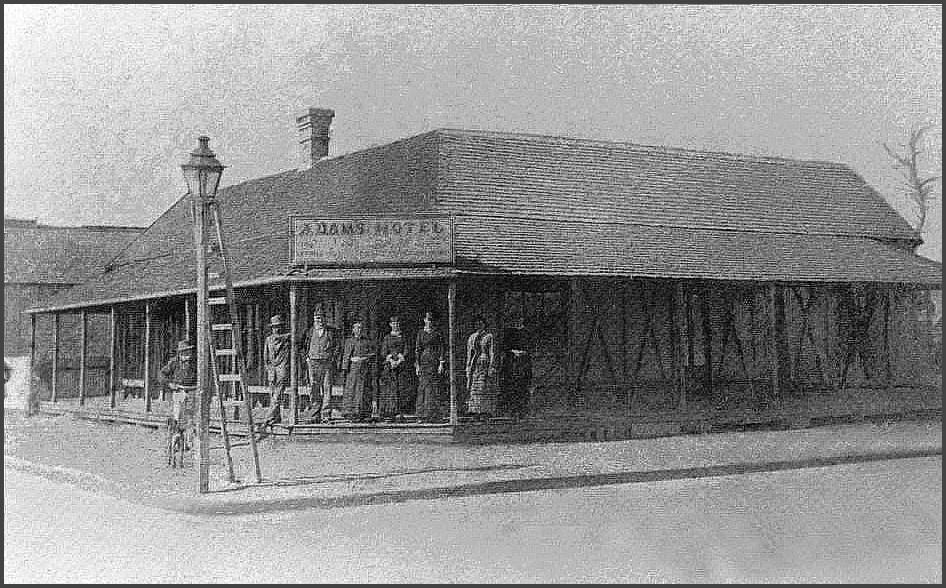
Chapter Four
A Time to Move On
Over the Decade 1870 to 1880 Some Significant Occurrences in the Home Country Were:
In 1872 the British House of Commons passed the Pacific Islanders Protection Act, an act that authorised British warships to board and to apprehend pirates on ships that were suspected of transporting illegal human cargo in international waters and to deliver them (if in the Pacific Ocean) to Australia for trial;
The Franco-Prussian War broke out in conjunction with the rise of Bismarck in Germany and of Gladstone in England;
As the leading maritime nation of the time Britain then commanded 27% of the world’s seaborne trade;
The two-party political system achieved prominence with the domination of English politics by Gladstone’s Liberals and Disraeli’s Conservatives;
Disraeli’s purchase of the company shares in the Suez Canal gave Britain control of this strategic waterway;
In anticipation of another Russian-Ottoman war England invaded Cyprus by deploying its Indian troops. It retained control of the island even though the expected war did not eventuate;
A second British invasion of Afghanistan took place to forestall a Russian expansion. The expansion did not take place;
In South Africa the Zulu War, with its Rorke’s Drift engagement;
The publication of Anthony Trollop’s novel The Way We Live Now;
The commencement of collaboration between Gilbert and Sullivan in the production of their satirical musicals; and
The publication of Thomas Hardy’s Under the Greenwood Tree.
AND - In the Early 1870’s Some Significant Occurrences in the Vicinity of the Lower Reaches of the Burnett River Were:
In 1870 Henry J. Ford’s store opened on the north bank and experienced serious flooding in the same year;
In 1871 Richard Palmer began clearing land for planting on his Millbank property;
Surveyor Barnes conducted a survey for a road from the settlement to the freshwater Elliott River Crossing. From this baseline additional surveys to facilitate the allocation of properties in the Woongarra Scrub took place. The subsequent settlement was pioneered by Messrs. Greathead and Archer to the south; Messrs. Kendall, Kirby, Jealous, Lee and McGill from Saltwater Creek extending to the east along the Burnett River’s southern riverbank; and a Maryborough contingent of Messrs. Adams, Noakes and Faulkner still further east towards the mouth of the river;
In 1872 the first crushing of sugar on a commercial basis took place in the Bundaberg area in Richard Palmer’s mill at Millbank; and
In 1873 the Mulgrave electorate was gazetted, and Mr. Walter Scott became the first elected Member for Mulgrave.
The Year of 1870
In 1870 Mr. Noakes was an active member of the Maryborough Sugar Company and was also a director, with Mr. Faulkner and others, of the Maryborough Permanent Building and Investment Society. In February of 1870, Charles Faulkner was successfully nominated for the position of Maryborough Council alderman in the March election.
In February 1870 it was learned that Mr. Robert Tooth had been forced to sever his connection with the firm of Tooth and Cran and had arranged his return to England due to ill health. His introduction of the Leibig meat preservation process had given a much needed boost to the Maryborough district at a crucial time and, over the following years, his successful innovation in the sugar processing area, together with his improvements to sugar production techniques, provided major benefits and a much needed boost to the Maryborough district’s economy. At a a later date the Bundaberg economy was also to benefit with the inclusion of his innovations in the Millaquin mill and refinery. His contributions to mill design were to make him a significant benefactor to both the lower Mary and lower Burnett districts. Appendix 2 gives the design details of his mill components.
Major flooding was to return to the Mary River and to neighbouring catchments in March 1870. The details of the flood’s effects on the district, as described in the Brisbane Courier, are reproduced in the following passages:
Maryborough’s unmetalled streets became quagmires and traffic ways that had been under water were almost impossible to traverse, when the water finally receded, owing to the accumulation of slime and mud. News from the countryside was scant though it was said that the road to Gympie was open to horsemen. Mr. Southerden, who had recently relocated to the Lower Burnett from Maryborough to open a general store in the new township of Bundaberg, informed the press that very boisterous weather was being experienced at his new location. As a result, his store’s goods had to be temporarily housed in rented storage to avoid serious damage. He advised that the Burnett River had risen to the level of the Bundaberg wharf but, up to that time, there had been no inundation of the farms and building sites adjacent to the river.
The storm had commenced at 2 a.m. on the Saturday morning, when violent gusts of wind and rain broke over Maryborough, and these continued without intermission for three days and nights. By Tuesday afternoon the clouds allowed glimpses of blue sky and sun to appear at intervals, though more heavy showers were still to follow. At about 9 a.m., in conjunction with the Saturday morning’s heavy rainfall, the river at Maryborough began to rise and thereafter maintained a steady increase in level up to Tuesday morning, when a flood height of thirty feet above low-water mark was attained. The Natural Paddock, a block of about six hundred acres located to the south of the town, was completely inundated. The settlers and dwellers in this locality, many of them farmers, had to flee for their lives leaving behind their household goods and cattle. Fortunately, several flood-relief boats had been held in strategic locations as a matter of routine and this enabled their crews, on hand for such emergencies, to assist many of the flood affected families in need of water-borne rescue.
On Sunday an inebriated woman in the Natural Paddock area deliberately entering the flood waters and was drowned. Owing to the strong current running in the river it had not been possible to recover her body. The Union Saw Mill, situated in the same locality, was being held in chancery at the time owing to an ongoing equity suit and, as a result, no one was willing to take responsibility for the securing of the mill’s timber stocks. Accordingly, a large quantity of this valuable material was washed away by the flood waters which also inundated the machinery and the mill houses. As the bailiffs did not hold themselves responsible for the safety of the assets an enormous depreciation in the value of the business resulted from the large stock loss and from the major damage to, or total loss of, the equipment.
Wilson, Bartholomew and Company’s mills on the opposite side of the river, also suffered material damage. On Saturday the strong river current dislodged several rafts of timber stored near the wharf and the mill’s works together with the managers’ residences were inundated. The floating swimming baths were another casualty having been forced on to the riverbank and partially demolished by impaction with the vast quantity of swiftly moving debris being carried downstream.
The small river steamer Mary Ann Eaton, of earlier mention, was undergoing repairs at M’Leigh’s boat shed. On the Sunday it was overturned by the river’s current and on Monday it was swept away. The Egmont steamer, which had been secured to a position in the middle of the stream by two anchors, had to have her boilers maintain constant pressure so that the thrust provided by its steam-engine could be used to reinforce the drag provided by the anchors. The coastal vessels in port were moored on the other side of the river with the ketch Alma close alongside the upper story of Palmer’s brick store.
Business, other than the portion relating to edibles, had come to a complete standstill. Many of the stores were closed, and the town had a very woebegone appearance. While Mr. Adams’s house itself remained dry he had lost a considerable quantity of maize, and other standing field crops. Mr. Clements had a barn filled to the roof with maize, six acres of standing crop and his humpy, with all the possessions it contained, swept away in the flood. Mr. Wilson’s sugar plant equipment and about 25 acres of cane were submerged, though fortunately his house remained dry and it became a refuge for about thirty flood victims. Mr. Barnes’s house, several acres of maize, and all of his worldly goods were lost to the flood, whilst Messrs. Anderson and Glasgow had their dwellings and nearly completed barn, together with 35 acres of maize, a ton of seed potatoes, 14 pigs, horse, harness, rations, clothes and all of their possessions carried away. Mr. Blackburn lost four acres of crops and all his possessions; however, his hut managed to resist the force of the flood waters and survived the onslaught. Mrs. Sutherland, a widow, lost six acres of maize though her house and chattels remained secure. Another farmer, Mr. Bromily, lost the six hundred bushels of threshed corn stored in his barn.
On the Saturday, telegraphic communications to Brisbane, inland and to the north were all cut off and the telegraph line repairer was unable to carry out any restoration. After riding for some distance he was forced to return with the news that Graham’s Creek had swollen into a broad river and, with every other creek also in flood, travel was impossible. With the roads closed to all traffic, several of the churches had to forego their regular Sunday’s service due to the absence of their congregations and his Worship the Mayor, Mr. E. Booker, with his usual good nature and thoughtfulness, arranged to have a large, empty town store available for the accommodation of the flood-bound and displaced flood victims for whom he arranged a generous allocation of provisions.
The hospital was surrounded by water, and the dwellers in that area, known locally as “over the creek”, had to travel a distance of about four miles to reach the centre of the town, owing to the Lennox-street, Adelaide-street, Walker-street, and Sussex-street bridges being so inundated that not even the handrails were visible. Home gardens were swept away and the results of many months, and in some cases years, of toil were lost. The farmers on the Mary River, Tinana Creek, and the Upper Mary all suffered damage and the “Old Township” was completely swamped. The outflow from the Yullulah Reservoir was about six feet over the bridge on the Gayndah road with downstream cattle and horses drowned and the farm produce swept away.
Mr. Travis’s boat and crew did a great service in saving a large amount of property from within the settlers’ cottages before water entered their buildings. Others including Mr. Lyons, his brother and others were also out in boats rendering assistance for the greater part of Monday night and there were many reports of people being rescued by the Customs boats on the Sunday and Monday nights. In one house, where the rapidly rising water had made an entrance, a woman and her young family were found peacefully slumbering in what would have been their last sleep but for the fore-thought of Mr. Sheridan, and the bravery of his men. The night was so dark that the bow of their boat could not be seen from the stern, and in places the crew had to feel their way, holding first to one sapling and then to another. In the darkness some victims were located only by their screams and this alone helped to ensure their rescue. The courage of some of the people at risk diminished as darkness approached and, in some instances, fusillades were discharged all through the night by settlers who had been isolated by the flood in their attempts to attract the attention of the relief boats.
Mr. Sheridan, by mobilizing the resources of the Customs and Harbour Master boats and men in the rescue operation, was occupied for all of the Monday night in rescuing a total of twenty-one of the people who had become isolated by the water that had flooded their homes. On the Tuesday morning, having been advised of some flood-bound settlers at Tinana Creek, he returned his crew and boat to the flood waters and located, at the delta formation of the Tinana Creek and Mary River junction, a flood-bound German family who were then relocated to a place of safety. While one of the Customs boats was engaged in rendering assistance to the people in the scrub Mr. Sheridan placed the other boat in a dray and took it to the Prince’s Ferry. From there he journeyed to the water reserve, where he found that the river waters had backed up to the level of the water stored in the reservoir. Mr. Sheridan and his men then inspected the farmhouses situated on the riverbank at this locality only to find that many were submerged. He ascertained that all tenants from these houses had been saved and, in a few instances, the house contents as well. Following their inspection, the crew returned by boat along the river.
On the Tuesday a man, apparently in a state of intoxication, was observed riding the height of the flood in a small, flat-bottomed boat waving his paddles triumphantly as he proceeded seaward at the rate of about nine miles (15 kilometres) an hour. It was impossible to afford the unfortunate fellow any assistance as he was out of sight before a boat could be manned to intercept him. There was also news of an adventurous timber getter who had started from Redbank in a dugout canoe in pursuit of a runaway raft and who was quickly gaining on the latter when last seen. One poor fellow named Patrick Campbell, under the influence of drink, was larking on a log that was floating in a reserve and slipped into the waters never to emerge alive. At about 5 o’clock in the evening the townsfolk saw the steamer Clarence coming up river bringing news from Rockhampton and on the Thursday the river level fell more than five feet.
The telegraph line-repairer, who had started out along the Gayndah Road on the Friday, returned on Tuesday night after having endured great privations in his vain endeavour to restore telegraphic communication with the capital of the Burnett (i.e. Gayndah). Having rejoined wires that had been snapped by falling branches in two locations he was brought up short at the Stoney Creek crossing twenty-three miles from Maryborough. The creek was running well in excess of bank height with no portion of the bridge being visible. His return was blocked by a small creek that had become impassable since his earlier crossing and, on retracing his steps to take shelter in a hut that he had observed near Stoney Creek, he was bailed up by the sudden rising of another watercourse that he had traversed a short time earlier. He was thus detained in uninhabited country between the two creeks without food or shelter, for twenty-four hours.
The colonists of this district were not the only sufferers of the inundation. The aboriginal inhabitants shared in the general calamity as they were prevented from obtaining their accustomed food supplies. The Collector of Customs, on his own initiative, wisely and humanely issued them with flour rations from the Government stores, there being no means of communication with Brisbane to obtain relevant instructions from his superiors.
Wallabies were thought to have disappeared from within the town limits though not so the possums. The flooding had caused these arboreal residents to share their elevated perches with myriads of snakes, centipedes, scorpions, wood bugs, ants, and other forms of unpleasant wildlife that covered the tree-tops in a seething, wriggling mass and a sickening stench of dead reptile, insect and fermenting vegetable matter filled the air within the scrub.
The records of the Maryborough Chronicle of the 10th of March provide the following details of the flood relief activities that had come under consideration at a special meeting of the Municipal Council. The meeting was held on a Wednesday afternoon, those present being the Mayor and Aldermen Adams, La Barte, Milner and Faulkner. A motion was carried appointing Mr. Booker, the Mayor, together with Aldermen La Barte and Milner as a committee to provide temporary relief to persons placed under distress by the flood. A second motion was then passed giving the Mayor authorization to telegraph the Government, on behalf of the municipality, to ascertain what manner of financial assistance the Government would be willing to contribute to the relief of the settlers who had been adversely affected.
It was understood that the Council would afford relief to needy flood victims until such time as the flood waters subsided sufficiently to enable labourers to be hired and employed in the repair of flood damaged roads and streets. This relief was to be provided mainly in the form of wages paid to those involved in the restoration of the damaged public infrastructure.
It was agreed that any financial assistance provided by the Government would be utilized to assist the farming population many of whom, it was feared, would be rendered almost powerless to restart their operations unless aided by a loan or gift from a dedicated fund. It was decided that the subject would be raised for full discussion at a meeting of the Council to be held on the following Monday.
Mr. Southerden was an early purchaser of an allotment in the Bundaberg township at an auction price of £5 5s. 0d. The allotments, of one rood in area, were auctioned at the Maryborough Lands Office in May 1870 at an average price of £4 9s 0d. There were approximately forty-five successful bidders including John Houston Cathcart, James E. Noakes, T. N. Milner and Mr. Gaffell (Gaffel).
In October 1870 the Commissioner for Lands accepted an application from Mr. George Greathead, under the Conditional Purchase Clause, for 80 acres of agricultural land on the Bingera run, County of Cook. At the same sitting Mr. Robert Strathdee’s application for 100 acres of agricultural land and 540 acres of second-class pastoral land on the Bingera and Barolin runs was rejected with the land being declared “not available for selection”.
Also in October 1870 a meeting chaired by Mr. R. Palmer was held in Mr. Southerden’s Bundaberg store to consider the acquisition of a national (i.e. Queensland Colonial Government) school. The meeting unanimously decided to collect enough subscriptions to erect a suitable school building and to engage a national schoolmaster. At the time a serious impediment towards financing the district’s development was the extreme tardiness experienced by the arriving settlers in having their property boundaries surveyed, this being a prerequisite to the commencement of the farming activities required to establish their financial independence.
The Year of 1871
In January 1871 a situation had arisen in Maryborough that must also have occurred, with minor variations, in many other towns of the colony during their early stages of development. The Government had made no provision for temporary accommodation in Maryborough to provide detention for mentally ill patients who required ongoing supervision and this had caused serious difficulties for a labourer named Kinnane (or variously Kennan and Kinane). In January his wife, Winifred, was exhibiting signs of an intellectual aberration over a period of about ten days and, following that, had exercised conduct of such an erratic nature that it had become necessary for her to be kept under constant surveillance.
The poor man, having to earn his living by daily labour away from home, could not provide this surveillance and, as he had no means of paying for an attendant his employer, Mr. Walter Adams, procured a ticket for his wife’s admission to the hospital, an admission that was refused by the resident doctors. Mr. Kinnane then took his wife to the lock-up and charged her with being of unsound mind. Owing to the nature of the unfortunate woman’s condition she was not brought into court and the inquiry was held in the lock-up. The detailed evidence that was taken to determine her state of mind disclosed irrational talk and behaviour but nothing dangerous to herself or others.
It appeared that there was sufficient evidence to warrant the Police Magistrate dealing with the case, rather than to dismiss it, so that he had before him the options of sending the woman to the Hospital, of keeping her in the lock-up, or of forwarding her to Brisbane. It was here that a difficulty arose. The Hospital managers refused to admit such patients into their institution; the lock-up had no provision for the safekeeping and treatment of the mentally ill and, to compound the problem, medical witnesses differed in their opinion as to the fitness of the woman to undertake the journey to Brisbane.
Dr. Brown testified that she was able to bear the journey, and Dr. Palmer testified that she was not. The Police Magistrate, to resolve this dilemma, adjourned the inquiry and requested procedural instructions from the Colonial Secretary. The Secretary in his reply directed the Magistrate to act on his own discretion but that the afflicted woman had to be given care under all circumstances.
The Magistrate then based his decision on the best option available to him at the time and ordered that a bed be placed in the lock-up for Mrs. Kinnane’s safekeeping and comfort until such time as a more satisfactory provision could be implemented. In the hope of overcoming the government’s resistance to providing the resources necessary to deal with emergencies of this nature Mr. Adams had the following ‘Letter to the Editor’ printed in the Maryborough Chronicle.
January 5, 1871
Sir,
It is a sad misfortune that a large town like Maryborough should be left without a place to receive persons that may have the misfortune to be afflicted with any diseases of the brain. In a warm climate like this we may expect to hear of many such cases and, in the full enjoyment of health, any one of us may, during our daily walks, be struck with the sun’s rays at any moment of the day; and is it not hard to think that, should one of ourselves or friends be struck down, there would be no place to receive us but a common felon’s cell? The very thought of such a place would alone suffice to drive the unhappy patient mad.
The cases that have of late been brought to the hospital and refused admittance ought to be sufficient to arouse the Government to motion. The Lunacy Act lays down that, on proof being tendered and on the oath of two medical men, that the person is a dangerous lunatic it shall be left to the discretion of the Magistrate either to commit him to goal, lunatic asylum or public hospital. It appears that the act cannot be carried out in Maryborough for the want of the necessary accommodation. If such be the case, the act is a dead letter, and the Government ought to step in and remedy so crying an evil. Have we not sufficient before us to arouse the dormant feelings of our present Government? Did not a week ago a man wander away and commit suicide? Then there is the unfortunate woman Kennan, within the week, afflicted with the same complaint; and if rumor speaks true, and I have every reason to believe that it does, there is another woman similarly afflicted in the neighborhood of the Waterworks. Surely this is enough to excite the Government to an act of real charity, and to cause a small building to be erected somewhere near the Hospital for the reception of such cases.
Walter Adams.
The above events, in combination with Walter’s subsequent letter to the editor of the Maryborough Chronicle, elicited enough public sympathy for the following letter to be directed to the editor of that newspaper.
Sir,
The public of this district should, in my opinion, regard with a good deal of satisfaction the letter that appeared in your issue of Saturday last signed by Walter Adams. What, may I ask, could be of greater moment to us than the subject in favor of which he speaks, namely the immediate necessity on the part of our Government for the establishment in Maryborough of a proper receptacle, or house of detention, to meet such cases as the melancholy one which he refers to in his letter?
It is hardly possible for one to realise the fact that an intelligent community will stand quietly by and see the poor woman in question admitted by two medical men on their sworn testimony to be of unsound mind and, at the same time, have evidence produced by her husband as to his inability to afford her the care demanded for the restoration of her health all but turned adrift on the world because, forsooth, Government has made no separate provision for such cases and the Hospital authorities refuse her admission on the grounds that her condition was not one which they are legally entitled to consider. Is the Hospital a public or a private institution? Common sense would most certainly accept Mr. Lyons’s review of the matter in his statement before the last general meeting.
Whether it be legally correct or not I am not prepared to say, but I think Mr. Walker would find it difficult to convince the people of Maryborough that an institution supported by public money, and erected for public use, is not a public institution. Waiving the legality of the question I think the committee would have acted more humanely and more in accordance with the wishes of the public had they, in this case of emergency, admitted the woman Kinane. In conclusion, 1 would ask is it true that many persons who had not paid their annual subscriptions, were allowed to vote at the election of officers of the Hospital Committee? If so, there must be mismanagement somewhere.
Yours, &c
Humanitas
Later Winifred Kinnane, who had become convalescent under Walter Adams’s provision of care, was to suffer a relapse and in February was again brought before the Police Magistrate. The evidence of the husband disclosed acts which showed her to be of unsound mind and, acting upon the evidence of Doctors Brown and Palmer, she was then committed to the Brisbane Reception House for treatment over a period of one month.
In January 1871 John Cathcart, the manager of William Southerden’s Quay Street store, made provision for a small area of the store to be set aside for post office purposes, thus making Mr. Cathcart Bundaberg’s first acting postmaster and, by September, having had the office upgraded to allow for the issue of money orders, he had become Bundaberg’s first official postmaster. Shortly thereafter, in January 1872, a direct mail service between Bundaberg and Maryborough was established followed by a Mount Perry service seven months later.
Commencing in June 1871 Parliamentary shenanigans of no mean order were to take place, against a background of disarray in the Palmer government. Those involved were the civic leaders, both within the government and within the opposition, the Maryborough electors and its elected representative, the Roman Catholic laity in Brisbane and a member of its clergy in Maryborough and, later, Walter Adams himself. A closer study of the debate indicates that the issue was very much of a political, not religious nature, and may have reflected the sensitivity to the numerical significance of the Irish Catholics on the electoral roll. The initial political turbulence was to result in an election where the sitting party was viewed in an unfavourable light and, as a result, was returned with only a small majority.
At the Maryborough end of the debate a Catholic priest of French nationality, Father Tissot, Note 1 wrote a letter to the local newspaper editor supporting a vote in the oncoming election for the incumbent Irish Catholic candidate for the Maryborough electorate (William Henry Walsh) thus antagonising some of the Irish Catholic laity who were supporters of the ruling (Palmer) party’s opposition and who purported to be afraid of an anti-Catholic political backlash. Walter Adams was later to defend the Maryborough priest’s right to express a political opinion on the basis that a religious person was entitled to voice such an opinion when acting in the capacity of a private citizen.
One of the early indications of the destabilization that was occurring within Mr. Palmer’s governing party was the proposal for an adjournment of the House for five months, as reported in the Brisbane Courier on Thursday the 8th of June 1871.
This adjournment was considered to be a Government manoeuvre to avoid holding an election, which would deliver it an unfavourable result. The resultant indignation was experienced both by the Government’s opposition and by the public in general. The first opportunity for a protest demonstration occurred on the Friday following the announcement of the proposed adjournment and the opposition party availed itself of this opportunity with enthusiasm.
For a number of days placards had appeared throughout Brisbane announcing that those opposing the adjournment would be entertained at a grand banquet to be held on the Friday evening with an admission price of half a crown (2s. 6d. now 25 cents). Given the opportunity to attend a grand banquet for the price of half-a-crown, and with the potential for interesting speeches to follow, many citizens succumbed to this well publicised temptation and, consequently, an estimated nine hundred representatives of Brisbane’s male population arrived to partake of the banquet. A further group of fifteen invited participants were seated along the front table on the far side of the Mayor.
Toasts were proposed to the Queen and to the Acting Governor by Mr. Francis, the leader writer of the Courier, and a toast to the (Legislative) Council, proposed by Mr. D. Griffiths, was responded to by Mr. Fitz, the only Legislative Council member present at the meeting, Mr. Charles Lilley, who was to deliver the speech of the evening, then rose to respond to the toast proposing the health of the opposition.
Mr. Lilley’s speech concentrated on the Palmer Government’s House adjournment issue and met with frequent interruptions many of which were occasioned by cheering from the floor. Mr. Lilley claimed that this acclamation would not cause him to rebel against the Government as he hoped that the Acting Governor would come to the Colony’s rescue. He then raised the issue of the Parliamentary Speaker, and of the Speaker’s attitude to railway financing policy, and worked the audience on this subject until Mr. M’Ilwraith, Note 2 the then leader of the opposition, took over the running.
When the resultant clamour had subsided Mr. Lilley resumed his speech having claimed that there never was a time in the history of any community when it more behoved every man to rise and defend his liberties, peacefully if possible but, if not, at whatever cost deemed necessary to defend them. They were not just fighting for twenty-five miles of a railway line to Ipswich Note 3 but for a liberal progressive policy namely the resumption of public infrastructure works, the encouragement of immigration and the M’Ilwraithian policy of requisition and realisation of the land’s value to pay for both. These, he claimed, were the issues that they were fighting for, and those that the Government was resisting. Speeches by Mr. Miles, Mr. King, Mr. M’Devitt and several other Opposition members followed and they all condemned the policy of the Ministry, praised that of the Opposition, and proposed that payment for all public works should be borne by local taxation. The meeting concluded slightly before 12 o’clock. Following this meeting the Opposition presented the Acting Governor with a petition containing a request to have the House recalled.
Further consternation was to arise on the 25th of July when the Colonial Treasurer, Mr. Bell, announced that the ruling party intended to relocate the seat of the Colonial Government away from Brisbane. It seemed strange for Mr. Bell to make this announcement rather than the Premier, Mr. Arthur Palmer, during his (Mr. Palmer’s) electioneering stop-over in his electorate of Gladstone as it was normal for the head of Government to announce a previously undeclared policy of this magnitude and, in the Premier’s situation, it would also have been much more effective if delivered in his own electorate.
It was claimed, somewhat cynically, that Mr. Palmer, by speaking as the incumbent Port Curtis member, could have informed his constituents of Brisbane’s rapacity, railway mania, and anti-squatting phase, and could then have declared that his Ministry was about to put an effective check upon the Brisbane establishment’s activities by removing the seat of Government to a more central location. In addition, if he had proclaimed the high probability of Gladstone, in the Port Curtis electorate and with its beautiful harbour, being selected as the future capital his re-election to office may well have been guaranteed. Under these circumstances it was claimed that neither Mr. Sydney Dick Melbourne, a local solicitor and the nominee opposing the Premier in his electorate, nor anybody else would have a stood a chance of election and would probably not even have accepted a nomination.
The question was raised that if the Premier did not wish to make use of the announcement to assist in his own re-election, why did he not let the Minister for Works (the Hon. W. H. Walsh, the Member for Maryborough) be the first to publish the ‘glad’ tidings to his own electoral constituents? It was further claimed that this would have secured his electoral return and there would have been no need for the Roman Catholic priest of Maryborough, Reverend Tissot, to be involved in the matter. It was also stated that Mr. Thompson, or even Mr. Cribb, had a greater right to express the government’s intention than had the Colonial Treasurer and that either of these could have made better use of the opportunity. If the planning had been made by Mr. Cribb and the Ministry before the commencement of the electioneering period, the question arose as to why it was kept under wraps for so long and why was it announced in this manner?
It was possible that the Treasurer, Mr. Bell, may have blurted out the secret without permission or he may have been executing a Ministry tactic to checkmate the Opposition and to divert attention from the issues that it had raised. It was pointed out that the removal of the seat of Government from Brisbane would provide another reason not to proceed with the construction of a railway service to Ipswich as, once the Parliament was removed from Brisbane, the Government offices could be relocated and trade would decrease.
Note 1: The Reverend Father E. Tissot had arrived in the colony with Bishop Quinn and was the first parish priest of Maryborough, arriving there in 1861. The Catholic diocese of Brisbane’s material assets at that time consisted of four churches and four schools. Father Tissot’s parish was one of the first in Queensland to extend an offer of accommodation to Sister (now Saint) Mary MacKillop’s teaching nuns. The Reverend Tissot was to depart Maryborough, in July 1875, at the age of 75 years as Dean Tissot, to return to his native France and to retire to the Novitiate of his order at Livery near Paris. A public meeting, chaired by the Mayor of Maryborough and supported by other local dignitaries, was held to mark the occasion of the Dean’s departure. At the meeting he was presented with a purse of sovereigns intended to provide for a degree of comfort during his return voyage to France. Dean Tissot died in Livery, aged 94 years, in August 1895.
Note 2: Thomas M’Ilwraith (McIlwraith), born in Ayr, Scotland on the 17th of May 1835, was one of the four sons of John M’Ilwraith, plumber and ship owner, whose wife was Janet née Howat. M’Ilwraith’s education was relevant to his later career and included the study of bookkeeping at the Wallacetown Academy. He later excelled in mathematics which he studied at the University of Glasgow. Subsequently, having migrated to Victoria in 1854 and, whilst performing work for the Victorian government on its construction projects, he acquired a civil engineering degree. John, his eldest brother, had migrated to Victoria in 1853 and had established himself as a successful businessman in that colony. During Thomas’s stay in colonial Victoria he was a successful subcontractor, mainly in railway line, tunnel and bridge construction. He also entered into partnership with his elder brother John in the establishment of a lead mill in Melbourne and later, in the 1860’s, he became a partner in the family’s shipping line. His main business investments were, however, extensive holdings in the western Queensland pastoral industry. M’Ilwraith first exhibited an interest in politics when he ran, unsuccessfully, for the seat of Sandhurst in Victoria and was defeated by a protectionist candidate.
Thomas M’Ilwraith became a dominant political figure in colonial Queensland over the period 1870 to 1896. He was the Member for Warrego from 1870 to 1871, the Member for Maranoa from 1873 to 1878, the Conservative Party Member for Mulgrave from 1878 to 1886 and the Member for North Brisbane from 1888 to 1896. Over this period he was also the Premier of Queensland from 1879 to 1883, for a period of five months in 1888, and again for a third term of seven months in 1893. He was also the Queensland Treasurer from 1879 to 1882 and again from 1890 to 1893 and was knighted in 1882 to become Sir Thomas M’Ilwraith K.C.M.G. Sir Thomas departed Queensland for England in 1895 but remained a minister of the government until 1897. Over the period 1874 to 1895 he was to hold several other ministerial positions related to public works, mines and railways. As well as his intensive interest in politics M’Ilwraith, in common with most political representatives of his time, was an influential businessman. Sir Thomas died in London on the 17th of July 1900.
Note 3: The construction of a Brisbane to Ipswich railway line was then a very contentious political issue subject to much public debate.
The proposal to hold the five month adjournment of the House having been abandoned, and following the ensuing election, the re-election of the sitting Member for Maryborough, the Hon. William Walsh, enabled the survival of the Palmer government. As a consequence a meeting of Roman Catholic electors was held in the Brisbane Town Hall on the 25th of July 1871 to consider the action of the Rev. Father Tissot with regard to Mr. Walsh’s re-election to the Maryborough electorate. The result of the vote in this electorate, together with that of Wide Bay, was considered to have been a critical factor in the survival of the government. The meeting attracted a large gathering from all classes of the Catholic population which constituted a significant percentage of the overall voting public at the time. Some details of this meeting are set out in the following passages:
The Mayor of Brisbane, Mr. Francis Murray, was called to the chair, and announced that the meeting had been convened by several members of the Roman Catholic Church to take into consideration the interference of the Rev. Father Tissot into the recently held election in the Maryborough electorate. He went on to state that it was desirable for the meeting to be composed entirely of Roman Catholics as otherwise it would be valueless as it could not then be considered an exclusive expression of the feelings of that body of the electorate. He therefore requested that the gentlemen of all other denominations present at the meeting be kind enough to retire. Those persons present who were not Roman Catholics then obliged the chairman by leaving the hall. At the completion of this exodus the Chairman declared that the meeting had been called in consequence of the letter by the Rev. Tissot, as published in the Maryborough Chronicle of July 15:
July 14, 1871
Gentlemen,
The importance of the present political crisis demands that every man having the welfare of Queensland at heart should advocate the cause which he thinks best prompted by this feeling. I desire to solicit your support, at the ensuing election, for that candidate who has hitherto served us so faithfully. I would warn my own people especially against being led astray by publications advocating a policy which is opposed to their true interests. The policy of the present Government is one that commends itself to all who desire to see the colony occupy a high position, progress steadily and safely, without danger of largely increased taxation, and I trust that the gentleman who represents that Government in Maryborough, and who looks for your support, will not be disappointed.
I am, Gentlemen, your humble servant,
P. E. Tissot,
The Catholic Presbytery, Maryborough
The Chairman then called for the mover of the first resolution, Dr. Kevin O’Doherty, Note 1 who claimed that he had been requested to propose the following resolution:
“Resolved, that we, Roman Catholic colonists of Queensland, yield to no other class of the community in our desire to uphold in its integrity the free Constitution under which we enjoy the blessings of religious liberty, and we hereby declare that we shall at all times deem it our first duty to resist any attempt to restrict that liberty, come from what quarter it may.”
Dr. O’Doherty’s initial presentation was greeted with loud cheers. He went on to say that he regretted very much that an occasion should have arisen calling for a declaration of that kind from the Catholics of Brisbane. They were aware that the letter, which had just been read, was published in the Maryborough newspaper prior to the late election, and that letter had appended to it the name of their good priest, Father Tissot. It would be ridiculous of them to call a meeting of their body in this public manner to give an expression of their disapproval to anything that that good man had done.
He said that he had the pleasure of being acquainted with Father Tissot, and he could say that he did not believe that in this colony they had a more pious or apostolic priest than him (Hear, hear). Father Tissot being of French nationality was almost entirely unacquainted with their language, and he did not believe that he ever read a line in any colonial newspaper. That he could have taken such a part as this in their politics seemed to himself (O’Doherty) utterly impossible.
The fact that his (Father Tissot’s) name had been thus made use of was only another proof to his (Dr. O’Doherty’s) mind of the great inconvenience at all events resulting from His Lordship, their Bishop, having felt it necessary to leave the diocese during his absence almost entirely in charge of clergymen having slight acquaintance with their language, but little sympathy with their feelings, and who most probably were entirely ignorant of the mischief which might result to the Catholic body of the colony from the publication of such a letter. (Hear, hear)
Now, it was the simple truth, as was stated in the resolution which he had read, that there was no class in the community that had the same interest as them in seeing that religious freedom was strictly adhered to in this colony, for he would venture to say at least ninety per cent of the Roman Catholics of Queensland were Irishmen born and there was no Catholic Irishman in Queensland who had not felt in his native land the curse accruing from religious intolerance. (Hear, hear) They had come out here because under their free institutions no man could dare to question their religious opinions, and they stood here on the platform of perfect equality with all colonists, no matter what their faith was. (Hear, hear)
But they must bear in mind that they constituted a minority in the colony, and any indiscretion, such as the publication of the letter, would naturally have the result that all such indiscretions have had in the neighbouring colonies and other places - the result of pitting against them the majority of their Protestant fellow colonists. (Hear, hear) He need not tell any old resident of Brisbane that many of their fellow colonists had not forgotten the prejudices which they had brought with them to the colony and would be only too glad to have a chance of combining against them.
They had not hitherto given them that chance and he said it with pride and satisfaction. They had thus acted, following the example of their good and wise bishop (Bishop Quinn), who had ever been remarkable, since his arrival in Queensland, for his endeavours to live at perfect peace with his fellow colonists of all denominations. He had no hesitation in saying that there was no bishop in Australia who was more respected or liked by his Protestant fellow colonists.
It appeared to him that the publication of this letter would have a most injurious effect upon the Catholic body in the colony unless they protested against it. (Cheers) If he were asked how it could act injuriously to them his simple answer would be that if it were allowed to be taken as a precedent in election times the result would be, at the next election, that there would be no single denomination whose clergy and pastors might not have letters in the papers abusing one or other candidate. They knew that the result would be to plunge them into the most bitter and absurd religious strife.
It was his belief that Father Tissot was not aware of the result that would accrue if they did not protest against a proceeding of this kind and it was on that account only that he had come forward when requested to protest in the most respectful manner against their clergymen interfering in these election struggles and interfering especially on the wrong* side. (Cheers) There were about half a dozen of his co-religionist candidates for constituencies at the present election, and he was happy to say that, with one exception (that of Mr. William Walsh), they were all on the right* side. He then moved the resolution which Mr. Donovan seconded, and it was then put to the meeting and carried unanimously. (* My italics)
Mr. Mooney moved the second resolution, one which he thought would speak for itself and did not require any further advocacy:
“That believing the interference of the Rev. Father Tissot in the recent election at Maryborough and the publication of a letter by him calling upon the Catholic electors to vote for a particular candidate to be at variance with the principles of religious freedom, we deem it to be our duty to give expression to our deep regret thereat and our disavowal of all sympathy with it.” The motion was seconded by Mr. Rourke, carried unanimously.
Mr. Cahill moved the third resolution:
“That copies of the foregoing resolutions be transmitted by the Chairman to the Very Rev. Vicar General of the diocese. He would simply say that they could not express in language too strong disapprobation of the action which was taken by Father Tissot or his superiors. He thought it was the duty of every Roman Catholic in the colony to signify his disapproval of such conduct” (Cheers) Mr. Fahey then seconded the resolution which was carried unanimously. Following this resolution, a vote of thanks to the Chairman terminated the proceedings.
The Maryborough Chronicle, on the 22nd of July, reported that the Rev. James J. Horan, Roman Catholic priest and curate of the Roman Catholic Presbytery, Maryborough was one of those citizens invited to a banquet held at the Royal Hotel on the evening of Thursday, the 20th of July, to celebrate the successful re-election of the local Member, the Hon. William Henry Walsh. No doubt the invitation to the good Father was in his position as the delegate for the aging Father Tissot. Reverend Horan, despite strenuous efforts to retain his services in the Fortitude Valley parish, had been transferred to Maryborough from this parish in March 1871 to act as a curate to the Rev. Father Tissot. The transfer was necessitated by the dramatic enlargement in Maryborough’s Roman Catholic congregation. Other invited guests to the banquet included the Rev. H. J. Lavers, the Hon. B. B. Moreton, Mr. B. Cribb Esq. P.M. Gayndah, together with Captains Cottier and Smith. The Chair was occupied by Mr. Henry Palmer who was to propose the toast of the evening to “Their member, the Hon. William Henry Walsh”. Nearly all the old and influential residents of the town and district attended the banquet and the hotel’s large dining room and the adjacent billiard room were filled to overflowing.
The speeches of congratulation delivered including one by Father Horan which followed a toast as proposed by Mr. Eaton to “our other guests” coupled with the name of Father Horan. In response Father Horan indicated that the honour was unexpected, and he felt unworthy to reply to such a toast and that his profession forbade him to enter politics. He then went on to say that:
“I must express my admiration that your late member has been again returned, against all kinds of political and other influences that had been brought against him. (Cheers) I had only once met with Mr. Walsh, at Brisbane, before he was a Minister of the Crown and when he was subject to all kinds of raillery and abuse from the Brisbane people but, as most of them were receiving public money, no wonder they made a noise. I hope to live long amongst you, and the more so because of the worthy manner that you have stuck to your member.”
There was a further raising of the issue, with two articles on the subject being included in the Maryborough Chronicle, Wide Bay and Burnett Advertiser on Saturday the 29th of July 1871. The first article was the Chronicle’s report on the Brisbane meeting; the second this newspaper’s strong repudiation of the Brisbane meeting’s conclusions. Contemporary articles of support for Father Tissot also appeared in the Queensland Times, Ipswich Herald and General Advertiser. A reproduction of the Chronicle newspaper’s repudiation is given below:
“On the fourth page will be found a report of a meeting of Roman Catholic electors held in Brisbane, on Monday evening last, to take into consideration the action of the Rev. Father Tissot in connection with the recent election for this town. We feel confident that had the speakers at that meeting known all of the circumstances attending this election they would have as heartily approved, as they factually condemned, the conduct of our venerable and revered townsman.
It is an undeniable fact that Catholic emissaries from Brisbane and Gympie did attempt to influence the Catholic electors to give their votes to Mr. King, Note 2 and it was not until Father Tissot saw that insidious influences were being brought to bear on his people that he spoke out in favour of Mr. Walsh. He did not do it privately as a pastor; he did not do it from the altar as a priest; but he spoke out in an independent, honest way as in elector.
Those who know Father Tissot are aware that he is no busy politician to embroil himself in the strife of parties. He lives, beyond all men we have been acquainted with, a life of exclusive devotedness to the interests of his church and the service of his parishioners and we may be sure he would not have stepped out of the ordinary course of that quiet, even and useful life had he not felt strongly that the occasion was so momentous as to call for an expression of opinion on his part.
Father Tissot has ever been a warm friend and supporter of Mr. Walsh and in a manful, honourable way he wrote to the electors of Maryborough on what he conceived to be their duty at the present crisis. Dr. O’Doherty expressed his opinion that the publication of the letter would have a most injurious effect upon the Catholic body in the colony, unless they protested against it, in as much as it might be taken as a precedent by other clergymen and so lead to religious strife. But a careful reading of his words shows that what he most deprecates is not religious strife but strife for what he calls “the wrong side”.
We should have heard no complaint of the Rev. Father Tissot if he had but advocated the policy of the late Opposition; indeed we suspect that the worthy doctor himself, if his memory will serve him so far back as 1867, will stand self-convicted in the eyes of a great many people, both in and out of Brisbane, of having actively sided and abetted an organized exercise of the same kind of influence he now depreciates but that was in the case of “patriotism” and “progress” and we all know that circumstances alter cases.”
Just when it appeared that the matter could, and probably should, have been laid to rest there was a further raising of the issue. A letter was published in the popular press the content of which is no longer available, and which probably appeared in the Chronicle’s rival publication, the Maryborough Mail, on the 2nd of August. It was obviously offering criticism of the contents of Father Tissot’s original letter as written on the 14th of July. Walter Adams’s contribution to the debate was in response to this ‘Letter to the Editor’ and it was published in the 8th of August issue of the Maryborough Chronicle:
Sir,
I observe that your bi-weekly co-temporary of August the 2nd has, if not a novel, a new charge against the Rev. Father Tissot. In reading that fine piece of literature I understood by it that the writer inferred that if clergymen, to whatever denomination they may belong, used their moral influence in political matters such influence would be most dangerous and would degrade their sacred authority and, the more blameless his life and the greater his devotion to his duty, the greater is the power a clergyman can obtain and the more dangerous it becomes to the state when it is brought to bear in favour of any political party.
Now, Sir, that paper, not being to me so safe an authority as to warrant me to give my assent to its assertions without any proof, or with proof of questionable character, perhaps the worthy writer would explain how, with all influences brought to bear on political parties, the most dangerous is that of a minister of religion who is devoted to the wants of poor people, the most moral, the most enlightened and the most concerned in the welfare of their own country. I cannot understand why that a legitimate moral power, be it ever so great, becomes the more dangerous when exerted over men less educated, or how it would be safer for the state that uneducated men should lie under the sole influence of men void of any morality or, not responsible in moral matters, by their office or social condition. As instance the fact that many letters appear in the public papers with a fictitious name.
The writer says again that the influence a minister can gain over his flock is very great, whereupon he infers that such influence in political matters endangers the safety of the state then, I should infer myself, if the influence of the most moral of men should endanger the safety of the state that newspapers, whatever opinion they express or however well conducted, would be equally dangerous, or more so, and would have to be repressed on account of their power being so great especially when exercised over uneducated men - that is the most part of their readers.
There are so many points in that fine article that I cannot understand them all. Perhaps it is because I am not a scholar, a lawyer or a politician but, no doubt, the writer will dispel my doubts by better reasons than the ones quoted in that article, reasons substantial and plain, reasons not full of words void of sense, or of new and questionable assertions which would plunge me in deeper darkness. In order that he may not begin to prove what is out of the question, or that is not questionable, I remark that what I mean is not, on the part of clergymen of any denomination, a religious influence but a moral one because religion or dogmatical creed has nothing to do with secular matters but these same matters, for the welfare of the state and of poor people, are in great need to be carried out with moral principles at the present time.
Humbly yours,
Walter Adams
P.S. The writer must be aware, if not I now beg leave to inform him, that the congregation of which I have the honour to belong was about to hold an indignation meeting to counteract the one in Brisbane but, it having come to the ears of their resident pastor, he at once prevented it although they had the example of their Catholic brethren of Brisbane who, having met at a political meeting and without the approbation of their local pastor, went off on religious matters of the highest order and gave lessons of prudence to their wise and venerated Bishop.
In the August 15th issue of the Maryborough Chronicle Wide Bay and Burnett Advertiser, and obviously in response to a follow-up ‘Letter to the Editor’ from the previously mentioned contributor, there appeared Walter Adams’s second reply:
Sir,
Your bi-weekly co-temporary, applying to my letter of the 8th, wishes to make it appear that I cannot speak English. Yet perhaps I may be able to speak common sense without the aid of a fielbergiter’s pen or the assistance of a spiritualist to guide it. It may be common to some writers, when failing arguments, to endeavor to write a thing down by abuse but that would be one of the basest subterfuges a man could resort to. It is not my intention to follow the writer in the bombastic style he uses, but endeavor to show him that the “purely secular influence” mentioned in answer lies in the fact that newspaper writers and public men rely on articles of a purely secular nature to support their appeals, whereas a clergyman, to whatever denomination he belongs “brings to bear an authority for which he claims a divine origin” is altogether out of the question.
A clergyman who will venture to speak on public matters will always rely on arguments of a purely secular nature, neither more nor less than newspapers or public men, and never on those of a religious kind, or on account of his authority as a clergyman, which would be no use and, in my mind, quite ridiculous. If the moral influence of a clergyman is augmented because he is a minister of religion, this very fact would be in favor of the public welfare, inasmuch as his special position binds him to be a moral man, and always to make good use of the power thus granted to his character.
Apologising for again troubling you
I am, Sir, humbly yours,
Walter Adams.
Following this epistle, a relative peace appears to have descended upon the Maryborough political scene.
Note 1: Dr. Kevin Izod O’Doherty was by then an immigrant with an interesting background. He was born in Dublin in 1823 and commenced his medical studies there. He joined the Young Irish League and, for participating in a demonstration, was imprisoned, convicted and transported to Van Diemen’s Land (Tasmania) in 1848-49. Whilst there he was granted a conditional pardon and then relocated to Sydney and on to Brisbane. He was granted an unconditional pardon in 1856 and returned to Dublin to complete his studies for a medical degree. On returning to Brisbane he was elected, first as an M.L.A. and then, over the period 1877 to 1886, as an M.L.C. in the Queensland Parliament. In 1885 Charles Parnell invited him to return to Ireland to represent the Irish National Party in the House of Commons. He accepted the offer and sat in that House for a short period. On returning to Queensland he became a leading Catholic layman in the Brisbane area, a staunch supporter of Bishop Quinn (and was also on record as having supported the Anglican Bishop of Brisbane) and a generous donor to the construction of Brisbane’s St. Stephen’s Cathedral.
Note 2: Mr. H. E. King was Mr. Walsh’s opponent in the local election in the reporting of which the Chronicle and the contributors to its ‘Letters to the Editor’ appeared to have been decidedly in favour of Mr. Walsh’s re-election.
In 1871 Walter Adams gave a clear signal that he had recognised an opportunity and challenge to the north. On the 28th of January he purchased three allotments in the fledgling town of Bundaberg at an auction conducted in Maryborough. He resigned from the Maryborough Council, and from his position as Chairman of the Works Committee, divested himself of his well-established business interests and of his property holdings all in preparation for his move to the Burnett. To mark the occasion, the citizens of Maryborough made a presentation to Mr. Adams in acknowledgment of his significant services to the development of the Maryborough district. The Maryborough Chronicle of the 16th of January 1872 gave the following description of the meeting that, with its accompanying presentations, was held to mark Walter’s departure:
Our old townsman, Alderman Adams, being about to quit Maryborough to settle on the Burnett River, where he has made a large selection of land, it was judged by those who have long known him and watched his career here, that he ought not to leave the district without some recognition of his public services amongst us.
Mr. Adams has never shirked taking that active part in social and political interests which we hold it is the duty of every good citizen to do, and even those who may differ from his views give him credit for his energy and honesty of purpose. Accordingly, on Saturday afternoon, a few townsmen, who had taken the lead in the matter, met at the Council Chamber and Mr. Travis, on being called to the chair, said that it was very gratifying to him to be asked to preside on that occasion. They had met to express their high esteem of the person and character of Mr. Walter Adams. He had known him for many years, in fact he came here as a working man, and he had not only worked for himself but had worked heart and soul for the benefit of the community.
Mr. Adams had identified himself with every public movement, and he was sure that one and all would miss his valuable services. He was sorry to say they could not keep him longer; there was none that would wish him God speed with better feelings than he did, and he knew that one and all had the same good wishes towards him. Following Mr. Maurice S. Walsh’s apology for the absence of Messrs. Sheridan and Palmer, who were at the Bay in response to an urgent call, he testified to the good services rendered by their departing townsman, who he would much miss as a public man.
Mr. M’Dermott, the Rev. Father Horan and Mr. J. P. Lyons, followed with speeches of a similar kindly and regretful fashion on Mr. Adams’s departure. Mr. Travis then presented Mr. Adams with the following testimonial, beautifully written and adorned on parchment, their good wishes for the happiness and prosperity of Mr. Adams, and for his wife, as a warm co-operator in every good cause:
“To Mr. Walter Adams,
We, the undersigned, residents of Maryborough, having heard with regret that it is your intention to remove from the district, desire to avail ourselves of this opportunity of expressing our sincere regard for you, and to mark our sense of the loss we shall sustain by your removal. During a residence here of many years you have invariably identified yourself with every public movement calculated to confer a benefit on the community, and your zeal and energy have ever been employed, when required, in a good cause. Feeling assured that your high character will be appreciated, and begging you will accept the accompanying gift, we wish, wherever your lot may be cast, yourself and your family happiness and prosperity in your new sphere.
We remain, dear Sir, your sincere friends.”
Mr. Adams replied:
“Gentlemen, after my seventeen years’ residence among you, it is with feelings of gratitude and pride that I receive your magnificent testimonial and its accompanying gift. Of gratitude, because you and my fellow townsmen generally are so kind as to forget, at the moment of my departure, our many little differences on questions of public interest, and to bid me God speed in such a friendly manner.
Of pride, because I can hand them down as an heirloom to my children, to emulate their spirit of enterprise, to awake in them the laudable ambition of being useful to their fellow townsmen, and to implant deeply in their hearts the praiseworthy desire of becoming good and industrious members of society. There is nothing I hope for with greater earnestness than that they (my children) may attain these great ends, because by so doing they are sure to meet with that future happiness and prosperity which you so kindly wish them as well as myself.
Allow me then, gentlemen, to thank you most sincerely and gratefully for your beautiful testimonial and handsome gift, and also for the kind wishes for the well-being of my family and myself. I can assure you that, although my sphere of action may be elsewhere, my good wishes shall be with Maryborough and its inhabitants; my thoughts shall constantly revert to those from whom I have experienced so much real kindness, and amongst whom the best as well as the most happy days of my life have been spent.
I might add that should Maryborough ever require my humble services, they shall be as willingly and entirely devoted to it in the future as well as they have been in the past. The interests of Bundaberg, where I mean to dwell, and Maryborough, from which I am about to depart, are, and I hope ever will be, nearly identical. Therefore, in this promise of my services I combine the prosperity of both places.
Again begging to express my high appreciation of your kindness, I venture to assure you that your handsome present shall continually serve to remind me of the deep gratitude I owe you, and to preserve in my heart a sincere wish that Providence may always watch over Maryborough and its inhabitants.”
A vote of thanks to the Chairman, which received an appropriate response, concluded the meeting. The gift, a handsome gold watch, and a brooch for Mrs. Adams were to await the engraver, and then to follow the recipient to his new home.
Walter’s earliest selection in the Burnett was made in 1871 and was a homestead block of 140 acres that consisted of 10 acres of agricultural and 130 acres of second-class pastoral land. It was positioned on the north bank of the Burnett River in South Kolan. His next selection was in the Gin Gin district and was of 320 acres.