Part Six Descendants of Walter and Mary Adams of Bundaberg
Chapter 22
Workers of Wood, Soil and Stone
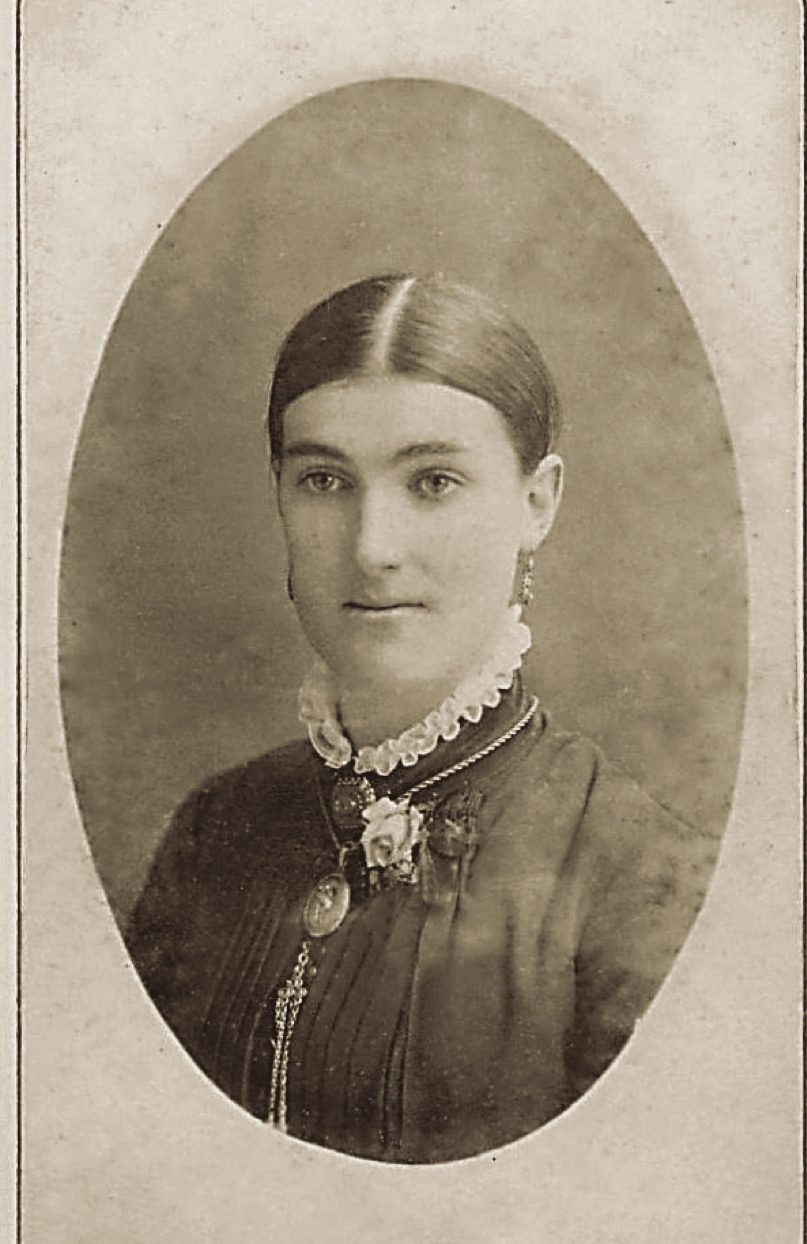
Matilda Jane, the eldest daughter of Walter and Mary, was born in Maryborough in 1856.
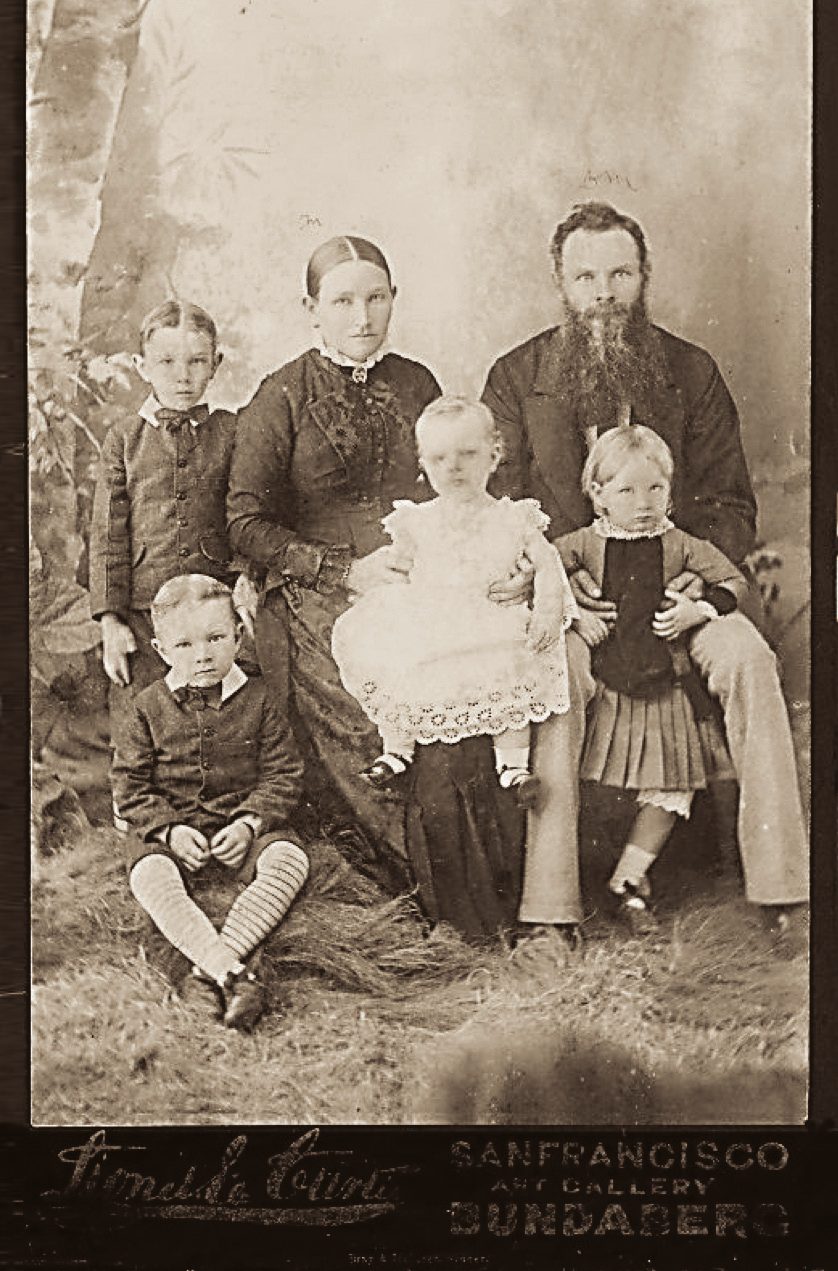
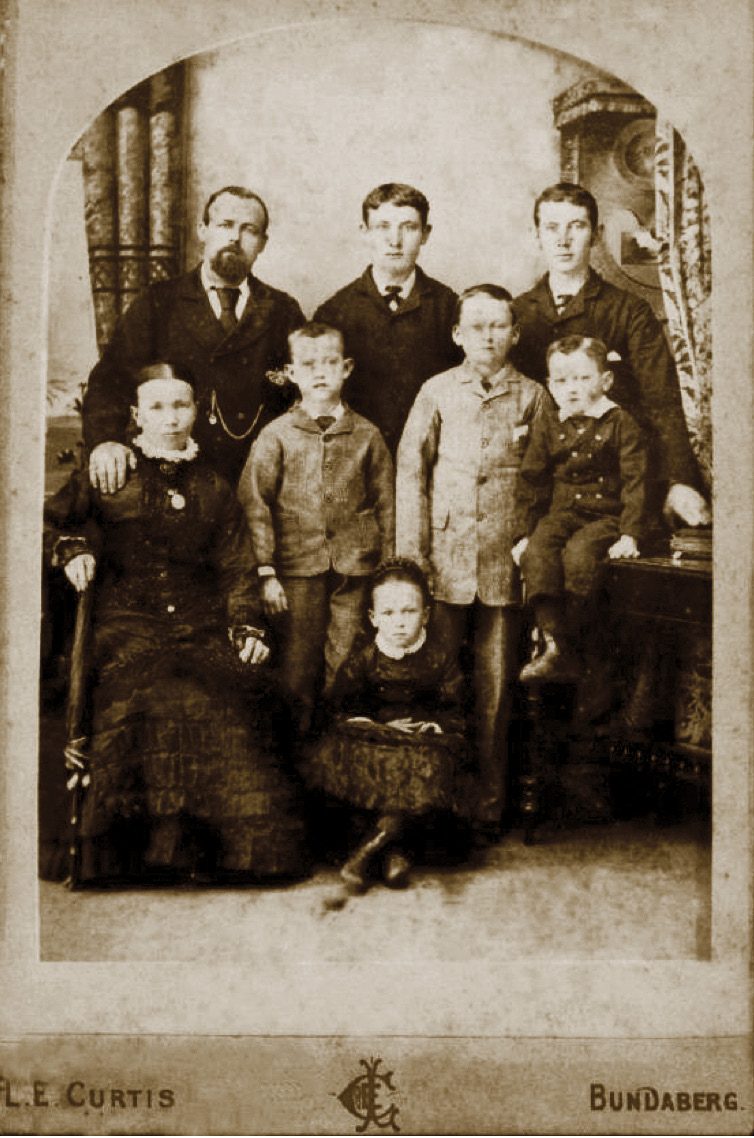
In 1880 she married Thomas Riedy, a native of Newmarket-on-Fergus, County Clare. They had five sons and six daughters, William Walter, George James, Thomas Reginald, Mary Winifred, Ellen Elizabeth, George Manus, Martin Aloysius, Matilda Gladys, Maria Florence, Annette Bridget, and Ann Muriel Thelma Adams. George James and Maria Florence Riedy died as infants.
No record has been found of Tom Riedy arriving in the colony. His obituary stated that he came to Australia in 1872 and that he obtained employment in the Williamstown sheep country of Victoria; however his arrival may have preceded this as he was probably in the Wide Bay-Burnett district by 1871 as, on the 26th August of that year, he selected via the Maryborough Lands Office, Lot 140 Portion No. 32 in the Parish of Kalkie. The selection consisted of 20 acres of agricultural land and 145 acres of 2nd class pastoral land which extended from the South bank of the Burnett. The lease was awarded on 14th September 1872 but residence only occurred from about November 1875. On inspection on 15th May 1876, a W. Maher, farmer and labourer, was resident on the land as Thomas’ Bailiff. Five acres of land had been cleared and planted to maize and two additional acres of scrub had been felled. A cottage of sawn pine consisted of two rooms, floored and shingled, and was in fair condition but was plainly furnished. He appeared on the Bundaberg electoral roll under the six month residency provision in 1876.
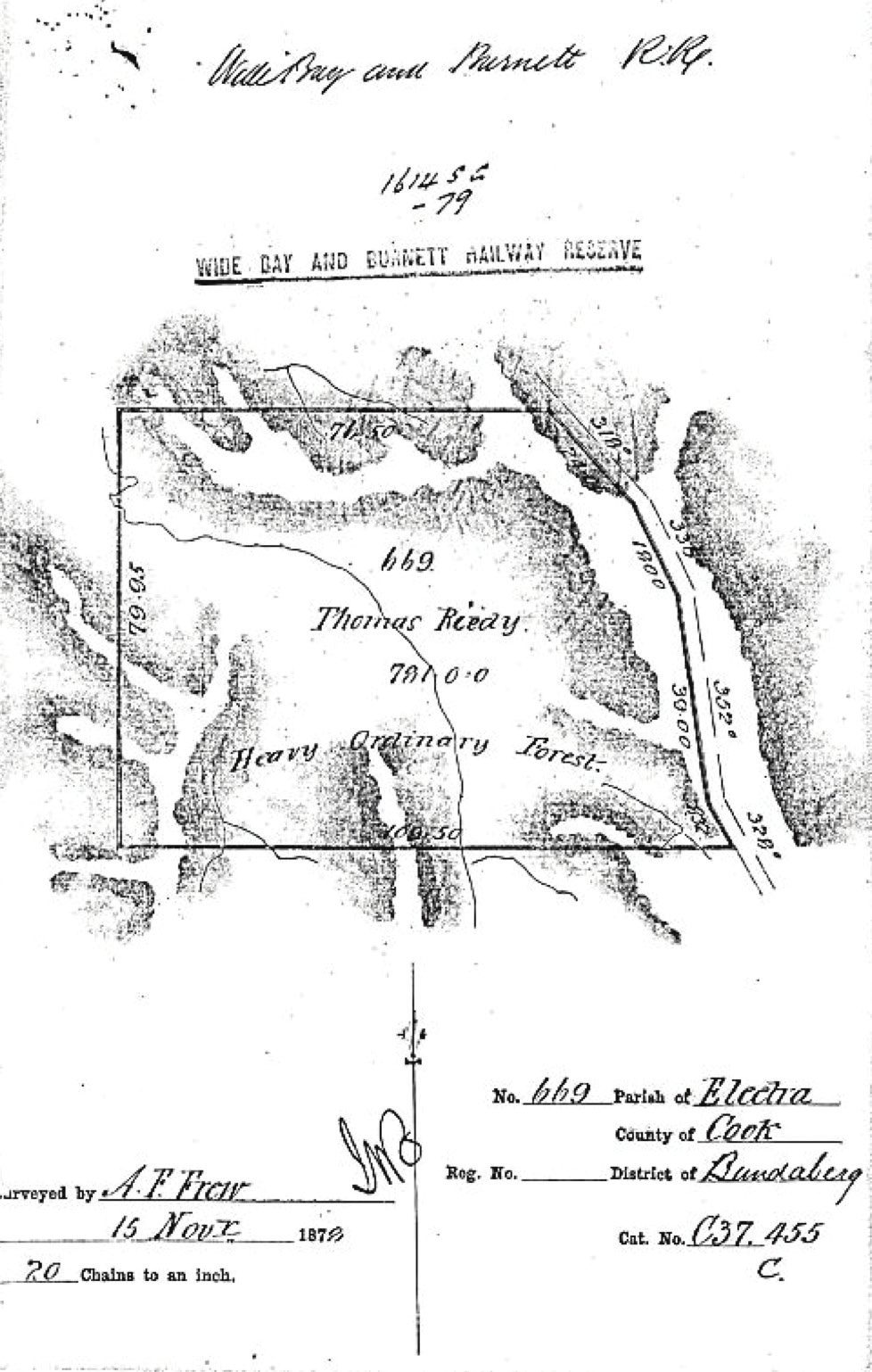
In the following year Thomas leased land at Rubyanna and on the 8th July 1878 he applied to select Lot 669 which was 781 acres in the Parish of Electra near Pine Creek. In June 1881 a Certificate of Compliance was granted on this property. However, it appears that Joseph Gillen, the same who had beaten Walter to the punch on the Symons’ Barolin property and who had returned in May 1884, following 16 months in the “Old Country”, held a mortgage on this property. (Appendix D1)
On the 25th November 1884 application was made to transfer the selection to Gillen but it was withdrawn on 13th October 1885. On 13th August 1887, however, the transfer from Thomas to Gillen was affected. Earlier, in 1873, Joseph and his brother John had been granted the first lease for a Government backed ferry service across the Burnett River. Joseph’s other claim to fame, or notoriety, was in being the only person fined over the “Battle of the Burnett”, a fracas in 1882 at the Queens Hotel over the arrival of coolies from Ceylon.
Thomas was also involved in the hotel industry and held licences for the West End Hotel, located on the corner of Quay and Tantitha Street, in 1880, the Sugarcane Hotel from 1881 to 1883 and the Star of the East Hotel in 1892 and 1894. By 1905 he was working in the Bundaberg district as a teamster. All his sons followed him into this occupation.
On the 22nd August 1906, Tom purchased at public auction two town allotments at Murgon. He gave his place of residence as Wondai so it is probable that at least some of the family had moved to that district before 1908 when Tom, Thomas Reginald and Mary Winifred appeared on the electoral roll as timber getter, teamster and milliner/ dressmaker respectively.
By 1910 Matilda Jane and the rest of the family had joined them. The year 1913 marked a significant development in the family. Matilda Jane, George Manus, Martin Aloysius and Ann Muriel Thelma Adams returned to Bundaberg. The Bundaberg and Upper Burnett branches of the Riedy family remain to this day.
Tom died at Wondai in November 1938, a month before his 93rd birthday. Matilda Jane had predeceased him by over 20 years. (Tom’s obituary – Appendix D2) The couple had been pioneers and pillars of the Catholic Church in Wondai and the high altar in St John the Baptist Church bears silent witness to the sacred memory of Matilda Jane.
The descendants of the two sons who remained in the Burnett also staked out different territories. Those of William Walter stayed at Wondai or moved only the short distance to Mondure. Those of Thomas Reginald moved further afield to Mundubbera, Durong, Proston and Boondoomba as well as Wooroonden and Mondure.
William Walter married Annie Hammelswang, a daughter of pioneers of the Childers/Gregory district. They had four sons and a daughter, William Walter Thomas, Eric Reginald James, Roy Eardly Adams, Leila Mary and Clarence George.
Thomas Reginald married Daisy Agnes Broom and no doubt establishing a useful contact for the family. Daisy was a grand-daughter of Thomas Broom, a pioneer of the Wide Bay and Gayndah districts who was renowned for the superior quality of his team bullocks. They also had four sons and a daughter, Cyril James, William Thomas, Arthur Reginald, Mary Matilda and George Herbert
During World War II, in May 1941, Arthur Reginald Riedy enlisted as a Private in 2/3 Pioneer Battalion. He embarked for overseas service in November 1941 and, therefore, would have been involved in the Battalion’s role in the capture of Finschhafen among other operations. Finschhafen was an air and naval base on the eastern end of the Huon Peninsula of New Guinea and the operation occurred in September and October of 1943. The unit probably returned to Australia for rest and retraining in March 1944 and in April 1945 the 2/3 Pioneers were to disembark at Morotai in the Moluccas.
On 1st May 1945 Tarakan, an island off the north eastern coast of Borneo, was invaded by an Australian brigade group, Oboe One Force, of nearly 12,000 men. Coulthard– Clark, publication year 2001, summarises the campaign. The operation was primarily intended to seize the airfield, which was needed to create a base for air and naval units supporting further operations against Japanese forces in Borneo, an objective not achieved since the airfield was found to be badly bomb cratered and waterlogged. When it was usable it was too late in the campaign to be relevant and the cost of the operation was not justified by the results. Gavin Long, publication year 1963, describes the action involving Arthur Riedy. On 7th May 1945 the 2/3rd advanced along John’s Track which followed the course of the Amal River.
... they met unexpectedly strong resistance. The leading platoon came under heavy fire just east of Pamusian; it attacked and one man was killed and the company commander, Captain R. L. Doman, and one other were wounded.
At 8.25 am on the 12th one of the fresh companies under Captain C. C. Knott attacked after heavy artillery and mortar fire. The objective was a long razor backed ridge sometimes only 3 feet wide on top and with almost sheer sides. It was covered with scrub and the bombardment had thrown in the path of the attackers a tangle of fallen limbs of trees; this not only impeded the advance but also improved the defenders´ field of fire. The leading platoon lead by Lieutenant Travers met concentrated fire but pressed on. Corporal Mackey’s section which was leading was under fire from three well sited positions at the top of an almost sheer rise. Mackey, accompanied by Lance Corporal Riedy, charged the first machine gun post, but slipped and fell into it. A Japanese soldier seized him but he struggled free, bayoneted the Japanese, and, with Riedy, killed the others in the post. Covered by Riedy’s fire, Mackey then charged another post with overhead cover containing a heavy machine-gun and threw a grenade through the firing slit, killing the gun’s crew. He then borrowed Riedy’s Owen gun and charged up a steep bank towards the third post, firing as he went. At the edge of the post he was hit and fell but not before he had silenced the enemy’s machine-gun. He had killed at least seven Japanese and taken three machine-gun posts. When Riedy saw Mackey fall he went forward to bring him out but found him dead. Riedy remained there firing at very close quarters until he was wounded.
Travers reorganised his platoon, in which every NCO had now been hit, and kept up heavy fire to help another platoon led by Sergeant Jones which was moving around the left. The platoon fought at close range for three hours and, when ordered to withdraw, only Travers and three others were occupying the position. Jones’ men, after struggling through fallen branches and thick undergrowth, came under converging fire and were forced back. It was now midday, the fight had lasted three hours and a half and 9 had been killed and 19 wounded – half the strength of the attacking forces.
The Japanese position was not finally taken until 14th May when Liberator aircraft, used in close support for the first time and with Lightning fighters dropping napalm immediately after the bombing, proved most effective.
For the action Corporal John Bernard Mackey was posthumously awarded the Victoria Cross and Lance Corporal Riedy was awarded the Distinguished Conduct Medal and promoted to Corporal.
Mary Winifred (May) bookkeeper, dressmaker, milliner and home maker, did not marry. Following the return of Matilda to Bundaberg May would have been the acting domestic anchor of the Riedy household.
Ellen Elizabeth married Bertram Robinson, an English migrant. Bertram gained a high reputation as a carpenter and builder in Brisbane. He worked on a number of public buildings including St. Stephen’s Cathedral. They had a daughter and a son, Joan Matilda Sophia and Brian Bertram. Joan married Patrick Edmund Kennedy who served in a Mobile Laundry and Decontamination Unit in the AIF. Brian, a schoolteacher, also enlisted in the AIF, initially in an anti-aircraft unit; however in 1945 he served as a Sergeant in a Special Personnel Group in Manilla, which was the base of MacArthur’s General Headquarters South West Pacific.
George Manus married Ivy Ann Selena Turner. They had two daughters, Shirley Matilda and Margaret Ellen (Nellie) and three sons, Ronald George, Max Thomas and Cyril James. Shirley married Ernest Arthur Ryan who served in the AIF. He was involved in the April-May 1945 build-up of Australian forces at Morotai. Nellie married George William Zeimer.
Martin Aloysius accompanied his youngest sister to the Dalby district on her appointment as a nurse to the local sanatorium. He died, unmarried, while working as a teamster in the Bunya Mountains.
Matilda Gladys married Charles Robert Desborough who worked as a clerk and accountant in Wondai, Yelarbon and Brisbane. Robert migrated with his parents, William and Elizabeth, on the s.s. Perthshire which departed London on 28th March 1912 and reached Brisbane on 2nd June 1912. They had three daughters, Lola Ursula Thelma, Gabrielle Matilda Annette and Marie Natalie Elizabeth (Molly). Lola married Edward Wann who served as a trooper in the 11th Light Horse, an AMF unit. Gabrielle, a schoolteacher, did not marry. She spent her later years in Bundaberg near her younger sister, Molly, who had married Charlie Golchert, a cane farmer descended from one of the early German families who came to Bundaberg to take up farming land in the Woongarra Scrub. Charlie served in AIF Transport Companies from 1941 to 1945.
Annette Bridget worked as a nurse in a number of areas of the State before marrying John Michael Winter of Ventry Station near Isisford. They had a son, John Michael Leonard.
Ann Muriel Thelma Adams worked as a psychiatric nurse at Dalby, Rockhampton and Goodna. She married Timothy Edward Taeffe, a clerk and shop-keeper who had served in the AMF during World War II. They had two daughters and a son, Noleen Thelma, June Mary Joan and Joseph Edward Leon.
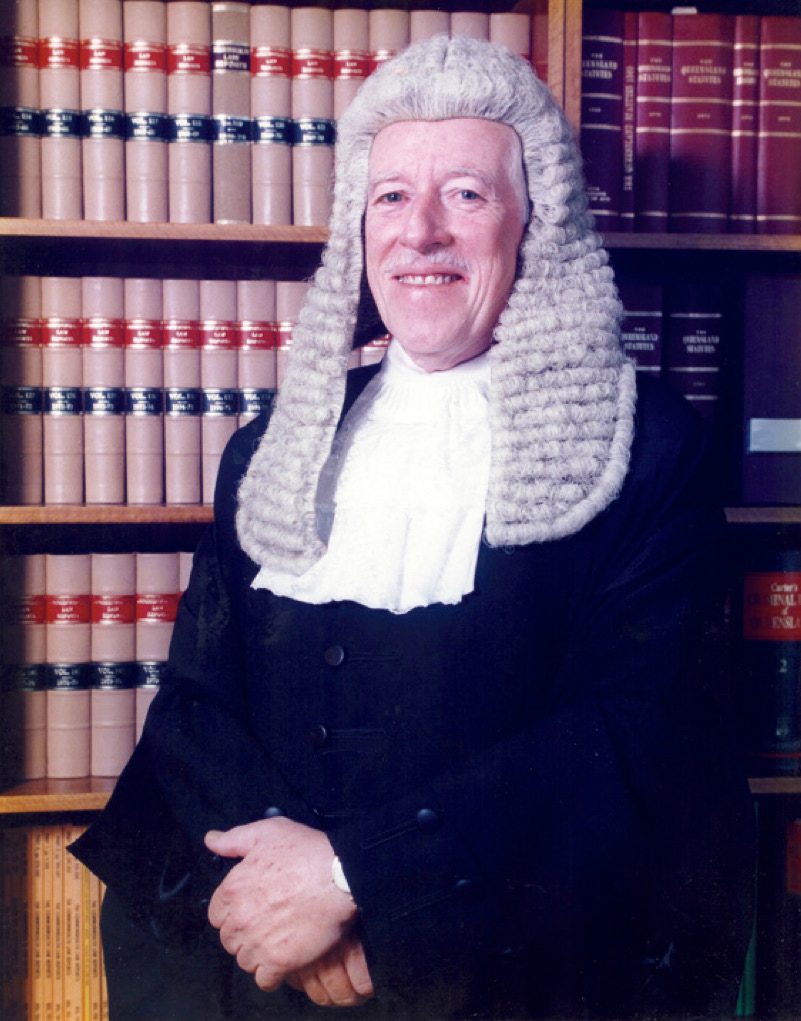
Leon Taeffe was a fine sportsman who achieved at cricket, rugby union and tennis. He graduated from teachers’ college and spent more than a decade as a primary school teacher, mostly at Mitchelton State School. He was admitted to the Bar in 1971 and in November 1995 he took silk as a Senior Counsel. It is said there was no fiercer sight than Leon in full flight during one of his many court appearances. As with many apparently hard men, Leon, underneath his veneer, was a generous and good humoured man (Oberhard - 2003). He died on May 11th 2003 at the age of 64 years.
Descendants of Tom and Matilda Riedy also bear surnames of Ballantyne, Boge, Bradley, Chard, Croft, Dierke, Draheim, Fleming, Fryer, Gadischke, Graham, Habermann, Hollett, Horan, Horne, Kitching, Kratzmann, Lange, Larsen, McInnes, McNichol, Mapp, Millgate, Parker, Peardon, Richardson, Sbresni, Schulz, Sempf, Southall, Spelta, Stayner, Stehbens, Thompson, Truebody, Waters and Watson.
The progress of the Riedy family reflects the changes in Queensland society over this period. Tom showed the versatility of the self-starters of his day before he and his sons turned to teamstering and the timber industry. The next generation farmed the land rather than harvesting its natural resource. A core of the recent generation has remained on the land but the majority have entered trades and professions.
APPENDIX D1
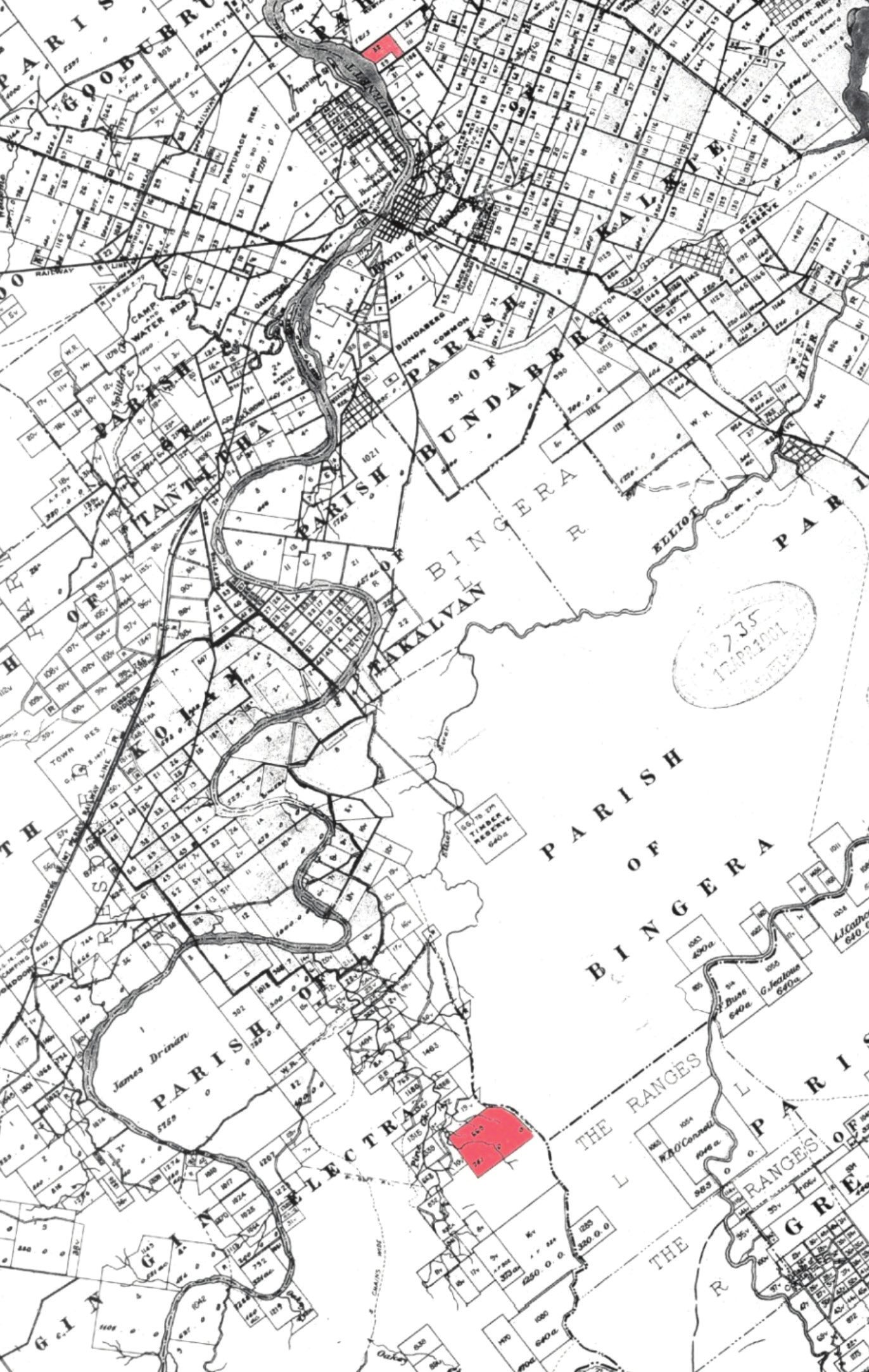
Thomas Riedy’s land holdings in the Bundaberg district
APPENDIX D2
OBITUARY OF MR. T. REIDY
November 1938
As briefly advised in last issue the land and active life of the oldest citizen of Wondai district came to an end on the night of Tuesday of last week, when Mr Thomas Reidy passed away peacefully in his sleep.
Born at Newmarket-on-Fergus, County Clare Ireland, in 1815, Mr. Reidy would next month have celebrated his 93rd birthday. In 1872 he came to Australia, first to Williamstown, Victoria. Always inclined towards the land, he obtained employment in the sheep country as a drover. Later he turned towards Queensland and eventually selected grazing land adjacent to Bundaberg, where he married Miss Matilda Jane Adams. At Bundaberg he became well established in the sawmilling and timber industry, besides becoming proprietor of two hotels.
A little over 30 years ago, with Mrs. Reidy and young family he came to this district, his pioneer activities and selection of land extending over the Wondai and Murgon areas. The timber industry again appealed to him and for a great many years - in fact right up to some three years ago when his age was 90 - he was known far and wide for his ability to handle a bullock team.
Three years ago he retired from regular work, taking up residence in Wondai with his daughter May, who accorded him devoted and patient attention in his declining years. On the night of his demise he had engaged in a game of cards and retired in usual good spirits but did not respond to the usual morning call from his daughter, to whom her sudden bereavement came as a great shock.
It is a coincidence of more than passing interest that the late Mr. G. P. Barber, ex MLA for Bundaberg, a close friend and with whose entry into Parliament Mr. Reidy was closely associated, passed away (aged 75) under exactly similar circumstances the preceding night in Brisbane.
Always an ardent churchman, the late Mr. Reidy was amongst those who established and erected the Roman Catholic Church at Wondai, his regular attendance at which was an integral part of his life, his and his daughter’s home being always open to, and the recognised headquarters in Wondai of, the RC clergy. The high altar in the church bears silent witness to the sacred memory of his wife, who predeceased him over 20 years ago.
There are three sons Willliam Walter (Wheatlands), Reginald Thomas (Woroonden), George Manus (Bundaberg), and five daughters Mrs. B. Robinson (Brisbane), Mrs. C. Desborough (Yelarbon), Mrs. J. Winter (Ventry Station), Mrs. E. Taeffe (Brisbane) and Miss M. Reidy - 24 grandchildren and two great-grandchildren. Also one brother - still living.
The funeral, which was largely attended, took place from St John the Baptist R.C. Church on Thursday afternoon to Wondai cemetery, Rev. Father Cullen conducting the services. F. H. Jones Pty Ltd had charge of the funeral arrangements.