Part Five Around the World in a Rather Short Time
Chapter 20
Oceania
We were the first that ever burst into that silent sea
AN OVERVIEW
In general usage the term Pacific Islander refers to the Melanesian, Micronesian and Polynesian – (Austronesian) inhabitants of Oceania.
THE MELANESIANS
From Queensland’s historical perspective the group of Pacific Islanders of most interest are the Melanesians. Whilst indented labour in Fiji was mostly of Indian origin the indented labour utilized in Queensland’s cane fields was drawn mainly, but not exclusively, from Oceania. The dominant sources of supply for this indented labour were the Melanesian populations of the Loyalty Islands, New Caledonia, New Hebrides and the Solomon Islands.
The Melanesians were early arrivals in this very extensive region and their main areas of occupation are now the island of East (Papua) and West New Guinea, Torres Strait, the Admiralty and Bougainville Islands, the Bismarck and Louisiade Archipelagos, the Solomon Islands, New Caledonia and the Loyalty Islands, Vanuatu and Fiji; while the Micronesians are to be found in Kiribati, Guam, Nauru, the Northern Marianas, the Marshall Islands, Palau and in the Caroline Islands. The Melanesians were probably also the original inhabitants of the Celebes, Borneo, Java and Sumatra before complete replacement by invaders from Southern China.
The Melanesians are the ancestors of the Papuan speaking peoples and their early migrations spread at least as far as the Solomon and Fijian Islands. Limited interaction occurred between these peoples and the later migrating Austronesian speaking people, commencing from about 1600 B.C. This interaction occurred in pockets along the northern coast of New Guinea, and in particular on the islets adjacent to the larger islands of the Bismarck Archipelago.
A migration that preceded the Austronesian expansion, and which had some interaction with the Melanesian peoples was that of the Lapita pottery making peoples whose migration routes led them to populate the very extensive maritime area to the east of New Guinea in the western and southern expanses of the Pacific Ocean. Their expansion into the Bismarck Archipelago resulted in the creation of pottery in the area which has been dated from about 1,350 B.C. Lapita artefacts have also been unearthed in locations as far removed as Fiji (from about 1,150 B.C.), Samoa, Tonga, Vanuatu and New Caledonia (from about 1,000 to 800 B.C.), The Lapita culture appears to have gone into terminal decline over the period 250 to 0 B.C.
NEW CALEDONIA
New Caledonia is located in the sub-region of Melanesia in the south-west Pacific approximately 1,200 kilometres east of Australia. It is comprised of the main island Grande Terre, the Loyalty Islands to the east, the Isle of Pines to the south and the Chesterfield Islands and Bellona Reefs to the west. It is said that the rugged coastline of the islands reminded Captain James Cook of the western coastline of Scotland (In Latin ‘Caledonia’) when he sighted it in 1774 and hence the name became New Caledonia or New Scotland.
The populations of these various islands consist mainly of Melanesian peoples. At a considerably later time Polynesian seafarers arrived and mixed into the general populations.
The first European arrivals in New Caledonia were whalers and sandalwood traders but the supply of sandalwood diminished and some of these traders became troublesome. Here as elsewhere new arrivals brought new diseases to which the original populations had little or no immunity and many of the islanders succumbed. As a result of this, and of other sources of friction, there resulted a commencement of hostilities and, perhaps as a result, the crew of the American ship, Cutter was killed and eaten by the Pouma tribe.
French missionaries started to arrive in New Caledonia in 1843 and Napoleon III, in an attempt to copy the British colonization of Australia and New Zealand, had France claim the islands. This claim was withdrawn following British objections. However in 1851 a French landing party was attacked by the native islanders at Balade and only one of the French party survived the subsequent massacre. A formal annexation by France ensued and, in 1853, Auguste Despointes’ expedition raised the French flag at the location of the massacre.
In the following year France established Port de France (now Noumea) as its capital and, following the British example, established a prison colony for criminals and political prisoners. There was a serious native uprising in 1878, and the following 1881 rising was only put down after considerable bloodshed. Subsequent to this the infusion of European settlers (including former convicts) and Asian workers, in combination with a decline in the islander population from introduced diseases, all but eliminated the potential for further insurrections.
THE SOLOMON ISLANDS
The first known European to land in the Solomon Islands was Alvaro de Mendena in 1568. European missionaries and some settlers arrived during the 18th and 19th centuries, with the German New Guinea Company assuming control of the north in 1885. The control of the southern islands came into British hands when they became a protectorate in 1893 and the eastern islands were rolled into this protectorate in 1898. Subsequently, in 1900, in an exchange of territorial responsibility, Germany surrendered the control of the northern islands to Britain in exchange for a British withdrawal from West Samoa. The Solomon Islands have had independence since 1978.
FIJI
The Lapita peoples are thought to be the first migrants to arrive in Fiji, possibly as early as 1,500 B.C., with the arrival of the now dominant Melanesian people being much later, in around 500 B.C. Burials discovered near Sigatoka were accompanied by pottery of the characteristic Lapita style originating from the north of New Guinea which is at least 3,000 years old. The Sigatoka burials were also accompanied by obsidian originating from the island of New Britain. New Britain is located a distance of 4,500 kilometres from the Fijian Islands and, although this glass like volcanic rock is known to have been transported throughout the Western Pacific by the Lapita seafarers its occurrence does not appear to be common in Fiji.
Other burials, accompanied by pottery whose designs were characteristic of that of the Lapita people of northern Papua New Guinea and of the Solomon Islands of about 550 B.C., were discovered at Bourewa, Fiji in 2005.
In the tenth century A.D. Fiji came within the sphere of the Tongan Tu’I Empire and this introduced some of the Polynesian language and customs to Fiji. However this Tongan influence was to go into decline in the thirteenth century. The later Polynesian invasion of Fiji that occurred in 1847 may have been prompted in part by memories of this earlier occupation.
A heavily fortified battle fort that had been occupied between 1250 and 1560 has been discovered at Kuku in Nausori and it contained some surprising discoveries, such as an iron axe that must have been supplied by contact with very early European traders. Could this contact have initiated an epidemic that contributed to the weakening of the Tu’I Empire’s hold on Fiji?
Tribal warfare was the norm in Fiji as it was elsewhere in the Pacific, and even today reminders of these wars can be found in the leg bones of defeated adversaries that have been set in the expanding forks of what were then saplings to be secured so that posterity could view the results of the victor’s triumph, permanently fixed in the now mature trees.
In 1822 European settlement was established at Levuka, in 1830 by Methodist missionaries William Cross and David Cargill. They were accompanied to Levuka by emissaries from the Tongan high chief and by a Fijian convert.
The Fijian chief of Viwa, Ratu Ravisa (Varani), was converted by the ministry of the Reverend John Hunt. Varani was subsequently to have considerable significance as a Fijian missionary where he acted as an effective counterbalance to the leading Fijian war-chief Ratu Seru Cakobau. In 1847 Prince Enele Ma’afu of Tonga invaded and, in 1848, set himself up in Lakeba.
The warlord Ratu Seru Epenisa Cakobau was installed as the Paramount Chief of Bau and adopted the title King of Fiji in 1853. On having to face a Tongan army led by Taufa’ahau, and the aforementioned Ma’afu in 1854, he acted to secure the unifying forces of Christianity
- together with its western influence – by his conversion to the Methodist persuasion. As a consequence the Methodist influence in Fiji has remained very strong, even up to the present time. In the following year Cakobau overcame the Rewa revolt and its leader, Mara, was executed in 1859.
In 1840 the first American expedition to Fiji took place under the leadership of Captain Charles Wilkes. In 1849 the store of settlertrader, and United States Consul, John Brown Williams was destroyed by stray cannon fire and looted by the natives. The United States Navy appeared upon the scene and demanded 5,000 United States dollars to compensate for Williams’ losses.
The home of the accident prone John Brown Williams was again destroyed, this time by an arson attack that took place in 1855 and another visit by a United States warship ensued. This time 44,000 in United States dollars compensation was demanded. Following still another unfriendly visit by a U.S. warship in 1858, Ratu Seru Cakobau offered to cede the islands to Britain for 40,000 United States dollars, an offer that was not accepted. Yet another American warship was to arrive in 1867 threatening to bombard Levuka.
Following Cakobau’s installation as Paramount Chief under, a confederacy of Fijian chiefs, the Polynesian Company of Australia offered to pay his debts and to assist in the formation of a constitutional monarchy, nominally under King Cakobau, but with the Legislature and its Cabinet under the domination of Australian settlers. Serious government overspending was to follow and a government official again offered to cede the Fijian Islands to Britain. This time the offer was accepted and so, on the 10th October 1874, Fiji became part of the British Colonial Empire.
In 1875 a disaster that has unfortunately, proven to be only too common when the initial contact or merging of a mobile population with an isolated one occurred, and a deadly measles outbreak killed one-third of the susceptible Fijian population.
The year 1879 marked the commencement of the recruitment of indentured Indian labour, and Fiji’s first major sugar mill was constructed at Nausori two years later. This was the start of one of Fiji’s major industries; sugar production had arrived and the Colonial Sugar Company was to become of great commercial significance to the island colony. In 1882 the colony’s capital was moved from Levuka to its present location in Suva.
THE OCEANIC POLYNESIANS
Polynesian maritime migrations have resulted in a very wide population distribution spreading eastwards across the Pacific Ocean. In the Pacific the main Polynesian centres of population occur (loosely listing the islands from west to east) in the Tuvalu, Wallis & Futuna Islands, Tonga, the Samoan Islands, Tokelau, Niue, the Cook Islands, French Polynesia (which harbours the historically significant Tahiti), Easter and Pitcairn Islands and the Hawaiian Islands.
The most southerly islands, those of New Zealand also form part of this grouping being the second last of the islands to be colonized
- in 1100 A.D., some one hundred years after Samoa. It is possible that this late discovery was a consequence of the Polynesians’ navigational technology which was best adapted to equatorial sea-travel. Their last colonization, by the Moriori tribal group, probably occurred in about 1400 A.D. and was of the Chatham Islands, 900 kilometres to the east of Christchurch. By the end of the 18th century the Moriori – who are now extinct – had an estimated population of about 2,000 persons.
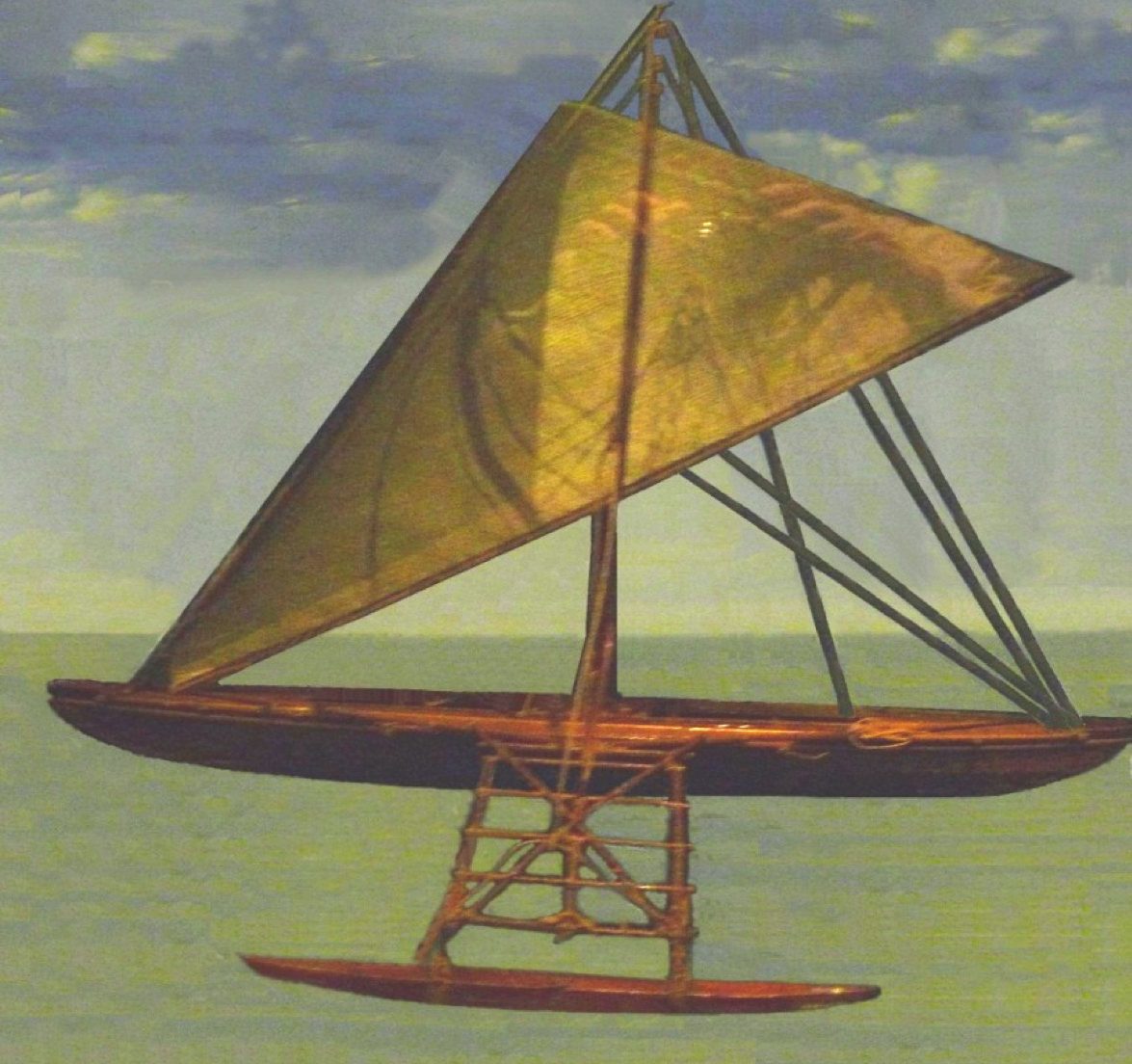
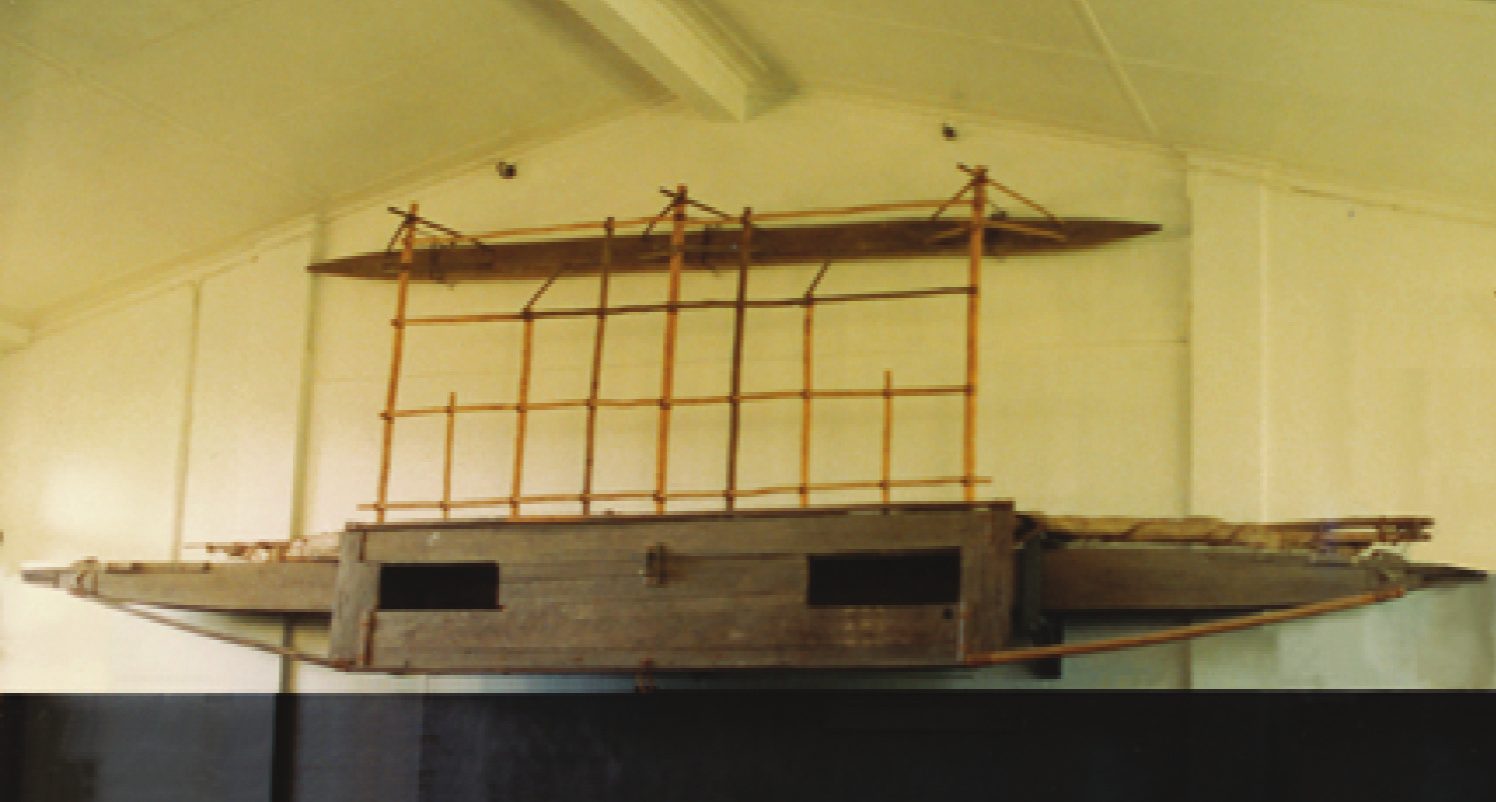
The forebears of the people who were to become the Polynesians originally derived from southern China via what is now called Taiwan. Their original seafaring skills were almost certainly developed by their to and fro crossings of the straight between Taiwan and the mainland. They were by far the greatest seafarers of the Neolithic period, and their development of the outrigger canoe was the technology that helped to drive their population expansion, with its very extensive areal extent.
This dual (sometimes triple) hulled craft was probably not dissimilar to the crafts used by our ancient Celtic ancestors to cross the narrow straight between Northern Ireland and the west coast of Scotland. However, while the Europeans were to develop the planked monohull for ocean going sea transportation, the Polynesians successfully adapted the outrigger canoe for this purpose. In all cases the main hull of the canoe which, in the case of the Polynesian craft and of the Torres Strait craft from the boat builders of the Sepik River, could be of a very considerable size. This hull was hollowed out using fire and adze from a single tree trunk.
From about 3500 B.C. the early Polynesian expansion progressed through the Malay Archipelago and the Philippines, replacing the original hunter-gatherer populations in the process. These early hunter-gatherers are thought to have occupied the islands of Indonesia for at least the previous one million years.
Elsewhere the Polynesian expansion was successfully resisted by the resident Melanesian populations and today the New Guinea Highlanders are almost entirely of Melanesian descent, while the occupants of the Solomon and Bismarck Islands are approximately eighty-five per cent Melanesian and fifteen per cent Polynesian.
The Polynesian migration along the Indonesian archipelago was to occur much later than the southern migration of the Australian aboriginal peoples which is believed to have taken place about 50,000 years earlier.
NEW ZEALAND
Upon their arrival in New Zealand the Maori, of Polynesian origin, had the very large, flightless native birds of the islands as a meat source. The extinction of these birds left dolphins and whales (and tribal warfare) as their remaining meat source. The Maori were expert fishermen and in the south island the harvesting of penguins and seals was practiced as was the hunting of mutton-birds in the far south during this bird’s annual migration. The roots of ferns were harvested and tenderized by pulverizing while seasonal berries and spinach like vegetables were also available.
Maori men were capable and dedicated warriors who both manufactured and utilized beautifully crafted spears and clubs which often incorporated greenstone or jade ornamentation. There was frequent intertribal warfare both before and after European contact and fortified villages were constructed in strategic locations as a means of protection. A series of trenches and stockades would be constructed around a hill site, somewhat reminiscent of the iron-age forts of Britain.
Abel Tasman, in 1642, was the first European known to view New Zealand. However his attempt to contact the Maori resulted in the death of four of his men in a skirmish and he abandoned any further attempts at contact. Captain James Cook, as part of his voyage to Tahiti to observe the transit of Venus in 1769 and to search for the Great South Land, first observed the New Zealand coastline near the present Gisborne. His men gathered a large volume of information about both the North and South Islands during his circumnavigation of these islands. He was to visit the New Zealand islands twice more before being killed by the natives on a Hawaiian beach in 1779.
By 1840 there were about 100,000 Maori and 2,000 Europeans in New Zealand. The European population consisted mainly of whalers, sealers and missionaries and was confined largely to the Bay of Islands and other coastal areas. From about this time the availability of traded guns, and the introduction of diseases for which the Maori had no immunity, established the basis for a rapid population decline. The Ngapuki tribe acquired traded muskets about 1818 and for the next fifteen years the Musket Wars determined the subjugation of musket-less tribes by the tribes with access to the firearm. This ensured that, by 1833, all surviving tribes owned muskets.
Another tragedy was to follow the return to the north island of New Zealand of a seal hunting ship after its visit to the Chatham Islands. The crew described islands of plenty where the natives knew nothing of fighting. A war party of 500 Maori armed with guns, clubs and axes set out and arrived at the Chathams on the 19th November 1835, followed by a second contingent of 400 warriors on the 5th of December. The Chatham Islanders were told that they were now slaves and a slaughter commenced. A Maori warrior later described the event. “We took possession – in accordance with our customs – we caught all the people. Not one escaped. Some ran away from us, these we killed, and others we killed – but what of that. It was in accordance with our custom.” (Diamond) In the first few days following the attack it was reported that they killed hundreds of Moriori, cooking and eating many of the bodies.
It needs to be remembered that, before becoming too critical of the Maori and other Pacific Ocean tribes for this and similar incidents, that some of the customs of our not too distant English and Celtic forebears also left a great deal to be desired. It appears to be an almost universal constant that a member of a clan or tribe is likely to have little or no regard for the rights of members of other clans or tribes. The bleak picture painted by the trauma and loss of life experienced during the course of nation building in countries such as England, Ireland and Scotland, and more latterly the United States of America, seems to indicate that mankind has not yet developed an elegant or non-violent method to break down the clan or tribal structures – however judging by experience up to the present time it would appear necessary to break down these structures wherever a viable nation is to be created.
In 1833 the British government appointed a British Resident to New Zealand, as a response to increasing lawlessness between settlers and traders, and in 1835 it signed a Declaration of Independence with northern Maori chieftains. However the lawlessness increased and questionable land sales were common so, in 1840, Captain William Hobson was sent to New Zealand as Lieutenant-Governor to acquire Sovereignty of New Zealand by means of a treaty.
This treaty, the Treaty of Waitangi , was drafted in both English and Maori versions each containing three articles. It was signed in February 1840 by the northern chiefs and over the following eight months it was circulated throughout the country making it possible for five hundred chiefs to eventually sign. However the differing versions were capable of differing interpretations and herein lay the foundation for future disputation.
Following the signing of this treaty, and with New Zealand now becoming an English colony, approximately 40,000 new immigrants were to arrive and by 1858 the population of Maori and immigrant were near equality. Even more immigrants of English, Scottish, Irish and Chinese descent were to arrive in the South Island during the gold rush of the 1860’s.
With increasing pressure on land ownership, and with problems arising from the ambiguities of the Treaty of Waitangi , skirmishes with the Maori escalated into war. This commenced in the north of the country by the mid 1840’s and in the remainder of the country by the 1860’s. The weight of numbers eventually brought about the defeat of the Maori fighters. However the war was far from one sided with the Maori military engineers often providing superior technology to those of the colonial forces. It has been claimed that it was the Maori who taught the basics of trench warfare to the British army during the course of these Maori Wars
OTHER POLYNESIAN ISLANDS
The more easterly islands such as those of Hawaii and French Polynesia, while of great significance to the voyages of Captain James Cook, had little practical influence on the Queensland history of the mid 1800’s and will not be considered further.
CONCLUSION
From the above it follows that, compared with the situations prevailing in the major part of what is now referred to as the western world and in Oceania, the embryonic Bundaberg in the colony of Queensland could be regarded as a haven of peace and tranquillity. Its attraction now becomes obvious.
As to the question, who would prefer to settle in an undeveloped patch of open eucalypt forest on the south bank of the Burnett River one hundred miles from nowhere rather than dwell back in the ‘civilised’ world of the time? – Well I would for one!
BIBLIOGRAPHY
Guns, Germs and Steel - the Fates of Human Societies, Diamond, Jared, W. W. Norton and Company, 1997
The Decade of Reform - The 1830s, Llewellyn, Alexander, David and Charles Publishers Ltd., 1972
An Illustrated History of Ireland From AD 400 to 1800, Cusack, Mary Frances, Bracken Books London, 1868 – reprinted 1996.
The Reign of George III 1760 – 1815 , Watson, J. Steven, Butler and Tanner Ltd, Frome, Somerset for Oxford University Press, 1960
<britainexpress.com> The Corn Laws
<newzealand.com> New Zealand
Wikipedia the free encyclopedia European Potato Famine
Wikipedia the free encyclopedia Industrial Revolution Social Effects
Wikipedia the free encyclopedia Battle of the Boyne
Wikipedia the free encyclopedia Great Famine (Ireland)
Wikipedia the free encyclopedia Highland Potato Famine
Wikipedia the free encyclopedia Highland Clearances
Wikipedia the free encyclopedia Pacific Islander
Wikipedia the free encyclopedia New Caledonia
Wikipedia the free encyclopedia History of Fiji
Wikipedia the free encyclopedia Lapita
Wikipedia the free encyclopedia Britannica, 15th Edition, 1978.