Introduction
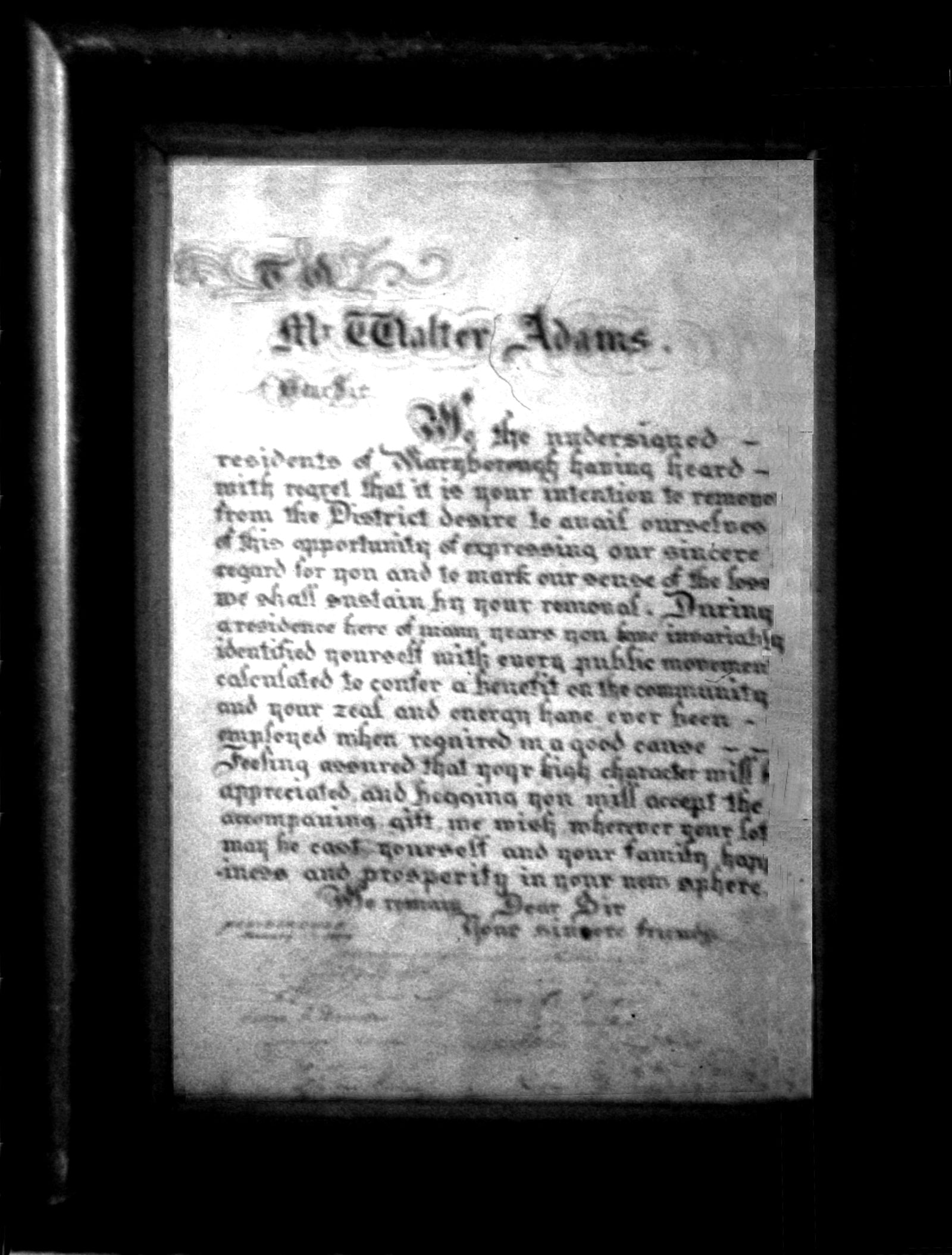
The genesis of this book coincided with a re-reading of the Maryborough Chronicle’s description of Mr. Robert Travis’s presentation speech to Walter Adams on his family’s 1871 departure from Maryborough to their new home in Bundaberg. In the presence of some of Maryborough’s leading dignitaries, and on behalf of its townspeople, Mr. Travis’s speech - in part – proclaimed: “To Mr. Walter Adams, We, the undersigned, residents of Maryborough ----------. During a residence here of many years you have invariably identified yourself with every public movement calculated to confer a benefit on the community, and your zeal and energy have ever been employed, when required, in a good cause.”
“----- you have invariably identified yourself with every public movement calculated to confer a benefit on the community, and -----.” It was the words “every public movement” that caught my eye. Even a very conservative interpretation of the word “every” would translate to ‘many’ or, more probably, ‘most’. This raised the immediate question - if Walter Adams was in attendance at “every public movement” in the early stages of Maryborough’s development would he not be just as active, or perhaps even more so, in his new location following the transfer of his family to a district that was only then in the process of constructing its first domestic residence? And if so, might it not be rewarding to investigate this proposition as it may be possible to produce a word picture that, in some measure, encapsulates a feeling for the motivations and activities that helped produce, over time, the Lower Mary and Lower Burnett regional development that we are familiar with today and that gives an insight into the living conditions of the early settlers? Further research indicated that the answers to these questions were – ‘yes he was’ and ‘yes it certainly would’.
In Walter’s response to the speech of Mr. Travis he was to make the acute observation that: “The interests of Bundaberg, where I mean to dwell, and Maryborough, from which I am about to depart, are, and I hope ever will be, nearly identical.” This comment has been given considerable weight and its significance, along with Mr. Travis’s comment above, is reflected in the selection of material included in the following pages. A study of the available records detailing Walter Adams’s attainment of practical experience in the promotion of a district’s growth and cultural advancement, and of his later activities in the pursuit of civic development, resulted in the compilation of a very comprehensive volume of material detailing the critical, early stages of development both in Maryborough and in Bundaberg over the period prior to May 1892. To this compilation can be added some personal knowledge on the subject obtained directly from recollections of family discussions.
The details of Walter’s career path therefore presented a very convenient timeline into which the sequence of events that had collectively driven Maryborough and Bundaberg’s early civic and economic development could be merged. Consequently, I have chosen to utilize Walter Adams’s career as the framework on which to attach the record of the historical events described in the following work. Here serendipity had taken a hand, as further research revealed that there were few other citizens of Bundaberg who were continually active in the civic area; who had arrived there in the late 1860’s to early 1870’s; and who had maintained a continuous residence over the period up to and including the early 1890’s.
Just as a description of the career of Walter Adams is intimately linked to the settlement and early rural and civic development of the Lower Mary and Burnett districts the linking of the careers of other early settlers such as Henry Ford, William Southerden, John Cathcart or Fredrick Buss to the area of retail store establishment, Thomas Child and the Crans to heavy industry or of Alexander Walker and the Young and Gibson families to pastoral and agricultural development would, I am sure, also be rewarding. Owing to advancing years such worthwhile projects must remain the province of future researchers.
Other than the information obtained from family sources the material contained in the following text is derived mainly from newspaper articles of the nineteenth century. Unfortunately the greater bulk of the relevant articles, as originally included in the editions of the Bundaberg and Mount Perry Mail, the Star and the other newspapers of the Lower Burnett District are no longer readily available, if they exist at all, and so the context of articles originating in these publications has been derived, in the main, from copies of these articles that were reproduced in the metropolitan newspapers.
The public access section of the National Library of Australia’s Trove service has been a very helpful, though time demanding, source of the information as preserved in the following newspapers’ archives: the Maryborough Chronicle Wide Bay and Burnett Advertiser, Queensland Figaro and Punch, Queensland Figaro, the Brisbane Courier, the Courier, the Moreton Bay Courier, the North Australian, and others. Their articles augment the much more limited amount of material residing in the family retained copies of the Bundaberg and Mount Perry Mail and the Bundaberg Star. The archival material contained in the newspapers that were scanned to produce the Trove library includes, given its very nature, sometimes archaic fonts and uneven quality of reproduction. These tend to produce optical character recognition (O.C.R.) reproduction of a variable nature, sometimes of a low legibility. Any resultant gaps have been filled, hopefully with an acceptable degree of accuracy, from information derived elsewhere. When this information is not available there may be mistakes, particularly with unverifiable names and other proper nouns, as these have been included in their original scanned form. Where an article has been reproduced in the wording of the original text it is intended that this be made clear though, to avoid confusion, there may be a change of tense from present to past in some instances.
There are many newspaper articles, both in the Trove collection and elsewhere, describing the Queensland parliamentary debates in which Walter had participated and, in this regard, I still retain Walter’s parliamentary volumes of the Queensland Colonial Government in my own library. I tend to find the wordiness of these parliamentary debates rather inhibiting and have largely exercised the lazy option in this area. However, whilst in our colonial past there was no federal government to further complicate matters. Bundaberg and district were still influenced, sometimes quite markedly, by the actions (or inactions) of the Queensland Colonial Government. It follows that the text contains some details of the colony’s parliamentary activities where these activities have had a significant impact upon the development of Maryborough, Bundaberg and of the Wide Bay district in general.
It became clear that Walter’s activities in the public domain, at least from the late 1860’s onwards, would have been difficult not to notice due to his widespread involvement in the agricultural, infrastructure and civic areas. From his April 1872 arrival in Bundaberg to the close of 1874, less than two years later, Walter and associates had surveyed and cleared the Bundaberg race course and he had independently contracted to undertake the initial works on the town’s most trafficked roads, the construction of a Bundaberg to Bingera road and the clearing for and construction of the telegraph line from the township to the pilot station at Burnett Heads. Over the same period he had, with the able assistance of Mary and family, a household to establish in a new town, a hotel to acquire and run, land selections to clear and render productive, the first bridge for public usage in Bundaberg to construct (under his own initiative), a Progress Committee and a School of Arts Committee to help set up and a major role to play in the acquisition of public reserves - these being only the items that come readily to mind.
However the following text is by no means all about Walter Adams as by far the greater part of the material is intended to give descriptions of, and provide some insight into and feeling for, the public events, commerce, living conditions, tribulations and challenges, both of a physical and political nature, encountered by our pioneers in establishing the viable colony, soon to become a state, in the virgin Australian bush. Even descriptions of river flooding, while telling of individual hardships experienced, can also provide useful indications as to the current state of a town’s development when reporting upon the businesses and individuals that had provided support to those afflicted or had themselves sustained serious flood damage.
In these days of cellular telephones, internet connections, all pervading government services and low church attendances it is difficult to comprehend the magnitude of the influence that the various religious institutions played in the lives of very significant portions of the early settler populations. The importance of these institutions to the pioneering settlers lay in their provision of social contacts, family support and, in some cases, the secular education that they provided. All of this was in addition to their well-attended religious functions and hence the lifestyles of the church going settlers cannot be fully envisaged without consideration of the activities and the influence of the religious institutions of their day. In a like manner the importance of public libraries to those early populations should not be underestimated as, in those days, there was no radio, picture theatres, television or internet. The interaction between the Irish Catholic and Protestant immigrants in the field of politics was also of a magnitude that cannot be ignored when considering early colonial governance.
A consequence of Walter’s propensity to be on the scene whenever significant civic activity was taking place is that a record of his activities tends to provide an insight into contemporary civic activity over a very significant period of Maryborough’s early development as a municipality and of Bundaberg’s first twenty years of development, from a scattering of eucalypts on the Burnett River bank to a ‘thriving community’. Application of the experience that Walter had acquired, as Chairman of the Maryborough Town Council’s Works Committee, was to make a very valuable contribution to development in the Bundaberg district. The great American revolutionary and diplomat John Adams has been described by the historian James Grant as being, “Too plain spoken for diplomacy and too honest for politics.” This description would have fitted Walter down to a ‘T’.
Account must also be taken of the considerable number of early pioneers, many being Walter’s associates, whose names appear in these pages and who, by becoming members of local committees or by adopting other means of collaboration, were to initiate the individual developmental projects that, taken collectively, were to make towns such as Maryborough and Bundaberg such prosperous and liveable locations. A significant number of the Bundaberg pioneers had, like Walter, migrated from the Maryborough district, retaining the practical knowledge derived from their previous experiences. Such people as the Palmers, the Crans, Charles Faulkner, the Noakes brothers, John Cathcart, William Southerden, George Greathead, Edward Tanner and others were to play very significant roles in Bundaberg’s early development. It is obvious that the major civic advancements in Maryborough, Bundaberg, and no doubt most other townships of the colony were not normally the results of spectacular happenings or of major events but resulted from the assembly and rational decision making of such citizens, largely at the local level.
Walter and his associates tend to emerge from these pages as distinct, interacting individuals; significantly more so than an unadorned description of the district’s activities and achievements would normally project. Some examples of Walter’s often mentioned generosity to those in adversity are detailed and his inquiring mind made him, amongst other things, a one man nineteenth century version of the C.S.I.R.O. and Department of Primary Industries combined. Examples of his relentless drive to nurture the colony’s - and particularly the Lower Mary and Burnett Districts’ - development are exemplified by his early experiments with sugarcane in Maryborough (when there were no crushing mills) and his importation of seed-wheat for trial by farmers in the Bundaberg district. This was in combination with his trial cultivation, harvesting and selling of arrowroot, potato, cabbage, banana, cotton, maize, sugarcane and other crops, together with the dissemination of information about the crop’s growth, harvesting and financial returns to the local agricultural organizations and in his enthusiasm to enter representative samples of the local produce in international trade fairs.
His championing in Parliament of the spirituous liquor, rum, as a snake-bite antidote although almost certainly made somewhat tongue in cheek in defence of the then brand-new Bundaberg rum distillery may have reflections in the activities of some of his descendants. Family descriptions of grand-uncle Jim come to mind and I, and my old engineering survey associate Tony Coutts, would never set out to work in such remote areas as the Gulf Country, Cape York or the Torres Strait without the inclusion of a bottle of Captain Morgan Jamaican Rum in our provisions. (If not needed for medicinal purposes it goes rather well with the juice of a green coconut.) In later times my brother John and I would not venture forth into the bush or desert without our protective supply of Bundaberg Rum. And wouldn’t it be great to know where to purchase bottles of Warner’s SafeCure for torpid livers and kidneys, given the ringing endorsement of the product by Walter and many other prominent citizens.
In writing on the establishment of a successful and permanent agricultural settlement, such as Bundaberg had become by the early 1890’s, it is helpful to consider elements that can be clearly defined and quantified and I have therefore chosen to consider the following items:
Distinctive, enduring and readily observable works and edifices of a pubic, private or clerical nature;
The establishment of co-operative committees and organizations civic, industrial and governmental to achieve common goals; and
The industries that did the most to promote the settlement’s early development.
These items are given the most weight in the subsequent text when describing a district’s physical and cultural development.
By the very nature of the circumstances under which this development occurred there will be no descriptions of earth-shattering events; instead successful civic, clerical and cultural improvements require such qualities as those mentioned below to be held by the more effective participants in the gatherings as described in the preceding paragraphs. These desirable attributes would include such qualities as:
integrity, patience and persistence;
a willingness to co-operate;
the ability to persuade and to balance competing interests;
the skill to negotiate compromises where the attainment of one particular outcome is not vital;
the ability to achieve conflict resolutions;
the confidence to address public gatherings;
the strength of character to attend to the needs (though not necessarily the wants) of constituents; and
the ability to overcome bureaucratic inertia when required.
It is a matter of record that the combination of a stable society and of the cumulative effect of civic events that were in themselves of an unremarkable nature, when applied over the collective Australian colonies, was to produce one of the most prosperous of all nations. It is also notable that, in attempting to describe the development of a region with its embryonic townships, it soon becomes apparent that this development cannot be visualized in isolation. Events taking place elsewhere, hundreds or even thousands of kilometres away can have a very profound impact upon the region’s development. It is also of considerable significance that both Maryborough’s and Bundaberg’s development was taking place in a period that coincided with the peak of the Industrial Revolution. During this period early versions of steam-driven mechanical devices such as locomotives, saws, milling machines and pumps were becoming available together with the advent of such now familiar items as bicycles, telegraphic services, telephones and gas delivery - via reticulation mains - for street lighting and for provision of domestic and commercial heating and lighting.
Bundaberg is fortunate in having well researched historical works already available in its libraries so that to provide information that is either new, or presented in a significantly different format, has required a great deal of consideration. Whilst a conscious attempt has been made not to repeat or, at the very least, to minimize repetition of details previously described in “BUNDABERG - history and people” by Janette Nolan, which carries its research well into the 20th century, or the detailed and well researched work “BUNDABERG - From Pioneers To Prosperity” by Neville Rackemann, these books have, on occasion, proved to be valuable for cross-referencing purposes. The value of Mr. Rackemann’s research lies in the fact that he was able to utilize the locally based material that was available to him in the Bundaberg newspaper archives and other town records of the 1980/90’s together with the relevant anecdotes of older district inhabitants, information that is no longer readily available to current researchers. In consideration of his comment that “----- it was left to me as to content; I admit that much material had to be left out. -----” I have hopes that, by adopting a different approach and by accessing many other sources of reference, this work will provide a useful amount of the material that ‘had to be left out’.
A description of actual events that had occurred over a period of remarkable development, by its very nature, contains a record of successes and failures and this can provide valuable guidance to the endeavours of following generations; one that is often ignored. In conclusion I wish to express the hope that, by placing in a more or less chronological order descriptions of the countervailing influences, conditions, lifestyles, achievements, setbacks and events that our pioneering ancestors experienced in their time, I will have provided the reader with something approaching a coherent narrative of a remarkable achievement, the creation of prosperous townships on virgin sites in a very few decades by migrants from many countries, and of many denominations, engaged in small business, farming, prospecting, mining and civil service, migrants who had chosen both the right and the obligation to be electors of their own government.
 A remark that has been attributed to Mark Twain that “It isn’t what you don’t know that gets you into trouble; it’s what you know for sure that just ain’t so.” has been borne in mind. The cross-checking of information, the accessing of historical sources in pursuit of specific information or to confirm the accuracy of long held verbal descriptions, largely from family sources, and with the conversion of this information into a compact and readable format has adsorbed a considerable amount of my time and resources. Would I do it again? Probably not; but now it is time to move on to the text itself including those segments that preserve the literary and historical remnants that have been bequeathed to us by those now long departed journalists.
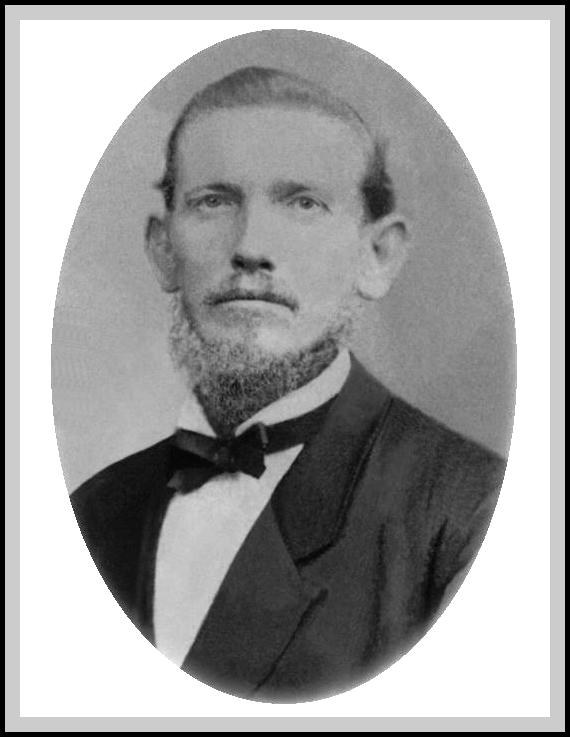
(A Family Studio Portrait)