Chapter Two
Life in the New World
Settlers had arrived in the lower Mary River district by the late 1830’s and this migration had culminated in the founding of the Maryborough settlement in 1847. By the close of 1848 the population of Maryborough had reached 380 and, in 1859, the settlement became a dedicated Port of Entry for inter-colonial coastal vessels carrying both freight and immigrants. The port, in the lower reaches of the Mary River, was initially founded to provide an outlet for the products of the developing pastoral industries of the district, particularly wool, from the Gayndah area and its surrounds. Coastal shipping transportation in those days, provided the only practical means of commercial transport in an era prior to the construction of formed roads and railways. Having to compete with few other commercial ports in south-east Queensland, Maryborough was regarded as being one of the colony’s main northern venues for commerce and immigration. It was located in the district now referred to as Wide Bay, then the colony’s area of most rapid pastoral development.
Prior to the advent of European settlement it was estimated that the local aboriginal population in the vicinity of the future Maryborough numbered approximately 5,000 persons and it was estimated that, in 1848, a number close to this attended a corroborree in the soon to be settled site of Maryborough’s ‘Old Township’. Mortal conflict between the native tribes and the timber getters, shepherds and squatters and that perennial scourge of disrupted tribal cultures, alcohol, was subsequently to cause a significant reduction in the aboriginal population's numbers.
A small boat with Andrew Pertrie, a government representative; Captain Jolliffe who had been engaged by a Hunter River squatter, Mr. Eales, to explore new land for development; the Hon. Walter Wrottesley, an English aristocrat and adventurer; Henry Stuart Russell, explorer, grazier and historian; five convicts and two aboriginals had set out from Brisbane in May 1842. This expedition was to discover the mouth of the Wide Bay River, later renamed the Mary River after Lady Mary Fitzroy, and return with two runaway convicts, James Davis and David Bracewell who had been living with the Wide Bay aboriginals.
On the expedition’s return Jolliffe reported to Mr. Eales and then set off for Wide Bay with a heard of sheep. Henry Russell, on a following expedition, set out in November 1842 and found Jolliffe, on Tiaro Station, in desperate straits having sustained massive stock losses due to native attacks. Mr. Jolliffe abandoned Tiaro Station in 1843.
Following this, Henry Stuart Russell travelling inland from Tiaro in search of pastoral land with his brother, Sydenham Russell, and William Glover encountered a river that he named the Boyne in the mistaken belief that it was the same river that had previously been given this name by John Oxley. The river that Russell had encountered was, in fact, a tributary of the - later to be named - Burnett River. As a result of Mr. Russell’s miscalculation Queensland now had two Boyne Rivers.
The earliest explorers of the Wide Bay and Burnett district lands were undoubtedly the pastoralists and overlanders who brought stock and took up grazing country. When it became publicly known that the Mary River was navigable, and that a large fertile territory lay beyond, many intending settlers moved northwards to establish sheep and cattle stations. The first township was founded ‘on the run’ in 1848 and later became known as the ‘Old Township’ to which the Gregories, Aldridges, Eales, Harwoods, Dowzers, Furburs, Palmers, and other pioneers relocated. In those primitive days bark humpies were plentiful, and Aldridge’s was the only hotel, Mrs. Irwin’s the only general store and Milner’s the only bakery.
For much of the earlier period described in this chapter the new settlers were living under very rudimentary, if not primitive, conditions. Government services were basic to non-existent and the new arrivals had little capacity to document the local happenings and conditions.
At first the roads were mere tracks made by bullock drivers or teamsters when travelling from one place to another and travellers attempting to follow them often went astray. The government surveyors’ broad arrow, on the ground or cut into a tree's trunk, was the sole indication of streets or thoroughfares and, until the year 1860, no serious attempts were made by the residents to improve the early town’s facilities. A single store, hotel, baker, butcher, saddler, and shoemaker were sufficient to maintain the community in a mutually supportive state. Many of the first squatters established themselves in bark huts or gunyahs, rough erections of timber slabs and bark, from which they set out in the early morning to check on the location of their sheep or cattle.
In I850, Edmund B. Uhr, who arrived with his wife and family, opened the first boiling-down works in Maryborough on the site of the future Botanical Gardens to service the local stock owners. Storekeeping in Maryborough was generally considered to have its origins in the activities of Messrs. Uhr, Aldridge and Dowzer, all of whom had established their own small outlets to sell useful and essential articles to bushmen and outlying stations. John Purser was born in Birmingham, England in 1822 and arrived in Sydney in 1850 where he obtained a position as a reporter under Henry Parkes. He arrived in Maryborough on the S.S. Waratah and joined Mr. Dowzer in his storekeeping business and opened his own soapmaking business ten years later. He promoted the Maryborough Permanent Building Society, was associated with some large mining ventures and with marine, fire and assurance companies.
Mr. Uhr, the first storekeeper, disposed of this business to Robert Travis who became the first merchant and second storekeeper to set up in Maryborough. He was born at Salford, Manchester and, in partnership with Mr. Melville, successfully maintained the business for many years. Following Mr. Melville’s retirement Mr. Travis continued the business on his own account. By 1855 the female element of the local population was still small with probably no more than six European women in the ‘Old Township’ and about four in the outlying district.
From the time Maryborough’s ‘New Township’ was proclaimed in 1851, and domestic and commercial allotments of land were sold, Maryborough began to advance and, aided by immigration and by an influx of pioneers from the ‘Old Township’ the town’s population markedly increased. The town’s streets, so-called, were named by the surveyors or owners of the allotments. It fell to Robert Travis, in association with Mr. Melville, to open the first store in “New Maryborough”.
Although, by the 2nd of February 1851 Maryborough had been established as a township, it took a full decade of growth for it to be incorporated into a municipality, this event taking place in March of 1861 and, on the 26th of April, Henry Palmer was elected as Maryborough’s first Mayor. He served a short term before being supplanted by John Eaton in August of the same year. The laying of the foundation stone of Maryborough’s hospital was to take place three years later, in 1864.
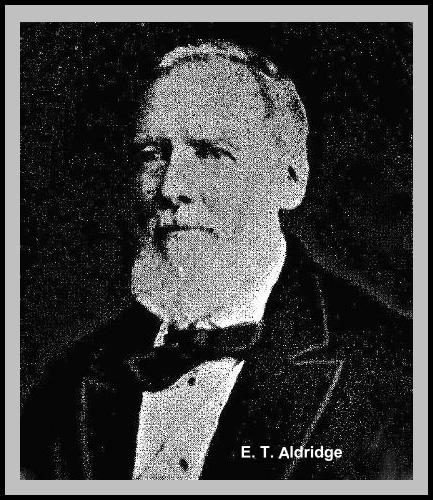 Edward Thomas Aldridge was recognised as being one of the first of Maryborough’s settlers having arrived there in the company of Henry and Richard Palmer in 1848. Mr. Aldridge acquired land at Baddow, later known as West Maryborough, but which was then regarded as the “Old Township”. The town’s site had been specifically selected as a desirable location for the loading and shipment of the wool that was delivered by wagons, drawn by bullock or horse teams, from the stations of the Burnett and Wide Bay districts.
Mr. Aldridge opened a general store and the Bush Inn Hotel which was removed, at a later date, to a new site that was subsequently occupied by the Royal Hotel. In 1856, a new Bush Inn Hotel was erected in Kent Street. The first Maryborough land sales were held in 1852 and Mr. Aldridge’s participation in these sales was to make him a significant owner of Maryborough’s real estate. He lived on his Baddow property until his death on the 18th of May 1888 at seventy years of age. Prior to this, his pioneering work in the sugar industry was of considerable significance both to Maryborough and to its neighbouring districts. Throughout his career he was to support and to encourage efforts to ensure the prosperity of the sugar industry.
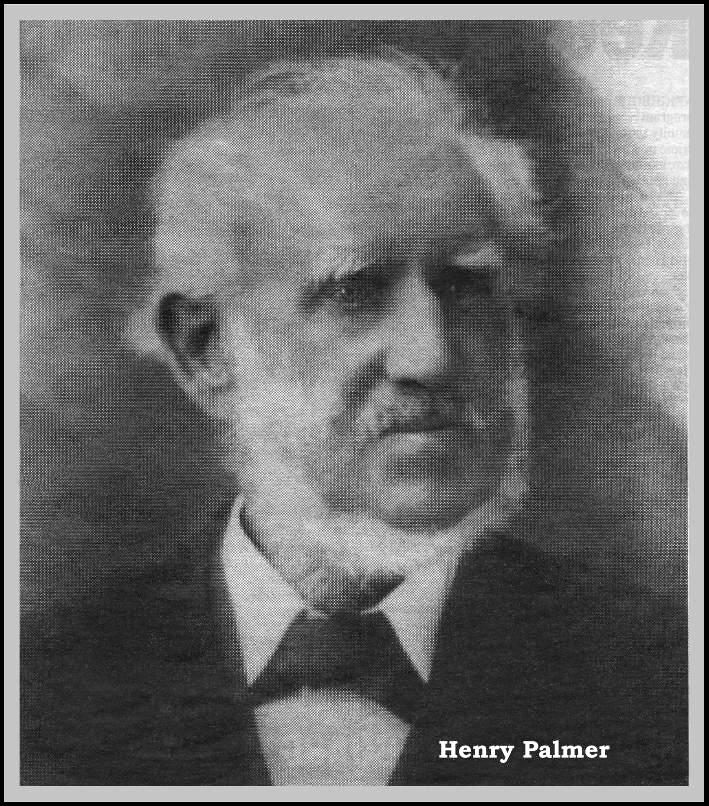 On his arrival in Maryborough’s “Old Township”, in the company of his brother and Edward Aldridge, Henry Palmer was accompanied by his own flocks and herds to enable the establishment of pastoral activities on a station that he had already acquired in the Burnett district. His brother, Richard E. Palmer, then travelled further north to pursue his own business interests in Gladstone. Henry conducted his pastoral activities over a period of many years and was to become one of the best known, and most respected, of the squatters on the east coast of Queensland.
The early years of the Adams family in Maryborough were dedicated to financial consolidation and to their expanding family. Walter and Mary’s children, all born in Maryborough, were: George Manus born on the 18th of May 1855, Matilda Jane on the 30th of November 1856 and Mary Ann on the 30th of December 1857. These were followed, in the 1860’s, by James Walter on the 23rd of May 1860, Sarah Margaret on the 14th of October 1862, Maria Emily on the 6th of July 1865, Susanna on the 30th of August 1867 (died 3rd of March 1869) and Ellen Elizabeth on the 17th of March 1869.
Following his arrival in Maryborough Walter worked as a blacksmith for wages and, by 1855, he had accumulated sufficient capital to purchase 64 perches of land in Lennox Street in the name of his new-born son. Further allotments were acquired in his own name, one on the 29th of October 1856 in Bazaar Street, and another on the 9th of September 1859 in Albert Street and, in or about 1855, he established a machinery business that he was to own and manage for seven years.
Over the Decade 1860 to 1870 Some Significant Occurrences in the Home Country Were:
Following the pioneering works on the Liverpool Borough’s sewage system designed by the Scottish engineer James Newlands, Engineer Joseph Bazalgette, assisted by William Haywood, eliminated the Great Stink of the Thames River at London and, as a consequence, virtually removed the threats of recurring epidemics such as those of cholera and typhoid;
Early in this decade England’s wealth was, in large measure, derived from the export of coal from its mines and from the manufacture of ships in the docks and slipways located in its northern districts;
An English dockyard launched the first iron hulled battleship;
The revitalisation of the north-east of England was achieved by the processing of imported fibres, mainly of cotton and wool, using the mechanization introduced by such men as Arkwright, Cartwright and Hargreaves in England, and by Eli Whitney (the inventor of the cotton gin) in America;
The American civil war’s (1861-1865) blockade of its southern states inhibited cotton deliveries to the English mills and its conclusion ended the use of slave labour in the cotton producing southern United States;
A flowering in the number of public schools as social instruments, and the revival of older established schools such as Rugby under Thomas Arnold, enabled the bourgeoisie to acquire many of the mannerisms and accents of the ‘gentlemen’ of the realm; and
Charles Dickens wrote David Copperfield and Great Expectations, Charles Kingsley Water Babies and Charles Lutwidge Dodgson (Lewis Carroll of Christ Church, Oxford) Alice in Wonderland.
AND - Over the Decade 1860 to 1870 Some Significant Occurrences in the Vicinity of the Lower Reaches of the Burnett River Were:
In 1861 Augustus Purling Barton acquired the Gin Gin Creek uplands from the Brown Brothers after earlier having forfeited the land that was to become the Gympie goldfield. The new station acquired the name Moolboolaman. Upon Mr. Barton’s death in 1914 Moolboolaman passed into the hands of his son, Mr. R. M. Barton who later entered into partnership with his nephew Mr. P. A. Elliot;
In early 1862 Alexander and Robert Walker, together with Messrs Barnard and Parker, on travelling the Burnett River from Gayndah to the future location of Bundaberg, declared the waterway to be navigable and investigated land holdings in the Lower Burnett area;
Shortly thereafter, in 1863, Alexander Walker acquired Bingera station from Mr. R. P. Marshall and Hassall and Ogg were established in their Tantitha Run;
In 1863 Nugent Wade Brown inspected the seafront land between the mouths of the Burnett and Elliot Rivers and, on his advice, a five-year lease on this land, to be used for the grazing of cattle, was taken up by the brothers Alfred and Arthur Brown;
In 1866 John and Gavin Steuart, with local aboriginal guides, travelled overland from the Baffle Creek works to the north bank of the Burnett River, at the location of the future North Bundaberg, to locate new timber resources to produce barrel staves for the packaging of tallow. The staves were intended to supply the Baffle Creek boiling down works as tallow and hides were the only transportable cattle products in those early days;
In January 1867 Thomas Miller’s schooner, the Elizabeth, was the first sailing vessel known to have entered the Burnett River in order to transport a consignment of cedar logs loaded at a site close to the location t of the future north-shore town wharf;
And the settler population, prior to the Steuarts’ arrival on the future Bundaberg’s north side, was estimated to be five men at Tantitha, two at Bingera and three at Kolan;
Over the period 1867-68 the Steuarts, together with Thomas Miller, acquired the Woondooma property of 320 acres on the Burnett River’s north bank, adjacent to the Mabbro property that had been selected in 1865 - but not immediately occupied - by Thomas Watson, with the intention of harvesting and utilizing the local timber in the manufacture of barrel staves;
Also, in 1867 Thomas Watson took up residence at Mabbro, having relocated from Alexander Walker’s Bingera station, to partner the Steuart brothers in their barrel stave manufacturing business. His first, and rather primitive, hut was constructed of discarded barrel staves;
In 1868 the embryonic settlement’s fortunes were boosted by the arrival and installation on the Burnett riverbank of Samuel Johnston’s sawmill, a very useful adjunct to a settlement about to experience rapid expansion;
Thomas Watson erected a more substantial slab hut on his Mabbro selection, to which he brought his wife and daughter, who thus became the Bundaberg settlement’s first and second female inhabitants;
District-Surveyor Thompson and his party surveyed a base line from the Yellow Waterholes through to an area that Thompson was to select as his Rubyanna property and then, on further direction from the Brisbane Survey Office, Thompson and his assistants Messrs. Ellwood and Edwards surveyed a Town Common and named the surveyed site “Bundaberg”. According to Mr. Loyau the Bundaberg survey was conducted in a location known to the aborigines as Biarbarrain in the district of Booralbooral; and
In this year the 1868 Crown Lands Alienation Act brought the Tantitha, Kolan, Barolin, Bingera and Branyan Stations under the Settled Districts category thus setting them aside for primary agricultural purposes.
In January 1860 Walter Adams showed an early interest in good governance by adding his signature to a letter from thirty-eight Maryborough town dignitaries and electors including such early inhabitants as E. T. Aldridge, E. B. Uhr, J. Dowser, R. Travis, H. Palmer, R. Case, Pierre Louis and A. Goodwin. The letter was addressed to Governor Sir George Bowen via the Queensland Colonial Secretary. This letter was objecting to the appointment of Mr. Halloran, the Commissioner of Crown Lands and Police Magistrate in Maryborough, to the electorate’s returning officer position. The basis of the objection was that, having acquired the official position of returning officer, Mr. Halloran had then exhibited a lack of impartiality by campaigning for his son-in-law in a local election. Whilst the Governor was to take no public action on the issue Mr. Halloran resigned from the returning officer position “for reasons irrespective of those mentioned by the memorialists”. There the matter appears to have rested.
In March of 1860 Thomas White together with William Keith established Maryborough’s first newspaper, the Wide Bay and Burnett Times, Maryborough, Gayndah and Northern Ports Advertiser. Later in the same year Mr. White relocated his business to Gayndah. The void created by the departure from Maryborough of Thomas White’s business was immediately filled by the establishment of the tri-weekly, conservative and long lived Maryborough Chronicle established by Mr. C. H. Buzacott in November 1860.
Charles Hardie Buzacott was born in 1885 at Torrington, Devonshire, where he received his education. He arrived in Sydney in 1852 and here he acquired experience both in printing and in journalism. Mr. Buzacott arrived in Maryborough in October 1860 where he established the Chronicle. In 1864 he started the Peak Downs Telegram, and six years later purchased the Rockhampton Bulletin, converting it into the Capricornian weekly in 1875. He entered Parliament as member for Rockhampton in 1873, resigned but was again elected in 1875. In 1879 he was appointed Postmaster-General under the M'Ilwraith Government with a seat in the Upper House. Whilst in office he originated the Divisional Boards Act and the Local Works Loan Act, was responsible for the passing of the Postal Card Act, and also established a direct mail communication between London and Brisbane. He has also been credited with the introduction of the telephone to Queensland.
He resigned his Parliamentary seat in 1880 and, in 1882, at the request of the Mayor of Brisbane, drafted the Tramway Bill which passed through Parliament as a Government measure. He then set up the Brisbane Tramway Company of which he was chairman in 1886. In 1884, acting on behalf of the Brisbane Newspaper Company of which he held a one-third interest, he purchased the site of the Courier building for £40,000 and then had erected upon it the imposing building in which the Courier, Observer and Queenslander newspapers were published.
Another notable resident of the expanding Maryborough, Charles Faulkner, was born in Lincolnshire in 1820 and arrived in Brisbane in 1848 following periods spent working in the Californian and Victorian goldfields. He moved to Maryborough in 1860 where he undertook work as a builder. In May 1862 he was appointed to the position of assessor for the Maryborough Council and still later took part in the Gympie goldrush of 1867.
On the 8th of October 1860 Walter Adams purchased three blocks of agricultural land, having a total area 13 acres 2 roods 24 perches, at The Pocket, which was located relatively close to the Maryborough town centre, and then commenced farming on the property that he named Somerville. Later, on the 21st of December 1869, he acquired an adjacent block of 4 acres 32 perches to expand both his area under planting and, hopefully, his income. The four blocks were located on the flood plain of the Mary River.
It is of considerable significance to this narrative that Edward Thomas Aldridge, widely acknowledged as being a founder of the Maryborough township, introduced the growth of the sugarcane crop into the Wide Bay district by its cultivation on his plantation, Copenhagen, in 1860. Innovation being part of Walter Adams’s nature he drew on the resulting Copenhagen cane stock and, in 1864, he produced stands of sugarcane “in the jungle near Maryborough, at a place called Somerville considered to be finer than anything ---------- seen in Mauritius” when viewed by an expert consultant, Thomy de Keating. Mr. de Keating, from Mauritius, had visited Maryborough in 1865 at the invitation of the Maryborough Sugar Growing Company Ltd. This expert opinion encouraged Mr. Adams to provide three sticks of cane, from a stool grown at The Pocket, to the Sub-collector of Customs in Maryborough, Mr. Sheridan, for his inspection. Mr. Sheridan, in turn, forwarded the samples to the Brisbane Courier which was then regarded as being Queensland’s leading newspaper.
Richard Bingham Sheridan was one of the earliest of Queensland magistrates. Born in Ireland in 1822, he arrived in Sydney in 1842. He was appointed by the Imperial Government to Her Majesty’s Customs in 1846 and received a promotion to Brisbane in 1853. Following Queensland's separation from N.S.W. he became the Chief Officer of Customs, Water Police Magistrate, Immigration Agent, and Harbour Master at Maryborough until 1883, when he retired on a pension, and entered Parliament as representative for Maryborough. He accepted an office in the Cabinet without portfolio and, at the beginning of 1886, was appointed Postmaster-General. Mr. Sheridan received the commendation of His Excellency Sir W. W. Cairns for his reformation of the treatment of Islanders engaged on plantations. He was prominent in the foundation of the Maryborough Botanic Gardens and, during his residence in Maryborough, held the rank of Lieutenant Colonel in the Volunteer Force. When leaving Maryborough to reside in Brisbane he was presented with an illuminated address together with a handsome dessert service.
William Southerden was born in 1832 at the Isle of Thanet, Kent and acquired his knowledge in the management of drapery stores whilst in London. He arrived in Sydney in 1852, where he entered the employment of the firm of Dawson and Eager. Relocating to Brisbane in 1854 he assisted his brother in establishing a business and then, in 1857, opened his own store in Maryborough a venture he maintained until 1872. By November 1860, in company with John Purser, James Dowser and Robert Case, he was a member and representative of the Maryborough Cotton Association.
The Year of 1861
Mr. Henry Palmer was elected the first Mayor of Maryborough on the 26th of April 1861. In May of that year he had a new brick store erected in the town to further the development of his expanding grocery business. Henry Palmer maintained his Maryborough Council office until August 1861, at which time he resigned from his positions both as Mayor and as Alderman. Following his resignation, and in the same month, the council agreed to approve Mr. Palmer’s application for a wharf-site lease over a riverbank position close to his newly constructed store.
In the April of 1861 Walter Adams exhibited an interest in civic affairs by nominating for a position as an Alderman in the Maryborough Council and, in July of the same year, he experimented with the practicality of planting, harvesting and marketing his first arrowroot crop. This experiment made him a pioneer planter of arrowroot in the Mary region. His finances were enhanced in November by the provision of services to the Wide Bay Cotton Growing Association whose members’ prospects had been enhanced by the advent of the American Civil War. The war together with its tumultuous consequences, including the blockading of the southern ports, had virtually eliminated the supply of American cotton to the English mills.
The pioneering Union Saw Mill of Frederick William Gladwell and Robert Greathead was installed in the latter half of 1861 and opened in December of that year. It was equipped with three circular saws driven by a six-horsepower steam engine. Early doubts as to the viability of the enterprise were resolved when Henry Palmer offered to purchase all of the mill’s commercial output from the first six months of its operation to assist in boosting Maryborough’s progress which had been severely inhibited by the lack of this vital building material.
The Year of 1862
In the mid-nineteenth century the most effective and efficient source of commercial energy was coal. It was used to fire up the furnaces of the industrial boilers and to be converted into gas for lighting, cooking and heating purposes. The discovery of the Burrum coal measures in the vicinity of Howard, possibly by a Mr. Buchanan, in or about 1862 Note 1 was therefore a very significant contribution to the next stage of Maryborough’s development.
Note 1: A Burrum area coal discovery has also been attributed to pastoralist William Howard following his exploration of the Burrum and Isis districts in 1863.
The Year of 1863
A Mr. Miller provided Maryborough with a significant quantity of coal for initial examination and, in January 1863, a meeting was held in the Bush Inn Hotel, with Henry Palmer in the chair, to determine any steps that the meeting deemed advisable to adopt in the development of the coal resources of the Maryborough area. At the meeting a committee was elected, consisting of Messrs. H. Palmer, R. Greathead, R. Travis, Dr. Ward and P. M. White, to explore the practicality of implementing the various options that had been raised at the meeting. Subsequent to this meeting a company was formed, and a steam-collier was ordered from Sydney to be installed as a component in the construction of a coal mine at Burrum. The mine’s construction was completed in 1865-66.
Walter’s ongoing carting business was to have its ups and downs and, in January 1863, his tender for the supply of bush logs to the town, almost certainly by bullock drawn wagon, was cancelled owing to the Council’s lack of funds at a time, prior to the Gympie goldfield discovery, when public funds in the colony were at a very low level.
The rivers played a major role in the daily life of newly established towns such as Maryborough and Bundaberg. At a time when ‘roads’ were either non-existent or rudimentary bush tracks the coastal sea-lanes provided such critical services as the supply of goods and food stuffs, mail and service delivery and passenger transportation. However, in the land of “droughts and flooding rains” the presence of the rivers proved to be a mixed blessing, they being sometimes servant and sometimes master. The costs of capital works required to provide for the necessary river crossings were also major considerations in a young colony of limited financial means.
The Maryborough Chronicle of the 19th of February 1863 reported that the Mary River, Barambah Creek and Burnett River catchments experienced the most tempestuous ten day weather period that had been experienced since the settlement of these districts. A boat belonging to Mr. Morrison and the Ban Ban Creek punt were washed away by the flood and Mr. Morrison was obliged to construct a new boat so that he could restore his mail service delivery to clients on the opposite creek bank. The Gayndah mail could not be delivered owing to the flooding of Barambah Creek and the Gayndah mailman also reported that the roads were in an impassable state, the creeks being extremely dangerous to cross, and that he had narrowly escaped drowning when swimming across Oakey Creek. The Gladstone mailman had departed Maryborough on the previous Sunday week, and had not returned, the watercourses on his route being even worse than those on the Gayndah line. Another consequence of the flooding was that settlers downstream of Salt Water Creek, on the left bank of the Mary River, had no means of access to the town until the flooding in the river had subsided.
Strong south-east winds had been experienced early in this stormy period, bringing with them copious amounts of rain and, by Thursday night, the wind had increased to such strength that trees were being uprooted and the dwellings of many settlers were placed at considerable risk. The weather was equally tempestuous on the Friday with the torrents of rain being accompanied by violent squalls succeeding each other in quick succession. As a result, nearly every household experienced some rain damage and the streets were converted into almost impassable quagmires.
Towards Friday evening the weather had moderated a little, probably due to the passing of the eye of a cyclone but that night the wind shifted towards the north-east and again rose almost to hurricane pitch with the rain being as heavy as that experienced during the previous night. Saturday and Sunday brought intervals of severe squalls and, on the Sunday, these squalls were accompanied by thunder. However, by Monday the wind had finally moderated and that night a thunderstorm arrived from the south-west which cooled the air for a time. Tuesday was a much warmer day, but a north-east breeze sprang up towards the evening and this was accompanied by the cessation of the rain periods.
Captain Coote of the steamboat Williams said that his ship had been in imminent peril during the storm. She had reached the Mary River bar on Friday morning, but was unable to cross, and was compelled to return to blue water. For seventeen hours the little vessel with its hatches battened down combated the storm and, over this period, the crew had serious concerns for their own safety. The vessel had put to sea with a few tons of iron on her upper deck and this had to be cast overboard to save the vessel as its weight had made it difficult for the ship to rise out of the heavy seas that were breaking over her bow and sides. When so lightened she managed to ride the waves and finally arrived in port on the Sunday afternoon. Mr. Wallace, chief officer of the Williams, stated that in all of his experience along this coastline he had never before witnessed such a storm and, had not the Williams been such a tight little vessel, there would have been no one to report upon the fate of those on board.
The ships Queensland and Clarence were at anchor off the white sandy cliffs of Frazer Island on Friday and early Saturday, but sailed outside the Bay during the daylight hours. The Williams was signalled by an unknown steamer’s blue light on Saturday when it was positioned a little south of the bar. This signal may have been sent by the Jane Somerville as she would have been at sea during the gale, having left the port of Gladstone for Maryborough early in the previous week. The Pacific was also at sea and was known to have turned back towards Keppel Bay before the storm's arrival.
The Mary River rose to a great height following the downpours, the wharf was completely submerged, and the steamboats that were in port were compelled to manoeuvre into midstream and to rely upon their anchors rather than on their normal river bank moorings. By the Friday night the Union Sawmill was flooded and the resident families living on the lower part of the mill’s ground had to be removed by boat at 9 p.m. A large quantity of timber was floating about the yard but, fortunately, none was lost as the current, of from eight to ten knots, was confined to the stream’s main channel. The Gladwell and Greathead mill’s loss was mainly due to the enforced stand-down time occasioned by the necessary restoration and maintenance works.
Heavy losses were sustained by farmers, whose land had been submerged, a farm at Copenhagen Bend being the greatest sufferer having lost twenty-five acres of corn ready for the harvest. The small acre farmers in the town’s eastern suburbs were affected in a similar manner by having their crops and dwellings inundated and this had required the relocation of their families by boat to a safe refuge. Walter Adams’s farm and the farm of Mr. Burns suffered the greatest damage with Walter’s loss estimated at about £60. Many trees had been uprooted by the storm but, when considering the large number of dead trees that had been left standing in the town, some of which, on falling, had crushed houses it was fortunate that no fatal accident was recorded.
In October 1863 another storm passed over Maryborough that again caused additional damage to farms in the east of the township with large hailstones flattening and shredding the settlers’ growing crops. Walter Adams was one of the settlers who again suffered damage and, on this occasion, he lost most of his newly extended acreage of mature corn.
It was also in this month that Charles Faulkner advertised his intention to commence business by setting up as a baker in Maryborough. A vote in council favoured Mr. Faulkner’s appointment as the aldermanic replacement for the position recently vacated by Mr. E. T. Aldridge. A show of hands at the council meeting resulted in ten votes for Mr. Faulkner, six votes for Mr. H. Palmer and five votes for Mr. Booker.
The Year of 1864
James Equestrian Noakes was born at sea in 1844 on the ship Equestrian, from which he acquired his second name. Mr. Noakes was educated in Sydney and served an apprenticeship with J. Ranken and Company a firm of storekeepers in Maitland, N.S.W. He arrived in Maryborough in 1864 to act as J. Ranken and Company’s confidential manager. Whilst there he founded Maryborough’s first cricketing eleven in 1864 and became the elected secretary of the Maryborough Cricket Club in January 1865.
In February 1864 Mr. Faulkner was proposed as a nominee for an aldermanic replacement but lost election to Mr. Melville by fifteen votes to three in a show of the ratepayers’ hands. However, in October 1864 Mr. Faulkner was successful in being elected as a director of the Wide Bay Benefit Investment and Building Society and was to remain as a director in the then Maryborough Permanent Building and Investment Society up to the year 1871.
The Maryborough Chronicle of the 17th of March 1864 reported that the entire lower Mary district was exposed to an event of almost biblical proportions. The flood of February 1863 proved to be merely a precursor to the flood of March 1864 which was referred to at the time as The Greatest Flood. This flood was caused by a massive storm that covered both the Mary and Burnett River catchments. The ground had been pre-saturated by continuous heavy rain falling over the preceding weeks causing the Mary River to break its banks and flood the adjacent lower land but this flooding had caused only localized damage and two or three days of fine, clear weather followed.
However, on the following Wednesday dense, dark, blue-black clouds gathered, the rain returned and heavy downpours followed. Commencing in the afternoon, and continuing until Saturday morning, the storm was to reach its maximum intensity on the Friday night with a tremendous wind and with rain that descended in sheets. There had been no significant rise in river levels until sundown on Friday but, by about ten o’clock that night, the level commenced to rise at the rate of three feet (900 mm.) an hour and the numerous families housed in the premises of the Union Saw Mill once again required removal to a place of safety with several boats having to be requisitioned for the purpose. The boats had to navigate by the light of the moon, as it filtered through gaps between the dense clouds, with the floating timber and debris contained in the fast-flowing river current making navigation exceedingly dangerous. Good fortune prevailed and, in a few hours, all the families had been rescued, though not too soon, as the flood waters continued their steady rise. On the Saturday morning some houses had begun to float and drift off into the flooded stream channel and two or three of these houses, together with their contents, were swept away. The floating houses that remained were secured with ropes but some of these had sustained so much damage that they later required rebuilding.
The sawmill machinery, engines, and boiler-houses, the greater portion of which had only just been erected, were all submerged halfway up to their roofs and there were fears that the foundations of solid masonry supporting the mill’s equipment would be damaged, in which case all of the heavy equipment would have had to be re-set. By Saturday the water had reached the mill proprietor’s house that was situated on the high bank behind the mill and the proprietor’s family were compelled to quit their premises.
At the large shipping store owned by Mr. Palmer the water rose two feet (600 mm.) above the level of the lower floor but up to that time it had been kept out of the building itself. On Saturday the water continued its slow rise and so, on Saturday night, Mr. Palmer’s perishable goods had to be relocated to an upper floor.
The scrub farms adjacent to the town were again submerged and it was fortunate that there was no loss of life. The farms of Walter Adams and of Michael Doran were the first to be flooded. Walter had left his farm early for safety reasons, but Mr. Doran waited until it was too late to escape and, with rapidly rising floodwater in his house, he and his family took refuge in the barn which had been constructed on slightly higher ground. However, the waters continued to rise and, but for a table that happened to have been retained in the barn, their situation would have been of an even more unpleasant and hazardous nature. The whole family of six persons, together with their cats, dogs and fowls, perched the whole night on this relatively small platform while the water rose several inches over the tabletop and the wind threatened to bring the rickety old building down upon them. On the following morning Messrs. Butcher and Pattison were passing near the spot in their boat and, on observing that Doran’s house was submerged to the upper wall-plates, concluded that the residents had escaped. The inmates of the barn had become hoarse from their overnight shouting, but a faint cry managed to attract the attention of the boatmen and the endangered group was finally rescued.
By Saturday the cyclone had passed and the wind, which had come from the south on Wednesday, veered to the east and then to the north-east and, by Friday, was blowing steadily from the west. Following this wind shift every trace of the storm was swept from the sky.
The flood water was to continue its rise on the Sunday morning and several houses, that had previously been deemed to be safe, were now in jeopardy. The tenants were compelled to abandon Mr. Keith’s farm when the farmhouse foundations began to erode. Other farmers in this locality were also to suffer severe losses. When the farms near the ferry, located on the bank of the river opposite the town, became flooded the farmers were driven off their improved land on the riverbanks and were forced to move onto higher ground further removed from the river. The punt that belonged to the newly acquired ferry service filled with floodwater and sank.
The flood was then about two feet higher than the flood of 1857, reaching nearly to the eaves of Mr. Aldridge’s shipping store that was located about twenty-five feet above the level of the wharf. The backwater, in flowing up the creek into the town reserve, covered the upstream bridges under many feet of water and covered the Kent Street bridge, near Macpherson’s, to a height of at least one foot.
Much was owed to the exertions of Mr. Sheridan and his boat’s crew who, in the midst of the storm on the Friday night, rescued the families located on the premises of the saw-mill and to the untiring efforts of the scrub farmers, including Mr. Rankin, who worked up to their waists in water whilst engaged in assisting the afflicted families to rescue what property they could from the rising flood waters.
By Monday morning the flood had fallen by about ten feet (three metres) leaving a train of slimy mud behind. The greatest sufferers of flood damage were again Messrs. Gladwell and Greathead, of the Union Saw Mill, and there was general sympathy in the town towards this enterprising firm. It was, unfortunately, a time when the quantity of stocks of both the unmilled logs and of the sawn timber was unusually large. Upwards of six hundred logs were swept away and a large quantity of sawn timber was also lost. The men’s quarters at the mill had been either washed down river or had become ruinous heaps of rubble but the more substantial work of the machine houses had saved these from coming adrift. The loss of time required to bring the mill’s machinery back to working order was to add a significant amount to the total monetary loss of approximately £1,500.
Next to Messrs. Gladwell and Greathead the farmers in the scrub near the town were the greatest sufferers. The farms of Walter Adams, Michael Doran and Mr. Jackson lost all of their growing crops, garnered corn, pigs and poultry. The farm house of Mr. Keith, together with the crops and out-buildings, had been swept away by the flood and the farm’s agricultural soil was removed to a depth of three feet (900 mm.) in places. The farmhouse had been located on a very high bank of the river which had been completely undercut by the current. Following the riverbank’s erosion induced collapse a running stream flowed over the spot previously occupied by the house. Mr. Bogild’s property at Copenhagen Bend was also a heavy loser as the flood destroyed its mature crops of maize, cotton and arrowroot..
Damage caused exclusively by wind had been less than originally feared with the most serious damage being caused by the levelling of the four sides of a large wooden store in the course of erection by Mr. Hanlon in Adelaide-street. Damage of a less severe nature was sustained by Mr. S. Smith who had the framework of a small store under construction blown over. The tenants of several of the tents about the town were stripped of their shelter and, in one of these tents, a woman in childbirth was exposed to the effects of the storm, fortunately without injury. These homeless victims were given shelter by their neighbours.
Henry Palmer, elected the first Mayor of Maryborough in 1861, was re-elected as Mayor in 1864 and retained this position until 1866. In May of that year Mr. Southerden sold his Bazaar Street produce merchant’s store and business to Thomas Buss to concentrate his attention onto his newly constructed grocery store.
Throughout the 1860’s William Southerden was extremely active in civic affairs. He helped to form the Chamber of Commerce, of which he was elected vice-president, and was also a trustee of the Cemetery reserve, a member of the Central State School Committee, Vice-president of the Hospital Committee and an alderman of the Municipal Council of which he was Mayor in 1876. He was also a purchaser of gold during the Gympie gold rush.
Over the 1864 year the income earned by the Adams’s carting business was augmented by renewed profits from the Maryborough Council contract. This had provided the business with additional earnings of about £1 18s. 0d. per month. In November of that year a Chronicle report on the Somerville farm’s produce stated that:
“We have at our office a fine sample of wheat grown on a farm in the immediate vicinity of Maryborough by Mr. Walter Adams. The wheat is in prime condition and will yield about forty bushels to the acre. Despite the general opinion to the contrary Mr. Adams believes that, with due precaution being observed in the cultivation, wheat would be as safe and profitable a crop as could be planted in this district. Certainly, one of the largest wheat growing countries in the world, Egypt, has a climate of as warm a temperature. At present it is mere theory that the growing of wheat cannot be carried on profitably here. Its cultivation has never been tried on a scale sufficiently large to prove this and the experiments that have been made on a small scale go to prove the contrary.”
And the Chronicle printed this follow-up article in December:
“There has been added to our editorial museum, during the past week, a loaf of bread manufactured by Mr. Walter Adams made from home-grown wheat and home-made flour. The bread is of that good homely quality on which the yeomen of England raise so much muscle and strength. Mr. Adams says he has used it in his own household for the past three weeks, and we certify to the excellent quality thereof, if we may judge by Mr. Adams’s personal appearance. The mechanical appliances for the manufacture of the flour were very economical yet efficient; a steel-mill, which cost 30 shillings and a wire sieve costing 5 shillings and 6 pence were all that were needed in the process. One, or two, hours’ labour in each week provides a week’s supply of flour for a large family.”
Walter Adams’s experiments with wheat growing were of considerable local interest as there had been no previous trials in subtropical coastal Queensland on a scale of sufficient magnitude to test this crop’s commercial viability. For this reason Walter was keen to have it trialled as he was of the opinion that, as wheat production would appear to have been successful in climates similar to that of Maryborough, then it should be possible to find suitable locations for wheat cultivation in the Maryborough district. Later, in May 1865, following discussions with his friends and associates, Messrs. Gladwell and Greathead, their firm agreed to support a wheat growing venture and offered to erect a flour mill in the district providing that the local farmers cultivated sufficient grain to make the mill commercially viable.
Walter pursued the issue of alternative crop production further by sending a ‘Letter to the Editor’ of the Chronicle, one that was actually directed at the region’s farmers, and intended to advocate the advantages of dual crop growth, it being obvious that a second crop in the one year should produce a significantly greater income. The following is a copy of this letter:
Sir,
It appears from the different letters, published in the Chronicle, that the farmers on the Mary River are doomed not to make farming pay unless they begin to grow sugar or cotton. But I would ask, where has farming been properly tested? We all know that the farmer who has to begin on a new farm and has not, or cannot, work anything but the (hand-held) hoe cannot compete with the farmer who can work the plough and has the means to do so. But there are none who use the plough that can come forward and say that potatoes will not pay though, from my own experience, I can safely say that, if we have a middling season, we can rely on three tons to the acre and I have never seen potatoes sold here for less than £9 per ton and often a deal more. The seed (potatoes) for an acre would cost about £5, which would leave £22 for labour and we are not now able to grow (even) one third of the potatoes consumed in the district. The only thing that is spoken of besides is maize.
Now, Sir, this ought to be only a secondary consideration for, in the other colonies, the farmer always gets a crop of wheat, oats, or barley off the land before planting maize and then, if maize should fail, they do not feel the loss and why, let me ask, can the farmer here not do the same? As for myself, as you are aware, I grew wheat last year and was glad to be able to produce a good sample and had it out in November in good time for the maize crop. The only thing I was sorry for was that I did not grow enough, for I planted only half a bushel, and had enough to support my family in flour from November until March which, I might here state, was nine in number. I purchased a steel mill for thirty shillings, and a sieve to separate the bran from the flour for five shillings. I was speaking with Mr. Greathead the other day, and that gentleman, told me if the farmers could be induced to grow wheat that he would get a pair of stones put up and grind their wheat by the bushel for them or purchase it for himself. So I think that the farmers have every inducement now to try wheat growing. I intend to plant nearly two acres this month on or about the first of June. I have the seed and am now getting the ground ready and I trust that others will follow my example. We shall then see whether potatoes and maize will pay or not.
Yours truly,
Walter Adams
Whilst the early wheat growing trials were encouraging, the moist climate east of the Dividing Range proved to be too favourable an environment for wheat’s natural pests much to the detriment of the coastal wheat crops. Subsequent trials indicated that maize (or corn) was a more reliable crop to grow under eastern coastal conditions.
The Year of 1865
In September, 1865 Henry Palmer, acting in his capacity as the chairman of the Maryborough Sugar Company, received a letter from Mr. Thomy de Keating that was accompanied by samples of granular sugar produced by the use of “rude appliances”. The granular samples were derived from a consignment of sugarcane stalks that had been supplied by Mr. White to Mr. De Keating to be utilized as planting material on the De Keating estate.
In December 1865 the Mayor and Alderman Groundwater met the local farmers’ committee of which Walter Adams was a member. The Council’s representatives did not agree with the committee’s selection of the site for a proposed agricultural produce marketplace. It was the Council’s belief that it would be more convenient to have the produce market located close to the existing down-stream wharf. The farmers’ committee, however, considered an upstream site to be more appropriate and used their numbers to out-vote the Council’s nominees. In the dispute between the council representatives and the farmers Walter, even though he owned a farm close to the down-stream wharf, agreed with the upstream farmers that the market should be located closer to the upper ferry, a placement that was to his own disadvantage.
In the same month Walter applied his enquiring mind to another project, the production and use of cornmeal in the baking of bread. While of an apparently trivial nature the letter serves to emphasize the critical influence that the availability of local produce had upon the diets of the then relatively isolated communities. He was to pass on the results of his own experimentation to the editor of the Chronicle. Details of his response to an earlier ‘Letter to the Editor’ as submitted by another reader of the Chronicle on this subject follow:
Sir,
There appeared in the columns of the Chronicle a few weeks ago, a long letter in which the writer advocates, in very strong terms, the use of cornmeal as being more healthy and also a great saving, not only to the consumer, but also to the colony.
Now, Sir, I quite agree with the writer’s remarks, but I think that when anyone is writing for the public, they ought to make things as clear as possible and not only tell them what can be done but teach them how. The writer says he has had made, of half maize and half wheaten flour, good bread, pastry, dumplings, and hominy, but does not show how they are to be made. It is not everyone who would like to eat hominy, but I suppose after using it a few times we would get used to it and it might be, or seem to be, something better as my family, after having used it a few times with new milk for breakfast, begin to like it very much. As for the bread, I have tried it several ways, and can say that if you mix the maize-meal and wheaten flour to set in the same manner as all wheaten flour, and let it rise, then work it, and put it into the oven to bake, you will find the flour baked, but the maize will be raw, and the bread would not hold together and would eat like so much sand in your mouth.
But, however, bread can be made of half wheat and half maize and, to enable you to judge for yourself, I have sent you a piece of bread that has been made of equal parts of each and, that I may not keep you in the dark as to how it was made, I will tell you and if anyone has a better method to propose I hope they will come forward with it for I would as soon eat the bread I have sent you as I would (an) all wheaten bread.
When you go to make your bread, take a portion of the wheaten flour and set it with yeast in the usual way, the other portion you reserve, as it will take a great deal of the flour to dry up the corn-meal, for the corn-meal will have to be boiled, and be sure that when you put your corn-meal down to boil that you use boiling water and, when it is cooked, it will be like so much hominy, but it must be very thick; then turn it out into a dish to get cool and, when cool, mix it with the flour you reserved for that purpose. You may use more than half maize if you like. The bread which I have sent you is half of each, and I intend for the future to use a deal of it. I may state the maize was ground in a small steel mill.
I am, Sir, yours,
Walter Adams
The Year of 1866
In February, 1866 Mr. Faulkner together with Messrs. Palmer, Southerden, Cook, Booker, Hawthorne and Rutherford were the alderman present at the first meeting of the Maryborough Council that had been elected under the Ward system . Mr. Palmer was voted Mayor.
Also, in the February of 1866 the local aboriginal tribes were in the news having removed the portable possessions from outlying farms in the vicinity of Maryborough. Mr. Murray, a farmer on Tinana Creek about a mile and a half from Maryborough, was at work on his farm on a Monday and saw some aboriginals entering his house. He and his man went up to the house, when the aboriginals decamped and, having armed himself with a gun, set off in pursuit leaving his man in charge of the place. However, on hearing a pistol fired behind him he returned and found his man overpowered by another party of aboriginals who must have been concealed in the vicinity. On his approach they made off taking with them a quantity of clothes and a valuable silver watch.
Walter, having his residence located on his agricultural property in the scrub near the town, had also experienced a robbery on the Sunday. A description of the event, as published in the local press, follows:
“On Sunday last, while I and my family were at church, the man that was left in charge of my place was attacked by a party of aboriginals who, I presume, must have been lurking about and watching for a favourable opportunity to plunder. They affected an entrance into the house before the man was aware of their proximity and cut off every chance of his obtaining anything to defend either himself or the house, so that when they attacked him, he was compelled to run and obtain assistance. On his return he found that they had decamped, having thoroughly ransacked the place and taken whatever they fancied. Boxes and drawers were all turned out, the beds stripped of the blankets, nothing was left for my family’s dinner, and many things were taken that can be of no possible use to them, such as breast pins, brooches, &c. When I returned and found how things were, I rode into town for the purpose of obtaining rations, intending on my return to follow up their track.
While in town I was advised to go and inform the Police Magistrate of the circumstances, which I did. That gentleman immediately came down and gave instructions to the sub-inspector, who at once gave orders to Sergeant O’Brien (what the orders were I am unable to say), and I was informed that two men would be after me as soon as possible. I then returned home, and after having dinner, I went in search of the marauders tracks, and found them to lead into the scrub, through which I followed their trail for some distance, but thinking the two men promised would be soon at my place, I returned and found that they had just arrived. I asked the sergeant what he intended to do; did they mean to dismount? The answer I received was that they could not leave their horses but would ride through the Natural Paddock, which they did, and straight home.
The fact of two troopers coming here on horseback to look for aboriginals that had but little more than an hour before plundered my house, and, after getting a drink, returning straight home again is rather more than I expected. Perhaps such was their instructions, or that they did not believe what I had stated, and merely came to find out if I had been robbed.”
Walter was left to mull over the thought that, from the point of view of officialdom, he was left as the sole protector of his family’s property and possessions.
Having been inspired by a lecture delivered by the Queensland sugar pioneer John Buhot, who had visited Maryborough in 1864, and recognising the potential for the income provided by the sugarcane crop to compete with that of maize Messrs. Gladwell and Greathead agreed to meet the needs of the increasing number of cane growers in the district. The partners employed Mr. Buhot to design a mill that was to become the Central Sugar Mill at Yengarie that had a rated capacity of approximately 4 tons of granular sugar per 12-hour shift. Tenders were called for the erection of the mill buildings in 1866. Machinery was transported from Sydney and wharves built on the river that were linked to the mill by tramway. Gladwell and Greathead had no use for the molasses by-product which was to remain in the hands of Mr. Buhot. The mill was ready for its first crushing in early 1867 and it was anticipated that there would be ten to twelve acres of cane available for crushing by that time. The first five acres of cane were to be harvested with the assistance of Pacific Island labour as supplied by Mr. Rankin. The sugarcane, following its cutting, was loaded into drays which transported and then discharged the stalks, by tilting their loads, into punts for delivery to the mill.
The Year of 1867
In March, 1867 Mr. Charles Faulkner was advertising the sale of several varieties of sugarcane plants and, in April of that year, an adjourned meeting of the Council attended by Aldermen Harwood, Wilson, Adams, Milner, Cooper and Walsh received Mr. Faulkner’s letter of resignation from his position as alderman. In July of the same year Mr. Faulkner entered a notice in the Maryborough Chronicle, Wide Bay and Burnett Advertiser that he had disposed of his baking business to Mr. Joseph Jack.
Work on the Tooth and Cran slaughter-house and boiling-down works for their meat curing process was well underway by March 1867 at Yengarie on Graham’s Creek with the expectation of an imminent commencement of operation. The works were located about one-half mile above the creek’s junction with the Mary River and the construction materials of bricks and sawn timber were being transported to the site by river punt with the dual boilers being floated to the site utilizing their own buoyancy. A significant amount of the site’s infrastructure, such as stockyards, boiling-down shed and workers’ cottages, had originally been constructed by Mr. J. C. White who had then been unable to put them to practical use. The Tooth and Cran Meat Preserving Works was designed to provide preserved, lean meat in addition to the traditional boiling-down products of hoofs & horns, hides and tallow thus adding considerable value to the final product. A Professor Liebeg of Germany was credited with the invention of this preservation process which enabled the transportation and trade of meat around the globe. It was intended to employ forty to fifty workers at the industrial site together with the attendant coopers, black-smiths and tin-smiths required to produce the necessary casks and hermetically sealed tinned containers. The workers’ cottages and the tradesmen’s workplaces were separated and Mr. Cran’s residence and the offices were located on a third site.
South America was regarded as being the main commercial competition for the supply of preserved meat products at the time. The economics of production were such that the produce of hoofs & horns, hides and tallow earned about £3 15s. 0d. per head of cattle processed whereas fifteen pounds of meat-extract per head at 8 shillings per pound of produce would earn a further £6 - giving a total sale price per beast of £9 15s. 0d. A purchase price of say £4 which, together with processing costs of £1 per head, gave a profit of £4 15s 0d. per head. With a throughput of 300 head per week the annual profit for an installation of this nature would be in the order of £75,000.
There was a ready demand for the preserved meat from the hospitals, armed-services and navy of the day and it was considered that there would be a rapidly expanding demand for the product from the general population. Feedstock of fat and store cattle was available locally as well as from the Wide Bay and Lower Burnett, Kolan and Baffle Creek districts and from the Gin Gin station and its surrounding selections. Early suppliers were Mr. Mant – 1,800 head; Messrs. Wilkin and Holt – 2,000 head from Kolonga and Captain Johnston, the shipping agent.
Mr. James Bartholomew was a native of Stirlingshire, in the parish of Mairavonside, Scotland. Before leaving the old country, Mr. Bartholomew was foreman of Martin and Co’s Steam Saw Mills, Dublin, the largest mill in the United Kingdom. Suffering from failing health Mr. James Bartholomew came to Maryborough in 1862 to take charge, as manager of Messrs. Gladwell and Greathead’s saw mill, where he remained until he entered into the partnership of Wilson, Bartholomew and Company as a proprietor of the Maryborough Saw Mill. His wide experience in the management of a business of this nature was of considerable value in enabling the successful establishment of both milling operations.
The construction of Wilson and Bartholomew’s Maryborough Saw and Planing Mills was completed by May 1867. Though the site of the mill had been covered by floodwaters in 1864 this flood was considered, by 1867, to have been an exceptional event. In lieu of the more usual, and hazardous, overhead belts and pulleys the mill’s machinery was driven by underground shafts powered by a 100 H.P. steam engine fed by two large boilers which relied upon the combustion of waste wood for fuel. The mill’s machining equipment included circular saws, a vertically mounted band saw, and planing facilities. The planing equipment could be set up for size reducing, smoothing, tongue and grooving and chamfering and the equipment was also capable of producing mortise and tenon jointing. This equipment was housed in three large buildings. Unfortunately for the owners the mill came on line during a depression, with its slack trading, so that the dressed timber had to supply markets remote from the lower Burnett, such as that of Sydney, where it had to compete with dressed timber from the United States and New Zealand.
In the same month Walter Adams’s eldest son George was leading one of his father’s horses to a suitable spot for tethering. In picking his way through some swampy ground George allowed the tethering rope to coil round his thigh just as, for some reason, the horse bolted. With the lower leg being embedded in the mud it offered too much resistance to the jerk on the rope and the thigh bone was fractured. Dr. Ward, a local doctor, was called in to reset the leg.
An article appeared in the Maryborough Chronicle, Wide Bay and Burnett Advertiser of the 4th of September 1867 that had considerable relevance to a public meeting that was to be held in Maryborough later in the following year. The article, though confusing as to timing, announced that: “Charge has been made against Captain Ross Lewin, of kidnapping some of the South Sea Islanders, now on Captain Towns’s plantation. The police magistrate left here yesterday for Townsville, to make a thorough investigation, and had not yet returned.”
The decades of the 1850’s and 1860’s, taken in combination, encapsulate the period that most probably represented the pinnacle of European lawlessness in the Pacific Ocean with such freebooting sea-captains as Ross Lewin, Ben Boyd, Albert Hovell, Ben Pease and Bully Hayes indulging in unscrupulous Pacific Islander recruiting and many other nefarious practices especially in the areas of sandal-wood, trepang and copra trading. By 1872 these activities were to become much less attractive to these and other unscrupulous merchants with the passing of the Pacific Islanders Protection Act in the British Parliament which authorized the apprehension and trial of seafarers engaged in such unlawful activities.
A lengthy description of the discovery of the Gympie goldfield is given in the following text as this was not only an event of great consequence to the prosperity of the colony but its description also paints a vivid picture of a significant portion of the colony’s development up to the late 1860’s. Squatters, by virtue of their pastoral leases, had established the large Mary River valley sheep and cattle stations in the 1850’s. It was typical of the time that the boundaries of these stations - Widgee (established 1849) to the west, Curra (established 1859) to the north, Traveston (established 1858) to the south and Imbil, still further to the south, of the present Gympie were not well-defined, and stockmen from these stations tended to avoid the broken country near Gympie Creek. This area was covered with open eucalypt forest on the ridges and dense rainforest, or scrub, in the gullies. This scrub flora included the stinging nettle, or gympie gympie, this name being derived from the nomenclature of the local aboriginal tribe. Closer settlement in the Mary Valley commenced when half of the original Imbil station land was resumed for settlement under the Crown Lands Act 1868 and made available for selection.
The following passages describe how an ordinary man who was engaged in his chosen occupation was to have an immediate and dramatic impact upon Maryborough’s everyday commerce and was also to produce a major, and desperately needed, expansion of the Queensland Colony’s economy. James Nash (1834-1913) was born in Beanacre, Wiltshire and migrated to Sydney in 1857 when twenty-three years of age. He moved to the Calliope gold diggings near Gladstone, Queensland in 1863 where he achieved some success. He then went on to the Boyne River diggings where the face that he was working collapsed in upon him causing severe injuries. Having recovered from this accident, he made for the Reid’s Creek diggings, near the Burnett River, with disappointing results. He then moved on to Nanango and finding nothing of interest there he made a start, early in September 1867, towards Gladstone via the Wide Bay district with his pick, shovel and dog, on a prospecting tour. He walked to Yabba station where he stayed the night and on Monday reached an old sheep station about twelve miles from Yabba where he encountered two station-hands tending cattle. They told him that some gold had been found at a location three miles from there called Bella Creek which he journeyed to, sampled and detected some colour in his gold-pan at several localities. He then travelled to Brisbane, via Imbil station, and while in Brisbane bought a horse and rations. He then returned to give Bella Creek a fair trial and, finding nothing of payable quantity, he set out again for Imbil where he camped the night with Rees Howel, who was manning the mail run from Maryborough to Brisbane, and Mr. Lamb, the manager of Imbil station.
He left Imbil the following morning and arrived at the empty Denman timber-harvesting camp at about 11 o’clock where he discovered a fire, boiled his billy and had his dinner. Just as he had finished his dinner Bob Wannel appeared. Mr. Wannel was hauling timber for Mr. Denman and Nash asked him where he could cross the Mary River. Mr. Wannel then offered to provide Nash with a guide following their dinner. As Mr. Nash had already had his own dinner they shared a social drink of tea and then moved on to Denman’s tent. Mr. Denman said that he was an old digger from Victoria so Nash showed him the few specks of gold that he had obtained from Bella Creek and Mr. Denman then indicated that Six Mile Creek was a likely place to find gold. Presumably, by basing his claim on this recommendation, Mr. Denman was later to claim that he was the genuine discoverer of the Gympie goldfield. Mr. Denman was then a dedicated timber-getter and there is no evidence that he had ever made an attempt either to open, or to develop, a gold field though it has been mentioned that James Nash’s brother did loan Mr. Denman his own gold mining claim at a later date.
On James Nash’s departure from the camp Bob Wannel arranged for a local stockman to indicate the location of the track down to the Mary River crossing. Mr. Nash was searching for the track when the stockman came looking for his herd and he showed Nash the track’s location. The river was crossed from west to east and Nash reached Traveston that night, stayed there with Harry Best and a stockman named Mr. Ramsey and who was employed by Mr. Powell.
He left Traveston the next morning and arrived at the recommended Six Mile Creek but, not liking the look of it, did not give it a try. Moving on he travelled down from what is now called Caledonian Hill and tried a pan of dirt. A speck of gold appeared and, during the remainder of that day and of the next day he won a further ounce and three pennyweights. On the following day he broke his hammer-headed pick and could do no more digging, so he travelled to Maryborough located downstream in the Mary River valley, Note 1 where he approached two banks and several stores, but could not sell the gold. At last he tried Mr. William Southerden, the storekeeper, a second time who then traded £3 for the gold - £l in money, the rest in tools and rations. Mr. Nash then returned to his gold discovery to conduct further sampling, taking about ten or twelve days for the round trip including his stay in Maryborough.
The first and second panning results at Sailor’s Gully, or Sawpit, an alternative, contemporary name for his Gympie site, were so positive that he decided to obtain more rations and to give the area a thorough testing before passing on any details of his discovery to the authorities. Having procured rations from Mr. Booker’s station, Curra, he went to work with a will and over the following six days he had won seventy-five ounces of gold. He then returned to Maryborough, and boarded the steamer (steamboat) to Brisbane where he sold his gold to the Flavelle Brothers, jewellers. Mr. William H. Walsh, Maryborough’s parliamentary representative, was in the shop at the time and asked Nash where he found the gold. Mr. Nash’s reply was, ‘up north,’ which was perfectly true, Gympie being north of Brisbane, though perhaps the answer was a trifle misleading.
It was at this time, while staying at St. Patrick’s Hotel, that Nash contacted the appropriate Government agency to provide details of his gold discovery so that there would be no mistake as to who was the original discoverer of the field if he were later to make a claim for the discoverer’s reward of £1,000. He then sent for his brother, John Nash, who was residing in Sydney, to join him in Maryborough. Having purchased a horse from Mr. Redhead, a farmer, a dray from Kent’s sale yard and having a gold cradle made at the old Pimlico shop he returned to Maryborough, accompanied by another digger called Malcolm, whom he had met on the Maryborough steamer’s southern voyage. At Maryborough, which was then holding a sitting of the Circuit Court, the miners obtained provisions and equipment, which included tarpaulin, corn, chaff and rations from the Travis store. It was from here that the two diggers, now fully equipped, set out for the diggings with Mr. Nash's brother to follow. Owing to the heavy load that their horse had to pull it took the party four (nine in Mr. Nash’s later recollections) days to reach the diggings owing to the need to unload and reload the dray at several creek crossings. On arriving at the diggings, it took very little time for them to determine that they were working a very payable gold field. Whilst working the gully the diggers awaited the arrival of John Nash for whom James had left sufficient directions at Maryborough’s Sydney Hotel for John to locate their camp.
Being anxious to register the claim Mr. Nash decided to wait for his brother no longer and starting from the camp at sundown reached Tiaro at daylight, unknowingly passing his brother John on the way. Upon arrival in Maryborough, where he learnt that his brother had already set out for the Gympie camp, he lost no time in reporting his gold discovery to Mr. R. B. Sheridan, the Police Magistrate, who arranged for Sergeant Ware to peg out the claim. Mr. Nash then visited the Commercial Bank where he would only deal with the manager, Mr. William Walker, who admitted him into his office. Here Nash drew from his pocket a bag which he thumped down on the table and said, “I have discovered a goldfield, and I wish to deposit those 30 ounces for your safe keeping.”
Sergeant Ware set out on Thursday the 17th of October and was accompanied by Maurice and William H. Walsh, Charles Brown (who subsequently relocated to Gympie), W. Leishman and, he thought, Mr. J. Cartright - Mr. Nash’s recollection; or by Messrs. E. Booker, Maurice Walsh, Charles Faulkner (veteran of the California and Victoria goldfields), and one black-tracker - a contemporary reporter’s account. During this party’s visit Nash withdrew from under the root of a tree a nugget that subsequently weighed in at forty-one ounces and which was discovered nesting within a cluster of smaller nuggets. At the party’s departure Charles Faulkner, having acquired considerable gold mining experience in earlier gold rushes, remained on the field to ‘shepherd’ the party’s claims and, no doubt, to undertake further exploration.
When the party returned, accompanied by Malcolm, to a spot opposite Maryborough’s Commercial Bank on Saturday the 19th of October a vigorous shout went up and all the people within hearing gathered around. In a few words, they learnt that the diggings discovered by Nash were a rich source of placer gold and, as proof of this, the party had returned with about one hundred and forty ounces of gold, eighty-three ounces of which was lodged in the bank. The forty-one-ounce nugget, another nugget weighing eleven ounces, and other gold samples were put on exhibition.
The news of this discovery flew like wild-fire and induced a great state of excitement in the citizens of Maryborough. On that Saturday night stores were cleared of prospecting pans, with the stocks of picks, shovels, and billycans also being in very high demand. Parties of men had immediately set out for the diggings and were shortly to be followed by scores more. Up to that time no prospecting had been conducted beyond the initial gully that had been tested. Following the returning party’s announcement nearly all the unencumbered, able-bodied men had left Maryborough and the rush had commenced. Mr. Davidson, later Surveyor-General but then the Land Commissioner in Maryborough, arrived in Gympie to “put the compass” over Mr. Nash’s claim and to reduce the claim's size at its lower end.
As previously mentioned, the country surrounding the Nash discovery was rather broken in character. The three gullies first worked were each about four to five hundred yards long and ran from a rather low ridge of heavily timbered iron-stone quartz into a creek which commenced about three-quarters of a mile higher up, and joined the Mary River about a mile and a half below the diggings. The gold was found on a bed rock with, in many places, only a few inches of wash dirt, and in no place was the wash more than fifteen inches thick. The gold nuggets and particles were found densely packed in bars crossing the gullies and the banks of the gullies were themselves yielding from one to five pennyweights (5 times 1/20th of an ounce) of gold to the bucket. The creek, both above and below the gullies, was sampled by the prospectors who obtained favourable results, but their activities in panning the fine gold particles were somewhat limited for want of water. About half a mile down from the gully junctions the main creek entered upon a flat across which it journeyed to join the Mary River. It was considered that this flat also had the potential to produce a plentiful supply of gold, provided that the water for washing the contents of the pans could be obtained. There was not much water available at the diggings themselves, but the river was only a mile and a half away. Unfortunately, the banks of the Mary River were very steep at this location. Later experience was to indicate that the gold-rich quartz veins, from which the placer gold was derived, had originally occurred where the intrusive mineral bearing quartz came into contact with the much earlier deposits of carbonaceous siltstone. Interaction between the quartz magma and the carbon in the siltstone appears to have been a vital element in the gold’s deposition.
Note 1: Maryborough, located on the Mary River downstream of the just discovered, and soon to be declared, Gympie goldfield was the only seaport and/or commercial centre within a viable, though far from short, working distance of the Gympie goldfield site at that time.
The discovery of the Gympie gold by Mr. Nash was to have a profound effect upon the finances of the Queensland colony and consequently upon the development of both Maryborough and Bundaberg. A graphic description of the effect of this event, which first impacted upon Maryborough in October, 1867, was included in the recollections of a Maryborough bank manager, Mr. William Walker, on retiring from the position of manager of the Commercial Banking Company of Sydney Limited. On his retirement in August 1908 he had been requested to relate matters respecting the public institutions and movements with which he had been closely connected during his forty-two years residence in the town. He was pleased to acquaint those present, including the Maryborough Chronicle reporter, with a recital of his recollections and these provided a great deal of information as to the commercial and civic activities of the lower Mary and Burnett districts and of the goldfields over the extended period of his residence. A foreshortened version of these recollections follows.
“On arrival in Maryborough on the 26th of January 1866, as accountant to the Commercial Banking Company of Sydney, I entered on my responsible duties. ----- . At that time things in Maryborough were exceedingly dull, and the outlook not at all bright in any direction. The only important industry in Maryborough at the time was that of timber. There were two sawmills, one at Dandathu known as Pettigrew & Company, and the other on the ground, now vacant between the Ferry Road and Walkers Limited’s ship yards known as Gladwell and Greathead. Great hopes were entertained for the sugar industry and, what was then known as the Maryborough Sugar Company had already planted, on their property on Tinana Creek, a fair area. That company was promoted, as I recall, by Mr. Henry Palmer, Mr. R. B. Sheridan, Mr. V. M. Davis, and Mr. Robert Travis. I do not think, as far as I can remember, that they were financially successful but their efforts did much to promote a desire to cultivate sugar cane in the district ----- the early experience did much to encourage the farmers to look elsewhere for suitable land, so that many ----- betook themselves to the famous Woongarra Scrub Note 1 and have been, I believe, very successful.
Yengarie was established in 1866 by Messrs. Tooth and Cran erecting very extensive boiling down and meat extract works which brightened very much the prospects of the town and district. It gave to the squatter a good outlet for his stock, and Maryborough benefitted much by having within it a settlement which grew into an important suburb meeting all requirements needed to maintain a population of three or four hundred persons. The boiling-down and meat extract business having closed, a cane crushing plant and sugar refinery were established there and continued for some years, until it was found that Bundaberg offered a greater scope for their enterprise and, in about the early eighties, Messrs. R. Cran and Company erected there the extensive refinery known as Millaquin.
The most notable event in the sixties, however, was the discovery by Mr. James Nash of the Gympie goldfield. The tale has often been told but its importance was so great at the time, and the discovery was of such advantage to the Colony of Queensland, that its repetition is not out of place even at this stage. On the 16th of October, 1867, James Nash called at the Commercial Bank (the old building which stood on the land now adjoining the present Queensland National Bank) and asked particularly to see the manager - he would see nobody but the manager. I went out to the counter, but he intimated he wanted to see me privately. I called him into my office where, without any remark, he drew from his pocket a bag, thumped it down on the table and said, “I have discovered a goldfield, and I wish to deposit those 30 ounces for your safe keeping.” Note 2
For some time I was scarcely able to make any comment, I was so delighted to hear of such a discovery. The news spread rapidly through the town and everyone who could get a pick and shovel and get away accompanied Nash to the field. That was on Wednesday. On the following Saturday I happened to be at the punt, the old Ferry Street punt, when I heard cheering on the Tinana side of the river which at first I could not understand, but I guessed it was the return of the diggers and I said to my friend who was with me, “Wait until the party comes across and we will hear the news.” We did so and the party were so delighted with the news they had to bring that they didn’t tell us the result in words but pushed into my hands lumps of gold weighing 20 or 30 ounces, so that there was no need to declare that Gympie was a great success; and it came at a time when it was most beneficial for not only Maryborough, but for all the colony, as times were bad with trade dull from one end of the land to the other. As a result of the excitement, steamer after steamer came and, with the great and good news having spread to the other colonies, there was a rush of diggers to Maryborough. They came here by steamers two or three times a week. As a rule those men had means, some of large amounts, showing that they were prepared to give the diggings a fair trial. Frequently the steamers arrived at night. In that case the knocking at the bank door was often early in the morning, and they compelled me to take from them their deposits, frequently in sovereigns, so that they could get away first thing to the diggings.
Of some importance in connection with Gympie was the discovery of what was known as the ‘monster nugget’, which was brought to me to be forwarded to the Sydney Mint for realization. It was found on a claim belonging to a party of diggers, which was on the verge of being abandoned, as up to that time very little success had attended the work of these men. The story goes that the men had lost heart on not getting payable gold. One said to his mates, “Well, I will have a. try with the pick once more” and in that effort he struck the nugget, so it is said. The gross weight of the nugget was 974 ounces. After being treated at the Sydney Mint, it was reduced to 906 ounces, and yielded, after expenses, £3,182 9s. 9d. (i.e. £3 10s. per oz.) ---------.
Towards the end of 1867 the rush had somewhat slackened but, on the report of the discovery of the ‘monster nugget’, the rush was renewed with greater vigour, and steamers full of passengers from New Zealand, Victoria and New South Wales arrived almost daily. The discovery of Gympie gold by Mr. James Nash was of such immense benefit to the colony (the total yield of gold being about £12 million at the time) that the Government could have granted him a life pension in addition to the allowance of £1,000 provided with the grant of an extended claim.
The sawmill industry expanded, when, in 1867, the Hon. A. H. Wilson returned from Scotland bringing with him an extensive plant which he, in conjunction with the late James Bartholomew, erected on the opposite side of the river adjacent to Canning Park. The partners suffered much loss in the flood of 1875, Note 3 but continued there until 1882, when the mill was destroyed by fire. They then built new premises and plant on their commodious site on the town side of the river now occupied by Wilson, Hart & Co. Ltd. The advent of John Walker and Company’s engineering establishment, in 1868, was of great importance to Maryborough as it fixed here a (manufacturing) centre whereby the machinery required for the sugar industry and for the Gympie goldfield could be supplied, and it raised Maryborough’s position to that of an industrial centre. -------- .
In April 1872 I was sent on a visit to Bundaberg to report on the town’s prospects and to determine if the opening of a branch there was justified. I made the journey along a bridle track passing through the Isis Scrub quite unconscious of the wealth that lay below. The track was so narrow that I, and the mailman whom I was following, could only make our way in single file. Note 4 We reached Goodwood on the first night and remained under the hospitable roof of Mr. Charles West. The next day we arrived at Bundaberg about noon. I found the place was one of great promise, indicative of a good future. After remaining a week, I reported to my head office and was fully determined to open a branch office which we accordingly opened shortly afterwards. At the time of my visit a number of stores had already been established and were doing good business. Among the storekeepers I remember Mr. William Southerden, Mr. J. T. Bell and Mr. Stephensen. Several hotels had already been erected and I also remember seeing Mr. Walter Adams, formerly of Maryborough, and Mr. Foley during the visit. I rode through the now famous Woongarra Scrub and all that was to be seen was here and there a few acres of maize. It was obvious that (up to that time) there had been no attempt at the cultivation of any sugar crops.”
Note 1: Settlers such as Walter Adams, George and James Noakes, Charles Faulkner and Edward Tanner had relocated to the Woongarra Scrub. George Greathead had relocated to an area south of Bundaberg. Woongarra was named by William Howard and Mr. Forbes who took up a selection there in 1856.
Note 2: As previously indicated James Nash had first tendered gold nuggets to Mr. Southerden, the storekeeper, to purchase a pick and food supplies but was instead advised to take the nuggets to the bank. As the bank manager would not exchange cash for gold Nash returned to the store and exchanged some nuggets for a pick, food and £1.
Note 3: Following the Mary River flood of 1875 the body of Mr. James Bartholomew, aged forty-four years, was found on the Monday morning at Leslie’s farm, below Dandathu. He was seen from those on board the schooner Douglas to step or stumble from the verandah of his house, whilst fully clothed, into the floodwaters at a time when the river level was still rising.
Note 4: The mailman was Mr. Charles West. The track from Maryborough crossed the Freshwater Elliott and entered Bundaberg from the south. It was used by travellers, including Walter Adams and his sons, when commuting by horse between Bundaberg and Maryborough. The alternative to overland travel between the two towns was by small, coastal passenger vessels from the Port of Maryborough to Bundaberg’s Burnett River wharf.
William. Southerden was one of the most active agents in the early development of mining on the Gympie goldfields which, prior to the founding of a Gympie township, was dependent upon Maryborough for services and commercial contacts. As the police department of the time was under the control of the Colonial Secretary, whereas the provision of a gold escort service came under the direction of the Colonial Treasurer, the Maryborough police had no authority to escort gold shipments. In October 1867 the Mayor, in a meeting at the Maryborough courthouse, arranged for the temporary provision of a private escort service to which Messrs. T. N. Milner, William Southerden, P. Graham and Nicholas E. N. Tooth volunteered their services. They departed for the diggings in mid-November and returned with a consignment consisting of 500 ounces of gold. The first official government escort arrived in Maryborough on the 5th of February with 3,525 ounces of gold:- for the Commercial Bank – 3,302 ounces; for Mr. Philpott -10½ ounces; and for Mr. Southerden – 20 ounces.
The Central Mill owned by Messrs. Gladwell and Greathead was experiencing difficulties due to accidents, the small scale of the refinery, outdated equipment and inexperience. In October 1867, the problems of the business were compounded both by an industrial explosion and by a labour shortage caused by the discovery of gold at Gympie. Even though the mill was operating day and night in October, it was closed in November due to financial problems. The Australian Joint Stock Bank foreclosed on the mortgage and plant from the operation was sold at auction in Sydney in December 1867 to John Meiklejohn. The equipment, as itemised at the auction, were a steam engine and boiler, evaporating pans, two large hardwood cane punts, a trolley with iron wheels with ratchet, a Cornish boiler and a tramway leading from the wharf.
George Greathead had been employed at the sugar mill of Gladwell and Greathead as an overseer from August 1866 to October 1867 and was responsible for tallying the men’s working hours and for providing them with payment certificates. From the onset of the sugar’s boiling down process his wages were set at 30 shillings (£1 10s.) a week with rations. George claimed in court that his ex-employers owed him for wages, and it was determined that he be awarded £1 per week for back wages, less an amount of £7 4s. 6d. ruled to have been previously paid, giving George an overall pay-out of £56 8s. 8d.
In October 1867 Walter Adams advertised the holding of a preliminary meeting of the district’s farmers to discuss the need for the establishment of an agricultural association, the meeting to be held on the following Saturday. He maintained that any sensible farmer would agree with the object of the proposed meeting and expressed his view that more co-operation was needed between the district’s farmers if they were to successfully achieve their objectives. The farmers’ response, regarding the proposed meeting, was positive suggesting that conditions for the start of such an association were favourable and, at the meeting itself, they agreed that any association of this nature would receive their full support. The first, and most difficult, step towards the establishment of a district farmers’ co-operative had been taken.
At this time the settlers in the district were boasting that there was as much value in the machinery erected on the banks of the Mary River, when including the sugar milling machinery that was about to be delivered, as there was in the remainder of the colony. This assertion was not far from the truth. There were then five sawmills on the river - Messrs. Gladwell and Greathead’s central mill in Maryborough, one on the Upper Mary at the Sugar Works, Messrs. Pettigrew and Sims’s mill at Dandathu, Mr. Eaton’s mill at Woodlands and also the mill of Messrs. Wilson and Bartholomew. In addition there was the large extract of meat establishment of Messrs. Tooth and Cran at Yengarie; Messrs. Gladwell and Greathead’s sugar factory; the Woodlands steam boiling-down establishment then leased by Mr. Booker and Mr. Purser’s soap manufacturing works.
A long drought had, by December 1867, proved to be fatal to much of the new cane crop plantings and, consequently, had placed considerable stress both upon the cane farmers and upon Gladwell and Greathead, the owners of the central mill. The mill was on the market, but the crushing had to be deferred until such time as the repairs and alterations, as deemed necessary by John Buhot, had been implemented.
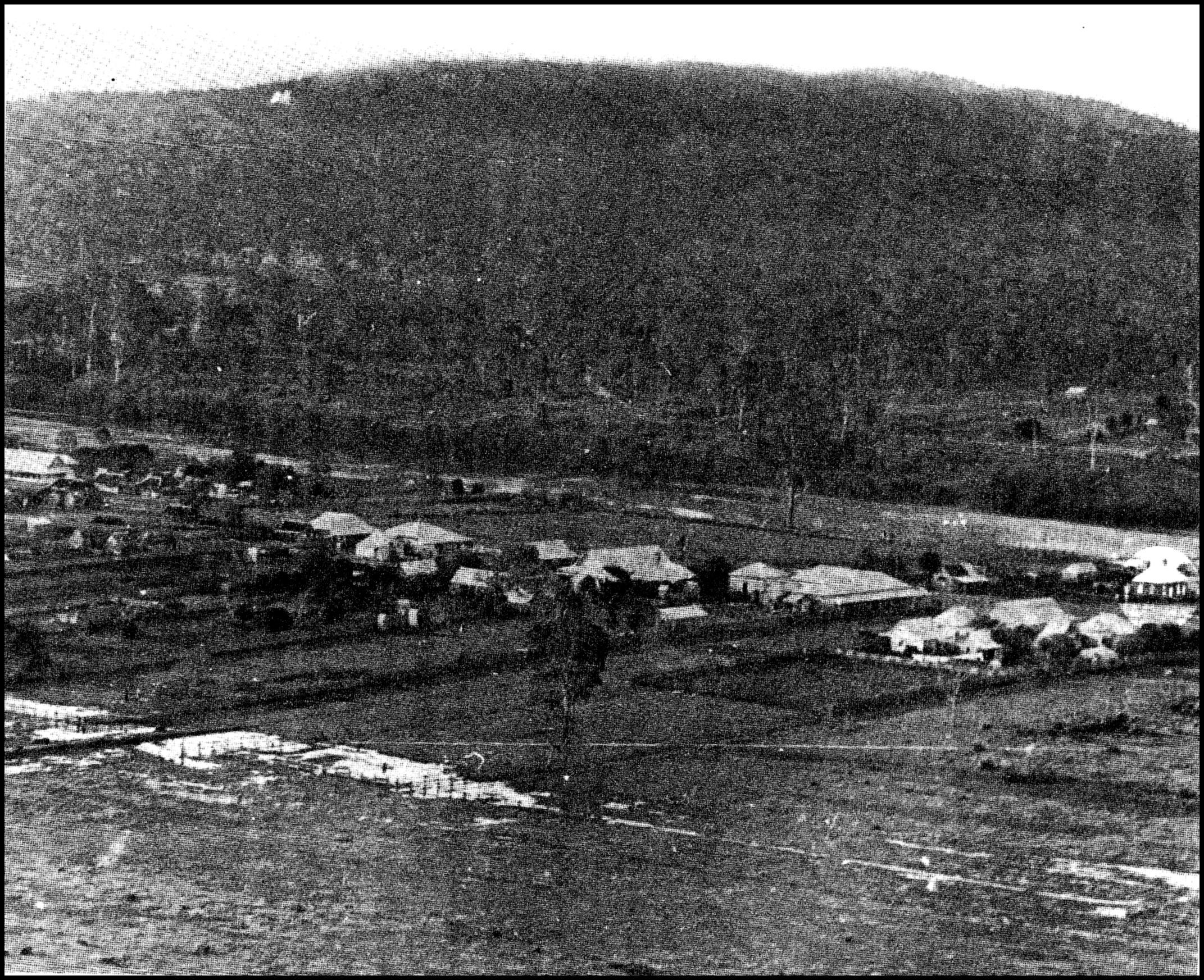
From the Gayndah and District Historical Society
(The 1890’s Flood ?)
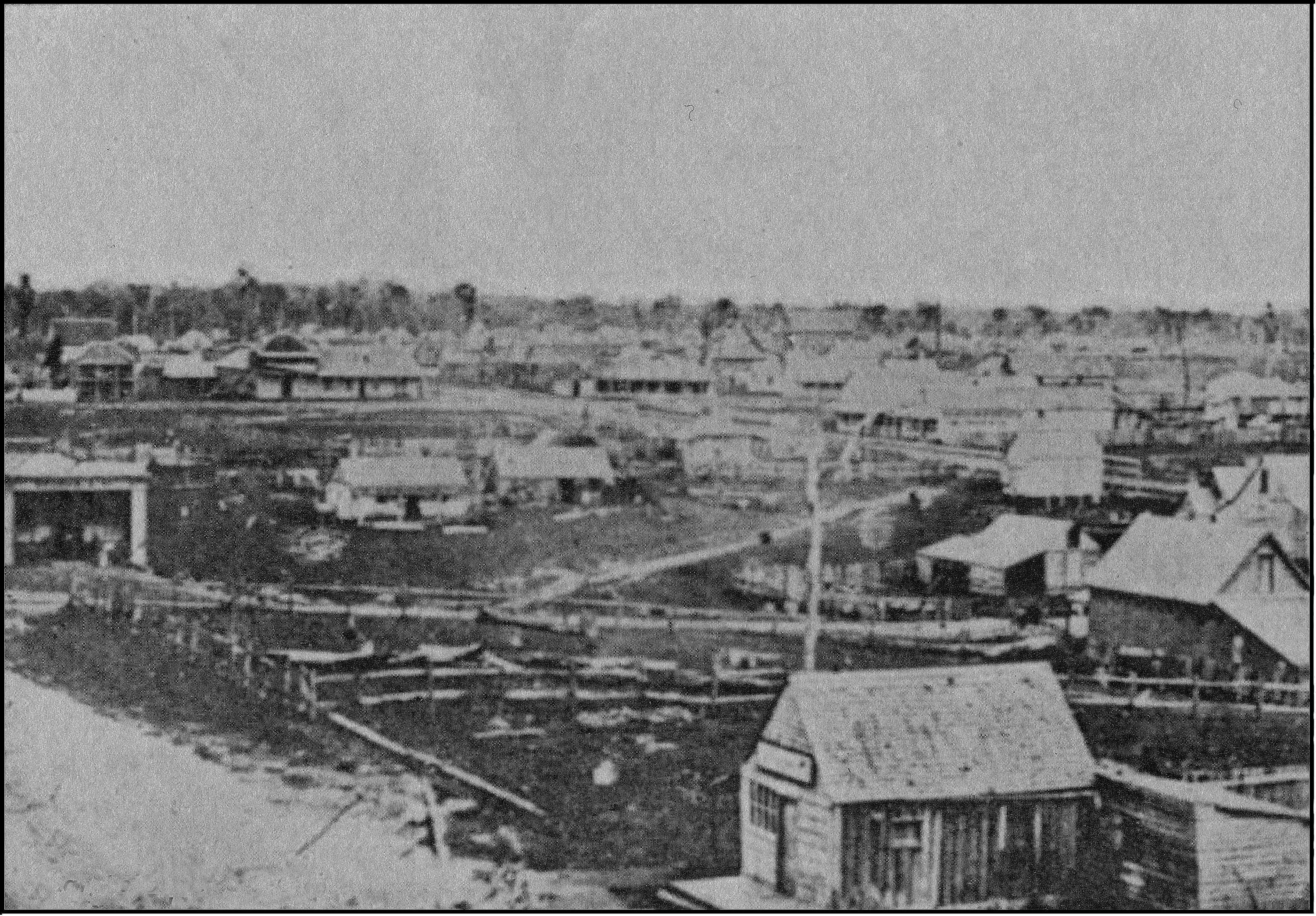
From THE HISTORY OF MARYBOROUGH AND THE WIDE BAY AND BURNETT DISTRICTS FROM THE YEAR 1850 To 1895 by George E. Loyau